
10 proven micro SaaS and startup ideas for 2026 - from client portals to AI meeting notes tools - that non-technical founders can validate, build, and ship on Rocket.new this weekend without writing a single line of code.
What would you do with a real, working SaaS product ready by Sunday evening?
The global SaaS market hit $466 billion in 2026 and is on track to double by 2029; and a growing share of that money is flowing into small, focused micro SaaS products built by solo founders, indie hackers, and small teams with no investor backing. (Source: SellersCommerce)
This post covers 10 SaaS ideas and startup ideas - each one rooted in a real pain point with proven demand, that you can ship on Rocket.new this weekend, no coding required.
Why Micro SaaS is the Smart Play Right Now
The SaaS industry grew from $31.4 billion in 2015 to $299 billion in 2025, nearly a tenfold jump in a decade. (DemandSage) That growth hasn't slowed down. But the interesting shift happening right now is where it's coming from.
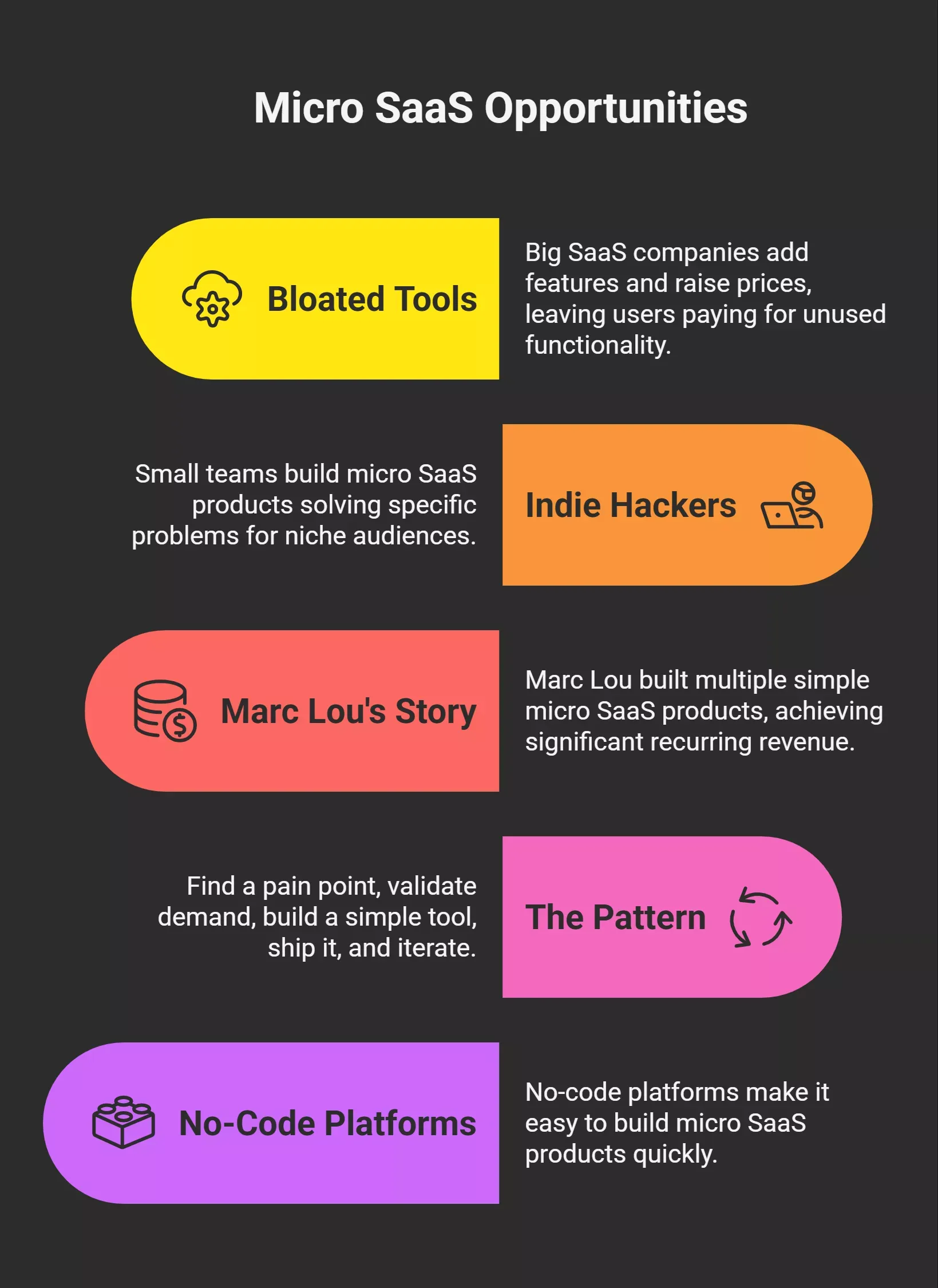
Big SaaS companies keep adding features and raising prices. The average company now uses 106 SaaS applications. Nearly 50% of those licenses sit unused for 90 days or more. Users are paying for tools that do 200 things when they only need five. That's a problem, and every repetitive pain point inside a bloated tool is a micro SaaS opportunity waiting to be built.
A growing group of indie hackers, solo founders, and small remote teams is building micro SaaS products that solve specific problems for specific niches. These aren't VC-backed companies chasing unicorn status. They're profitable, recurring-revenue software tools serving a target audience that's tired of over-engineered enterprise tools.
Marc Lou's story says it all. He made $1,032,000 in 2025, not from one big product, but from stacking multiple simple micro SaaS products over time. Each one solved a specific problem for a focused target audience and added another layer of recurring revenue. (Source: Indie Hackers)
The pattern: find a real pain point, validate demand fast, build a simple tool, ship it, and iterate based on feedback.
That pattern has never been easier to follow. With the right no-code platform, you can go from micro SaaS idea to working product in a single weekend.
What Makes a Good Micro SaaS Idea Worth Building?
Not every software idea belongs in a product. The best micro SaaS products share a few clear traits. They solve one repetitive pain point for a well-defined target audience. They address a gap that existing solutions don't fill cleanly. They can be built small, shipped fast, and iterated on based on real user feedback.
Before picking from the list below, run your micro SaaS idea through this filter:
| Criteria | Question to Ask |
|---|---|
| Pain point | Does someone lose time or money because this problem isn't solved? |
| Target audience | Can you name exactly who would pay for this - what role, what industry? |
| Proven demand | Are people already paying for a partial fix or a workaround? |
| Simple scope | Can you ship the core version in a weekend without writing code? |
| Recurring revenue | Would users need this tool month to month - not just once? |
| Competitive advantage | Is the existing solution too expensive, too complex, or too generic? |
If most of those land on "yes," you have a micro SaaS idea worth pursuing. The ones that don't pass this filter usually fail because the target audience is unclear or the problem isn't painful enough for someone to pay to solve it.
From Problem to Product: The Micro SaaS Build Process
Here's how the typical path looks when a micro SaaS idea moves from concept to paying customers on a no-code platform:
The key is keeping that first version tight. Don't try to build every feature on the list. Build the one thing that solves the core problem and get it in front of real users as fast as possible.
The 10 SaaS Ideas and Startup Ideas Worth Building Right Now
1. Client Portal for Freelancers and Agencies
Freelancers and agencies spend hours every month chasing clients for feedback, files, and approvals. The workflow looks something like this: a project update gets buried in email, a file lands in WhatsApp, approval happens in a Slack DM, and invoices live in a separate Google Drive folder. Nothing connects. Nothing is easy to find.
A branded client portal fixes this. The idea is simple: one private, secure link per client where they can upload files, view project updates, leave feedback, sign off on deliverables, and track invoices. No more inbox archaeology.
The target audience is freelancers, marketing agencies, designers, web developers, and consultants who manage multiple clients at once. This target audience is actively paying for combinations of Notion, Trello, Loom, and Google Drive just to patch together a messy substitute.
Tools like HoneyBook and Dubsado serve this market but are priced between $19 and $80 per month and loaded with features most small agencies never open. A focused client portal with clean file sharing, intake forms, and approval workflows at a lower price point has clear, proven demand. The niche focus is the competitive advantage.
2. AI Meeting Notes and Action Items Tracker
Remote teams sit through multiple meetings every day. After each one, someone spends 20 minutes writing notes by hand. Action items get buried. Follow-ups never happen. The meeting was productive, but the decisions inside it disappeared.
An AI meeting notes tool connects to Google Calendar, ingests a meeting transcript, and automatically pulls out a clean summary of meeting notes, key decisions, and individual action items. Each participant gets their tasks sent directly after the meeting ends.
The target audience is remote teams, startup founders, marketing teams, and small businesses running on Zoom, Google Meet, or Microsoft Teams. They're paying for scattered tools, Notion for notes, Asana for tasks, email for follow-ups, that don't talk to each other.
Tools like Otter.ai and Fireflies exist, but they're priced for larger teams and carry complexity most small businesses don't need. A lightweight AI meeting notes product targeting teams of 3-20 people at $15-$25 per month per workspace has a wide open target audience. The problem is real, the pain is monthly, and the demand is proven.
3. Appointment Scheduling Software for Local Businesses
Local businesses still rely on phone calls, DMs, and spreadsheets to manage bookings. Salons, therapists, personal trainers, legal consultants, wedding planners, and real estate agents all deal with the same problem: wasted hours on manual scheduling, double bookings, and costly no-shows.
Appointment scheduling software built for a specific niche - say, hair salons, solo lawyers, or fitness coaches- can beat generic tools by offering industry-specific features: service menus, client intake forms, automated reminders, online payment processing, and Google Calendar sync in one place.
The target audience is small business owners and solo practitioners who serve local clients. This target audience is underserved by generic scheduling tools. Calendly is built for B2B sales calls. Acuity is powerful but overwhelming. A version of appointment scheduling software built specifically for salons, for example, with specific service categories, client history, and automated reminder messages at $20-$30 per month would immediately serve a target audience that existing solutions are failing.
The niche focus is the entire competitive advantage. You're not competing with Calendly. You're serving the specific target audience they've decided not to prioritize.
4. Invoice and Payment Tracker with Automated Reminders
Freelancers and small business owners lose real money to late payments - not because clients refuse to pay, but because nobody followed up at the right time. An invoice tracking tool with automated reminders solves this pain point without the overhead of a full accounting platform.
Core features: create invoices in minutes, set payment due dates, automate follow-up emails at 3, 7, and 14 days overdue, and surface a simple dashboard showing which clients owe what. Add a client payment link connected to Stripe so clients can pay directly from the invoice.
The target audience includes freelancers, consultants, marketing agencies, and small service businesses. Many of these users are already paying for tools like FreshBooks or Wave, but feel like they're wasting money on features they'll never use. A stripped-back invoice tracker at $10-$15 per month with smart automated reminders hits exactly the right price point for that target audience.
The problem is universal. The solution doesn't need to be complicated.
5. Inventory Forecasting Dashboard for E-commerce Stores
Small e-commerce businesses waste money every month because of poor inventory management. They over-order slow products and run out of fast ones. Existing inventory forecasting tools from platforms like Shopify are either too basic or locked behind expensive enterprise plans that most small stores can't afford.
An inventory forecasting dashboard pulls product data from the store and surfaces simple, readable insights: which products are trending, which are stagnating, what to reorder before stock runs out, and when to expect the next stockout based on current velocity. Add automated alerts and weekly reports via email.
The target audience is small e-commerce businesses, Shopify store owners, Etsy sellers, and retailers managing their own inventory. This target audience doesn't need complex analytics dashboards. They need three clear numbers: what's running low, what's sitting still, and what to order this month.
Existing solutions either over-engineer the problem or require a developer to set up. A simple inventory forecasting tool at $20-$40 per month, built specifically for small store owners, fills a gap that has real, proven demand.
6. Landing Page Builder with Google Analytics Dashboard
Most no-code landing page tools are either too complex for non-technical users or too limited to be useful. What small brands actually need is a dead-simple landing page builder with a connected Google Analytics dashboard built in from the start. No complex funnel builders. No 200-option menus. Just: write your offer, pick a layout, add a form, publish, and track your results.
The target audience is small businesses, online educators, coaches, micro influencers, and solo entrepreneurs who need to validate demand for a new product or service fast. They're not developers. They want to go from idea to a working landing page in under 30 minutes.
Tools like Carrd serve this market at the simple end and Webflow at the complex end. A landing page builder specifically for non-technical users with Google Analytics reporting built in - and nothing else to learn - fills the middle ground clearly. Add a basic A/B testing feature in month two to give users a reason to stay and upgrade.
The landing page is often the first thing a new micro SaaS founder builds to validate demand. A tool that makes that faster and more trackable has a ready target audience.
7. AI-Powered Content Tools for Repurposing Long-Form Content
Content creators, podcasters, YouTubers, and marketing teams sit on hours of valuable long-form content, podcast episodes, webinars, blog posts, videos - but they don't have time or a clear workflow to repurpose it. Each piece of content could generate a week of social media posts, a newsletter, and a short-form script. Instead, it gets published once and forgotten.
An AI-powered content repurposing tool solves this. Users paste or upload long-form content - a blog post, a podcast transcript, a YouTube link - and the tool generates social media posts formatted for LinkedIn, X (Twitter), and Instagram, plus show notes, an email newsletter snippet, and a short-form video script. All from one input.
The target audience is podcasters, YouTubers, creators, online educators, and marketing teams at small brands. Tools like Repurpose.io exist but are priced for teams and carry complexity most solo creators don't need. A focused version of these AI-powered content tools at $15-$25 per month, targeting individual creators and small marketing agencies, has a broad and growing target audience.
Content repurposing is a repetitive task that takes 2-3 hours a week. Creators will pay $20 per month easily to get those hours back.
8. Branded Feedback and Approval Portal for Marketing Agencies
Marketing agencies spend enormous amounts of time chasing client approvals on ad creatives, social posts, landing pages, and campaign assets. Email chains with attachments named "final_v12_FINAL_approved.png" are not a workflow.
A branded feedback and approval portal gives each client a private link where they can view project files, leave in-context comments, and click "approve." The agency gets a simple management dashboard showing what's pending, what's been approved, and what needs revisions - across every client in one place.
The target audience is marketing agencies, video production companies, design studios, and social media management teams. This target audience is already paying for combinations of Frame.io, Dropbox, and email to approximate this workflow. A single, focused tool with file sharing, in-context comments, and approval tracking at $30-$50 per month per team is a clear improvement.
Branded client portal solutions exist, but most are either too broad or too expensive. A focused approval portal for marketing agencies at the right price point is a micro SaaS product with real, proven demand.
9. Remote Team Check-In and Weekly Reporting Automation Tool
Most management tools built for remote teams are designed for enterprises. Basecamp, Asana, and Monday.com are overkill for a startup with five to fifteen people. What small remote teams actually need is a simple async check-in tool that doesn't add to the meeting load.
Each team member answers three questions every Friday: "What did you finish this week? What did you struggle with? What's your priority for next week?" The tool collects those answers and generates a clean weekly report for the team lead, automatically. No chasing. No additional meetings. No manual formatting.
The target audience is startup founders, small remote teams, and mid-sized companies trying to keep everyone aligned without scheduling more calls. Existing communication tools like Slack and email collect these updates, but don't organize them into readable reports. A focused weekly check-in tool with automated reports and team tracking at $15-$30 per month solves a problem that every remote team has every single week.
Automation tools like Zapier can approximate this workflow. But a dedicated, ready-to-use product with no setup friction is a completely different experience for the target audience.
10. Niche CRM for Service Businesses
Generic CRMs like HubSpot or Salesforce are built for sales teams at scale. They're expensive, loaded with features that don't apply, and completely over-engineered for a solo therapist, personal trainer, legal consultant, or wedding planner. These professionals need something much simpler.
A niche CRM for service businesses focuses on what actually matters for that specific industry: client contact details, session or appointment history, follow-up reminders, notes from past interactions, invoice tracking, and payment status. No pipeline stages. No campaign management. No enterprise dashboards.
The target audience includes coaches, therapists, lawyers, real estate agents, freelancers, and local service providers. This target audience is currently using spreadsheets, phone notes, or duct-taped combinations of generic tools. A CRM built specifically for, say, therapists, with session notes, recurring appointment tracking, and automated follow-up reminders, can charge a premium precisely because it fits the specific audience perfectly.
This is one of the best micro SaaS ideas available right now because the niche focus itself is the moat. A general CRM can't compete with a tool that speaks the exact language of its target audience.
Generic Tools vs. Your Custom Micro SaaS: A Quick Comparison
| Category | Generic Tool | Focused Micro SaaS |
|---|---|---|
| Monthly price | $20-$150 per seat per month | $10-$50 flat per month |
| Features | 200+ options, most unused | Focused on one core use case |
| Target audience | Everyone in every industry | One specific role or industry |
| Onboarding | Long and complicated | Simple - ready in minutes |
| Competitive advantage for niche users | None | Built exactly for their problem |
| Switching cost | High - deep integrations | Low friction to get started |
| Support | Generic documentation | Tailored to the niche's language |
The opportunity in micro SaaS is not about building bigger. It's about building smaller, more specific, and more useful for a target audience that existing solutions are ignoring or overcharging.
Validate Demand Before You Start Building
Picking one of the 10 ideas above is step one. Before building, spend 30 minutes validating demand. Here's how:
- Search LinkedIn, Reddit, and industry forums for conversations about the specific pain point
- Check if people are already paying for a partial solution, which confirms proven demand
- Post on LinkedIn or X describing the problem, and see who responds and what they say
- Build a simple landing page with an email signup form before building the full product
- Use Rocket.new's Solve feature to run a structured market research report on the idea
If you can collect 10-20 email signups from real people who match your target audience before you build, you've validated demand. If you struggle to get any response, the problem may be smaller than you expected, and that's a useful, money-saving signal.
The micro SaaS model works because you're not taking a big bet. You're running small, fast experiments to find the problem that a specific target audience will actually pay to solve.
From the Community
"We've been noticing a shift lately. One that's changing how we think about SaaS. Most of the big-name platforms felt either way too expensive, over-engineered for what we needed, or missing core features we actually cared about. So instead of trying to bend our workflows to fit someone else's software, we started building our own. Sometimes it's just a weekend build that replaces a $100/month tool - but it works better because it's ours." - Jamie McArdle, LinkedIn, Read the post
This is exactly the mindset driving the micro SaaS movement in 2026. People are tired of paying for tools that don't fit. The best startup ideas right now aren't groundbreaking inventions - they're better-fit solutions to problems someone is already paying to patch with three different tools and a spreadsheet.
Build Your Startup Idea on Rocket.new This Weekend
This is where the 10 ideas above go from interesting to actually shippable. Rocket.new is the platform that makes it possible for non-technical founders to build, launch, and monitor a working SaaS product in a weekend, without writing code.
Most no-code platforms give you a way to build. Rocket.new gives you a way to build, research, and compete, all from one place with one shared context.
Rocket.new describes itself as the world's first "Vibe Solutioning" platform. That means it combines three distinct capabilities that most tools split across multiple products:
Solve: Validate Your Micro SaaS Idea Before You Build
You describe a problem or SaaS idea in plain language. Rocket.new runs a structured market research report with real data, competitive insights, and actionable recommendations. This is where you validate demand and understand your target audience before spending a single hour building.
Most founders skip this step. They build something for months, then discover nobody wants to pay for it. Rocket.new makes validation a starting point, not an afterthought.
Build: Production-Ready Apps Without Writing Code
Rocket.new turns your description into production-ready code. Web apps, mobile apps, dashboards, client portals, scheduling tools, forms, payment flows - you describe what you need, and Rocket.new handles the code behind it.
This is a fundamentally different experience from tools like Bubble or Webflow, which require you to learn visual logic builders and database schemas. With Rocket.new, non-technical founders describe the product in plain language and get a working application back. The gap between "I have a micro SaaS idea" and "I have a live product" shrinks from months to a weekend.
Intelligence: Monitor Competitors After You Launch
After you ship, Rocket.new monitors your competitors continuously. It delivers signals about what they're doing, where they're moving, and where the gaps in the market are opening up. This kind of competitive intelligence used to require a full-time analyst or expensive third-party tools.
For micro SaaS founders competing against larger, better-funded companies, this is a meaningful competitive advantage. You can react to market changes in real time without paying for a separate analytics platform.
Why Rocket.new is Built for This Moment
Over 1.5 million people across 180 countries have used Rocket.new. The demand for fast, accessible, and intelligent buildings is already there.
Other platforms like Bubble, Webflow, and Glide are good app builders. But they stop at building. Rocket.new starts with research, builds the product, and continues monitoring after launch. The three pillars share one context: What you research in Solve feeds directly into what you build, and what you build connects to what you track in Intelligence.
For any of the 10 micro SaaS ideas listed above, Rocket.new gives you:
- A validated market research report before you write a single prompt
- A working app with real features, including authentication, forms, dashboards, file sharing, and payment processing
- Competitive monitoring after launch so you can stay ahead without switching tools
The platform was designed specifically for founders who want to go from idea to paying customers without a development team, a six-month build timeline, or a large budget.
The Right Micro SaaS Idea is Already Around You
The best SaaS ideas and startup ideas don't come from brainstorming sessions. They come from frustration - a repetitive pain point that someone deals with every week and can't find a good solution for.
Every one of the 10 micro SaaS ideas in this list targets a real problem that freelancers, agencies, small businesses, and service professionals deal with consistently. They don't need something complex. They need a simple tool that does exactly what they need, at a price that fits their budget, built for their specific target audience.
That's the opening that micro SaaS fills. Rocket.new gives non-technical founders everything they need to go from idea to working product in a single weekend, from researching the market to building the app to tracking what competitors do next.
Pick one idea. Sign up with Rocket.new. Validate demand on Friday. Build on Saturday. Ship on Sunday. The gap between "I had this SaaS idea" and "I have paying customers" has never been shorter.
Table of contents
- -Why Micro SaaS is the Smart Play Right Now
- -What Makes a Good Micro SaaS Idea Worth Building?
- -From Problem to Product: The Micro SaaS Build Process
- -The 10 SaaS Ideas and Startup Ideas Worth Building Right Now
- -1. Client Portal for Freelancers and Agencies
- -2. AI Meeting Notes and Action Items Tracker
- -3. Appointment Scheduling Software for Local Businesses
- -4. Invoice and Payment Tracker with Automated Reminders
- -5. Inventory Forecasting Dashboard for E-commerce Stores
- -6. Landing Page Builder with Google Analytics Dashboard
- -7. AI-Powered Content Tools for Repurposing Long-Form Content
- -8. Branded Feedback and Approval Portal for Marketing Agencies
- -9. Remote Team Check-In and Weekly Reporting Automation Tool
- -10. Niche CRM for Service Businesses
- -Generic Tools vs. Your Custom Micro SaaS: A Quick Comparison
- -Validate Demand Before You Start Building
- -From the Community
- -Build Your Startup Idea on Rocket.new This Weekend
- -Solve: Validate Your Micro SaaS Idea Before You Build
- -Build: Production-Ready Apps Without Writing Code
- -Intelligence: Monitor Competitors After You Launch
- -Why Rocket.new is Built for This Moment
- -The Right Micro SaaS Idea is Already Around You