
A practical guide to total addressable market calculation covering top-down, bottom-up, and value theory approaches. Explains TAM, SAM, and SOM with formulas, real examples, and how Rocket.new connects market research to product building.
What if the number in your pitch deck is completely wrong?
Not just a little off - but built on assumptions that fall apart the moment a VC presses you on the math?
Total addressable market calculation is how you answer the most important question in any business: how large is the opportunity you're chasing? TAM (Total Addressable Market) represents the maximum revenue potential if your product captured every possible customer in your space. It's the ceiling, not a target.
The stakes are high.
Getting your total addressable market calculation right is not optional. It shapes your go-to-market strategy, guides your resource allocation, and tells potential investors whether the revenue opportunity is worth their attention.
TAM, SAM, and SOM: The Three-Layer Market Framework
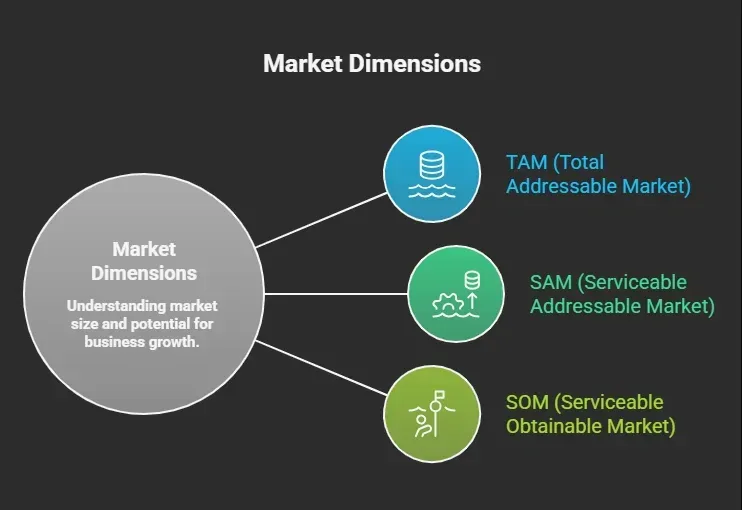
Before calculating total addressable market, you need to understand where TAM sits in the broader market sizing picture. Investors expect all three layers:
-
TAM (Total Addressable Market) - the entire revenue opportunity if you had 100% market share, with no competition and no geographic or capability constraints.
-
SAM (Serviceable Addressable Market) - the portion of TAM your product can actually serve right now, based on your business model, geography, and target market.
-
SOM (Serviceable Obtainable Market) - the realistic slice you can capture in the next 1-3 years given your current team, budget, and go-to-market plan.
Think of it as three concentric circles - each smaller and more grounded than the last. TAM is the big picture. SAM is the segment you can serve. SOM is the chunk you can actually win.
| Metric | What It Shows | Typical Source | VC Red Flags to Avoid |
|---|---|---|---|
| TAM | Total opportunity at 100% share | Gartner, IDC, Statista, McKinsey | Copy-pasted from a report with no date |
| SAM | The slice your product can serve | Segment TAM by geo, vertical, customer type | "All English-speaking SMBs" with no logic |
| SOM | Realistic 3-5 year capture | Pipeline x win-rate x ACV, bottom-up | Stated as "1% of TAM" with no calculation |
Why Most Founders Get Market Sizing Wrong
Most founders don't get this wrong because they can't do the math. They get it wrong because they don't understand what the number is supposed to communicate.
A thread on r/SaaS put it well:
"We see numbers like '$10B market' in pitch decks all the time. But when you break it down properly, things start looking very different. That $10B might include enterprise buyers you can't realistically access. It may assume global reach when you're actually selling in just 2-3 countries... When I started doing bottom-up calculations instead of top-down assumptions, my perspective changed completely."- r/SaaS, Are most SaaS founders overestimating their TAM? (Feb 2026)
LinkedIn pitch consultant Iswarya R echoes this:
"Most founders get their market sizing wrong. Not because they can't do the math, but because they don't understand what each number is actually telling investors. SOM is where most decks lose credibility - founders either lowball it out of fear or inflate it to impress."- Iswarya R on LinkedIn
Big numbers without logic behind them are just big numbers. The bottom-up math is what gets you funded.
Three Methods to Calculate Total Addressable Market
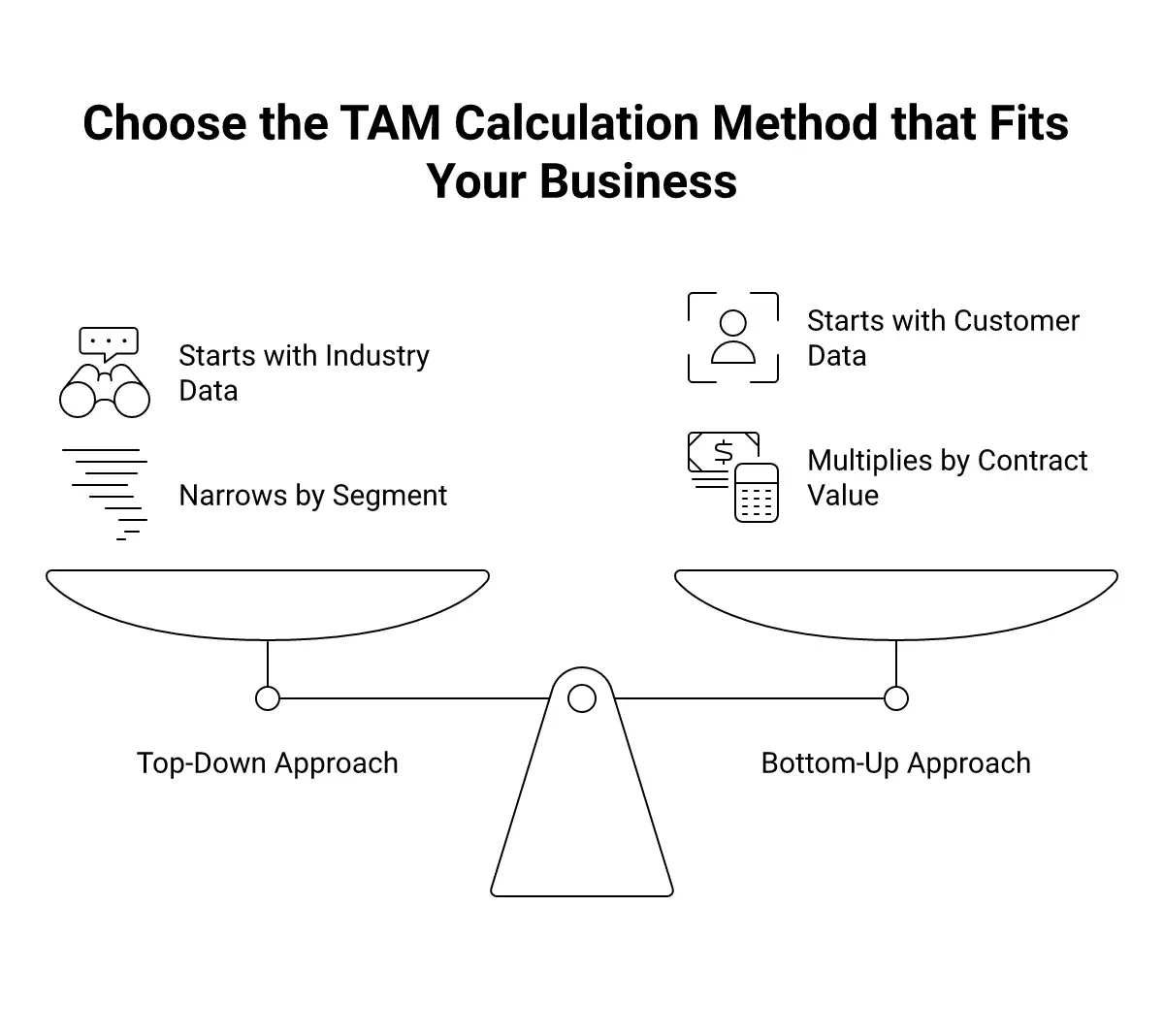
There are three primary approaches for calculating TAM. Each suits a different stage and data availability.
 TAM Calculation Methods
Top-Down Approach
The top-down approach starts with large industry data from third-party reports and narrows it down based on your target segment.
How it works:
-
Find the total industry market size from a reputable source (e.g., Gartner, IDC, Statista)
-
Apply filters to identify the portion your product can realistically serve
-
That filtered number becomes your TAM
Best for: early-stage pitches, high-level strategic planning, category validation.
Watch out for: compounding assumptions. If your CRM only serves US SMBs, your TAM is not the entire $98.84 billion global CRM market.
Bottom-Up Approach
The bottom-up approach builds from what you actually know - your pricing, your target customers, and your geography - and scales up from there. This is almost always more credible with investors.
The core formula:
TAM = Total number of potential customers x Average Annual Revenue Per Customer
Example:
-
You're building HR software for small businesses in the US
-
There are 6 million SMBs with 10-200 employees
-
Your average annual contract value is $1,200
-
TAM = 6,000,000 x $1,200 = $7.2 billion
This method forces you to define your ideal customer profile, your pricing model, and your addressable geography before you write a single number. Investors find this far more defensible than a figure borrowed from an industry report.
Value Theory Approach
The value theory approach is the third method - and one of the most powerful when your product creates quantifiable outcomes.
Rather than counting customers, it asks: how much value does your product create, and what percentage of that value can you capture as revenue?
Example:
-
Your SaaS product saves mid-market companies $150,000/year in operational costs
-
You price at 10% of that value = $15,000/year per company
-
There are 40,000 companies in your target segment
-
TAM = 40,000 x $15,000 = $600 million
The value theory approach works best when your product has a measurable ROI and your pricing is tied to outcomes rather than features.
Market Research: Where to Get Reliable Market Data
Strong TAM analysis depends on strong market data. Outdated numbers or poorly sourced reports are red flags in any investor conversation.
Third-Party Data Sources
Use industry reports for top-down approaches. Reputable sources investors recognize:
-
Gartner - technology and enterprise software markets
-
IDC - cloud, software, and technology infrastructure
-
Statista - broad market data across almost every category
-
Forrester - customer experience, digital strategy, technology
-
IBISWorld - industry-level data for niche and local markets
-
McKinsey Global Institute - macroeconomic trends and growth data
Always check the publication date. In fast-moving industries, market data older than 18 months can lead to bad assumptions. Investors notice old citations.
Internal Data and First-Party Research
If you already have paying customers, your internal data is often more accurate than any third-party report.
-
Interview 10-20 ideal customers and ask what they currently spend solving the problem
-
Run surveys to validate willingness to pay
-
Review your CRM for patterns in deal size, close rate, and customer type
-
Use pilot program data to validate SOM assumptions before pitching
For early stage startups without existing customers, build bottom-up models from public sources. LinkedIn filters let you count companies by size and industry. Tools like Apollo or Lusha give contact counts by vertical. Government business registries provide total business counts by sector.
How Market Conditions Change Your TAM Over Time
TAM is not a static number. Market dynamics, regulatory changes, and new technologies can shift your entire market potential - sometimes quickly.
Uber is the most-cited example. Their original SAM was the US taxi and limousine market, worth roughly $4.2 billion. Their long-term TAM vision was the entire global transportation market - over $5.7 trillion. As ride-sharing displaced traditional cabs and Uber expanded into international markets and logistics, their serviceable obtainable market grew alongside their capabilities.
The lesson: calculate TAM for where the market exists today. Use growth trends and market expansion signals to tell the larger story - but be clear about what is current versus aspirational. Investors want today's number, not a projection dressed up as a current figure.
Refresh your TAM, SAM, and SOM at least once before each fundraising round. Market reports update, new competitors enter, pricing shifts, and new customer segments become accessible.
Common TAM Calculation Mistakes
| Mistake | Why It Hurts | The Fix |
|---|---|---|
| Using entire industry as TAM | Investors know it's inflated | Narrow to your actual addressable segment |
| Claiming "1% of TAM" as SOM | No logic, no plan, no credibility | Build SOM from pipeline x win-rate x ACV |
| Outdated data (2+ years old) | Markets move fast | Refresh sources before every pitch |
| Only top-down, no bottom-up | One method is not enough | Cross-validate both approaches |
| No ICP defined before sizing | TAM has no logical foundation | Define the ideal customer profile first |
Launch Your Validated Market Idea with Rocket.new
So you've done the market research. You've run the TAM calculation, defined your SAM, and built a credible SOM from real numbers. Now what?
The next question most founders face: should I actually build this? And if yes - what exactly should I build that speaks directly to this market?
That's the gap Rocket.new was built to close.
The Thinking Before the Build
Rocket.new is the world's first Vibe Solutioning platform - a single workspace where teams research what to build, build it, and monitor what matters. Its core decision intelligence feature, Solve, is built specifically for the kind of strategic market research that makes TAM analysis useful rather than theoretical.
Solve takes any business question - including market sizing, competitive analysis, go-to-market planning, and pricing research - and returns a full structured answer with evidence and recommendations. Instead of opening five browser tabs, pulling a Statista report, cross-referencing industry data, and stitching it all together manually, you describe the question and Rocket handles the research.
For founders doing total addressable market calculation, this matters because:
-
Market research connects directly to the build decision - not to a Google Doc that gets forgotten
-
Competitive intelligence runs alongside TAM work, not after it
-
The Solve output carries context forward into the Build, so your market thinking informs the product from day one
Build from Your Research, Not Around It
Where tools like Bolt, Lovable, and v0 drop founders straight into code generation, Rocket builds from the intelligence layer first. Those platforms build what you tell them to build. Rocket figures out what's worth building - then builds it.
That distinction matters enormously for founders doing market sizing. If your research identifies a specific niche - say, compliance software for healthcare companies with 50-500 employees in the US - Rocket can generate a landing page, a web app, or an internal dashboard built for that exact customer segment, with the market context already embedded.
Key Rocket.new features for market-driven building:
-
Solve - turns any market or business question into a full structured analysis. Run TAM research, go-to-market planning, competitive mapping, and pricing strategy from a single prompt.
-
Intelligence- monitors every public platform your competitors operate on and interprets what their moves mean for your positioning. Useful for understanding how competitors are sizing and framing the same market.
-
Build - generates production-grade web apps, mobile apps, and landing pages in Next.js and Flutter. Once your market research is done, Build generates the product that speaks directly to your validated customer segment.
-
Context - persistent shared memory across all tasks. TAM research informs your landing page copy, your pitch deck data room, and your sales tool - all in the same workspace, without re-explaining anything.
What a Strong TAM/SAM/SOM Model Looks Like
A well-structured market sizing model for a pitch or planning document includes three grounded, connected layers:
-
TAM - with the source, the date, and a clear explanation of why this industry is the right universe for your product
-
SAM - narrowed by your target market segment, geography, and business model with logic behind each filter
-
SOM - calculated from real math: number of reachable accounts x annual contract value x realistic win rate
Use both top-down and bottom-up. One validates the other. A $400M TAM from IDC alongside a $22M SOM calculated from your pilot pipeline is a far more compelling story than a "$20B global opportunity" with no supporting math.
The clearest signal to investors that you understand your market is not the size of your TAM. It is the clarity of your reasoning behind all three numbers.
Total Addressable Market Calculation: Make the Number Work for You
Total addressable market calculation is where many ambitious ideas meet reality. The founders who get it right share a few habits: they start from a clear ideal customer profile, they cross-validate top-down and bottom-up approaches, they use reputable sources with current dates, and they build a SOM from real pipeline logic not a percentage pulled from a large number.
The founders who get it wrong tend to reach for the biggest number that sounds impressive, hope no one presses them on the math, and find out in a pitch meeting that a savvy investor has already spotted the gap.
Run your total addressable market calculation as if someone smart is going to stress-test every assumption you make. Because they will. And when the number is defensible, it opens doors instead of closing them.
Table of contents
- -TAM, SAM, and SOM: The Three-Layer Market Framework
- -Why Most Founders Get Market Sizing Wrong
- -Three Methods to Calculate Total Addressable Market
- -Top-Down Approach
- -Bottom-Up Approach
- -Value Theory Approach
- -Market Research: Where to Get Reliable Market Data
- -Third-Party Data Sources
- -Internal Data and First-Party Research
- -How Market Conditions Change Your TAM Over Time
- -Common TAM Calculation Mistakes
- -Launch Your Validated Market Idea with Rocket.new
- -The Thinking Before the Build
- -Build from Your Research, Not Around It
- -What a Strong TAM/SAM/SOM Model Looks Like
- -Total Addressable Market Calculation: Make the Number Work for You