
Learn how Rocket.new Intelligence separates itself from traditional monitoring tools by delivering actionable competitive insights, enabling businesses to track market shifts, uncover opportunities, and make faster strategic decisions with greater clarity.
Why “Rocket.new Intelligence isn’t a monitoring tool” matters right now?
Monitoring tools only watch activity and send alerts. Competitive intelligence helps teams understand what the activity actually means, what actions to take next, and how to shape a stronger product plan.
The demand for competitive intelligence keeps growing quickly. According to Precedence Research Report, the competitive intelligence tools market is expected to reach nearly USD 19.18 billion by 2035 as companies look for faster decision making and more actionable insights from AI powered systems.
So, businesses no longer want simple monitoring dashboards. They want intelligence tools that connect raw data, planning, execution, and product direction inside one clear workflow.
This blog will help readers understand why Rocket.new stands apart from traditional monitoring platforms and how competitive intelligence supports smarter product building, planning, and long term growth.
Monitoring Feels Useful Until Teams Need Direction
Monitoring platforms usually look helpful in the beginning. Teams connect data sources, follow competitor updates, and track activity across social media, GitHub, pricing pages, and product launches. Then things slowly become noisy instead of useful.
What Usually Happens With Traditional Monitoring Tools
-
One screen tracks social media activity
-
Another dashboard shows competitor updates
-
Github commits appear in separate feeds
-
Teams keep switching between multiple tools
-
Raw data keeps growing every day
-
Alerts explain what is happening, not why it matters
-
Product teams spend more time organizing information than acting on it
-
Decision making becomes slower because context is missing
That is where competitive intelligence creates the real difference. Instead of showing endless notifications, Rocket connects signals into context and gives teams actionable insights.
A startup building mobile apps does not only need alerts. The team needs direction on what feature to create next, what audience to target, and how to shape the next project plan.
Why Competitive Intelligence Means More Than Alerts?
A lot of teams confuse monitoring with competitive intelligence. The difference is actually pretty simple. Monitoring only reports activity. Competitive intelligence explains what the activity means and what teams should do next.
What Competitive Intelligence Actually Does
-
Collects raw data from different data sources
-
Tracks competitor updates across social media, GitHub, pricing, and product launches
-
Connects frontend changes and backend updates into one clear view
-
Organizes customer reviews, hiring signals, and market activity
-
Turns scattered information into actionable insights
-
Helps teams create a smarter project plan
-
Supports faster decision making without endless manual research
-
Fits naturally into daily work instead of becoming another disconnected app
Rocket takes this approach further. Instead of sending random alerts, Rocket connects signals into structured direction. For example, if a competitor changes pricing, the app does not stop at the notification. Rocket explains how the move could affect customer acquisition, feature expectations, product positioning, and future planning.
Modern product teams move fast. Founders, marketers, developers, and designers do not have hours to manually organize data collection from multiple tools. They need competitive intelligence tools that save time, support better planning, and help teams stay focused on building the right app at the right moment.
Where Traditional Monitoring Starts Falling Apart?
Traditional monitoring platforms often create more noise than clarity. Teams receive endless updates from different sources, yet very little guidance on what actions should follow next.
Common Problems With Traditional Monitoring Platforms
-
Teams receive too much raw data with very little meaning
-
Platforms track website changes, social media comments, github pushes, and product announcements without proper context
-
Product teams struggle to decide which competitor updates actually matter
-
Monitoring systems rarely connect intelligence with execution
-
Teams still need separate apps for planning, design, code, and project management
-
Switching between multiple tools slows down daily work
-
Marketing teams, founders, and product teams often work from separate dashboards and reports
-
Different teams end up using disconnected information, which creates confusion
Rocket removes that fragmentation by connecting competitive intelligence directly into the same experience where teams create, plan, build, and ship products.
How Rocket Connects Intelligence With Product Building?
Rocket is positioned as an AI powered vibe solutioning platform. That wording matters because rocket is not trying to become another passive monitoring dashboard.
Rocket combines competitive intelligence, product planning, and app building in one shared workflow. So, teams can move from insight to action without switching systems.
Here is a simple breakdown:
| Traditional Monitoring | Rocket Competitive Intelligence |
|---|---|
| Tracks competitor updates | Explains competitor moves |
| Shows raw data | Produces actionable insights |
| Separate from product work | Connected directly to build workflows |
| Focus on alerts | Focus on decision making |
| Multiple tools required | One shared app experience |
| Monitoring only | Intelligence plus execution |
That difference changes how teams operate.
A founder can use natural language prompts inside Rocket to create a product plan. Then the same project can move into app development, frontend design, backend structure, and deployment. The intelligence never disappears during the process.
Rocket.new Intelligence Overview and How It Works
According to the official Rocket documentation, Rocket combines strategic research, AI powered app building, and competitive intelligence into one system.
The process feels close to working with a strategy team inside one app.
Here is how the workflow usually looks:
-
Teams enter a prompt in natural language.
-
Rocket gathers signals from different data sources.
-
The platform organizes raw data into structured insights.
-
Teams create a project plan.
-
Rocket helps generate code, frontend structure, backend logic, and app flows.
-
The project moves into build mode.
-
Competitive intelligence continues after launch.
Many competitive intelligence tools stop once the product ships. Rocket keeps learning from competitor updates, social media activity, and changes across the market.
So, intelligence remains connected to the project after launch.
Key Features of Rocket Intelligence
Rocket includes several key features tied directly to competitive intelligence.
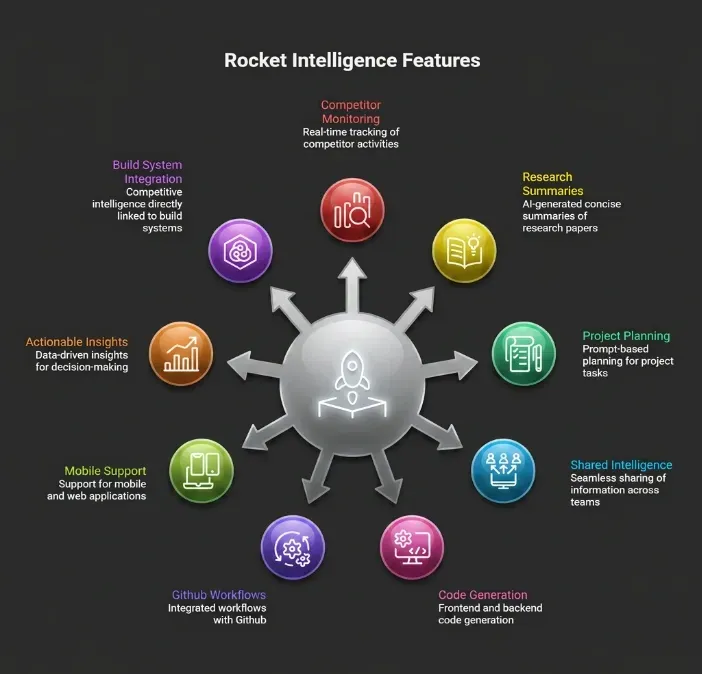 The platform also includes a free tier, which helps small teams get started without heavy setup. That free tier lowers the barrier for founders testing a new app idea.
Why Competitive Intelligence Changes Product Decisions?
Good competitive intelligence helps teams think with context instead of reacting emotionally to competitor updates.
A monitoring platform may only send alerts, but Rocket adds reasoning that supports smarter planning, product direction, and decision making.
How Rocket Adds Context to Competitor Updates
-
Feature Impact: Explains why a competitor feature actually matters
-
Audience Response: Shows which customer segments are reacting positively
-
Frontend Trends: Identifies frontend patterns appearing across competitors
-
Project Planning: Suggests realistic timelines for the next project phase
-
Code Structure: Helps teams understand what code workflows may be needed
-
Customer Behavior: Predicts expected user reactions based on market activity
-
Product Direction: Supports smarter pricing, positioning, and app strategy
-
Decision Support: Reduces guesswork during planning and execution
For example, if a rival launches mobile apps with AI powered onboarding, a traditional monitoring tool only sends a notification. Rocket connects the update with strategic context and actionable insights.
That added context saves time and helps teams make better product decisions instead of reacting blindly to every competitor move.
Why AI Powered Intelligence Tools Feel Different?
AI powered intelligence tools feel different because they reduce manual work and make decision making faster. Older intelligence tools expected teams to read reports, organize findings, and connect the dots themselves. Rocket changes that experience by acting more like an active assistant instead of a passive dashboard.
How AI Powered Intelligence Tools Improve the Workflow
-
Prompt Based Workflow: Teams enter a prompt and define goals in natural language
-
Project Direction: Rocket helps create a clear project path quickly
-
Frontend Support: Assists with frontend setup and interface structure
-
Backend Generation: Supports backend planning and logic generation
-
App Building: Helps teams shape app flows and product structure
-
Mockup Planning: Creates mockup direction for product ideas
-
Code Suggestions: Generates useful code recommendations during development
-
Simpler Experience: Reduces clutter compared to traditional monitoring dashboards
Rocket creates a workflow that feels smoother, cleaner, and more lovable for teams working across product planning and app development.
A lovable experience matters because teams stay engaged longer, move faster, and spend less time dealing with disconnected screens and manual research.
The Role of Prompts and Natural Language
Prompt driven workflows are becoming common across modern AI tools, and Rocket strongly follows that approach. Instead of forcing teams to learn complicated systems, the platform lets users describe ideas in natural language and move directly into planning and execution.
How Prompt Driven Workflows Help Teams
-
Natural Language Input: Teams describe ideas in simple language
-
Project Planning: Rocket helps create product plans and workflows quickly
-
App Structure: Supports frontend flows and backend logic generation
-
Mockup Direction: Helps founders shape mockup concepts faster
-
Code Suggestions: Provides useful code support during development
-
Faster Start: Helps non technical founders get started with less friction
A founder can simply describe an app idea and receive structured direction, competitive intelligence context, and build support inside the same experience.
That workflow feels more like collaboration and less like configuring complicated software tools.
Competitive Intelligence After Launch Matters Too
A lot of teams think competitive intelligence stops once an app launches. In reality, that is usually when the next stage begins. Competitors react, customer expectations shift, and new market patterns start appearing quickly.
What Happens After Product Launch
-
Social Media Activity: New campaigns and customer conversations start happening
-
Pricing Changes: Competitors adjust pricing and positioning strategies
-
Github Updates: Development activity and feature pushes increase
-
Frontend Experiments: New interface trends begin appearing across products
-
Customer Expectations: User behavior and feature expectations continue changing
-
Ongoing Tracking: Rocket keeps monitoring signals after launch
-
Project Growth: Teams continue improving the project instead of letting it become stale
Rocket keeps the competitive intelligence loop active after launch by tracking competitor reactions, social media activity, github updates, pricing shifts, frontend experiments, and changing customer expectations, helping teams continuously improve the project instead of letting the product become outdated.
Why Teams Want Fewer Tools Right Now?
Modern teams are tired of jumping between disconnected platforms all day. Too many systems create confusion, slow down work, and break the flow between planning and execution.
Why Fragmented Workflows Create Problems
-
Design Separation: One app handles design work
-
Code Management: Another platform manages code workflows
-
Research Gaps: Teams use separate tools for research and competitive intelligence
-
Project Tracking: Project tasks sit inside different systems
-
Alert Overload: Monitoring platforms send notifications that teams often ignore
-
Constant Switching: Moving across multiple tools wastes time and focus
-
Disconnected Context: Teams lose visibility between planning, research, and execution
Rocket reduces tool overload by bringing competitive intelligence, planning, research, code workflows, and project execution into one clear experience, helping teams work with less switching and better focus.
Rocket and the Shift From Monitoring to Decision Systems
The competitive intelligence category is changing because teams no longer want passive dashboards that only report updates. Modern teams want systems that support action, planning, and product direction in real time.
How Rocket Supports Decision Making
-
Tracks competitor activity and market signals
-
Supports project planning and execution
-
Helps teams create app structures and workflows
-
Assists with mockup creation and frontend ideas
-
Supports backend setup and code workflows
-
Connects competitive intelligence with the full product cycle
-
Helps teams move from research into action faster
-
Reduces dependence on disconnected monitoring systems
Rocket reflects the shift from passive monitoring toward intelligence systems that actively support product decisions and planning.
Monitoring platforms only watch activity, while competitive intelligence helps teams think, plan, and build with better context throughout the entire product cycle.
Why the Experience Feels Different Inside Rocket
Rocket feels different from traditional intelligence tools because the workflow stays connected from start to finish. Instead of moving across disconnected platforms, teams can manage planning, research, and product building inside the same experience.
What Makes the Rocket Experience More Connected
-
Teams can move from prompt to project quickly
-
The same app supports strategy and build workflows
-
Frontend planning and backend logic stay connected
-
Rocket assists with code generation and mockup design
-
Competitive intelligence remains part of the workflow
-
Teams spend less time switching between systems
-
Founders, marketers, and developers work from the same context
-
Shared visibility supports better collaboration and planning
Rocket creates a more connected experience by combining competitive intelligence, project planning, code workflows, mockup design, frontend ideas, and backend logic inside one shared system, helping teams stay aligned and make better quality decisions throughout the product lifecycle.
Free Tier Access and Early Product Validation
Rocket includes a free tier for users who want to test workflows before moving into larger projects. That gives startups and small teams a chance to understand the platform without major upfront cost.
A founder can create a small web app project, review competitor updates, test mockup ideas, and generate code inside the same experience. That makes early product validation much easier for teams still shaping their direction.
The free tier also helps teams learn how Rocket connects competitive intelligence, planning, and app building before scaling into bigger product work.
Zip Files, Tokens, and Modern AI Workflows
Modern AI powered workflows involve more than prompts and automation. Teams also care about practical details like tokens, code organization, generated assets, and deployment ready project files.
Important Parts of Modern AI Workflows
-
Generated files need proper project organization
-
Zip file exports help teams move projects quickly
-
Developers often rely on zip file handling during testing and deployment
-
Token management affects prompt processing quality
-
Better token handling creates smoother workflows
-
Organized code assets reduce confusion during development
-
Faster transitions from planning into execution save time
-
AI powered systems work better when workflows stay structured
Rocket supports these practical workflows by connecting project handling, code organization, and deployment preparation inside the same experience.
Rocket combines competitive intelligence, prompt driven workflows, token handling, zip file exports, and structured code organization into one connected system that helps teams move faster from planning into execution.
Rocket.new Intelligence Is Not a Monitoring Tool
Most monitoring platforms flood teams with raw data, disconnected alerts, and endless screens. Teams spend more time figuring out what is happening than actually building the right app or improving the next project plan.
Rocket approaches competitive intelligence differently. The platform connects research, planning, frontend direction, backend logic, code workflows, and execution inside one shared experience. Instead of isolated notifications, teams receive actionable insights that support faster decision making and smarter product development with one AI powered workflow.
If your team wants competitive intelligence that supports real product building instead of passive monitoring, Rocket.new is worth trying.
Table of contents
- -Monitoring Feels Useful Until Teams Need Direction
- -What Usually Happens With Traditional Monitoring Tools
- -Why Competitive Intelligence Means More Than Alerts?
- -What Competitive Intelligence Actually Does
- -Where Traditional Monitoring Starts Falling Apart?
- -Common Problems With Traditional Monitoring Platforms
- -How Rocket Connects Intelligence With Product Building?
- -Rocket.new Intelligence Overview and How It Works
- -Key Features of Rocket Intelligence
- -Why Competitive Intelligence Changes Product Decisions?
- -How Rocket Adds Context to Competitor Updates
- -Why AI Powered Intelligence Tools Feel Different?
- -How AI Powered Intelligence Tools Improve the Workflow
- -The Role of Prompts and Natural Language
- -How Prompt Driven Workflows Help Teams
- -Competitive Intelligence After Launch Matters Too
- -What Happens After Product Launch
- -Why Teams Want Fewer Tools Right Now?
- -Why Fragmented Workflows Create Problems
- -Rocket and the Shift From Monitoring to Decision Systems
- -How Rocket Supports Decision Making
- -Why the Experience Feels Different Inside Rocket
- -What Makes the Rocket Experience More Connected
- -Free Tier Access and Early Product Validation
- -Zip Files, Tokens, and Modern AI Workflows
- -Important Parts of Modern AI Workflows
- -Rocket.new Intelligence Is Not a Monitoring Tool