
Competitive intelligence becomes valuable only when interpreted. Without context, teams face information overload. This article explains how to filter, analyze, and transform raw data into meaningful insights that support faster, smarter decision-making.
Why does competitive intelligence fail even with so much data?
Most companies spend too much time collecting competitor updates and very little time turning that information into useful insights. The result is noise, scattered alerts, disconnected reports, and strategy discussions that rarely lead to action.
According to Evalueserve, 90% of Fortune 500 companies use competitive intelligence to gain competitive advantage, yet many teams still struggle with interpretation and decision making.
So, the real problem is not access to intelligence or market data. The bigger gap comes from context, analysis, and understanding what competitor moves actually mean for customers, market trends, and business strategy.
This blog will help readers understand why competitive intelligence often turns into noise and how platforms like Rocket.new help teams turn competitor signals into actionable insights.
Competitive Intelligence Turns Into Noise Without Context
Most businesses already have access to huge amounts of data. Teams track press releases, social media updates, pricing models, product launches, hiring patterns, patent filings, trade shows, job postings, and marketing campaigns. Sounds useful, right? Well, not always.
Competitive intelligence without analysis creates confusion because teams end up staring at dashboards filled with scattered data from multiple sources without understanding what deserves attention.
-
One competitor changes pricing.
-
Another launches a feature.
-
Someone posts a hiring update on LinkedIn.
-
Another company announces a partnership.
-
Product teams waste time discussing updates that do not affect customers.
-
Sales team members enter meetings without enough background for the call.
-
Strategy teams lose focus because every update feels equally important.
-
Companies keep collecting data but fail to act on the right signals.
Without interpretation, competitive intelligence becomes noise instead of useful insights. The problem is not access to data.
The real difference comes from understanding what competitor moves actually mean for customers, market trends, and strategic decisions.
Why Most Competitive Intelligence Process Flows Break Down?
The process sounds easy on paper. Businesses gather competitor intelligence. Teams run analysis. Leaders make informed decisions. Real life looks very different.
Most companies use multiple tools for monitoring competitors. One platform tracks website changes. Another watches social media.
Another handles market research. Then teams switch between spreadsheets, Slack messages, PDFs, and screenshots. After that, someone manually tries to connect everything. The issue is not data collection. The issue is interpretation.
For example:
| Competitor Signal | What Most Teams See | What Smart Analysis Reveals |
|---|---|---|
| New pricing page | Price drop | Push for market share growth |
| Hiring AI engineers | Recruitment update | New product direction |
| New customer stories | Marketing content | Focus on enterprise customers |
| Product launches | Feature release | Shift in business strategy |
| Patent filings | Legal activity | Future market expansion |
Competitive intelligence research becomes messy when companies rely on disconnected systems. Teams spend more time organizing data than understanding competitor strategies.
Many businesses focus too heavily on collecting data instead of identifying market trends, and that table shows exactly why competitive intelligence analysis matters.
How Competitive Intelligence Creates Real Business Value
Good competitive intelligence works when teams can connect separate signals into one clear story. A competitor lowering prices is not just a pricing update.
The real value comes from understanding what those competitor moves actually mean for the market, customers, and business strategy.
-
A price drop may signal pressure on revenue.
-
It may point to a push for market share.
-
It may show pressure from competition.
-
It may reveal weak customer retention.
-
Product teams can decide whether they should respond or ignore the move completely.
-
A sudden increase in AI hiring may point toward automation plans.
-
It may signal product changes.
-
It may reveal new capabilities entering the market.
-
Strong intelligence tools help businesses move from observation to action.
-
The goal is not just monitoring competitors.
-
The goal is understanding why competitors act the way they do.
That interpretation changes decision-making and helps teams stay ahead of market trends. Competitive intelligence creates real business value when businesses turn competitor signals into actionable insights instead of just collecting more data.
Why Product Teams Need More Than Alerts?
Product teams face constant pressure. They need to identify trends, track market gaps, respond to customers, and protect competitive advantage at the same time.
Simple alerts do not help much because competitors constantly change features, onboarding flows, pricing, and messaging.
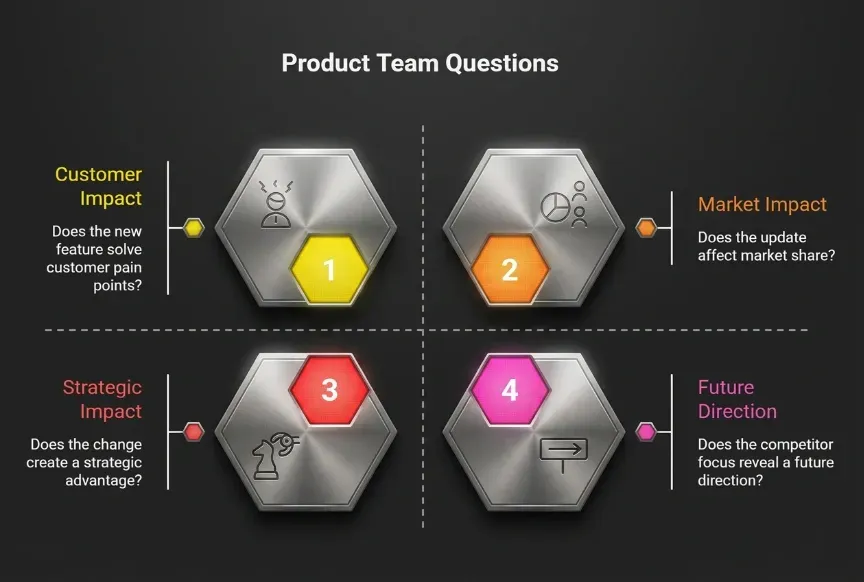 Without analysis, constant competitor updates create noise instead of insights. That is why strong competitor intelligence requires interpretation, context, and continuous system tracking instead of simple alerts alone.
Competitor Intelligence is Not Industrial Espionage
People sometimes confuse competitor intelligence with industrial espionage. They are completely different.
Competitive intelligence research focuses on public information, market understanding, and ethical analysis instead of secret or illegal activity.
Differences:
-
Competitive Intelligence Research: Uses public information and legal sources.
-
Information Sources: Market trends, company announcements, trade shows, customer reviews, press releases, website changes, social media updates, and job postings.
-
Main Goal: Understanding the market and making better strategic decisions.
-
Role of Intelligence Tools: Collect public signals and turn them into useful analysis.
Good competitor intelligence helps companies stay ahead without crossing ethical lines. The process is about understanding competitors and market behavior through public signals, not stealing secrets.
Why Businesses Struggle With Scattered Data?
Most businesses do not suffer from lack of data. They suffer from lack of clarity. Different teams track different signals, but very few companies connect everything into one clear picture.
Problem Areas
-
Customer Tracking: One team tracks customers.
-
Competitor Monitoring: Another tracks competitors.
-
Campaign Analysis: Another tracks marketing campaigns.
-
Market Intelligence: Another watches market intelligence reports.
-
Scattered Data: Teams end up buried under data from multiple sources.
-
Slow Decision Making: Leaders cannot identify trends fast enough.
-
Missed Opportunities: Product teams miss market gaps.
-
Reactive Strategy: Strategy discussions become reactive instead of proactive.
Competitive intelligence works best when teams can view competitor moves, market trends, customer feedback, and strategic planning in one platform. That shared context matters because companies without it usually react too late.
How Rocket.new Connects Competitive Intelligence With Action
Rocket.new fixes competitive intelligence by connecting research, analysis, monitoring, and execution inside one platform.
Instead of forcing businesses to jump between multiple tools, Rocket.new combines market intelligence, competitor intelligence, and product strategy into one process.
-
Connects research, analysis, monitoring, and execution in one platform.
-
Combines market intelligence, competitor intelligence, and product strategy.
-
Keeps intelligence connected to product teams and strategy teams.
-
Helps businesses avoid switching between multiple tools.
-
Tracks competitor pricing changes, product launches, and messaging shifts.
-
Helps teams quickly understand the meaning behind competitor moves.
-
Turns competitor signals into actionable insights instead of random notifications.
-
Combines research, AI product building, and competitive intelligence in one workspace.
That connection changes how teams work because intelligence stays connected with decision making instead of sitting in isolated reports. Teams can react faster, understand competitor strategies more clearly, and focus on actions that create real business impact.
Rocket.new Turns Intelligence Into Action
Rocket.new focuses on one major problem. Most intelligence tools stop after collecting data, but Rocket.new continues the process. The platform connects competitor signals with business strategy so teams can understand what market changes actually mean.
-
Tracks competitor moves, market trends, customer signals, website changes, and hiring patterns.
-
Connects competitor signals directly with business strategy.
-
Helps businesses understand competitors instead of just monitoring them.
-
Turns pricing changes into competitive intelligence analysis.
-
Connects hiring waves with strategic planning.
-
Treats homepage redesigns as part of market analysis.
-
Helps teams act faster with stronger context.
-
Keeps product teams connected with market research and competitor intelligence during development.
-
Creates a tighter process between strategy and execution.
Rocket.new helps businesses move from passive monitoring to real understanding. Instead of collecting disconnected updates, teams can connect competitor signals with strategy, market analysis, and faster decision making.
Rocket.new Intelligence Features and Capabilities
Rocket.new Intelligence focuses on helping teams track competitors and understand what changes actually mean.
Instead of showing random alerts and scattered data, the platform connects competitor signals with research, strategy, and execution.
Key Features and Capabilities
Here are the some features and capabilities.
Continuous Competitor Monitoring
-
Tracks competitor moves across websites, social media, customer signals, news, and hiring updates.
-
Helps businesses stay ahead of fast market changes.
Website Change Tracking
-
Monitors updates across competitor websites.
-
Helps teams react faster to pricing, messaging, and feature changes.
Shared Context Across Teams
-
Connects intelligence with product teams and strategic planning.
-
Reduces the gap between analysis and action.
Strategic Research and Analysis
-
Combines competitor intelligence with market research and business strategy.
-
Helps teams understand the real impact behind competitor moves.
Product and Market Connection
-
Links product teams with market trends and customer insights.
-
Supports stronger strategic decisions with better context.
One Platform Instead of Multiple Tools
-
Keeps research, intelligence, and product workflows inside one platform.
-
Reduces scattered dashboards and wasted time.
Rocket.new brings competitor intelligence, market research, product strategy, and execution together in one connected process. That shared system helps teams focus less on organizing data and more on understanding competitors, identifying market trends, and making faster strategic decisions.
How Competitive Intelligence Helps Teams
Competitive intelligence helps teams stay ahead when businesses treat intelligence as an active process instead of a storage system.
The real value comes from analysis, interpretation, and understanding competitor moves before the market fully shifts.
-
Strategic Planning: Supports better strategic planning with stronger market visibility.
-
Decision Making: Helps teams make faster and smarter decisions.
-
Market Positioning: Improves positioning against competitors in the market.
-
Product Launches: Helps businesses plan smarter product launches.
-
Customer Understanding: Gives teams better understanding of customer behavior and expectations.
-
Competitor Response: Helps companies react faster to competitor moves.
-
Market Share Tracking: Makes market share tracking more accurate and actionable.
-
Predictive Insights: Helps businesses predict market shifts before competitors fully move.
The process helps companies avoid reactive strategy and late responses to competition. With proper analysis and interpretation, businesses can identify trends earlier, respond faster, and create stronger competitive advantage.
Why Market Trends Matter More Than Alerts?
Market trends tell a bigger story. One competitor move may not matter, but repeated changes across the market usually signal something important. That is why businesses need analysis instead of random alerts.
Signals Teams Should Watch
-
Pricing Changes: Multiple competitors changing pricing models may signal market pressure or market share battles.
-
Hiring Patterns: Increased hiring can reveal future product direction or expansion plans.
-
Customer Complaints: Repeated customer feedback may expose pain points and market gaps.
-
Feature Launches: Similar product launches across competitors may signal a larger market shift.
-
Signal Interpretation: Competitive intelligence tools should help teams connect those signals instead of showing disconnected updates.
Businesses identify trends early when they understand patterns instead of reacting to isolated alerts. The companies that stay ahead are usually the ones that understand the market before everyone else reacts.
Why Competitive Intelligence Needs Continuous Analysis?
Competitive intelligence is not a one-time project. It is a continuous system because markets shift, customers change, and competitors react constantly. Businesses need ongoing analysis to keep strategy relevant and actionable.
Reasons Ongoing Analysis Matters
-
Changing Markets: Market conditions shift constantly.
-
Customer Behavior: Customer expectations and needs continue to change.
-
Competitor Reactions: Competitors regularly adjust pricing, products, and messaging.
-
Regular Monitoring: Businesses need intelligence tools that support continuous tracking.
-
Fast Interpretation: Teams need quick analysis instead of delayed reports.
-
Shared Visibility: Product teams and strategy teams need shared access to intelligence.
-
Action-Oriented Analysis: A strong competitive intelligence platform keeps analysis connected to action.
-
Real Business Impact: Better intelligence improves strategy, decision making, and customer understanding.
Without ongoing analysis, intelligence becomes another folder filled with reports nobody reads. Competitive intelligence creates real impact when businesses continuously monitor competitor signals and turn analysis into action.
Why SWOT Analysis Alone Is Not Enough?
Many companies still rely on basic SWOT analysis once or twice a year. The problem is simple. The market moves too fast, and static reports cannot keep up with constant competitor activity and changing customer expectations.
Key Problems With Static SWOT Analysis
-
Competitors release updates weekly.
-
Market trends change constantly.
-
Customers shift expectations quickly.
-
Static reports cannot keep up with fast market changes.
-
Businesses need active monitoring instead of occasional reports.
-
Competitive intelligence requires continuous analysis.
-
Intelligence tools provide better visibility than yearly SWOT reports.
-
Competitor intelligence systems help teams react faster.
That is why businesses now rely on intelligence tools and competitor intelligence systems instead of occasional reports. Continuous monitoring and ongoing analysis help teams stay ahead of competitors and respond faster to market changes.
The Real Difference Between Data and Intelligence
Data alone does not create strategy. Interpretation creates strategy. That is the real difference between collecting information and building meaningful competitive intelligence.
Differences Between Data and Intelligence
-
Businesses can collect thousands of updates from competitors and still fail to make informed decisions.
-
More data does not automatically create better strategy.
-
Companies with stronger analysis often gain better insights with fewer signals.
-
Competitive intelligence depends on context, interpretation, and timing.
-
Better analysis helps businesses understand what competitor moves actually mean.
-
Strong insights come from interpretation, not endless monitoring alone.
-
Strategy improves when teams focus on meaningful signals instead of random updates.
The value of competitive intelligence does not come from endless screenshots or massive amounts of raw data. The real value comes from understanding competitor signals clearly and turning those insights into smarter strategic decisions.
Why Rocket.new Fixes Intelligence Noise?
Most businesses already collect huge amounts of competitor intelligence and market data. The real problem is that teams still struggle with analysis, focus, and decision making because the information stays disconnected. Product teams, sales team members, and strategy leaders often waste time sorting through scattered data without clear insights.
Rocket.new combines competitor intelligence, market research, analysis, and product workflows inside one platform. That shared process helps businesses stay ahead, react faster to competitor moves, and make strategic decisions with stronger context. Competitive intelligence creates real impact when teams understand what competitor signals actually mean.
Want competitor intelligence that leads to action instead of noise? Check out Rocket.new and see how one platform can help teams track competitors, understand market trends, and make faster strategic decisions.
Table of contents
- -Competitive Intelligence Turns Into Noise Without Context
- -Why Most Competitive Intelligence Process Flows Break Down?
- -How Competitive Intelligence Creates Real Business Value
- -Why Product Teams Need More Than Alerts?
- -Competitor Intelligence is Not Industrial Espionage
- -Differences:
- -Why Businesses Struggle With Scattered Data?
- -Problem Areas
- -How Rocket.new Connects Competitive Intelligence With Action
- -Rocket.new Turns Intelligence Into Action
- -Rocket.new Intelligence Features and Capabilities
- -Key Features and Capabilities
- -Continuous Competitor Monitoring
- -Website Change Tracking
- -Shared Context Across Teams
- -Strategic Research and Analysis
- -Product and Market Connection
- -One Platform Instead of Multiple Tools
- -How Competitive Intelligence Helps Teams
- -Why Market Trends Matter More Than Alerts?
- -Signals Teams Should Watch
- -Why Competitive Intelligence Needs Continuous Analysis?
- -Reasons Ongoing Analysis Matters
- -Why SWOT Analysis Alone Is Not Enough?
- -Key Problems With Static SWOT Analysis
- -The Real Difference Between Data and Intelligence
- -Differences Between Data and Intelligence
- -Why Rocket.new Fixes Intelligence Noise?