
AI tools generate responses using probability, so identical questions can produce different answers every time. Variations in training data, prompt wording, system settings, and context further increase inconsistency. Solve on Rocket.new solves this by grounding answers in live data, structured research, and persistent context for reliable business decisions.
You type the same question into two AI tools. You expect the same answer. You get two different answers instead.
A 2026 study from Washington State University found that ChatGPT gave consistent answers only 73% of the time across ten identical prompts.
Why Solve? Solve was built for a different job.
Why AI Gives Different Answers to the Same Question
How Probabilistic Systems Generate Output
-
AI models do not store fixed answers. They predict the next word in a sequence based on probability.
-
Each time you send a prompt, the model samples from possible word sequences. The entire output changes based on that selection.
-
Temperature controls how much randomness enters this process. Lower temperature means more predictable answers. Higher temperature introduces more variability.
-
Top p filters that the model considers. When set wider, identical prompts can give different answers on the same AI platform.
So when AI gives different answers to the same question, the cause is built into how these systems work. They are not search engines. They produce probability-based responses every time.
Why Training Data Creates Different Answers
-
Every AI platform trains on a different mix of data. Some models pull from public websites. Others include licensed sources or curated content.
-
One AI model might have deep context on financial regulation. Another might lack depth in that area entirely. These are examples of how training data shapes what each model knows.
-
AI models also vary in size. Larger models tend to produce more detailed responses. Smaller models may generate shorter output.
-
Data updates on different schedules. New versions of a model can change how AI systems respond, shifting the accuracy of responses over time.
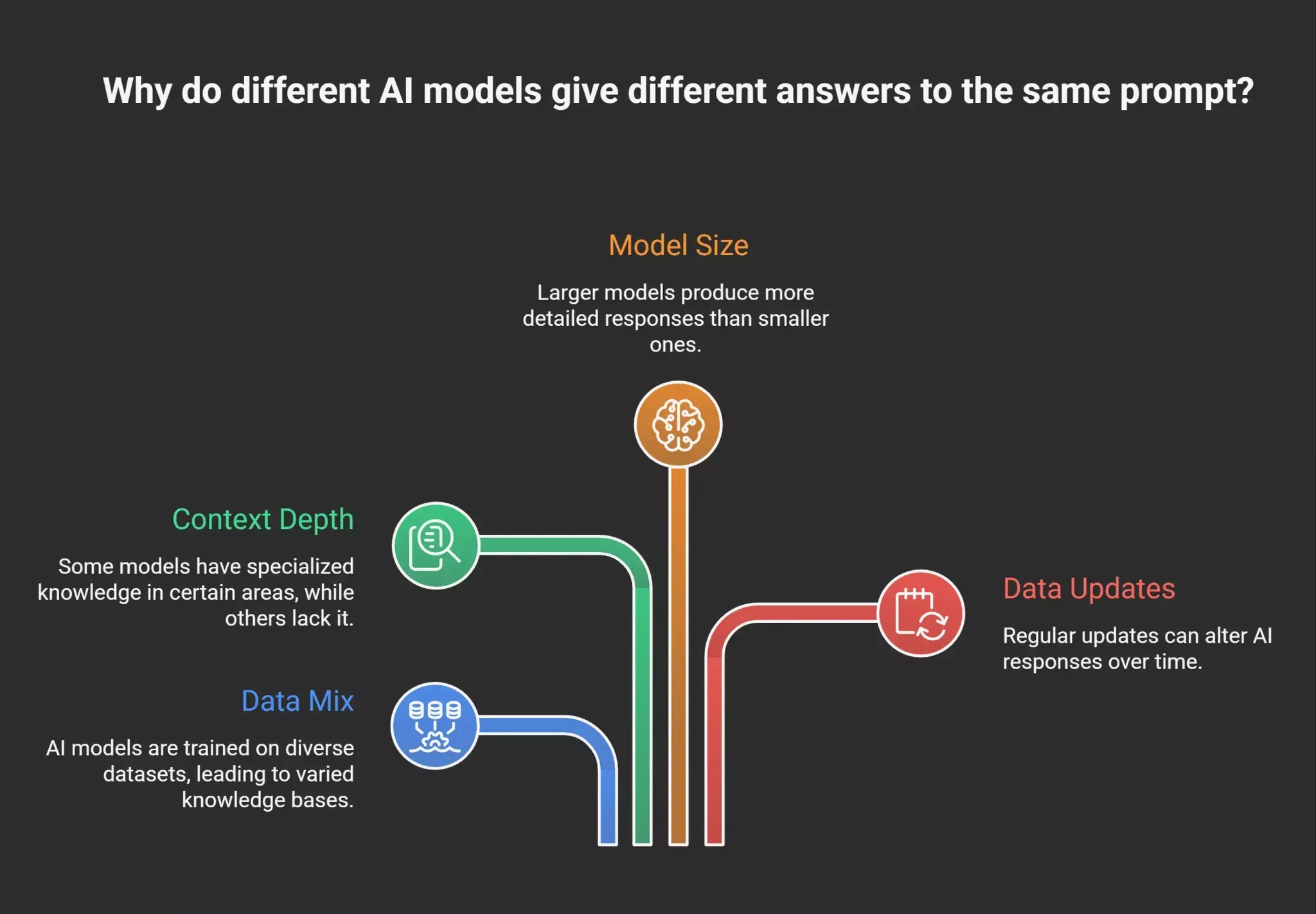 This explains why identical wording fed into different AI models can return answers that feel like they came from entirely different systems. The training data underneath is simply not the same.
How Context and Session Memory Shape AI Answers
Conversation History Changes Output
-
AI does not answer in isolation. It considers the context of earlier messages and adjusts based on what came before.
-
If your earlier parts of the conversation focused on compliance, the AI platform interprets your next question through that context. The same query asked fresh may give different answers entirely.
-
Even a follow-up question can shift how AI interprets your intent, changing the final answer.
-
Specialized systems often manage a long business context in a memory layer to prevent contradictions. General-purpose AI models do not retain context this way.
Why Wording Changes Everything
-
Small changes in wording can redirect how AI interprets a prompt. Swapping a synonym leads the model down a different reasoning path.
-
The wording you choose affects which patterns the model matches and which answers it returns. This is one of the biggest reasons many users see different responses to what feels like the same question.
-
The AI's understanding of what you are asking depends on wording, phrasing, and word order. Identical intent expressed with different wording will give different answers.
-
Providing clear context and precise wording helps reduce response variability. Vague prompts give the model room to interpret, and that room creates variability in AI responses.
What System Prompts and Safety Filters Do
How They Shape AI Responses
-
Every AI platform has system prompts that run behind the scenes. These shape the tone, length, and depth of answers.
-
One AI platform might instruct its models to be brief and direct. Another might push for longer, friendlier answers. Same question, same prompt from the user, but the hidden rules make the systems respond in their own way and produce different output.
-
Safety filters also vary across AI platforms. Some restrict certain topics or add disclaimers. Others let the AI models give answers more freely.
-
These configuration differences are one of the main reasons AI chatbots give different answers to the same question, even when using similar underlying models. The same output is rarely produced twice.
This is why the same prompt typed into one AI chatbot returns a bulleted list, while another AI chatbot gives a paragraph. The systems behind the scenes are different.
| Factor | General AI Platforms | Solve on Rocket.new |
|---|---|---|
| Training data | Broad public web data | Shared research layer with live data |
| Instructions | Optimized for general tasks | Structured for business decision-making |
| Format | Varies by session | Structured briefs with evidence |
| Memory | Resets between tools | Connected across Solve, Build, and Intelligence |
| Consistency | Low across repeated runs | Responses grounded in data and recommendations |
| Compliance | Varies by provider | SOC 2, GDPR, CCPA by default |
Why do different AI Platforms Give Different Answers
Model Configuration and Architecture
-
Each AI platform configures its models differently. Temperature settings, context window size, and available data all vary.
-
Some platforms run multiple AI tools behind a single interface, routing your prompt to different models. The same AI platform can give different answers on different days.
-
When one AI gives you a confident recommendation and another AI gives you a hedge, the difference comes down to model configuration and context.
-
AI systems do not all interpret the same input the same way. Architecture choices change how identical questions get processed and which answers get returned.
-
As examples, a pricing strategy prompt sent to a general AI chatbot might return a short paragraph. The same question sent to Solve returns a structured research brief.
Why Prompt Engineering Matters
-
The way you write a prompt determines whether you get a good answer or a wrong answer. Prompt engineering is the practice of structuring your prompt to get consistent results.
-
Without specific constraints, the model fills in gaps, leading to different ideas and different conclusions.
-
Users in the early days of AI expected it to behave like a traditional search engine, returning one correct answer every time. That expectation is wrong because AI chatbots generate answers rather than retrieve them.
-
To refine prompts and reach a correct answer, give the model a clear context and enough constraints to narrow the output.
-
Good examples of prompt engineering include specifying format, audience, and depth. These details reduce the chance of getting AI responses that miss the mark.
Prompt engineering helps explain why experienced users get more consistent output from AI tools. They have learned to control the variables that cause AI variability.
Why Solve Returns a Structurally Different Kind of Answer
What Makes Solve Different From General AI
-
Solve on Rocket.new is not a chatbot. It runs structured research, pulls live data, and returns formatted output with evidence and recommendations.
-
When you type a business question into Solve, it interprets intent, connects to relevant market data, and returns output you can present to a room or hand to a developer.
-
General AI platforms rely on internal memory from general training data, which often leads to different conclusions when external knowledge is needed. Solve connects to current data sources through Retrieval Augmented Generation (RAG), grounding every answer in specific context.
-
Solve maintains a unified knowledge layer across your project. Earlier decisions stay in context. Your next question builds on everything that came before.
Where Other AI Platforms Fall Short
-
Most AI chatbots reset context between sessions. Ask the same question tomorrow, and the models have no memory of today's conversation.
-
General AI platforms handle a broad range of tasks. That breadth means they lack context in specific business topics. A prompt about pricing strategy might return generic answers rather than grounded data.
-
When AI search tools pull from the open web, the search results shift based on timing and location. Different sources give different answers.
-
A brand appears in AI search only when the model has enough confidence in it. With general AI models, that confidence shifts from run to run. Solve bypasses this by grounding answers in a connected context rather than probabilistic sampling.
What People Are Saying
"AIs do not give consistent lists of brand or product recommendations. If you don't like an answer, or your brand doesn't show up where you want it to, just ask a few more times." - Rand Fishkin, SparkToro
Fishkin's research tested 2,961 prompts across ChatGPT, Claude, and Google AI. Fewer than 1 in 100 runs returned the same answer list. When business decisions depend on reliable answers, that inconsistency matters. This is where the difference between a general AI platform and Solve becomes clear.
How Rocket.new Handles AI Response Variability for Business Research
When AI gives different answers across multiple AI tools and sessions, business teams lose time cross-checking output. Rocket.new built Solve to close that gap. You describe a market problem or opportunity, and Solve returns an evidence-backed report ready for decision-making.
Rocket.new features that directly address the consistency problem:
-
Vibe-solutioning platform connecting research, building, and competitive monitoring in one workspace
-
25k+ templates library, free to use, covering market analysis, GTM strategy, and product direction
-
Saves up to 80% tokens through template-first generation, improving consistency of AI responses
-
Supports Flutter (mobile) and Next.js (web), so research flows into production-ready builds
-
Collaboration features built in for real-time teamwork
-
3 Products, One platform: Solve, Build, and Intelligence, keeping data connected across every phase
How Solve Connects to This Problem
-
Market validation before building: Ask Solve a business question, and get a structured brief with competitive data and a clear recommendation, not a chatbot summary that gives you different answers every time.
-
Continuous memory across sessions: Solve retains your research and competitive signals. Your next question builds on what came before, reducing contradictory AI responses.
-
Research that moves into execution: Take your Solve answers directly into Build without re-explaining your goals. The same data carries forward.
-
Competitor monitoring with Intelligence: After launch, Intelligence tracks competitor moves and feeds signals back into Solve, keeping your answers grounded in live data.
Rocket is built for teams that need consistent, evidence-based answers, not a different answer every time they ask one query.
Getting Consistent Answers From AI Research Systems
AI response variability is not going away. Models give different answers by design. Any prompt, sent to different AI models will return different responses based on training data, hidden instructions, temperature, wording, and context.
General AI platforms sometimes return a good answer and sometimes return a wrong answer. Solve on Rocket.new gives you structured, grounded research that does not reset between sessions. For business research, that difference is the one that matters.
Stop guessing with AI, use Solve on Rocket.new for consistent, decision-ready insights every time.
Table of contents
- -Why AI Gives Different Answers to the Same Question
- -How Probabilistic Systems Generate Output
- -Why Training Data Creates Different Answers
- -How Context and Session Memory Shape AI Answers
- -Conversation History Changes Output
- -Why Wording Changes Everything
- -What System Prompts and Safety Filters Do
- -How They Shape AI Responses
- -Why do different AI Platforms Give Different Answers
- -Model Configuration and Architecture
- -Why Prompt Engineering Matters
- -Why Solve Returns a Structurally Different Kind of Answer
- -What Makes Solve Different From General AI
- -Where Other AI Platforms Fall Short
- -What People Are Saying
- -How Rocket.new Handles AI Response Variability for Business Research
- -How Solve Connects to This Problem
- -Getting Consistent Answers From AI Research Systems