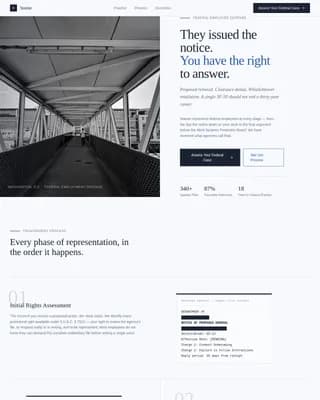
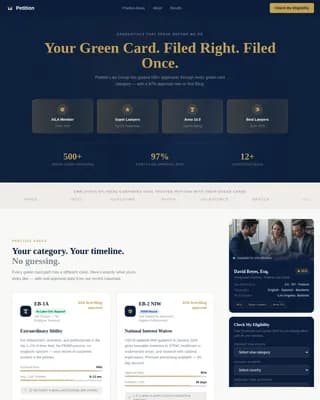
Accord is an editorial landing page template built for real estate mediation practices. It pairs a two-column sidebar layout with a transparent, chapter-by-chapter process reveal that guides visitors from conflict recognition to consultation booking. The design is calm and authoritative, using warm white, quiet graphite, muted sage, and terracotta accents to create trust before a single word is read.
by Rocket studio
Loading preview…
Quick summary
Accord is a single-page landing page template designed for real estate mediation professionals. It uses a persistent sidebar table of contents and three editorial process chapters to walk visitors through every phase of mediation before asking them to book. The result is a page that earns trust through radical transparency rather than sales pressure.
Who this template is for
This template is built for mediation practitioners who handle property-related disputes and want a professional online presence that reflects their process honestly. It works especially well for independent mediators and small practices handling high-stakes, emotionally loaded cases.
Divorce attorneys or mediators guiding couples through the division of a shared family home
Estate and probate mediators working with siblings or heirs who have inherited property
Commercial mediation practitioners managing landlord and tenant disputes outside of court
What problem this template solves
Property disputes rarely start as legal problems. They start as relationship breakdowns, and the people involved are often exhausted, distrustful, and unsure whether mediation will actually work. Most mediation websites fail these visitors because they hide costs, obscure the process, and look indistinguishable from law firm boilerplate.
Visitors cannot see what mediation actually involves, so they default to expensive litigation
Generic legal-services templates feel cold and adversarial, which is the opposite of what mediation offers
There is no clear path from "I'm curious" to "I'm ready to book," so warm leads go cold
What you get with this template
Accord delivers a fully structured, design-ready landing page that treats transparency as its core conversion strategy. Every section has a clear job to do, and the layout is deliberate at every scroll depth.
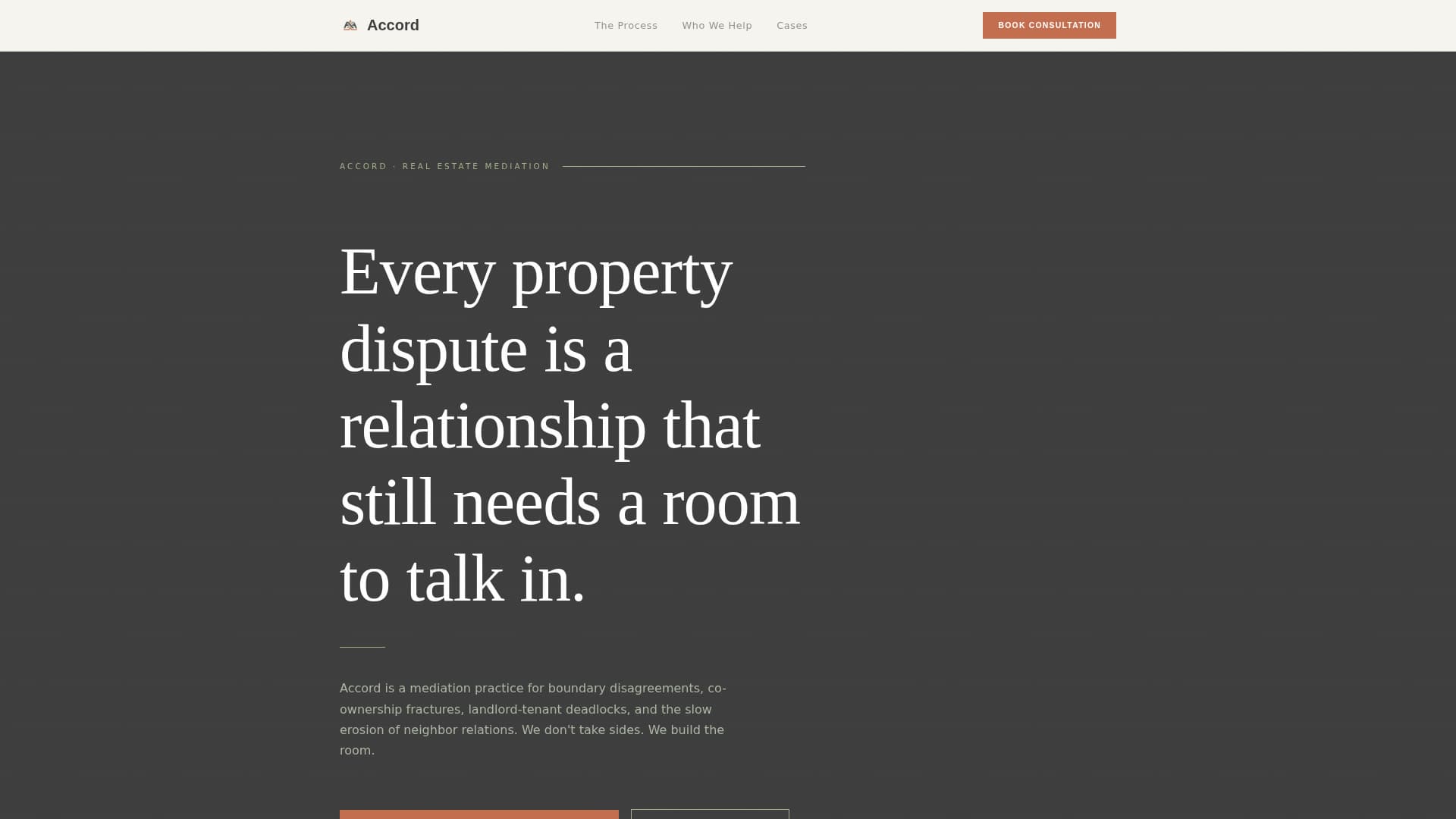
A manifesto-style header with a full-width typographic statement, white text on graphite, and a primary call-to-action
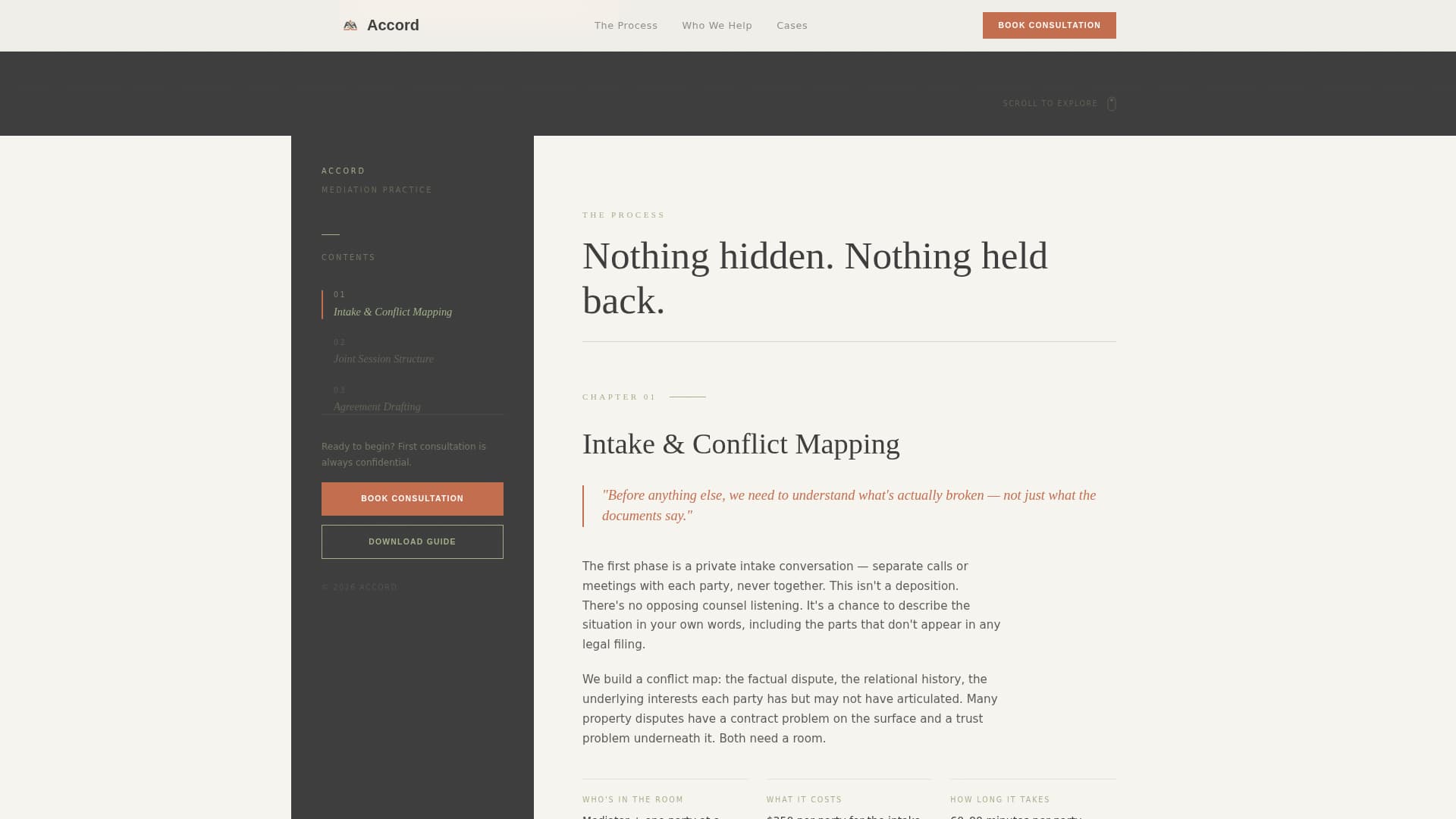
Three editorial process chapters in the main column, each opening with a terracotta pull quote and plain-language explanation of intake, session structure, and agreement drafting
Theme
Editorial Magazine
Creative direction
Transparent Process
Color system
Cloud Canvas
Style
Sidebar Companion
Direction
Booking/Scheduling
Page Sections
Manifesto Header with Booking Call to Action
Scroll-linked Sidebar Table of Contents
Three-chapter Transparent Process Layout
Step-reveal Consultation Booking Form
Email-gated Mediation Guide Download
Testimonials with Case-type Labels
Related questions
What types of property disputes is this template designed for?
Who is the ideal user for this landing page template?
How does the dual conversion path work?
Does the sidebar layout work on mobile screens?
Can the process chapters be edited to match my own mediation practice?
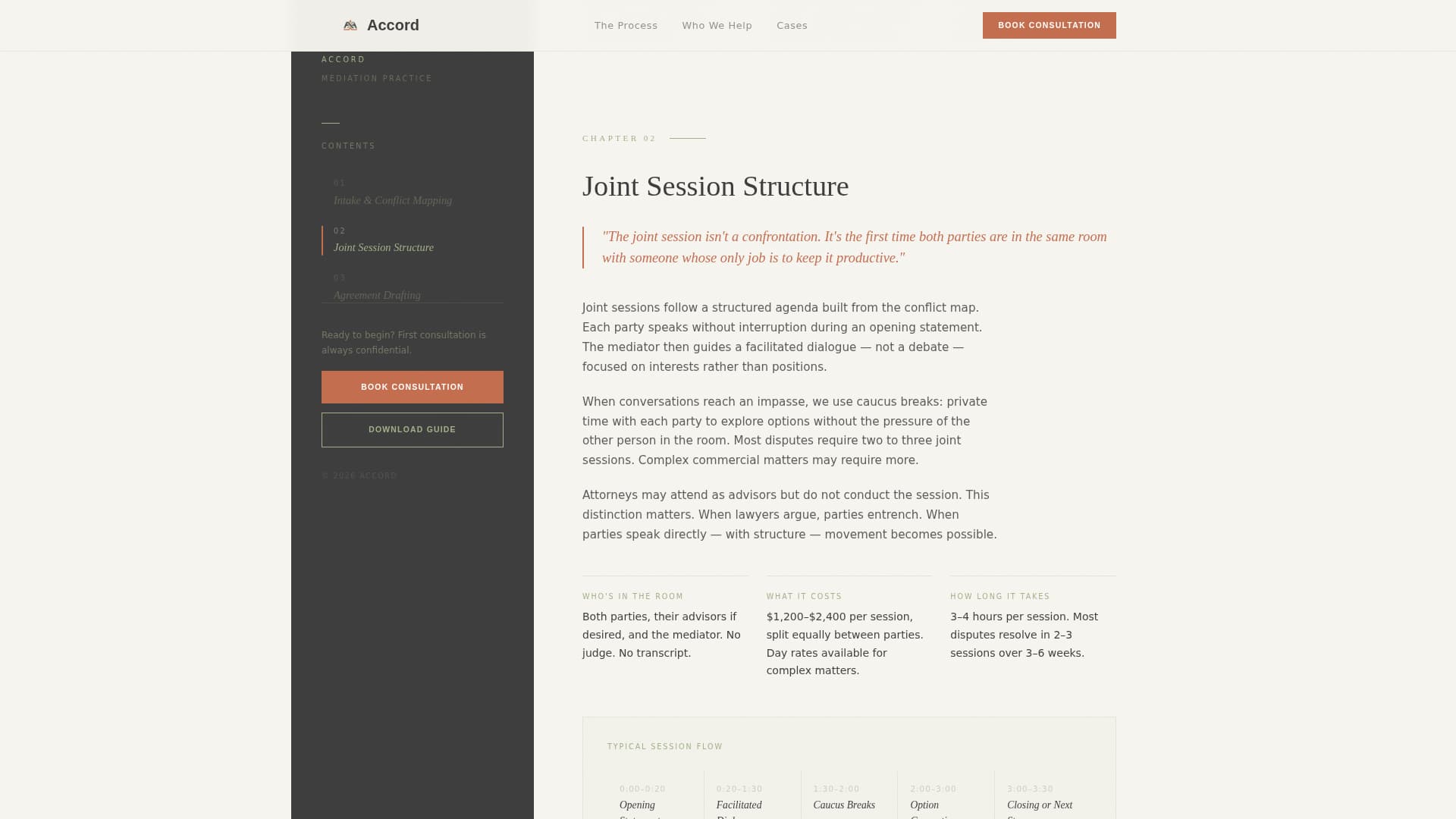
A persistent sidebar with a scroll-linked table of contents that highlights the active chapter as the visitor reads
A multi-step booking form covering conflict type, number of parties, and preferred consultation format before revealing a calendar widget
A secondary lead capture path with an email-gated guide download for visitors not yet ready to book
A conflict types section, testimonial pull quotes, and a minimal single-row footer
Feature list
A brief overview of the standout capabilities built into this template.
Manifesto Header with Primary Call to Action
The header spans the full viewport width with an editorial serif headline set in white on deep graphite. A thin sage rule sits beneath the statement, and the primary "Book a Confidential Consultation" button appears here in terracotta before the visitor scrolls further.
Scroll-Linked Sidebar Table of Contents
A persistent sidebar tracks the visitor's reading position across all three process chapters. As each chapter enters the viewport, the corresponding sidebar item activates, giving the page a magazine-style reading experience that also signals professionalism and structure.
Three-Chapter Transparent Process Layout
Each numbered chapter covers one mediation phase: intake and conflict mapping, joint session structure, and agreement drafting. Every chapter includes what happens, who is present, estimated cost, and timeline, so the visitor has no unanswered process questions by the time they reach the booking form.
Step-Reveal Booking Form with Calendar Widget
The consultation booking form uses a step-reveal pattern. Visitors first select their conflict type from a dropdown, specify the number of parties involved, and choose their preferred consultation format. The calendar widget appears only after those fields are completed.
Email-Gated Guide Download
A secondary conversion path offers a downloadable mediation guide to visitors who are not yet ready to commit to a consultation. The guide mirrors the page's transparent process content in a portable format, and access requires only an email address.
Testimonial and Social Proof Section
Long-form testimonial pull quotes are displayed with case-type labels, giving prospective clients a direct point of identification. Each testimonial is tied to a specific conflict category, reinforcing the breadth of the practice's experience.
Page sections overview
Section
Purpose
Manifesto Header
Opens with the core editorial statement and primary booking call to action
Process Chapter One
Explains intake and conflict mapping in plain language
Process Chapter Two
Describes joint session structure, participants, and timing
Process Chapter Three
Covers agreement drafting and what a resolution looks like
Conflict Types
Lists the dispute categories this practice handles
Testimonials
Displays resolved-case pull quotes with conflict-type labels
Booking Form
Captures conflict type, party count, and format before showing the calendar
Guide Download
Offers the mediation guide PDF in exchange for an email address
Page Footer
Displays copyright and essential links in a single minimal row
Design & branding system
The visual identity follows an Editorial Magazine theme built on a Cloud Canvas color palette. The overall feeling is that of a considered architecture journal: unhurried, literate, and free of unnecessary decoration.
Colors: warm white (#F7F5F0) for all backgrounds, quiet graphite (#3D3D3D) for the sidebar and header, muted sage (#A3B18A) for sidebar type and accent details, and deep terracotta (#C46E4E) reserved exclusively for calls to action and pull quotes
Typography: Fraunces, an editorial serif, handles all headlines and pull quotes; DM Sans handles body text and user interface elements throughout
Animations are kept intentionally low to medium in intensity, using scroll-linked sidebar highlighting, chapter reveals on scroll, and subtle fade-ins to maintain the calm tone without distraction
Mobile & speed optimization
The template is built desktop-first to honor the two-column sidebar layout, but it includes a graceful mobile stack that reorganizes content into a single readable column when viewport width requires it.
On smaller screens, the persistent sidebar collapses and the chapter table of contents reflows into a top-of-page navigation element
Static content sections use server components to keep initial load lean, while IntersectionObserver handles scroll-tracking behavior for the sidebar active states
The booking form step-reveal and guide download capture both function within the stacked mobile layout without losing their sequential logic
How this template helps you convert
Accord is built around a single insight: when people understand the entire mediation process before they commit, their hesitation shrinks. Transparency replaces persuasion, and the layout is engineered to deliver that understanding efficiently.
The manifesto header creates immediate emotional resonance, positioning the practice as a calm, credible alternative to court before the visitor has read a single process detail
The three-chapter layout with persistent sidebar removes every process unknown, so by the time a visitor reaches the booking form, the only remaining question is availability on their calendar
The dual conversion paths, a direct booking form and an email-gated guide download, capture both ready-to-book visitors and those who need more time, reducing overall lead loss
Other information about this template
Accord sits at the intersection of legal-adjacent professional services and editorial web design. It is a strong fit for practices that want their digital presence to reflect the same qualities they bring to a mediation room: clarity, patience, and no hidden agenda.
The template style is Sidebar Companion, a two-column format where the main content column and the persistent sidebar work together rather than independently
The creative direction is Transparent Process, meaning the layout is structured to reveal every step of the service before asking for commitment
The header concept is Quote/Manifesto, a full-width typographic statement designed to land like the opening sentence of a long-form essay
The landing page direction is Booking and Scheduling, with the entire page architecture oriented toward getting a qualified visitor to complete the consultation booking form
The color system is Cloud Canvas, a warm and restrained palette that deliberately avoids the high-contrast visual language common to legal and financial websites