Hobby & Passion Content Blog & Content Website Template
Arcana is an editorial magazine landing page built for the tabletop RPG design community. It pairs a cinematic dark visual identity with deliberate typography and a scroll-driven layout that unfolds like a hardcover rulebook. The template drives readers toward a featured editorial collection, with a clean newsletter path for weekly craft essays on game design.
by Rocket studio
Quick summary
Arcana is a single-page editorial landing page template crafted for tabletop RPG design blogs and communities. It uses a Cinematic Dark color palette, Luxe Minimal layout principles, and a scroll-driven narrative structure to communicate editorial authority from the first moment a reader arrives. The page moves visitors from a cinematic hero header through a belief-driven manifesto, three editorial pillars, and two clear calls to action.
Who this template is for
This template speaks directly to people who treat game design as a serious craft discipline. Whether you homebrew adventures late into the night or write long-form essays about the theory behind a dice pool, this page gives your publication a visual identity that commands respect before a single word is read.
- Indie tabletop RPG designers self-publishing systems, zines, or game jams projects on platforms like itch.io
- Veteran game masters who homebrew entire rule sets and want to share ideas and essays with a wider audience
- Layout artists and editorial creators in the tabletop RPG space who need a landing page that reflects their production values
What problem this template solves
Most RPG blogs look like they were assembled in a hurry. Generic themes, cluttered navigation, and weak visual hierarchy fail to communicate that the content inside is worth a reader's time. A game designer building a publication around craft deserves a page that holds the same standard as the work it represents.
- No strong editorial identity: generic blog themes bury the unique voice that draws readers to niche tabletop RPG content in the first place
- Weak conversion path: readers land, feel uncertain, and leave before discovering the essays or community behind the publication
- Poor first impression: without an immersive, thematic aesthetic, even excellent writing on character creation or magic systems gets dismissed at a glance
What you get with this template
You get a fully structured, single-section editorial landing page that reads like a publication's front cover and editor's letter rolled into one. Every layout decision, typographic choice, and color value has been made deliberately to serve the tabletop RPG design audience.
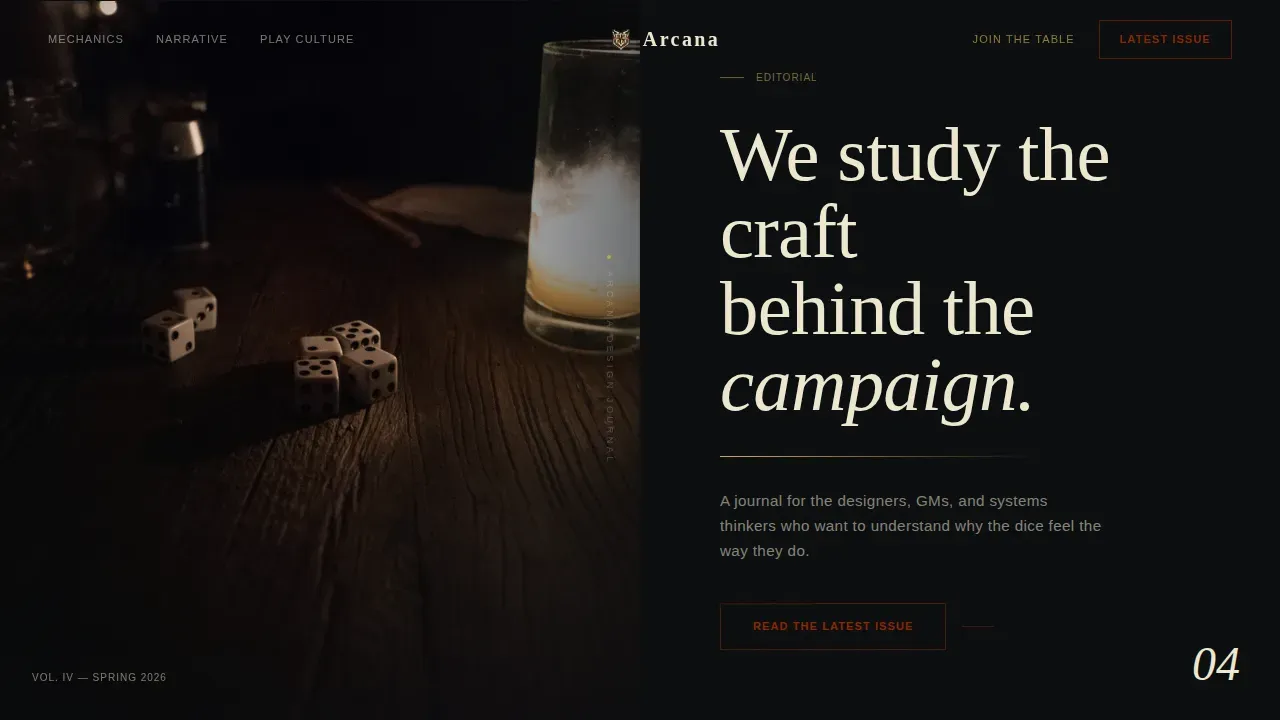
- A cinematic hero section with a split layout, moody overhead photography on the left and a bold serif headline on obsidian on the right
- A full-width manifesto block with staggered typographic belief statements, three editorial pillar sections with featured article cards, a minimal newsletter capture, and a fixed bottom call-to-action bar
- A complete Cinematic Dark design system using Cormorant Garamond for display type, DM Sans for body and interface text, and a four-color palette that feels like a limited-edition zine with gold foil stamping
Feature list
This template ships with a set of deliberate design and layout features rooted in the editorial magazine format. Every element has been chosen to serve the specific world of tabletop RPG craft publishing.
Cinematic Split Hero Header
The hero section divides the viewport in two. The left panel holds a moody overhead photograph of a tabletop mid-session: hand-drawn maps, polyhedral dice mid-scatter, pencil shavings curling near a character sheet, and candlelight throwing warm shadows across everything. The right panel is pure obsidian with a large letterspaced serif headline in parchment ivory. A thin gold rule separates the headline from a two-line subhead that defines the editorial mission. This opening moment gives readers the sense of cracking open a hardcover rulebook for the first time, the spine resisting just enough, a world waiting behind the table of contents.
Full-Width Typographic Manifesto
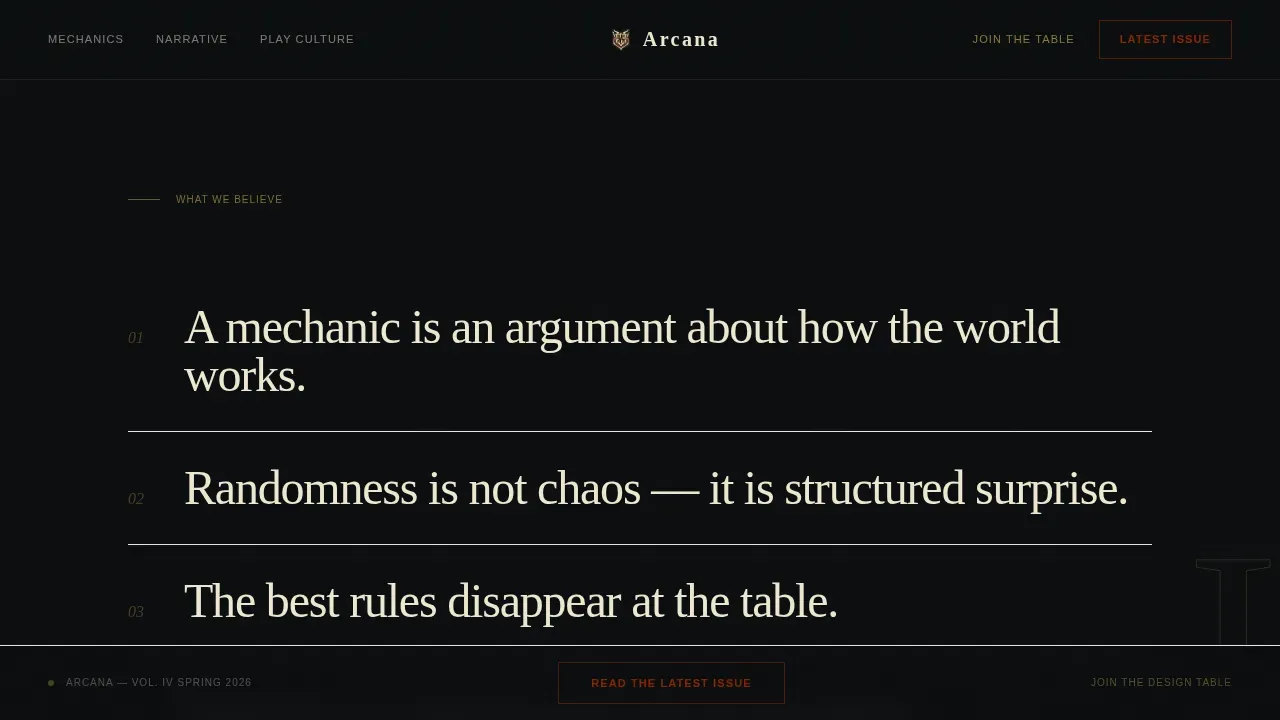
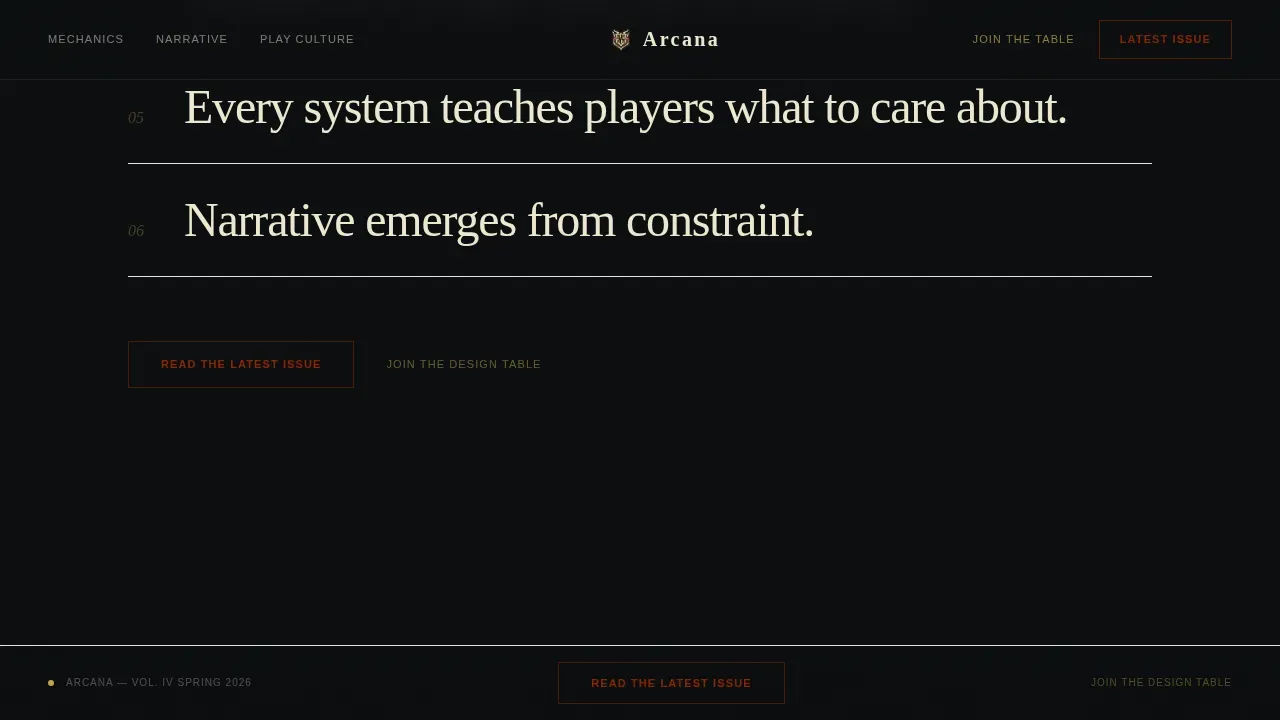
Scrolling past the hero, the page surfaces a manifesto section. Each belief about game design and the art of tabletop storytelling appears as a single typographic statement on its own line. The rhythm is deliberate: generous whitespace between each statement lets the ideas breathe. This section establishes point of view immediately and signals that this is a publication with opinions, not a content mill. The primary call to action, styled in punctuation red, sits beneath the manifesto and invites readers to explore the current editorial collection.
Three Editorial Pillar Sections
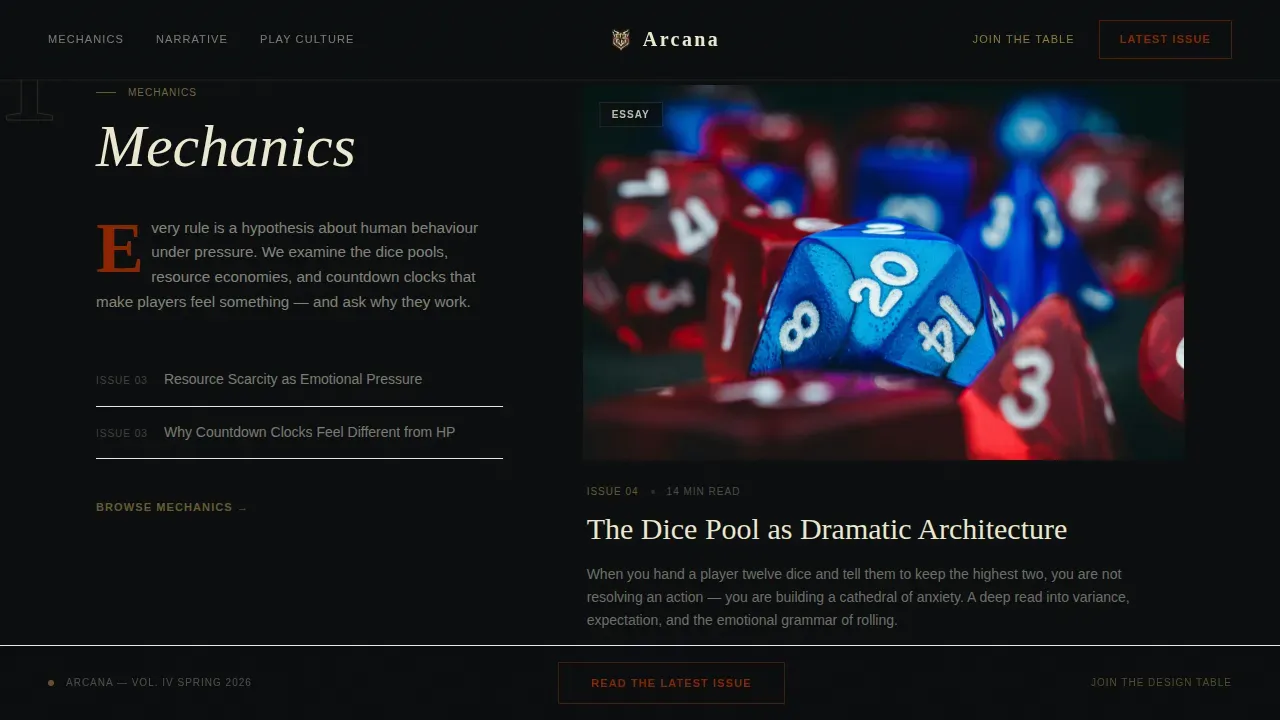
The core editorial structure organizes content around three named pillars: Mechanics, Narrative, and Play Culture. Each pillar opens with a magazine-style section header and a single paragraph of design philosophy. Below the philosophy sits a featured article card showing an article thumbnail, author name, issue number, and read-time estimate. The three sections alternate between asymmetric layouts, creating a rhythm that mirrors the varied pacing you find in a well-structured print magazine. Readers interested in topics like character creation theory, magic system design, or dungeon master technique can orient quickly toward the content that matters to them.
Fixed Bottom Call-to-Action Bar
After the first scroll, a fixed bar appears at the bottom of the viewport. It carries the primary call to action in punctuation red: "Read the Latest Issue." This persistent element keeps the conversion path visible throughout the entire reading experience without interrupting the editorial flow. It disappears only when the reader reaches the footer, keeping the focus clean.
Minimal Newsletter Capture
The newsletter section uses a single email input and one sentence of context: "One essay on game design craft, every Thursday." The gold-leaf accent color frames the input without overwhelming it. No form complexity, no multi-field friction. Readers who are interested in a weekly craft essay can subscribe in seconds. This section supports the secondary conversion goal without competing with the primary call to action path.
GSAP ScrollTrigger Animation System
The template includes a high-animation layer built on GSAP ScrollTrigger. Image reveal wipes, staggered text animations, and parallax effects animate the page as the reader scrolls. The manifesto statements stagger into view one at a time. Article card thumbnails reveal with a cinematic wipe. The hero image loads with a parallax offset that adds depth to the split layout. These animations are loaded client-side only, keeping static sections performant on first paint.
Page sections overview
| Section | Purpose |
|---|---|
| Cinematic Split Hero | Establish editorial identity with a moody photograph and a bold serif headline on obsidian |
| Full-Width Manifesto | Declare the publication's beliefs about game design through staggered typographic statements |
| Editorial Pillars | Present three content categories with philosophy paragraphs and featured article cards |
| Newsletter Capture | Invite weekly essay subscriptions with a minimal gold-accented email input |
| Fixed Bottom Bar | Keep the primary call to action visible throughout the scroll experience |
| Footer | Close the page with a horizontal dark-background footer pattern |
Design & branding system
The Arcana template uses a Cinematic Dark color system built around four values chosen for restraint and atmosphere. The palette feels like a limited-edition zine printed on black card stock with gold foil stamping. Every color plays exactly one role, and nothing competes for attention.
- Obsidian (#0B0D0F) as the primary background, parchment ivory (#EDE8D0) for body text and pull quotes, muted gold leaf (#C9A84C) on accent lines and hover states, and punctuation red (#8B2500) reserved exclusively for calls to action and drop caps
- Cormorant Garamond handles all display and headline type, bringing the weight and presence of a serif typeface from a bygone era of fine print publishing, while DM Sans handles all body copy and interface elements for clean legibility
- Gold rule dividers, hover states on article cards, and section separators all use the gold leaf value, creating a visual system that is consistent across every scroll position
Mobile & speed optimization
The template is designed desktop-first to serve the primary audience of designers and writers at their desks. Mobile parity is built into the layout so the editorial experience translates cleanly to smaller screens without losing the cinematic atmosphere.
- The split hero collapses to a full-width stacked layout on mobile, preserving both the photograph and the headline at readable sizes
- Static content sections use server components for fast initial rendering, while the GSAP animation layer loads client-side only so the core editorial content appears before any animation begins
- The fixed bottom call-to-action bar adapts to mobile viewport sizing, keeping the primary conversion action reachable with a thumb tap
How this template helps you convert
The page is built around two conversion goals: driving click-throughs to the current editorial collection and capturing newsletter subscriptions. Every layout decision supports one of these two paths without creating noise between them.
- The primary call to action appears twice in high-visibility positions: once beneath the manifesto where editorial momentum peaks, and again as a persistent fixed bar that follows the reader through the entire scroll, making the action available at any moment of decision
- The secondary newsletter path is placed after the editorial pillars, when a reader has already encountered three areas of content and is most likely to feel invested enough to subscribe for more essays each week
Other information about this template
This section covers additional context about the editorial philosophy and the content territory the Arcana template is built to support. The topics below reflect the craft areas the publication's three pillars address, and they help readers understand what kind of ideas and adventures this template is designed to house.
- Campaign design depth: Tabletop RPG campaigns require careful planning and structure to produce engaging gameplay. A well-designed campaign holds a clear adventure idea at its center, one that creates an immediate threat and demands action. Planning encounters across a range of types, including combat, exploration, and direct confrontation with adversaries, gives adventures the variety that most groups find satisfying session after session.
- Session Zero and character creation: Session Zero is a crucial step in campaign design. It is the first session where players build characters collaboratively and establish group dynamics before the adventure begins. Character creation in tabletop RPGs combines mechanical statistics with narrative elements. The three pillars of character creation are mechanical framework, personality and motivations, and role within the party. A first character made during Session Zero often shapes how the rest of the campaign unfolds.
- Character motivations and relationships: Character motivations drive the narrative and raise the emotional stakes. Conflicting motivations among characters lead to rich storytelling and character development moments that other players remember long after the session ends. A character's abilities are most interesting when they express who that character is, not just what they can do in combat. Backstories should focus on pivotal events that shaped a character's worldview without overwhelming the narrative with backstory stuff that never surfaces in play.
- Narrative and villain development: A compelling narrative in RPGs requires an urgent problem that demands action. Good villains should be introduced early and have a presence throughout the story to build suspense. The best villains often have a personal connection to the characters, which makes scenes of direct confrontation feel earned. A villain's presence should linger even when they are not on the table, influencing events and other characters across the campaign.
- World-building and magic systems: Creative world-building means creating unique settings that enhance the storytelling experience. Magic systems can reflect the specific nature of the world they inhabit, influencing gameplay and narrative in equal measure. Incorporating unusual magic systems can provide fresh gameplay and give players new ways to explore the implications of the world. Unique world-building elements, from strange creatures to unusual landscapes, challenge player expectations and make adventures feel genuinely new.
- Cross-media influences: A game designer today draws from a wide range of sources. Video game narrative techniques, visual storytelling from films, and even actual play podcasts and streams all feed into how tabletop RPG design evolves. The integration of visual art styles from a video game into a tabletop rulebook can create a more dynamic and engaging experience. These cross-media influences make the ttrpg space richer and bring more designers into the craft each year.
- Running effective sessions: Establishing clear expectations with players is crucial for running effective RPG sessions. Balancing spotlight time ensures every player feels valued. Using callbacks to previous events enhances narrative continuity and player investment. Encouraging players to develop relationships with other characters, including non-player characters, creates more engaging storylines. Incorporating player feedback into the game can improve the overall experience moving forward.
- Epic tales and interesting storytelling: The most memorable adventures tell epic tales that connect individual scenes to a larger story. Interesting storytelling in tabletop RPGs comes from the interplay between player agency and structured design. A dungeon master who understands both mechanics and narrative can describe scenes with the kind of precision that makes players feel the actual play unfolding around the table. The goal is not just fun in the immediate moment but a campaign that feels meaningful weeks and months later.
- Game jams and community: Game jams are an increasingly important part of how indie designers discover their voice. They create time-boxed projects that force designers to focus on a single idea and ship it. Many designers who began with a game jam have gone on to write full systems. The hope is that the Arcana template helps more of those designers land a publication presence that reflects the quality of their work.
- Design and editorial craft: An effective template for a tabletop RPG design blog must balance thematic immersion with high-conversion utility. Thematic typography should reflect the publication's identity while maintaining readability. A compelling headline should immediately define the blog's value. Social proof elements such as article thumbnails with author names and issue numbers help establish authority in the community. It is critical to convey the unique value of the blog within the first few seconds of landing on the page. A high-contrast call to action button, a clear value proposition, and an evocative hero visual are the most important elements of a landing page in this space. The Arcana template addresses all of these requirements inside a single, scroll-driven editorial page built specifically for the tabletop RPG craft publishing world.
- Starting a new blog post or project: Whether you are beginning with a single blog post or launching a full editorial project, this template gives your ideas a home that looks and feels considered. The learning process of building a design publication is long. Having a strong landing page from the beginning means readers understand what you stand for before they discover your first article. Moving forward from a rough Google Doc to a published, designed editorial presence is one of the most meaningful steps a tabletop RPG designer can take. The near future of indie tabletop publishing belongs to creators who treat their craft as a real discipline, and this template is built to support that ambition.
Theme
Luxe Minimal
Creative direction
Vision & Mission
Color system
Cinematic Dark
Style
Editorial/Magazine
Direction
Click-Through
Page Sections
Cinematic Split Hero Section
Typographic Manifesto Block
Three Editorial Pillar Layout
Persistent Fixed Call-to-action Bar
Minimal Gold-accent Newsletter Capture
GSAP Scrolltrigger Animation Layer
Related questions
Who is the Arcana template designed for?
What sections are included in the template?
Can I adapt the editorial pillars to my own content categories?
Does the template include the GSAP animation layer?
Is this template suitable for a newsletter-first publication?