RegTech Startup Pricing & Packages Website Template
The Comply regulatory gap scan RegTech landing page template is a modular card-grid layout built for seed-stage compliance platforms. It presents regulatory data with the density of a procurement spec sheet, using a Feature Tab Switcher, jurisdiction coverage cards, integration spec panels, a pricing comparison table, and a persistent sticky comparison bar to move compliance teams from spreadsheets to automated gap analysis.
by Rocket studio
Quick summary
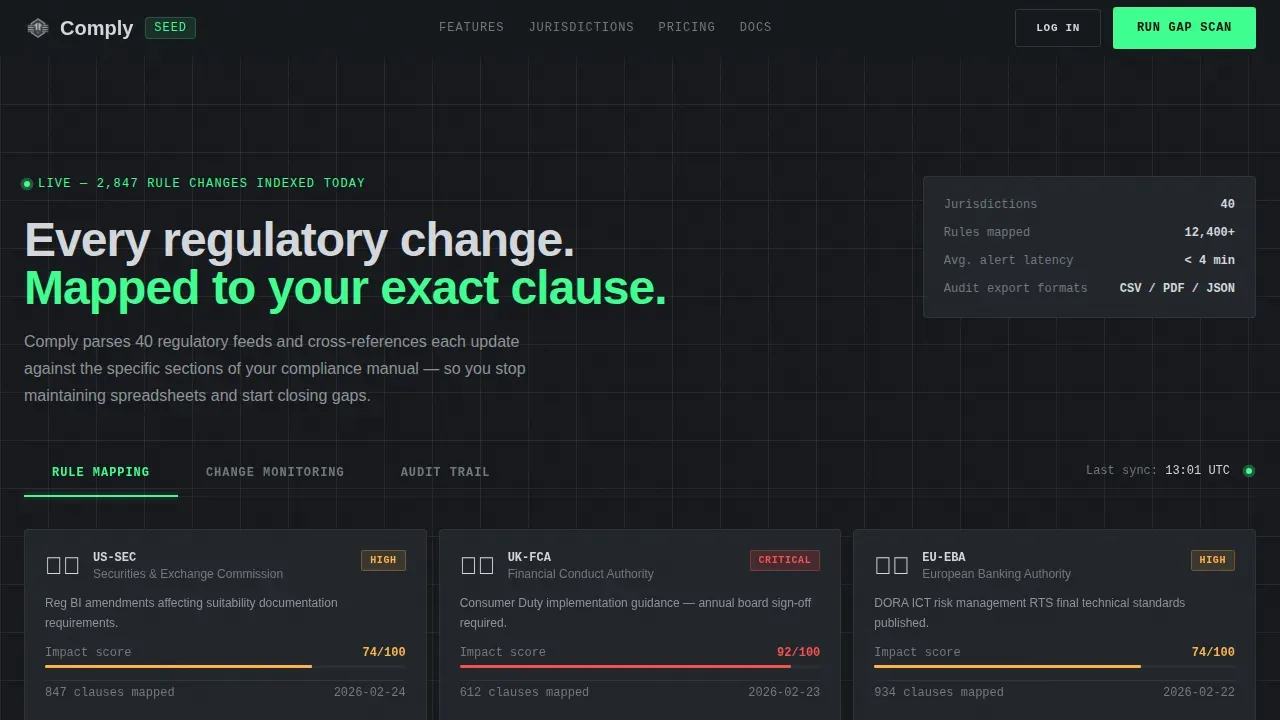
Comply is a single-page RegTech landing page template designed for seed-stage B2B compliance platforms. It surfaces regulatory gap analysis data through a modular card grid, a three-tab hero switcher, and a sticky comparison bar. Every section is structured to help compliance officers, fintech legal teams, and procurement analysts trust the product before they ever reach the form.
Who this template is for
This template is intended for founders and product teams launching a RegTech platform that automates regulatory compliance gap analysis. It suits teams who need to demonstrate data density and structured knowledge to skeptical, detail-oriented buyers.
- Compliance officers at mid-tier banks who currently track regulatory gaps in spreadsheets
- Fintech heads of legal who need to demonstrate audit readiness and compliance status to investors
- RegTech analysts conducting procurement assessment and benchmarking tooling across vendors
What problem this template solves
Compliance teams face a real risk when they rely on manual procedures to track regulatory requirements. A firm that uses color-coded spreadsheets to manage gap analysis is exposed to human error, missed updates, and non-compliance events that carry significant financial and reputational cost.
- Spreadsheet-based gap tracking makes it hard to identify compliance gaps systematically across forty jurisdictions
- Manual processes create specific gaps in documentation and corrective actions that auditors can expose
- Without a structured framework, teams fall short of regulatory standards before they know there is a problem
What you get with this template
This template gives your team a complete, production-ready landing page built around the Spec Sheet creative direction. Every card is a self-contained data unit. The grid IS the argument, so visitors can evaluate your compliance gap analysis platform before they read a single paragraph of marketing copy.
- A Feature Tab Switcher hero with three views: Rule Mapping, Change Monitoring, and Audit Trail
- Jurisdiction coverage bento cards, integration spec panels, a pricing tier comparison table, and a sticky "Comply versus. Spreadsheet" bar
- A three-field gap scan form and a gated PDF spec sheet download to capture leads at two commitment levels
Feature list
This template is built around six core components that work together to demonstrate product credibility through data density rather than narrative paragraphs.
Feature Tab Switcher Hero
Three labeled tabs sit across the top of the viewport: Rule Mapping, Change Monitoring, and Audit Trail. Each tab click swaps the card grid below using a clean horizontal slide transition. The active tab glows with a signal-green accent. This mechanical interaction lets visitors analyze each compliance dimension before scrolling further.
Jurisdiction Coverage Card Grid
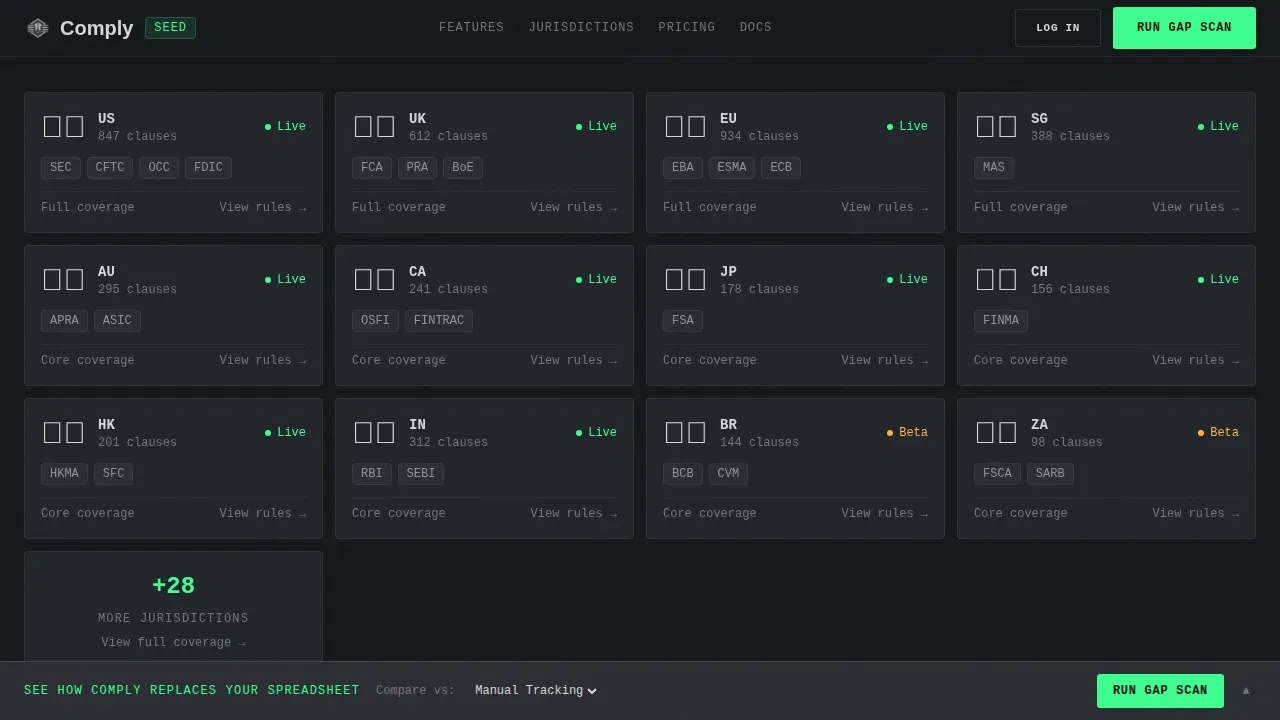
Forty jurisdiction cards display flag icons, clause counts, live-status indicators, and effective dates. Teams can review current state coverage at a glance. This section helps visitors determine which regulatory gaps the platform already tracks across their relevant markets.
Compliance Gap Analysis Data Cards
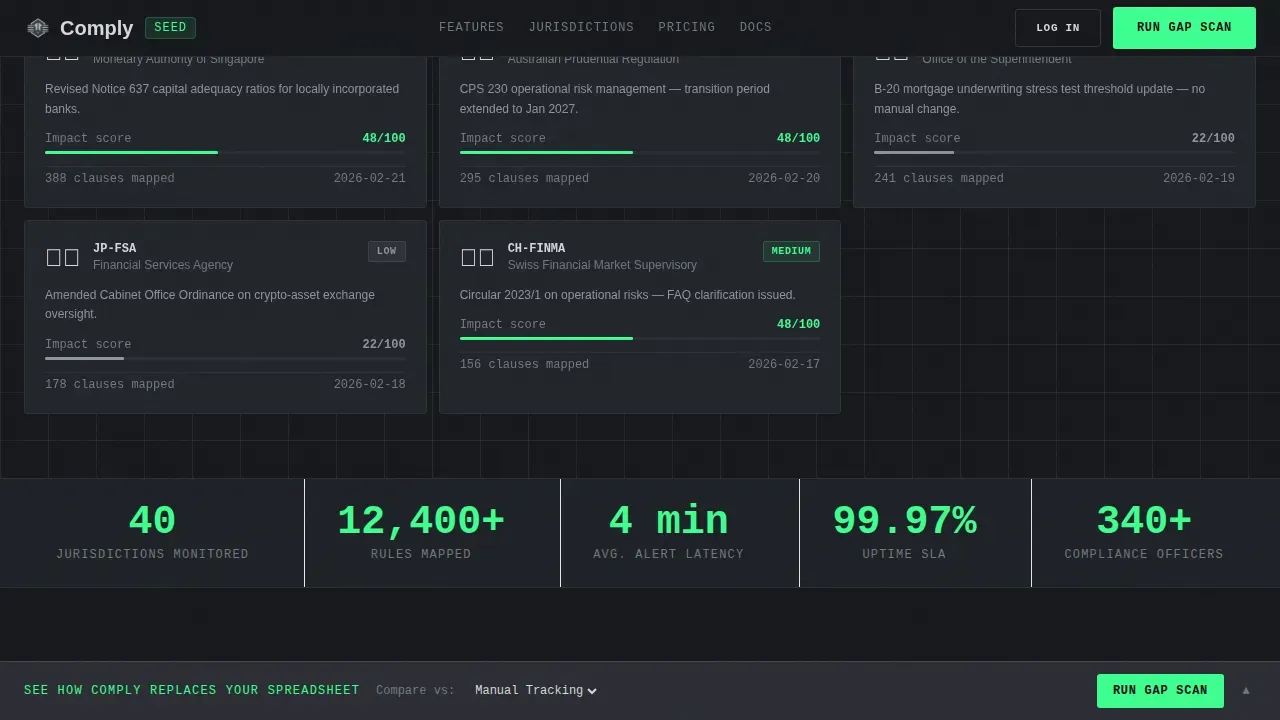
Each card documents a regulation name, issuing body, impact score, and a plain-language summary. This spec-sheet format allows compliance teams to systematically evaluate the platform's rule-mapping depth. The card structure mirrors the way a rigorous compliance gap analysis template organizes findings for stakeholders.
Integration Spec Panels
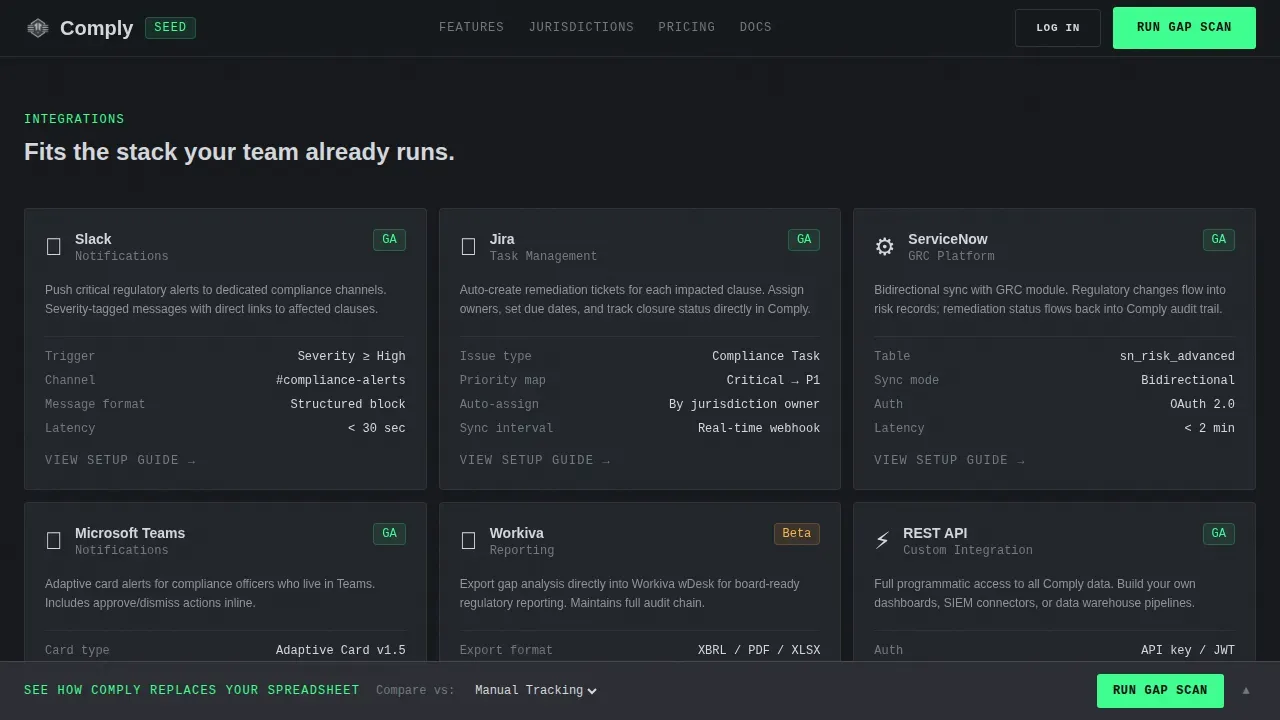
Three integration cards cover Slack, Jira, and ServiceNow. Each panel presents connection details as a self-contained data unit. This helps procurement analysts assess workflow fit and define how the platform connects to existing systems without reading lengthy documentation.
Sticky Comparison Bar
A persistent bar fixed at the bottom of the viewport reads "See How Comply Replaces Your Spreadsheet." A dropdown lets visitors auto-populate a two-column comparison against manual tracking or alternative tools. This section is a valuable tool for teams that need to build a business case for switching from spreadsheets.
Gated Lead Capture Flows
The primary call to action is "Run a Free Regulatory Gap Scan" with a three-field form. A secondary path offers a downloadable one-page PDF spec sheet gated behind email. Both flows create conversion opportunities at different levels of buyer readiness.
Page sections overview
| Section | Purpose |
|---|---|
| Feature Tab Hero | Switch between Rule Mapping, Change Monitoring, and Audit Trail card grids |
| Jurisdiction Coverage Cards | Display forty jurisdiction flags with clause counts and live compliance status |
| Integration Partner Panels | Present Slack, Jira, and ServiceNow spec cards for procurement review |
| Pricing Tier Table | Compare feature checkmarks across tiers in a bare, scannable format |
| Sticky Comparison Bar | Persistent bottom call to action with dropdown to compare against spreadsheets |
| Gap Scan Form | Three-field form to initiate a free regulatory gap scan |
| PDF Download Gate | Email-gated spec sheet for secondary lead capture |
| Developer Minimal Footer | Metric counters, audit trail timestamps, and navigation links |
Design & branding system
The visual identity follows a Directory and Discovery theme built on a Monochrome Steel color system. The palette feels like a brushed stainless server rack panel: industrial, zero-ornamentation, and structured for trust. Typography pairs JetBrains Mono for data labels with DM Sans for body copy.
- Colors: gunmetal (#2B2D33) for backgrounds, cold-rolled steel (#71797E) for secondary elements, bright aluminum (#D4D7DC) for surfaces, and signal-green (#3DFF8F) reserved exclusively for interactive states, live-status dots, and primary calls to action
- Type: JetBrains Mono handles all data fields and labels; DM Sans carries body text for readability
- No ornamentation: the grid and card structure create visual hierarchy without decorative elements
Mobile & speed optimization
This template is built desktop-first, matching the primary audience of compliance officers and procurement analysts who work at desk workstations. The card grid and tab switcher are optimized for large-screen data scanning.
- Server Components handle static content; Client Components manage tab state and GSAP counter animations to keep initial load efficient
- Live-feed pulse dots, scroll-triggered card reveals, and GSAP counter animations run on the client without blocking static render
- The modular card structure allows teams to review and update individual sections independently without rebuilding the full layout
How this template helps you convert
This template is built around a Comparison/Versus conversion strategy. Visitors are shown dense, structured compliance data first. By the time they reach the form, they have already used the product's logic. RegTech tools can reduce gap analysis timelines from weeks to days, and this template makes that case visually before asking for a single detail.
- The Feature Tab Switcher lets visitors analyze Rule Mapping, Change Monitoring, and Audit Trail data on their own terms, building confidence before any call to action appears
- The sticky comparison bar surfaces the "spreadsheet versus. Comply" gap analysis side by side, giving procurement teams the documentation they need to justify a switch
- The two-tiered lead capture flow (free gap scan form and gated PDF) creates a conversion path for buyers at every risk level and commitment stage
Other information about this template
This template is well-suited for RegTech teams that need to demonstrate regulatory compliance rigor to cautious buyers. Several additional aspects are worth noting before you build.
- The comply regulatory gap scan regtech landing page template is designed to showcase 2,400 or more mapped rules and 99.97% uptime as metric counters in the footer section
- Compliance management software landing pages benefit from prominently featuring credibility signals; this template includes space for metric counters and audit trail timestamps that serve that function
- RegTech solutions that transform manual gap analysis into a continuous automated process can use the live-feed Change Monitoring tab to demonstrate that capability directly on the page
- The gated PDF download and gap scan form follow action-oriented call to action best practices; phrases like "Run a Free Regulatory Gap Scan" and "Download the Spec Sheet" are already baked into the layout
- Reviewing and updating the compliance gap analysis cards as regulations change is straightforward because each card is a self-contained modular unit
- Proactive compliance gap scanning can reduce overall compliance costs by reducing the window between a regulatory change and a firm's corrective action; the template is structured to communicate this benefit clearly
Theme
Directory & Discovery
Creative direction
Spec Sheet
Color system
Monochrome Steel
Style
Card Grid (Modular)
Direction
Comparison/Versus
Page Sections
Feature Tab Switcher Hero
Jurisdiction Coverage Card Grid
Compliance Gap Data Cards
Integration Spec Panels
Sticky Comparison Bar
Two-tier Lead Capture Flow
Related questions
Who is this landing page template built for?
Can I customize the jurisdiction cards and compliance gap data in the grid?
What conversion paths does this template include?
How does the sticky comparison bar work?
Does this template include the actual compliance monitoring software?