Gaming Hardware Review Landing Page Template
Benchmark is a hub-and-spoke anchor-nav landing page built for gaming hardware review publications. It presents GPU thermal data, peripheral benchmarks, and storage results as a structured technical journal. The Cinematic Dark design, red annotation accents, and lead-generation gating make it feel authoritative and purposeful for competitive gamers, PC builders, and IT procurement teams.
by Rocket studio
Quick summary
Benchmark is a single-page, anchor-nav landing page template designed for gaming hardware review publications. It organizes dense benchmark data into readable journal-style chapters, earns reader trust through visible methodology, and converts visitors through a gated dataset download and email subscription path.
Who this template is for
This template is built for publishers and creators who take hardware testing seriously and need a page that matches that standard.
- Competitive gaming content creators who publish GPU thermal results, peripheral response data, and storage benchmarks for FPS-focused audiences
- PC builders and hardware enthusiasts who want to present repeatable lab findings rather than opinion-driven reviews
- IT procurement managers and B2B hardware publishers who need structured, data-backed recommendations to support bulk-buy decisions
What problem this template solves
Most review page layouts treat benchmark data as an afterthought. They scatter numbers inside long blog posts, bury methodology notes, and offer no clear path for readers who want the raw data. Benchmark fixes this.
- Readers lose trust when testing credentials are absent; this template opens with a full methodology section before any product appears
- Data-heavy content becomes unreadable without visual structure; the chapter-by-chapter anchor nav keeps findings organized and skimmable
- Lead generation feels intrusive when it appears before value is delivered; this template gates the downloadable spreadsheet only after two full chapters of free, visible data
What you get with this template
You get a complete, single-page research document layout that handles every stage of the reader journey, from credibility to conversion.
- A six-section anchor-nav structure covering hero, methodology, GPU thermals, peripherals, storage, and editor's picks
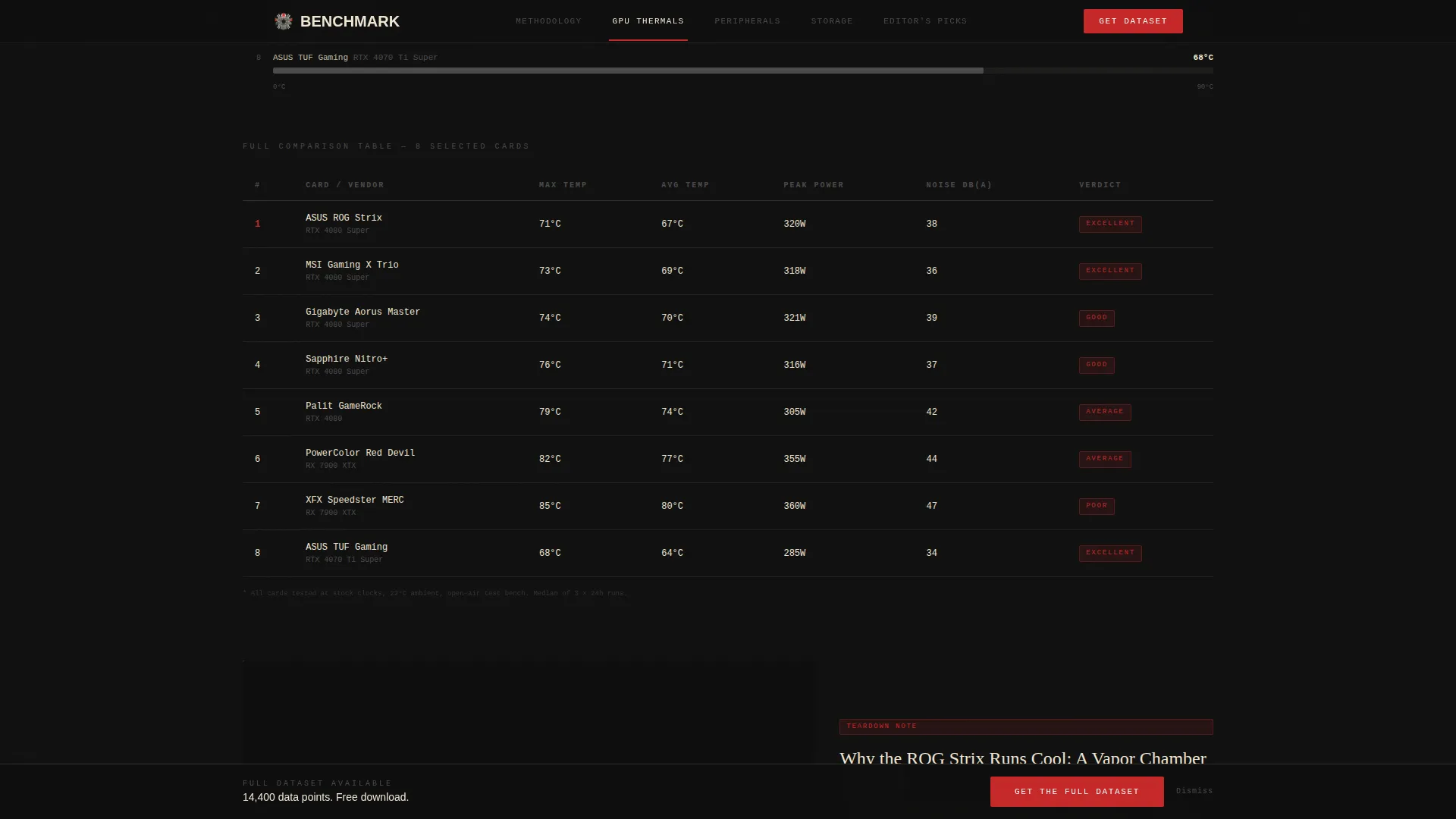
- Interactive bar charts with red accent hover states, comparison tables, annotated teardown photography placeholders, and a two-path lead-generation system
- A desktop-first layout built for wide-viewport data tables alongside a scroll-spy persistent navigation bar that keeps readers oriented throughout long content
Feature list
This section covers the core built-in capabilities that make Benchmark a purpose-built template for hardware review publishing.
Hub-and-Spoke Anchor Navigation
A persistent top navigation bar links directly to each chapter: Methodology, GPU Thermals, Peripherals, Storage, and Editor's Picks. A scroll-spy system highlights the active section as the reader moves down the page, so orientation is never lost inside long data-heavy content.
Editorial Hero with Half-Page Layout
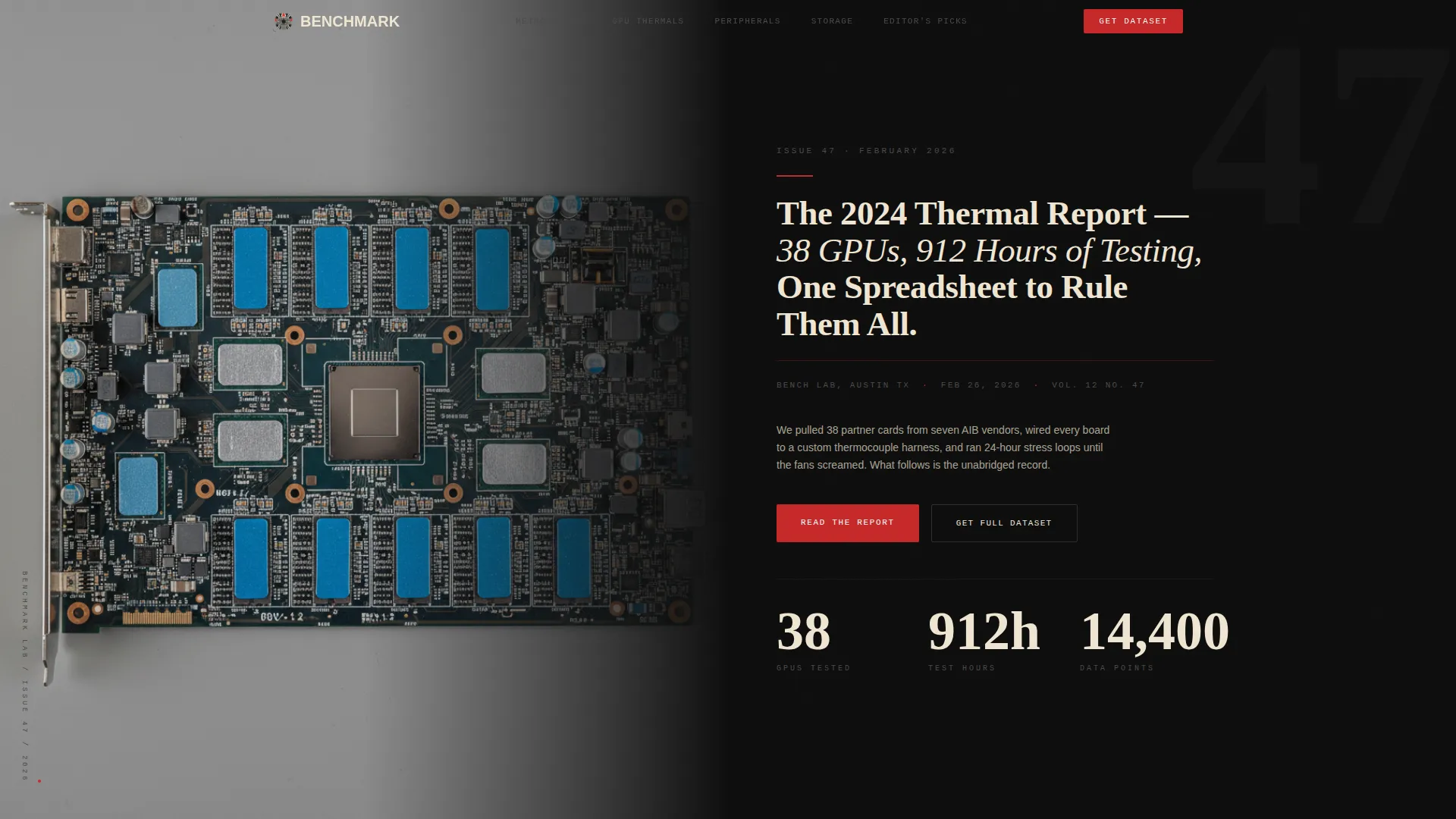
The header splits into two equal halves. The left side holds a high-contrast, shallow-depth-of-field photograph of a disassembled graphics card lit by a single overhead softbox. The right side presents a condensed serif masthead headline, a thin red rule, and a dateline set in monospace type for an immediate technical-journal tone.
Interactive Benchmark Charts
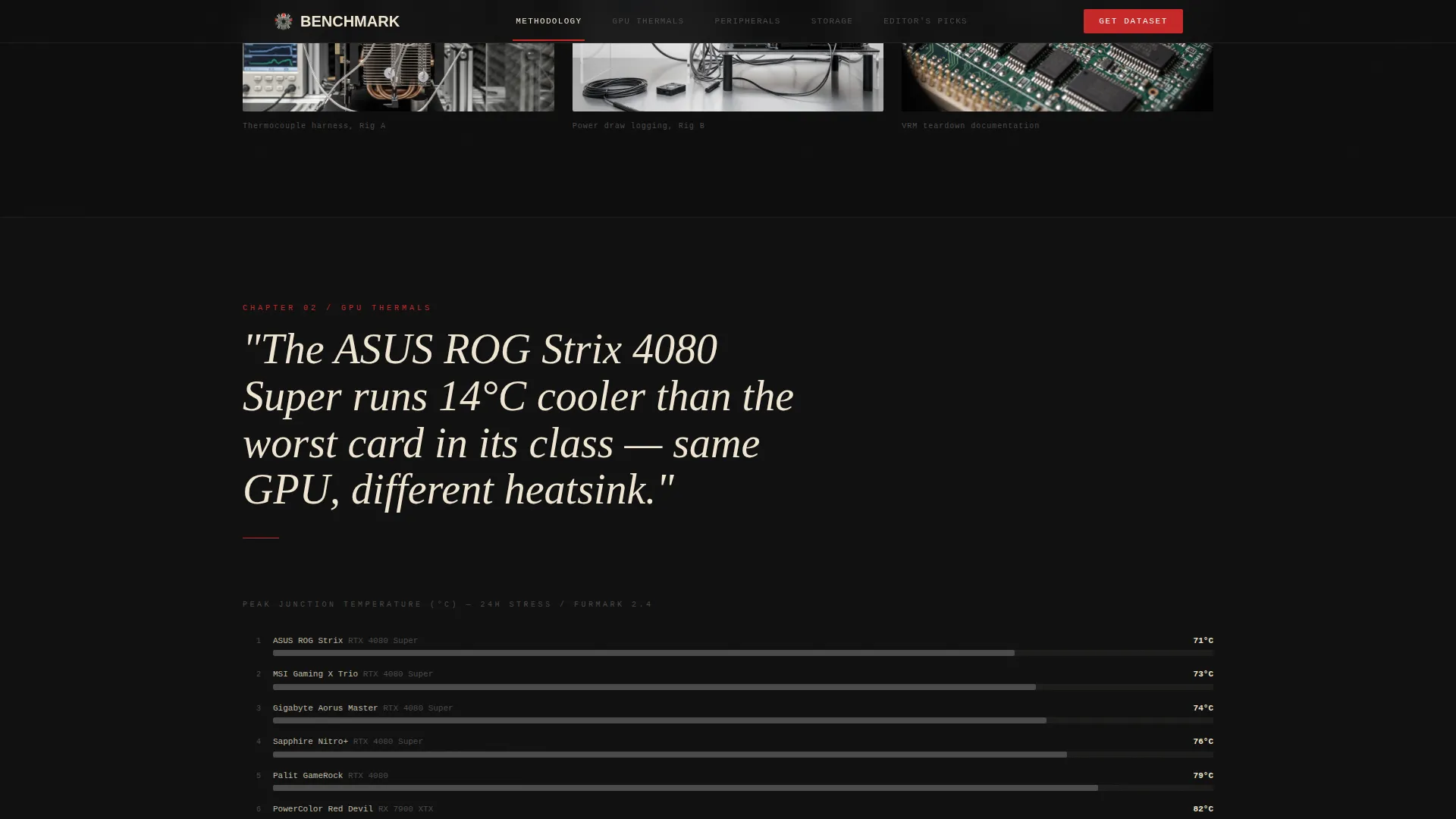
Each chapter section includes interactive bar charts built with GSAP ScrollTrigger animations. Bars animate on scroll reveal, and hover states highlight individual results in the scarlet red accent color, making comparison across 38 GPU data points practical and visually precise.
Gated Dataset Lead Generation
The primary call to action reads "Get the Full Dataset" and gates a downloadable benchmark spreadsheet. The form collects email address, primary use case (competitive gaming, content creation, or workstation), and budget tier. It appears as a fixed bottom bar after the first spoke section and again as a full-width interstitial before the Editor's Picks chapter.
Methodology Credibility Section
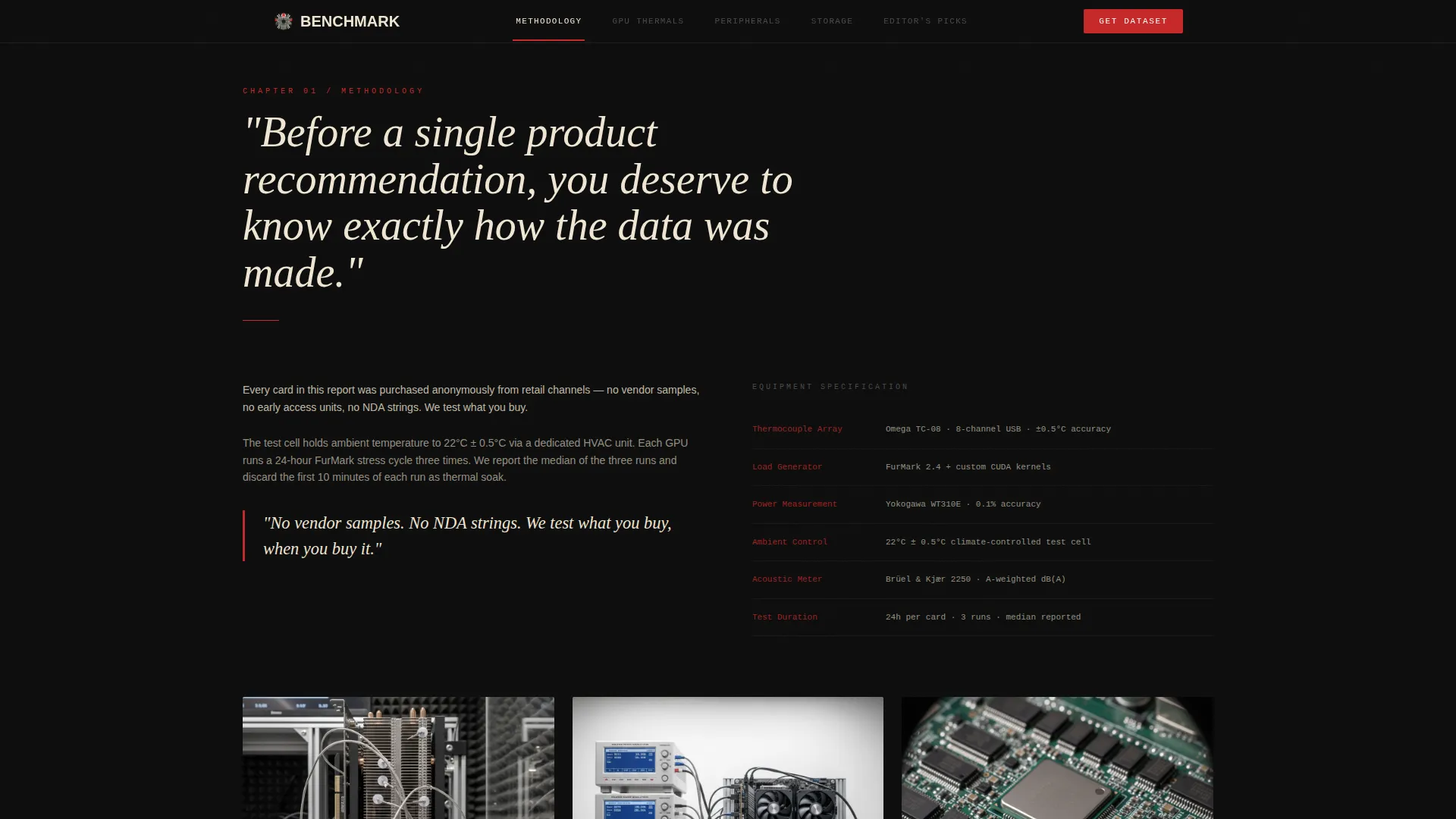
Before any product verdict appears, readers encounter a dedicated methodology statement with lab photo placeholders and equipment specification details. This section establishes repeatable-data credibility and signals the difference between opinion-led reviews and lab-verified findings.
Editor's Picks Closing Chapter
The final chapter condenses every preceding finding into five decisive hardware recommendations. Each recommendation carries a single-sentence rationale, making the section fast to read and immediately actionable for readers who have absorbed the preceding data chapters.
Page sections overview
| Section | Purpose |
|---|---|
| Hero Header | Establishes editorial identity and issue context with masthead headline and teardown photo |
| Methodology Statement | Presents lab credentials, equipment specs, and testing approach before product data |
| GPU Thermals Chapter | Displays comparison tables and annotated bar charts for 38 GPU thermal results |
| Peripherals Chapter | Shows switch actuation counts and response time tables for competitive peripheral data |
| Storage Chapter | Presents read and write benchmark comparisons across drive categories |
| Editor's Picks | Delivers five final hardware recommendations with one-sentence rationales and dataset call to action |
| Footer Subscription | Captures email via single-field embed for monthly report subscription path |
Design & branding system
The visual identity follows an Ink and Paper theme rendered through a Cinematic Dark color palette. Every design decision reinforces the feeling of a technical journal reviewed under a desk lamp at 2 a.m., with data sheets stacked nearby and margin notes in red.
- Color palette: matte black (#0D0D0D) as the primary background, warm newsprint cream (#F0E6D3) for body text and section dividers, red-pen annotation scarlet (#C62828) for anchor-nav highlights and pull-quote markers, and graphite pencil gray (#4A4A4A) for secondary type and chart gridlines
- Typography system: Fraunces condensed serif for masthead headlines, JetBrains Mono for data labels and monospace datelines, and DM Sans for body copy and table text
Mobile & speed optimization
Benchmark is designed desktop-first because its core audience, competitive gamers and PC builders, consumes data-heavy hardware content on wide-viewport screens. Data tables and interactive bar charts require horizontal space to remain readable.
- GSAP ScrollTrigger powers section reveals, image wipes, and chart bar animations at a medium intensity that keeps motion purposeful without overwhelming the content
- Server Components handle static content sections while Client Components manage interactive chart states and lead-generation form behavior, keeping page interactivity responsive
How this template helps you convert
Trust is built through visible data before any gate appears. The conversion path is sequenced deliberately so that the ask feels like a natural next step rather than an interruption.
- Two full chapters of free benchmark data, GPU thermals and peripheral results, are visible to every visitor before the gated dataset form appears, establishing that the full spreadsheet is worth requesting
- The lead-generation form appears twice at high-intent moments: as a fixed bottom bar after the first spoke section and as a full-width interstitial before Editor's Picks, capturing readers at peak engagement
- A secondary email subscription path in the footer offers a low-commitment entry point for readers not yet ready to share detailed use-case information
Other information about this template
Benchmark fits naturally into the broader gaming hardware review publishing space, where readers expect precise data presentation and distrust vague performance claims.
- The template is categorized under Blog and Editorial, Gaming and Esports Blog, with a niche focus on gaming hardware review content
- Animation intensity is set to medium, using GSAP ScrollTrigger for scroll-triggered section reveals, bar chart entrance animations, and image wipe transitions
- The lead-generation form segments respondents by use case, competitive gaming, content creation, and workstation, which supports audience-aware follow-up communication
- Pricing references are formatted in USD, and temperature data follows the Celsius standard used across hardware review publishing
- The footer uses a minimal developer and publication pattern focused on the monthly report subscription rather than a full site footer
Theme
Ink & Paper
Creative direction
Industry Report
Color system
Cinematic Dark
Style
Hub & Spoke (Anchor Nav)
Direction
Lead Generation
Page Sections
Hub-and-spoke Anchor Navigation
Editorial Half-page Hero
Interactive Benchmark Bar Charts
Two-path Lead Generation System
Methodology Credibility Section
Editor's Picks Closing Chapter
Related questions
Is this template designed for a single review or an ongoing publication?
Can the benchmark tables and charts be updated for new issues?
What information does the lead-generation form collect?
Does the template work for both consumer and business-to-business audiences?
Why is the layout optimized for desktop screens?