History & Culture Blog Booking Website Template
Canvas is a hub-and-spoke art history landing page template built for slow-essay editorial blogs. It organizes content into four thematic gallery rooms, leads visitors through a visual quiz that captures email at the halfway point, and presents long-form writing inside a warm, book-catalogue aesthetic that feels as deliberate and considered as the art it covers.
by Rocket studio
Quick summary
Canvas is a single-page art history blog template organized as a curated exhibition. Four anchor-navigated gallery rooms hold essay cards, wall-placard pull-quotes, and hover-zoom painting details. The primary conversion path is a visual quiz called "Discover Your Art Eye," with a secondary path leading readers straight to the essay archive.
Who this template is for
This template is built for writers and publishers who treat art history as serious literary territory, not quick listicles. It suits anyone running a content-first editorial platform where the writing itself is the product.
- Graduate students and independent scholars who publish thesis-adjacent essays on painting, technique, or art history periods
- Amateur painters, art educators, and curious gallery-goers who want a platform that matches their reading habits
- Editorial bloggers and small publications covering art history, museum culture, or visual criticism at a literary pace
What problem this template solves
Most blog templates flatten every topic into the same scrolling feed. For an art history blog, that generic structure undercuts the writing before a reader even begins. Canvas fixes the structural mismatch between literary long-form content and standard template layouts.
- Readers land with no clear sense of where to go, so they leave before finding the essay that would have hooked them
- Generic call-to-action buttons feel transactional against writing that asks for patience and attention
- There is no visual hierarchy that signals depth, curation, or the difference between a quick post and a considered essay
What you get with this template
You get a fully structured, single landing page designed around four thematic content rooms, a visual quiz with email capture, and a featured essays mosaic. Every section is built to reflect the weight and texture of its subject matter.
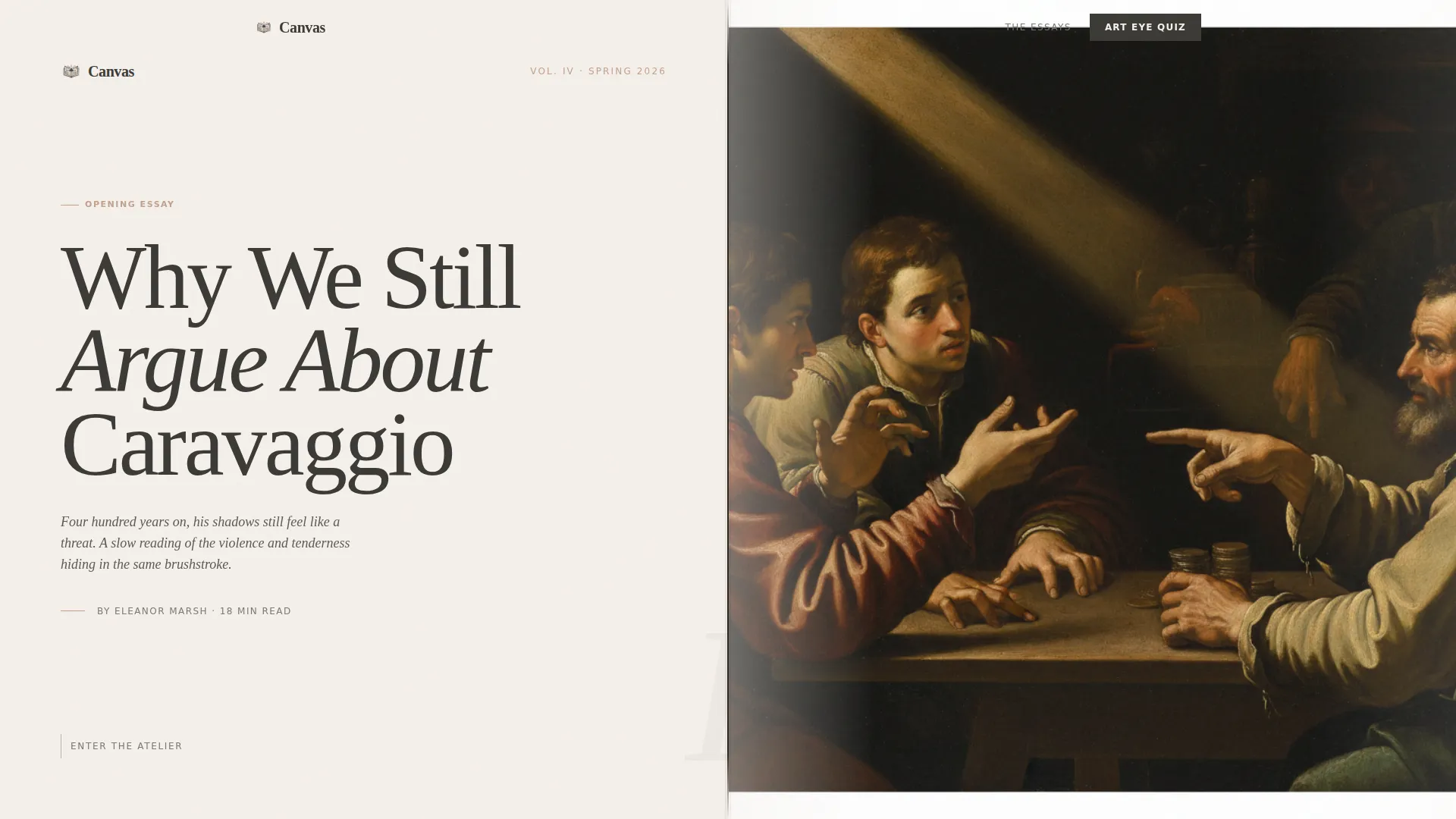
- A book-spread hero section with a serif chapter title on the left and a cropped, bleeding painting detail on the right
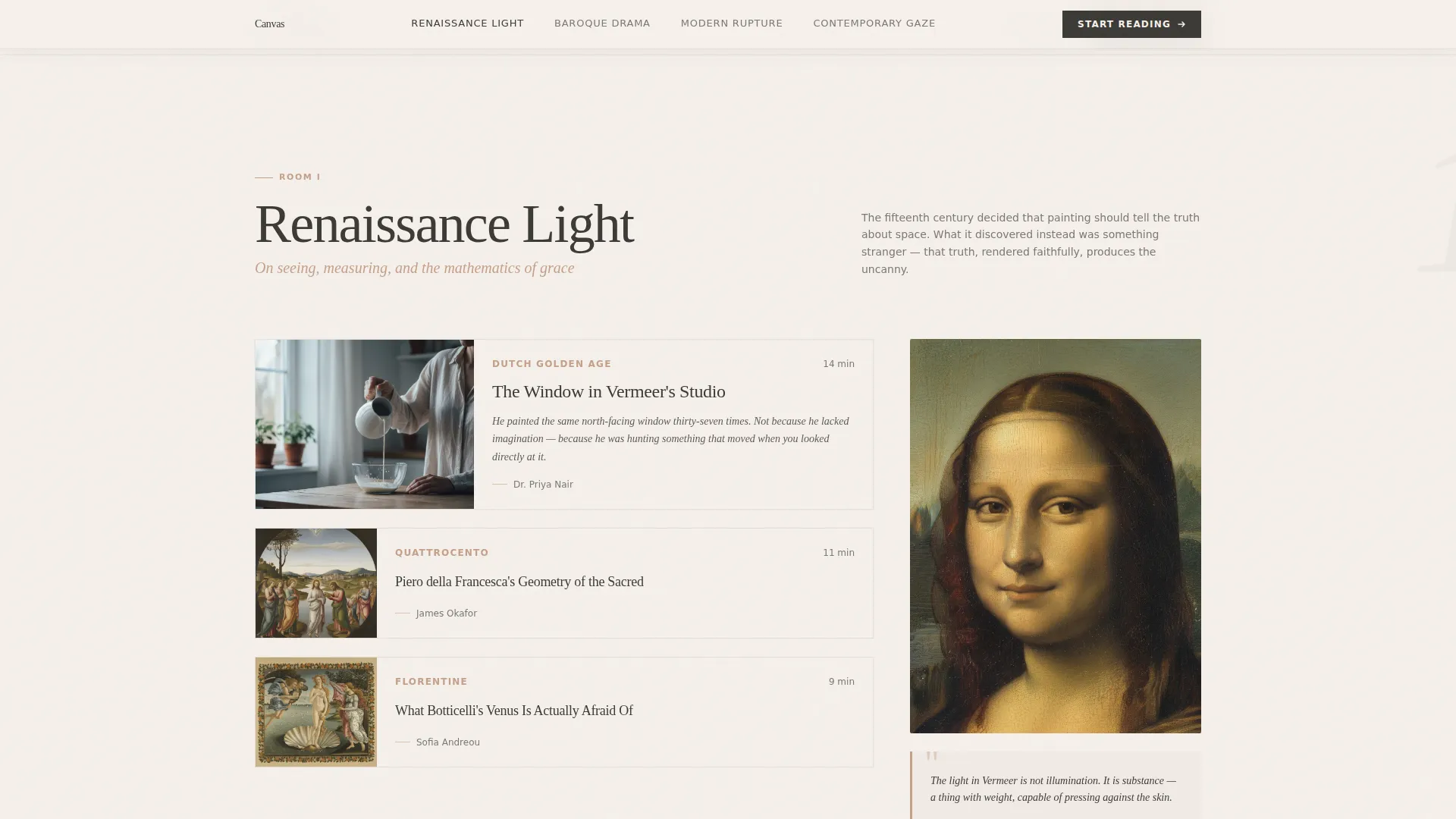
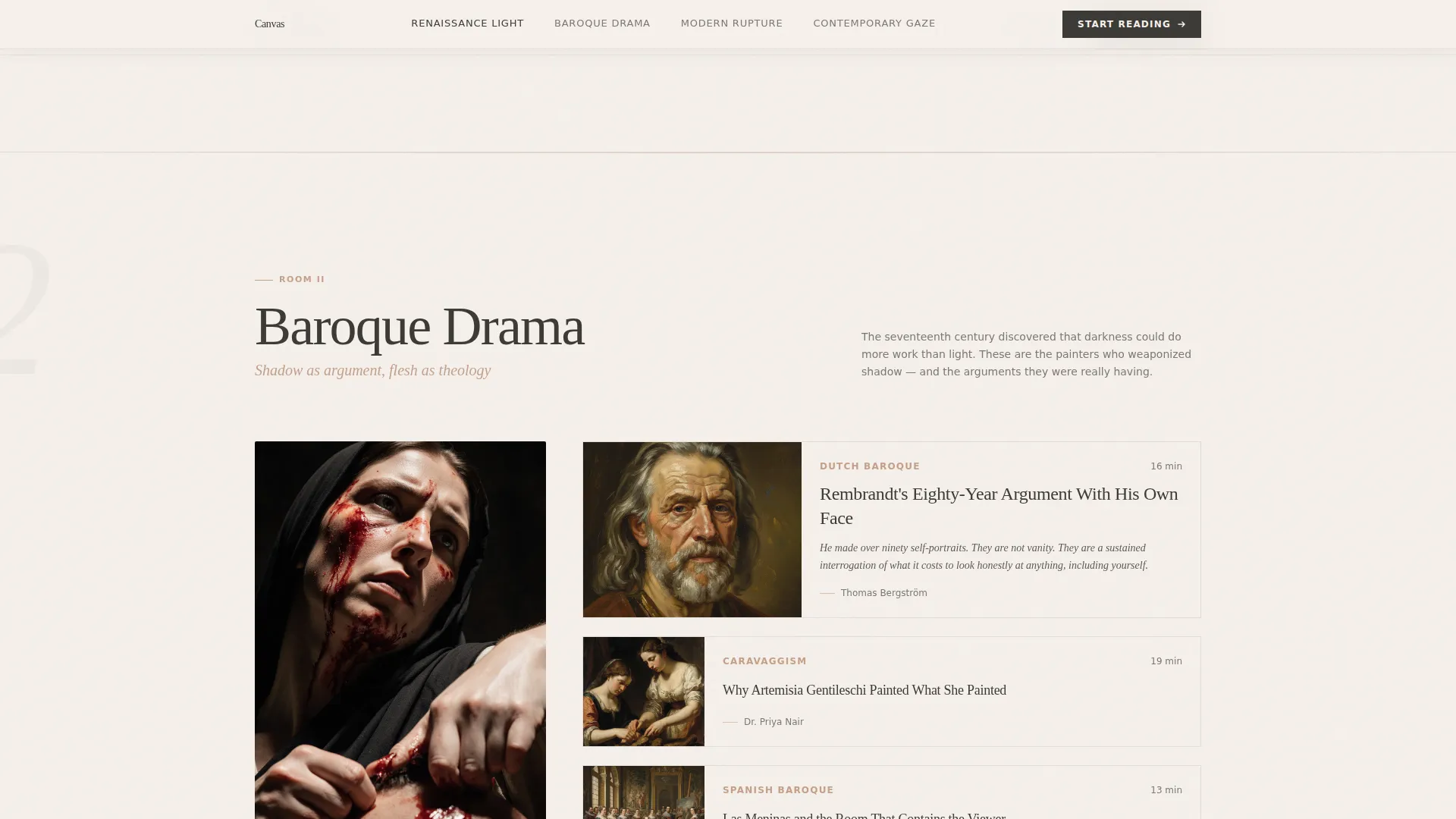
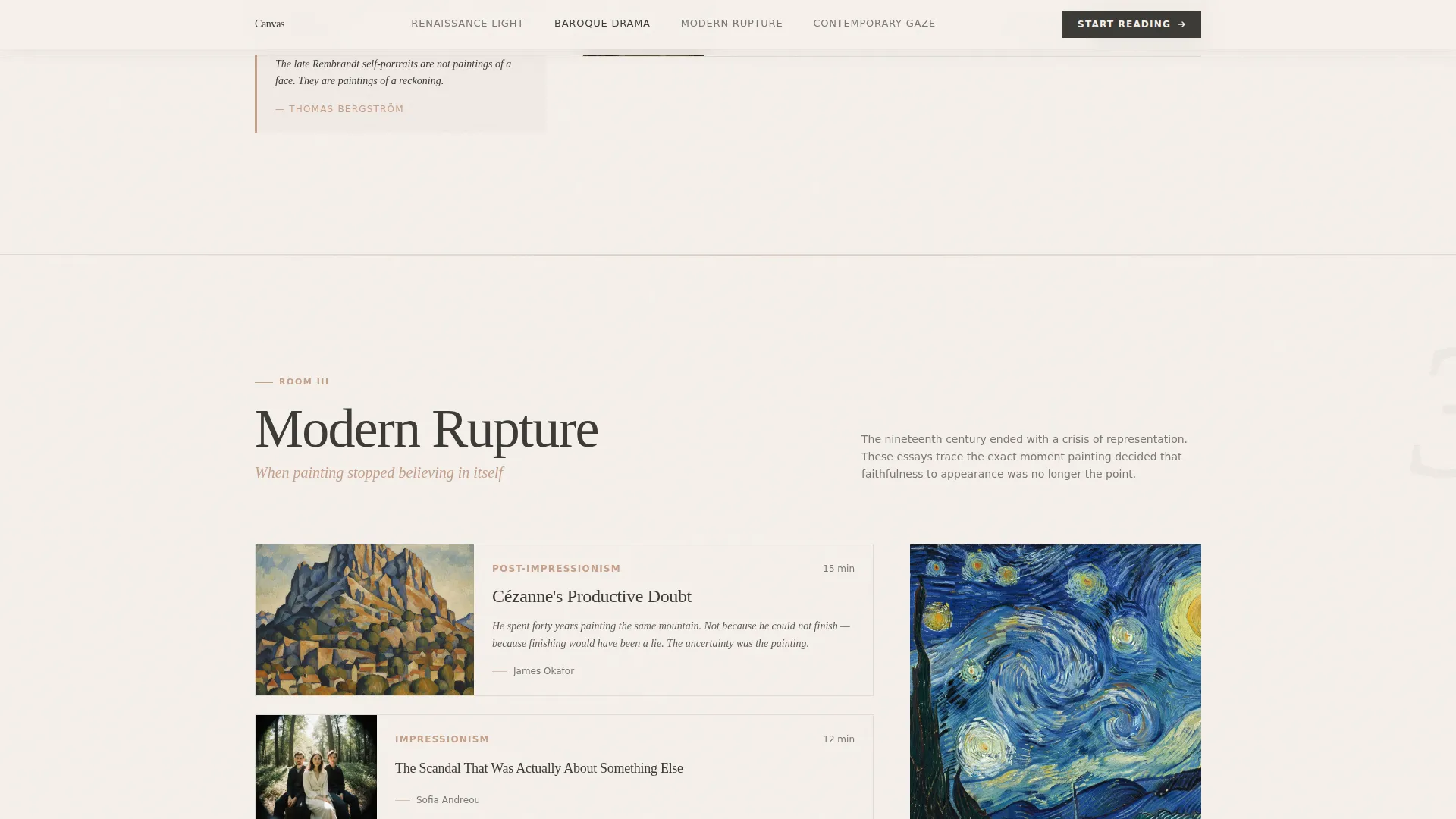
- Four anchor-navigated gallery rooms (Renaissance Light, Baroque Drama, Modern Rupture, Contemporary Gaze) each containing essay cards, hover-zoom image details, and wall-placard pull-quotes
- A "Discover Your Art Eye" quiz modal with email capture at the midpoint, a featured essays mosaic in an asymmetric grid, an About the Atelier trust section with a secondary newsletter sign-up, and a horizontal-flow footer
Feature list
This template ships with carefully designed components that serve both the reading experience and the conversion goal. Each feature is grounded in the template's editorial identity.
Book-Spread Hero Section
The hero fills the full viewport as a single imagined book spread. A large serif chapter title sits on the left page while a high-resolution cropped painting detail bleeds off the right edge. No competing buttons appear until the visitor scrolls past the fold, keeping the first impression purely typographic and atmospheric.
Hub-and-Spoke Anchor Navigation
An anchor navigation bar links directly to each of the four thematic gallery rooms. Readers can jump to Renaissance Light, Baroque Drama, Modern Rupture, or Contemporary Gaze instantly. Active navigation markers use vellum gold to signal the current room without visual noise.
Gallery Room Essay Cards with Wall Placards
Each gallery room contains essay cards paired with image details that zoom on hover. Pull-quotes are styled as wall placards, echoing the physical language of a curated museum exhibition. Essay counts per room give readers a sense of depth before they commit to entering.
Visual Quiz with Midpoint Email Capture
The "Discover Your Art Eye" quiz presents cropped painting details and asks visitors to identify era, technique, or emotional intent. The quiz collects an email at the halfway point using the line "We'll send your full results and a personalized reading list," delivering value before asking for commitment.
Featured Essays Mosaic
An asymmetric grid of essay cards demonstrates writing quality and editorial range. The mosaic is positioned after the quiz call-to-action to catch readers who prefer to browse before committing to the quiz path.
Staggered Scroll Animations
The template includes slideInBlur reveals, parallax painting details, and staggered scroll animations across sections. These animations reinforce the sense of entering and moving through a real exhibition space, room by room.
Page sections overview
| Section | Purpose |
|---|---|
| Book Spread Hero | Sets the literary tone and introduces the chapter title concept without competing buttons |
| Anchor Navigation Bar | Lets readers jump directly to any of the four thematic gallery rooms |
| Renaissance Light Room | Houses essay cards and wall placards focused on Renaissance painting and light |
| Baroque Drama Room | Covers Baroque technique, chiaroscuro essays, and dramatic compositional arguments |
| Modern Rupture Room | Presents essays on the break between academic tradition and modern art movements |
| Contemporary Gaze Room | Explores challenging contemporary works to build intellectual momentum |
| Quiz Call to Action | Introduces "Discover Your Art Eye" as the primary email capture conversion |
| Featured Essays Mosaic | Asymmetric essay grid that demonstrates editorial quality and range |
| About the Atelier | Trust-building section with publication context and secondary newsletter sign-up |
| Horizontal Flow Footer | Closes the page with navigational links in a clean horizontal pattern |
Design & branding system
The visual identity follows an Atelier Studio theme built around the Soft Mist color system. Every color choice references the physical world of art-making: unstretched linen, charcoal dust, kiln-fired clay, and the warm paper of a printed catalogue.
- Core palette: linen white (#F5F0EB) for backgrounds, graphite wash (#3B3A36) for body text and structure, kiln-fired rose (#C4A08A) for accent surfaces, and vellum gold (#D4C5A0) reserved for hover states and active navigation markers
- Typography pairing: Fraunces serif display for headings, chapter titles, and pull-quotes; DM Sans for body text and interface elements
- The overall aesthetic reads like morning light through a north-facing studio window: warm without sweetness, muted without lifelessness
Mobile & speed optimization
The template is designed desktop-first to honor the long-form reading habits of its primary audience, graduate students and art educators who read extended essays at a desk. Mobile responsiveness is built in so the experience holds on smaller screens.
- Interactive components including the quiz modal, accordion gallery rooms, and hover-zoom image details are handled as client components to keep animations responsive
- Static sections such as the hero, essay cards, and footer are built as server components to keep initial load clean and efficient
- Staggered scroll animations and parallax effects are scoped to the sections where they serve the gallery-walk experience, avoiding unnecessary motion elsewhere
How this template helps you convert
Canvas uses a two-path conversion model. The quiz path captures email with value delivery first. The archive path lets readers self-select into the content without friction. Both paths begin from the same landing experience and reinforce each other.
- The "Discover Your Art Eye" quiz engages visitors with cropped painting details, collects an email at the halfway point by promising full results and a personalized reading list, and converts curious readers into subscribers before they reach the end of the quiz.
- The "Start Reading" anchor in the navigation sends readers directly to the essay archive, serving the audience that wants immediate content access and building trust that leads to newsletter sign-up later.
Other information about this template
Canvas is a practical starting point for any editorial team or solo writer who wants their art history blog to feel as considered as the writing inside it. The template's structure and visual identity are ready to adapt to a range of publication voices, from academic to conversational.
- The template is built for the Blog and Editorial category, specifically the History and Culture Blog subcategory, with the Art History Blog niche as its primary use case
- The Hub and Spoke anchor navigation template style means every content section is reachable without full-page scrolling, which suits long-format publishing platforms with multiple content pillars
- The Gallery Walk creative direction, Chapter and Book header concept, and Quiz and Assessment landing-page direction are all built into the template structure from the ground up, not added as optional extras
Theme
Atelier Studio
Creative direction
Gallery Walk
Color system
Soft Mist
Style
Hub & Spoke (Anchor Nav)
Direction
Quiz/Assessment
Page Sections
Book-spread Hero with Serif Chapter Title
Hub-and-spoke Anchor Navigation
Gallery Rooms with Wall-placard Pull-quotes
Visual Quiz with Midpoint Email Capture
Featured Essays Asymmetric Mosaic
Staggered Scroll and Parallax Animations
Related questions
Can I change the four gallery room topics to match my own content focus?
How does the email capture quiz work within the template?
Is this template suitable for a solo writer or does it require a large content library?
What font pairing does this template use?
Can I use this template if I cover art topics outside the Western canon?