True Crime Analysis Content Blog Website Template
Casefile is a masonry-style true crime analysis landing page built for forensic-minded bloggers and armchair detectives. It combines a full-bleed atmospheric header, cascading evidence-card grid, and an inline quiz with email capture to turn late-night readers into engaged subscribers. The design feels like a private investigator's studio: restrained, cerebral, and quietly obsessive.
by Rocket studio
Quick summary
Casefile is a single-page true crime analysis landing page template built around a masonry card grid, a typewriter-animated hero, and a forensic instinct quiz. It is designed for niche editorial blogs that treat cold case analysis as a discipline, not entertainment. The layout guides curious readers from first impression to email capture without interrupting the experience.
Who this template is for
This template is built for writers and creators who take true crime content seriously. It suits niche editorial voices that want to stand apart from surface-level crime content.
- True crime bloggers who publish deep-dive cold case analysis and want a home that matches the weight of their work
- Criminology students or independent researchers publishing case breakdowns for a dedicated online audience
- Podcast hosts or documentary fans who want a content hub that converts midnight scrollers into email subscribers
What problem this template solves
Most blog templates are built for lifestyle content. They do not carry the atmosphere or structure that forensic analysis writing demands. Readers arrive from Reddit threads or podcast communities already primed, but a generic layout breaks that tension immediately.
- No compelling entry point: a standard blog header does not hook analytical readers the way a typewriter headline over an atmospheric desk photograph does
- No credibility path: visitors who land cold need a clear sense of the blog's rigorous philosophy before they commit to reading or subscribing
- No conversion bridge: going from a blog post list to an email signup is a weak ask; an inline quiz creates genuine engagement before the capture moment
What you get with this template
The template delivers a complete single-page layout with every section pre-built and ready to populate with your own cases and copy.
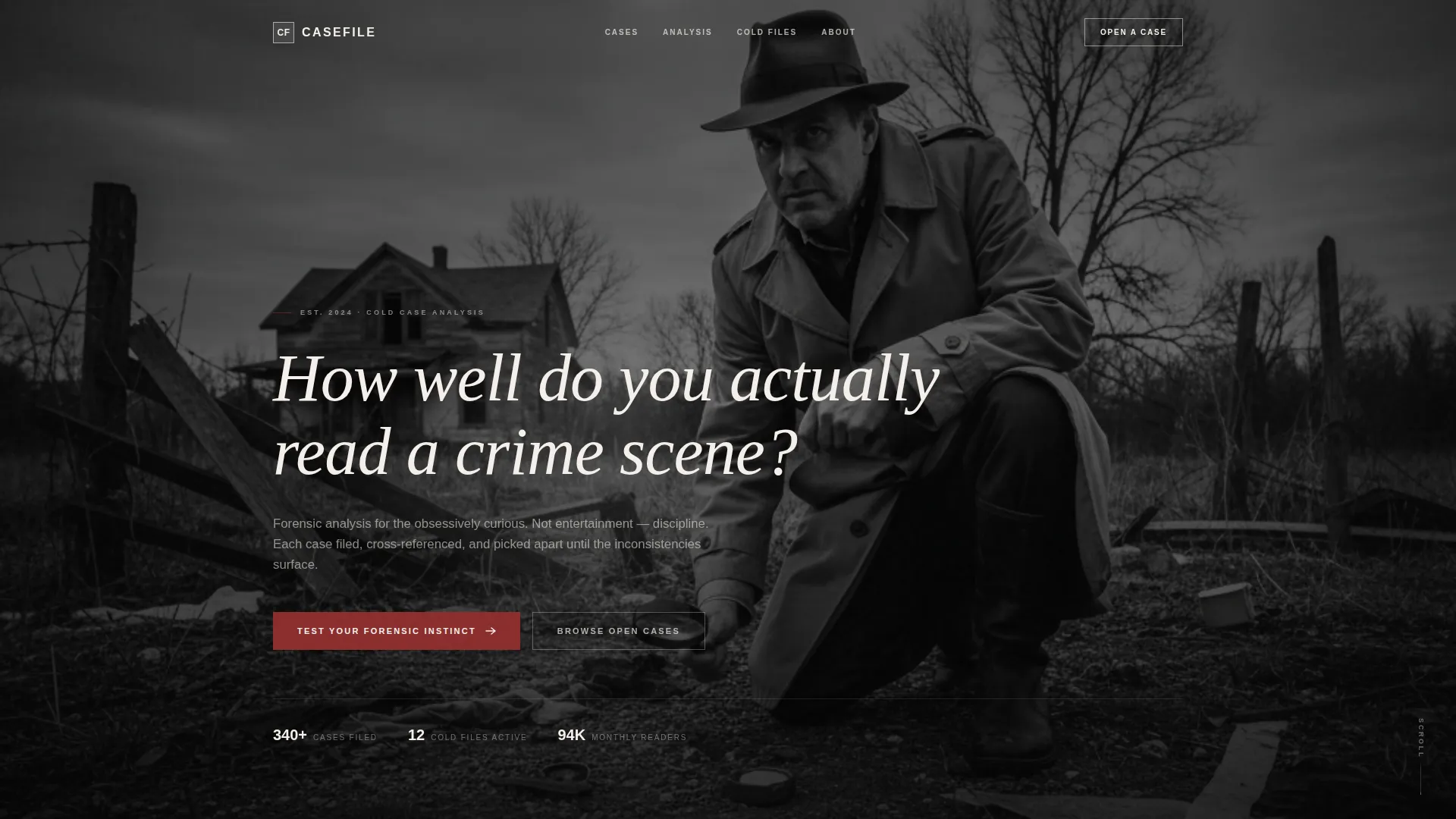
- A full-bleed hero section with a desaturated overhead desk photograph and a typewriter-effect headline that animates on load
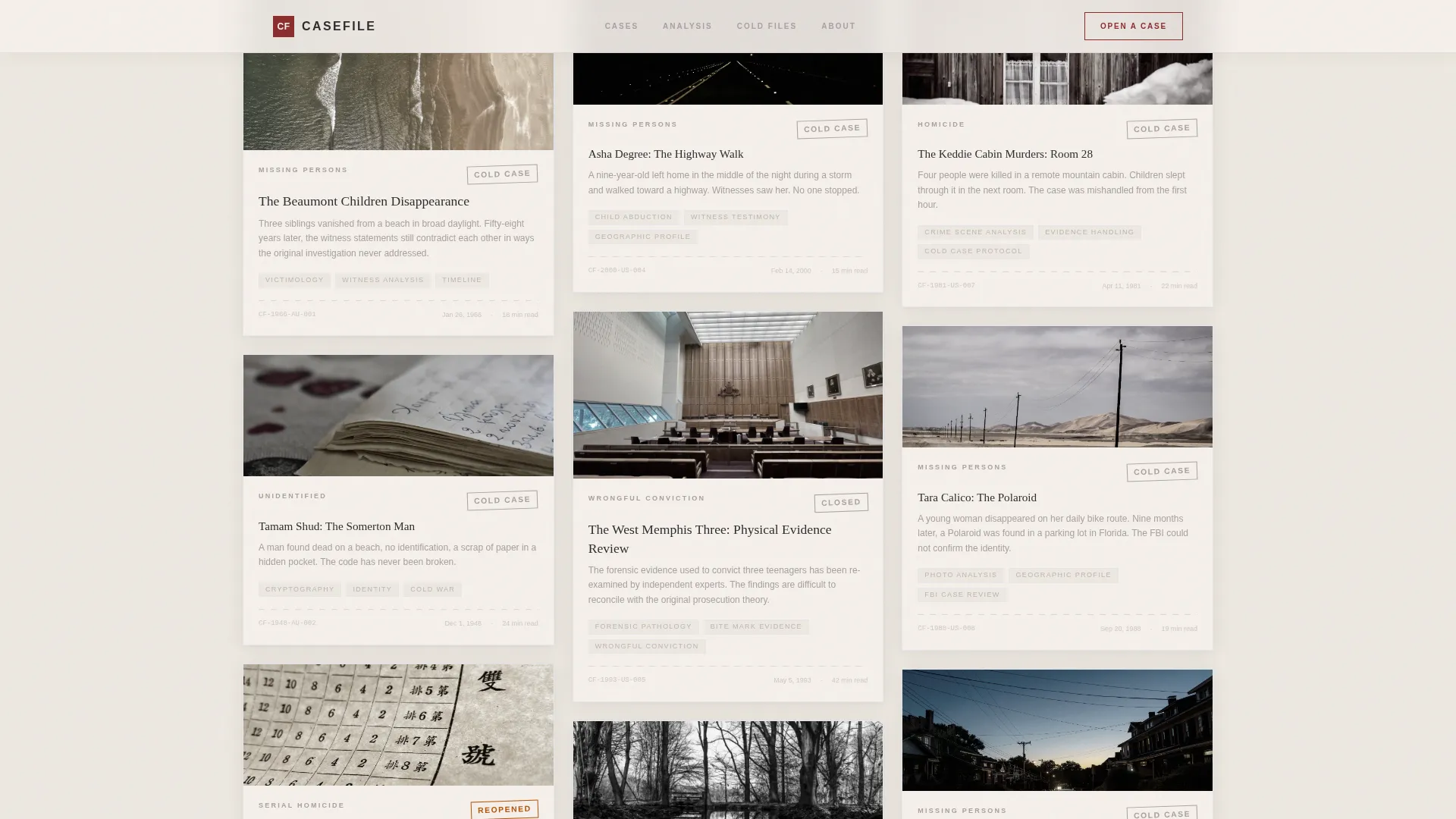
- A cascading masonry evidence wall with case thumbnail cards, small-caps titles, and muted timestamp labels
- An inline forensic instinct quiz with five case-scene questions, no email gate before the assessment, and a single-field email capture tied to results delivery
Feature list
This section covers the core built-in capabilities of the template, drawn directly from the design and interaction brief.
Typewriter Hero Animation
The hero headline types itself in character by character on a two-second delay, simulating a manual typewriter effect over a full-bleed, near-monochrome desk photograph. This creates immediate tonal atmosphere before a visitor reads a single word.
Masonry Evidence Card Grid
Case thumbnails cascade in a staggered masonry layout inspired by a corkboard evidence wall. Each card displays a cropped image, a small-caps case title, and a muted gray date. Cards shift from prominent known cases toward obscure cold cases as the visitor scrolls deeper.
Scroll-Triggered Stagger Reveals
As the visitor scrolls, card rows enter the viewport with a staggered animation. This pacing mirrors the slow, deliberate rhythm of case-file reading and keeps the layout feeling intentional rather than static.
Inline Forensic Quiz
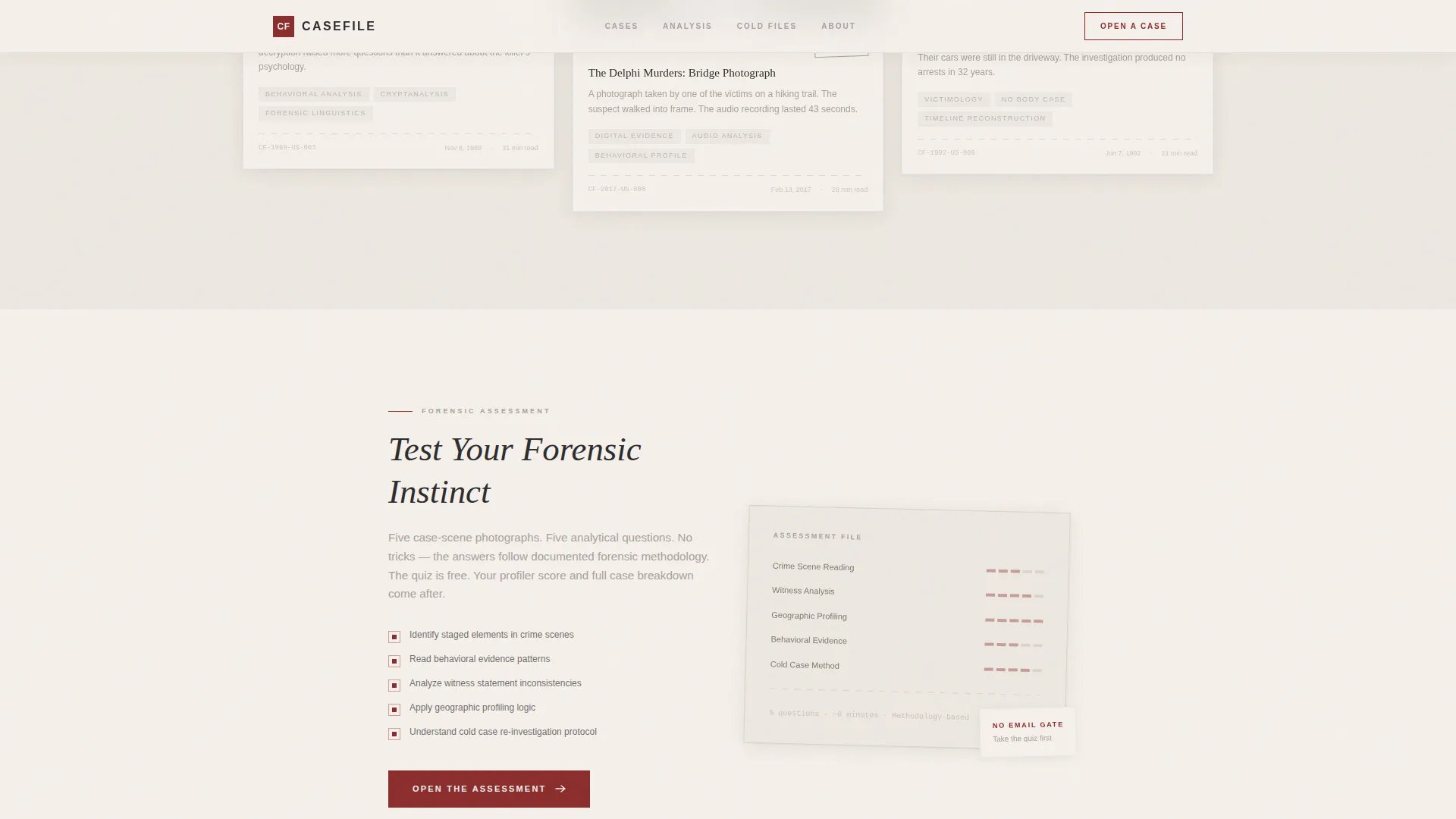
The primary call to action triggers a five-question inline quiz built around case-scene photographs and multiple-choice analysis prompts. No email is required to start; results are revealed only after the visitor enters a single email field, making the capture feel earned rather than forced.
Vision and Mission Section
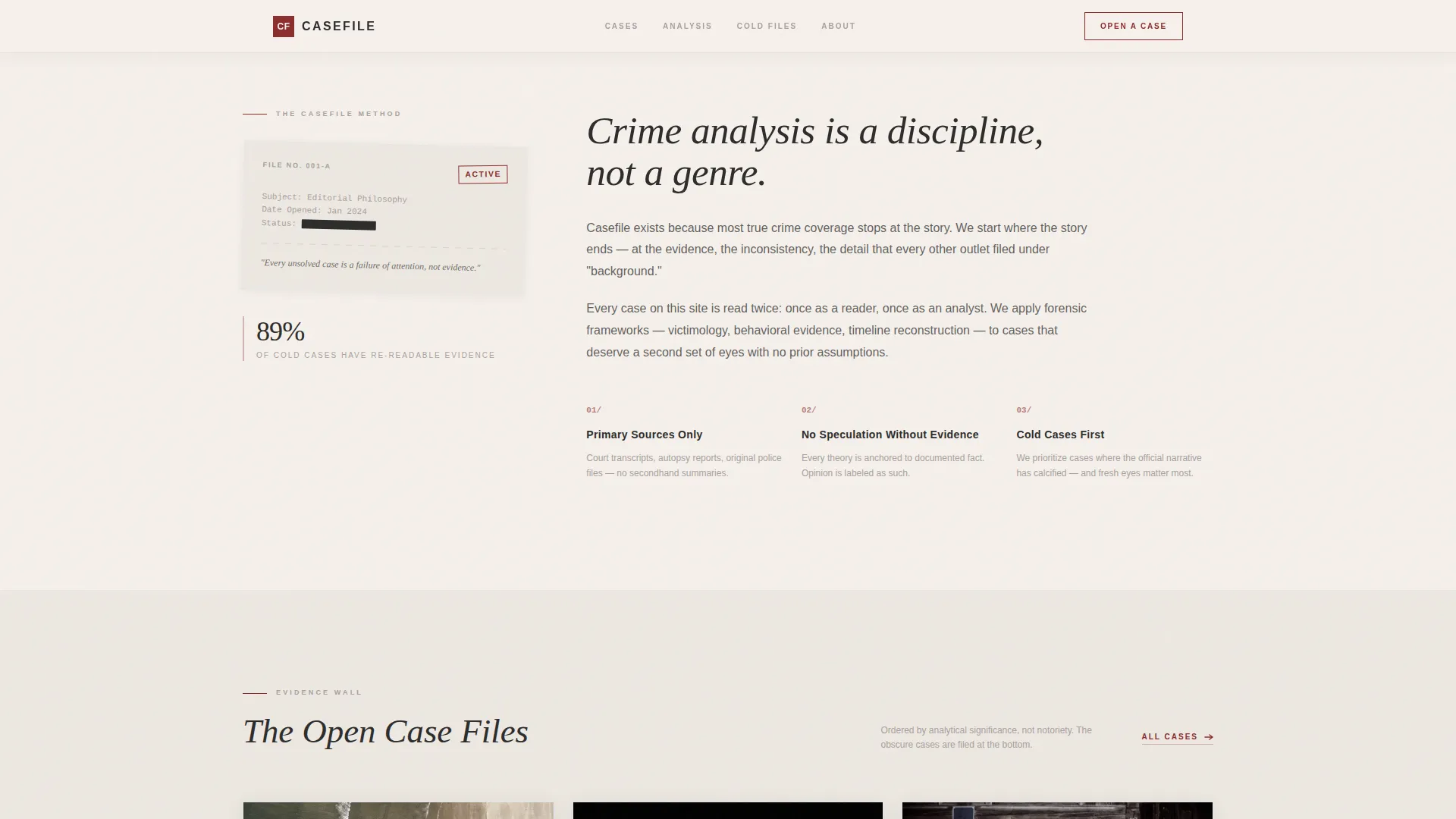
A dedicated philosophy section sits between the hero and the evidence grid. It establishes the blog's core argument: that crime analysis is a discipline requiring rigorous fresh eyes, not passive entertainment consumption.
Secondary Browse Path
Below the quiz, a secondary cold case grid gives readers who are not ready to subscribe a no-commitment way to keep exploring. This reduces exit intent without pressuring the visitor.
Page sections overview
| Section | Purpose |
|---|---|
| Full-bleed hero | Sets atmospheric tone and delivers typewriter headline |
| Vision and mission | States the blog's analytical philosophy |
| Masonry evidence wall | Cascading case cards build credibility through depth |
| Forensic instinct quiz | Inline five-question assessment drives engagement |
| Browse open cases | Secondary cold case grid for readers not yet ready to subscribe |
| Minimal footer | Horizontal minimal footer closes the page cleanly |
Design & branding system
The visual identity follows an Atelier Studio approach with a Cloud Canvas color palette built to evoke aged paper, case files, and forensic restraint.
- Colors: soft parchment white (#F5F0EB) for backgrounds, charcoal graphite (#2C2C2C) for body text, muted evidence-tag gray (#A8A0A0) for secondary labels and timestamps, and a deep forensic red (#8B2D2D) for accent elements and the primary call to action
- Typography: DM Sans handles body and interface text for clean readability; Fraunces serif is used for case titles, bringing the weight and texture of a printed court document
- The hero photograph is desaturated to near-monochrome with only faint warmth in the wood grain, reinforcing the cerebral and restrained tone across every section
Mobile & speed optimization
The template is built with a mobile-first priority, recognizing that the core audience scrolls late at night on a phone rather than a desktop.
- Lazy loading is applied to the image-heavy masonry grid so card images load progressively as the visitor scrolls rather than all at once
- The inline quiz is built with tab-switching state management so it functions cleanly on small screens without layout breaks or clipped answer options
How this template helps you convert
The conversion path is structured to build trust before making any ask, matching how analytical readers actually behave.
- The typewriter headline and atmospheric hero create an immediate sense of place, pulling in readers who would otherwise bounce from a generic blog layout
- The masonry evidence wall and vision section establish credibility and signal depth, warming the visitor toward the quiz call to action
- The inline quiz hooks engagement first and only requests an email to deliver the profiler score, making the capture moment feel like a reward rather than a toll
Other information about this template
This template is well suited to editorial projects that want a strong visual identity without sacrificing readability or conversion structure.
- The footer uses a Pattern 3 horizontal minimal layout, keeping the close of the page clean and uncluttered
- Social proof elements including case count metrics, reader statistics, and a pull quote are included as section components to reinforce authority
- The template uses DM Sans and Fraunces as its type pairing, both available as web fonts, keeping the design easy to customize within the established system
- Animation intensity is high throughout the template, including the typewriter hero, masonry stagger reveals, and scroll-triggered card entries, which can be adjusted to match your preferred pacing
Theme
Atelier Studio
Creative direction
Vision & Mission
Color system
Cloud Canvas
Style
Masonry/Pinterest
Direction
Quiz/Assessment
Page Sections
Typewriter Hero Animation
Masonry Evidence Card Grid
Scroll-triggered Stagger Reveals
Inline Forensic Instinct Quiz
Vision and Mission Section
Secondary Browse Open Cases Path
Related questions
Do visitors have to enter their email to take the forensic quiz?
Can this template work for a podcast or video-based true crime channel?
How many case cards can the masonry evidence grid hold?
Is the color palette easy to swap for a different brand identity?