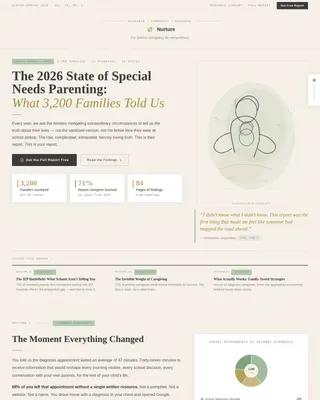
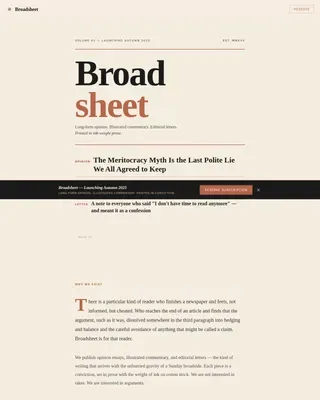
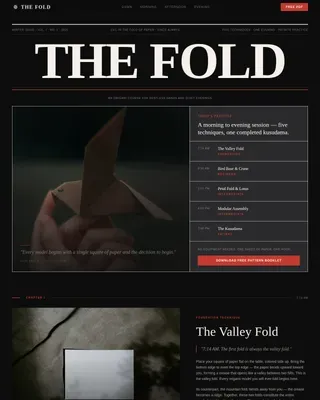
Science & Research Blog Blog Website Template
Catalyst is a single-column landing page template built for a chemistry and materials science blog. It opens with an oversized serif manifesto quote, flows through an editorial philosophy section and a curated article grid, and closes with a persistent call-to-action bar. The Luxe Minimal design uses warm stone tones and a reactive amber accent to project intellectual authority and draw readers into the archive.
by Rocket studio
Quick summary
Catalyst is a single-column landing page template designed for a materials science editorial journal. It leads with a typographic manifesto, moves through editorial prose and a curated three-article grid, and ends with a persistent call-to-action bar. The warm stone palette and oversized serif typography create a reading environment that feels rigorous yet welcoming.
Who this template is for
This template is built for editors and publishers running a science or research-focused blog. It suits anyone who needs to earn reader trust before asking for a single click.
- Graduate researchers and materials engineers who expect editorial depth and technical credibility
- Curious generalist readers who engage with science aesthetically and value well-argued prose
- Independent science editors and journal founders launching or refreshing an online publication
What problem this template solves
Many science blogs look either too clinical or too casual. Neither approach earns the trust of a technically literate audience. Catalyst solves the credibility gap by letting editorial voice do the persuading before any call to action appears.
- Readers leave without exploring when a page leads with a subscription gate or a generic hero image
- A purely functional layout fails to signal the intellectual quality of the writing behind it
- Without clear editorial positioning, a materials science blog blends into the broader noise of online publishing
What you get with this template
You get a fully structured single-column landing page that proves editorial voice before asking for any reader commitment. Every section is sequenced to build intellectual trust through the scroll.
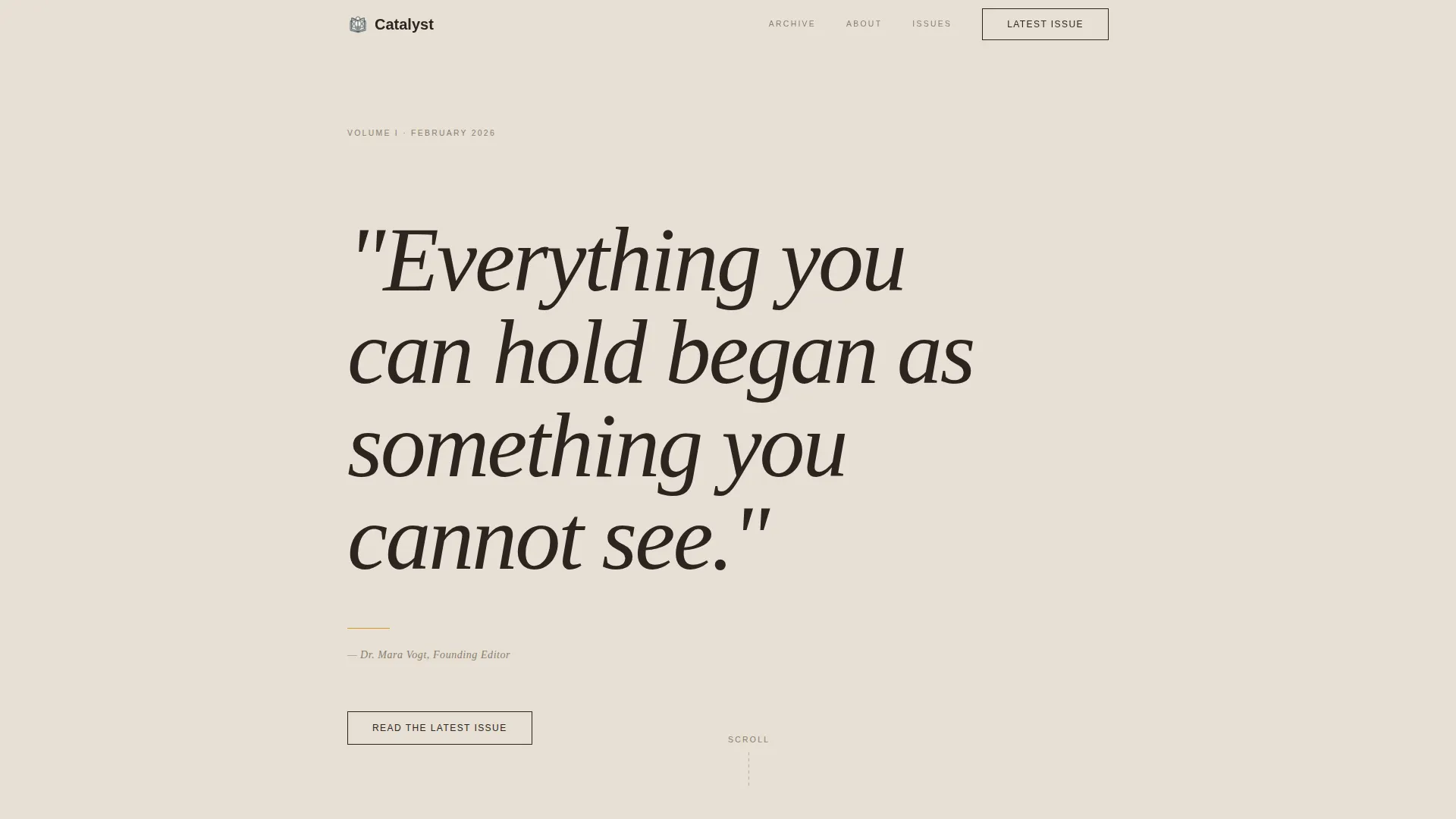
- A typographic hero with an oversized manifesto quote, a thin amber rule, and a founding editor attribution
- An editorial philosophy section written as a prose letter to the reader, followed by a three-article curated grid with abstract scientific imagery
- A persistent amber call-to-action bar after the article grid, plus a secondary archive text link for self-directed browsing
Feature list
A concise paragraph introduces the feature list below, which covers the core capabilities built into this template.
Oversized Typographic Hero
The hero displays a single bold manifesto sentence in an oversized, lightweight serif typeface against the limestone background. No image or illustration competes with the words. A thin amber rule and a one-line founding editor attribution follow directly below, grounding the philosophy in a human voice.
Editorial Philosophy Section
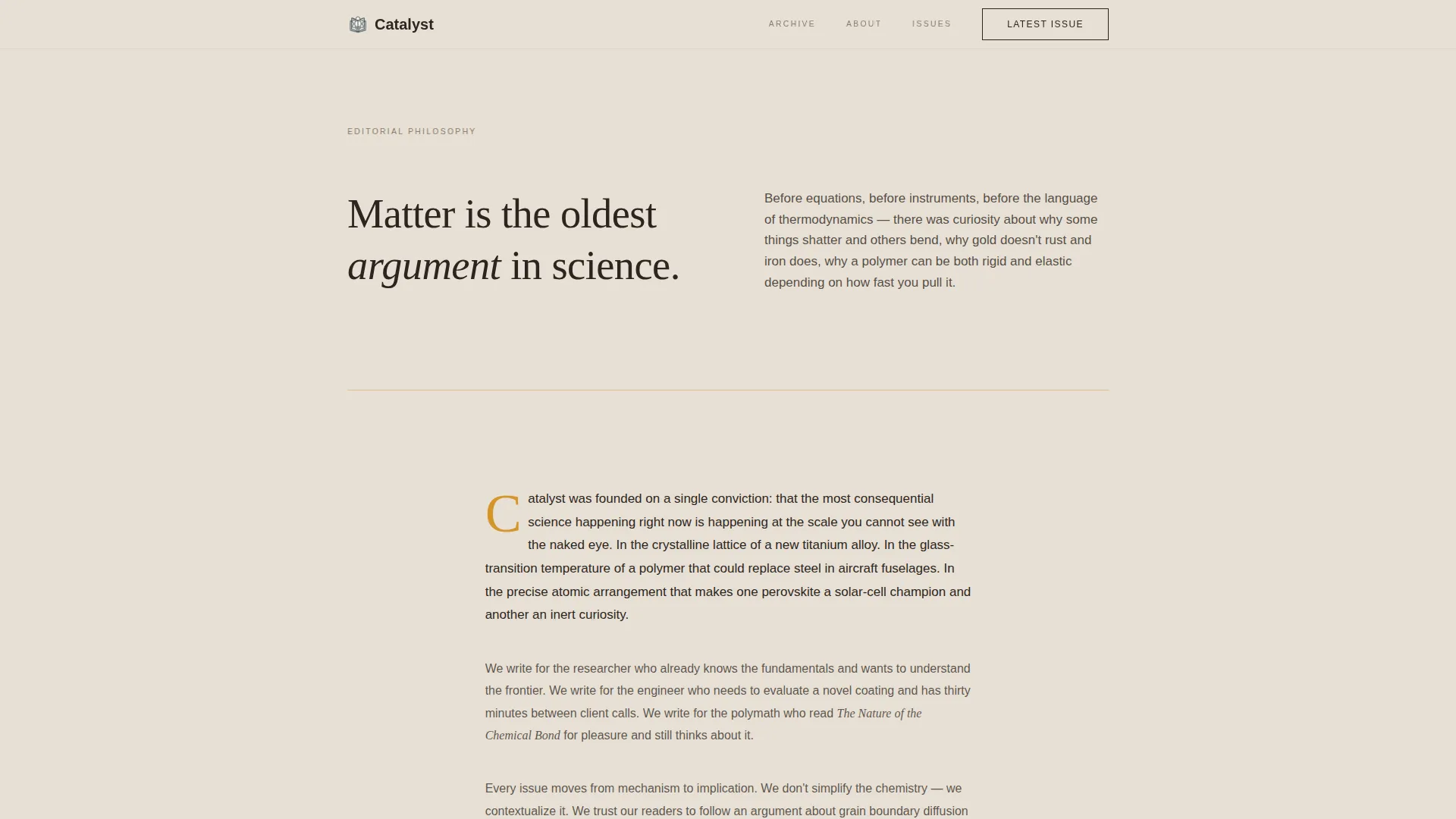
A flowing prose section reads like a letter to the reader. It explains why materials science matters, how the journal approaches its subject, and what the reader gains by staying. The rhythm alternates between generous typographic passages and moments of visual rest.
Curated Article Grid
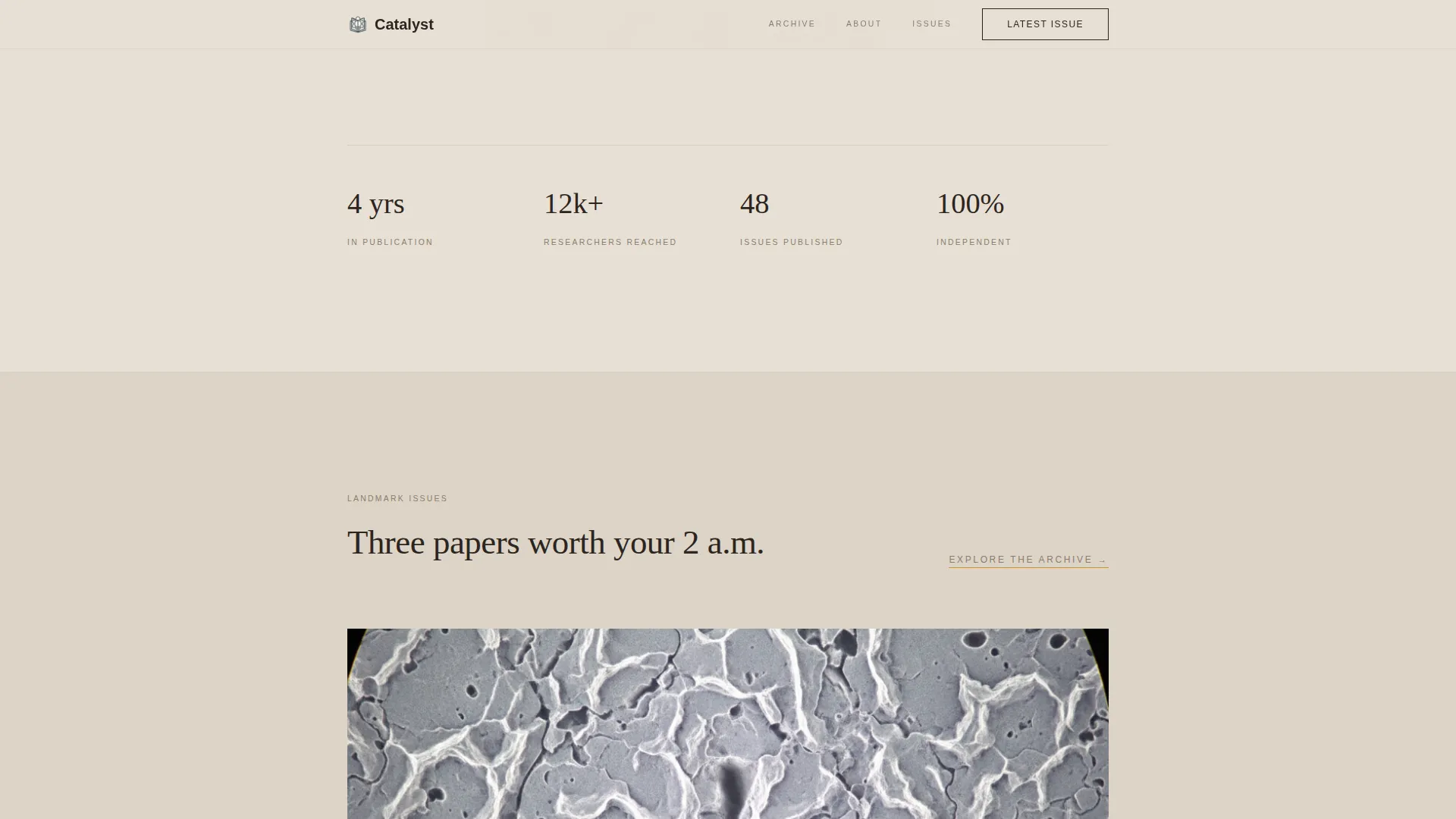
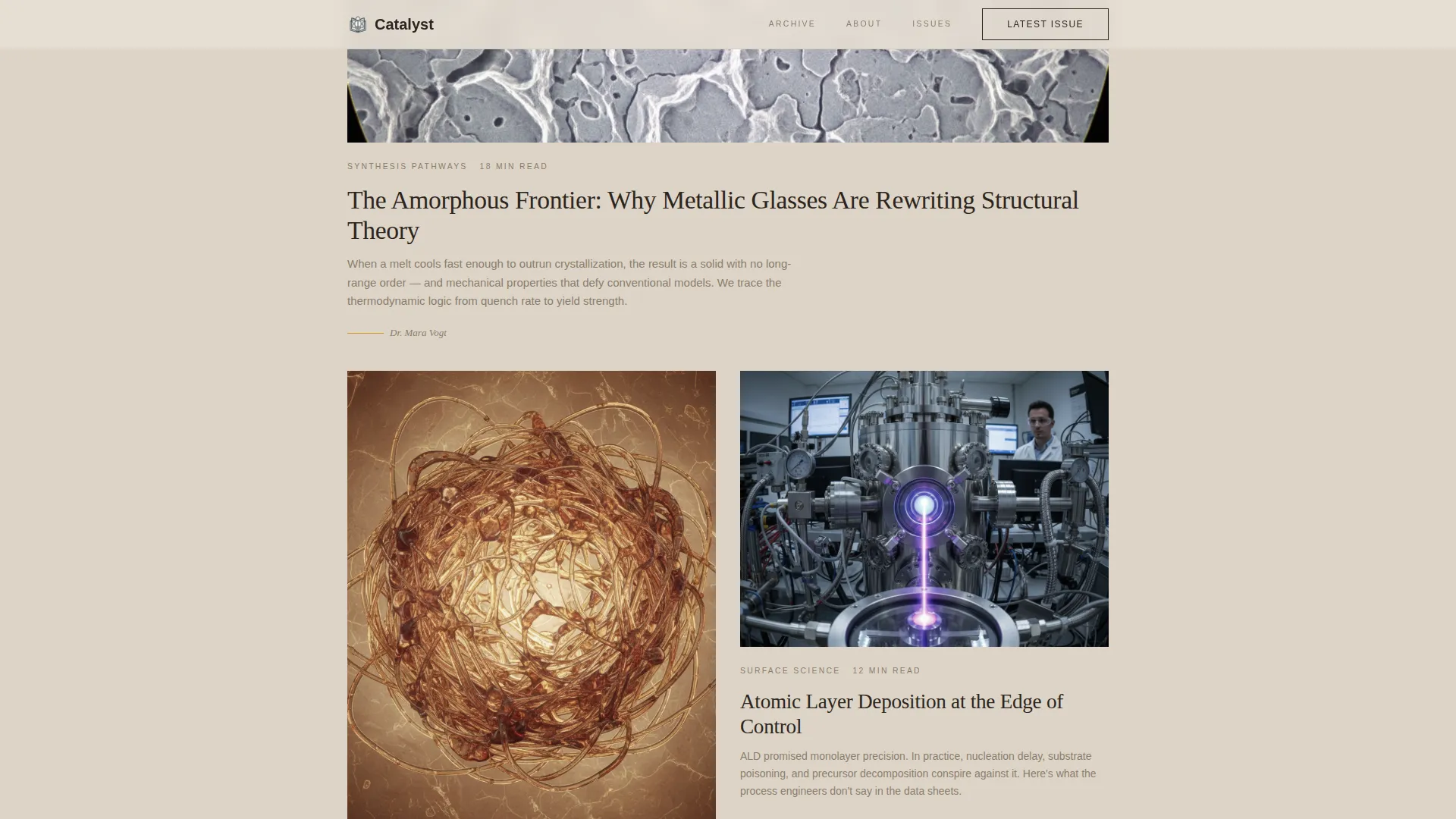
Three landmark articles are displayed in an asymmetric masonry layout, each paired with abstract scientific imagery. A secondary text link, "Explore the Archive," sits at the base of the grid for readers who prefer to browse independently rather than follow a guided path.
Dual Call-to-Action System
The primary call to action, "Read the Latest Issue," appears first as a ghost button beneath the manifesto and again as a persistent amber bar after the article grid. This two-point placement guides readers without pressuring them at a single moment.
Scroll-Reveal Animations
Fade-up reveal animations and staggered scroll effects are built into the layout. An amber underline hover state activates on links, and the primary call-to-action button uses a magnetic hover interaction for added tactile feedback.
Warm Stone Branding System
The color system uses quarried limestone as the background, a deep espresso tone for body text, and molten amber reserved strictly for links and hover states. Fraunces serif handles display type while DM Sans covers body copy, creating a clear typographic hierarchy.
Page sections overview
| Section | Purpose |
|---|---|
| Manifesto Quote Hero | Opens with oversized serif quote, amber rule, and editor attribution |
| Ghost Button call to action | Invites readers to the latest issue directly beneath the manifesto |
| Editorial Philosophy | Prose letter explaining the journal's purpose and approach |
| Curated Article Grid | Showcases three landmark pieces with scientific imagery and an archive link |
| Amber call to action Bar | Persistent call-to-action block reinforcing the primary click path |
| Footer | Closes the page with horizontal layout pattern |
Design & branding system
The visual identity follows a Luxe Minimal theme built around a warm stone color system. Every design decision reinforces the feeling of a laboratory housed inside a sun-warmed mineral environment.
- Colors: quarried limestone (#E8E0D5) background, deepite (#2C2520) for body text, kiln-fired sand (#C4B098) as a supporting tone, and molten amber (#D4952A) reserved exclusively for links and hover states
- Typography: Fraunces serif for all display and headline text, DM Sans for body copy, creating a clear and readable hierarchy across the single-column flow
- Whitespace is used deliberately throughout, with generous gaps between sections that give the layout a measured, editorial breathing rhythm
Mobile & speed optimization
The template is designed desktop-first with graceful mobile collapse built into the layout. Static server components keep JavaScript minimal so the page loads quickly on any connection.
- The single-column flow adapts cleanly to smaller screens without breaking the typographic hierarchy or the manifesto hero
- Fade-up scroll reveals and magnetic hover states use Intersection Observer events, keeping animations smooth without heavy scripting overhead
- Minimal JavaScript dependencies mean the page remains responsive and lightweight even as scroll-reveal effects engage during reading
How this template helps you convert
Catalyst earns the click by proving editorial credibility through the scroll before presenting any call to action. The conversion logic is built into the sequence of the page itself.
- The manifesto hero establishes voice and authority immediately, so readers who continue scrolling are already invested in the journal's perspective
- The editorial philosophy section and curated article grid provide evidence of depth and rigor, answering the reader's implicit question of whether the writing is worth their time
- The dual call-to-action system, a ghost button after the manifesto and a persistent amber bar after the grid, captures readers at two natural moments of peak engagement without interrupting the reading experience
Other information about this template
This template is part of the Catalyst series and is categorized under Blog and Editorial, specifically within the Science and Research Blog niche. It is a strong fit for chemistry and materials science publications that want to position themselves as both technically credible and literarily distinct.
- The page is built as a single-column flow landing page, making it straightforward to adapt content sections without restructuring the layout
- The founding editor attribution in the hero and the editorial independence statement in the amber bar section serve as built-in social proof elements
- The template uses Fraunces and DM Sans as its typeface pairing, both of which are available as web fonts and easy to replace if a publication uses a different type system
- No forms, subscriber gates, or data-capture elements are included by design; the page is optimized purely for click-through into the archive
Theme
Luxe Minimal
Creative direction
Vision & Mission
Color system
Warm Stone
Style
Single Column Flow
Direction
Click-Through
Page Sections
Oversized Manifesto Quote Hero
Editorial Philosophy Prose Section
Curated Three-article Grid
Dual Call-to-action System
Scroll-reveal and Hover Animations
Warm Stone Color and Type System
Related questions
Is this template suitable for a single-author science blog?
Does the page include any subscription forms or email capture?
Can I replace the color palette with my own brand colors?
How many articles does the curated grid support?
What typefaces does this template use?