Celluloid — Authoritative Movie Studies Landing Page Template
Celluloid is a masonry-layout landing page template built for a film and cinema analysis online course. It combines a scholarly Ink and Paper visual identity with a research-wall grid, inline video previews, and a click-through enrollment flow. The design pulls aspiring screenwriters, film school applicants, and dedicated cinephiles deeper into the page until they are ready to enroll.
by Rocket studio
Quick summary
Celluloid is a single-page, masonry-style landing page template for a film analysis course. It guides visitors from an emotional first reaction to cinema toward a confident click to enroll. The layout feels like a well-annotated film theory paperback, warm and scholarly, with a clear red call to action woven through every section.
Who this template is for
This template suits course creators and educators who teach cinema, film theory, or screenwriting craft. It is built for people who need to convert curious visitors into paying students without using a traditional lead-capture form on the page itself.
- Aspiring screenwriters who need to build an analytical vocabulary for their craft
- Film school applicants preparing admissions essays that demonstrate close-reading skills
- Cinephiles who feel something powerful in great cinema and want the language to describe it
What problem this template solves
Most online course pages look the same: a hero banner, a bullet list of modules, and a checkout button. That approach does not work well for an intellectually serious audience. Film scholars and cinephiles are skeptical buyers. They need to trust the instructor's eye before they hand over money.
- Visitors arrive curious but unconvinced, with no proof of the instructor's analytical depth
- A generic course page does not mirror the texture and tone of a rigorous film education
- There is no low-friction way to let potential students sample the actual course thinking before committing
What you get with this template
You get a fully structured, single-page layout that does the trust-building work before asking for a click. Every section is designed to deepen engagement progressively, from the first hero image to the syllabus download link near the bottom.
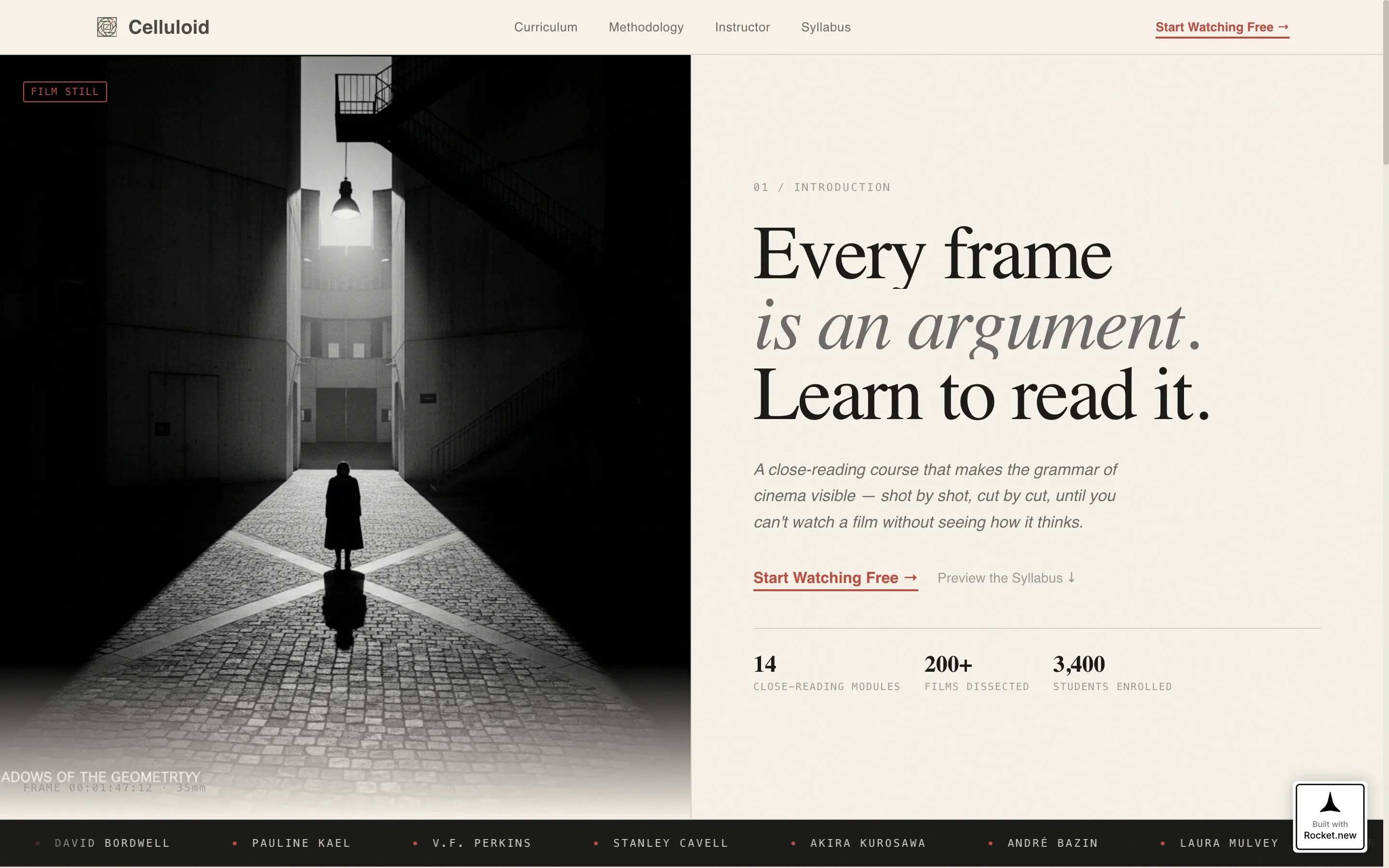
- A half-page hero with a high-contrast black-and-white film still, a serif headline, and a red call-to-action link
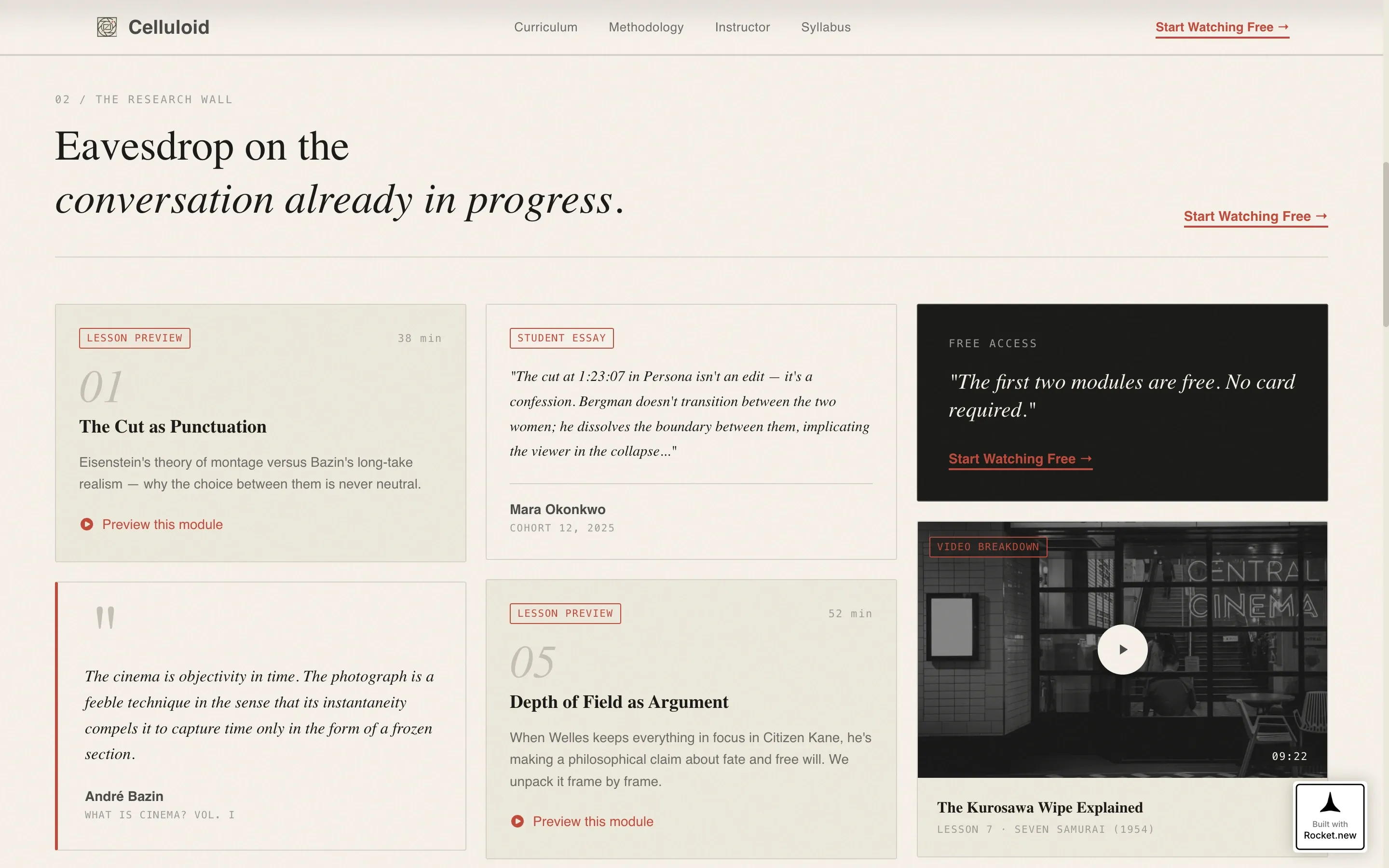
- A masonry research wall of mixed-content cards including lesson previews, theorist pull-quotes, annotated shot diagrams, and student essay excerpts
- Two embedded inline video breakdowns that prove the instructor's analytical voice before the visitor reaches the enrollment step
Feature list
Half-Page Hero with Film Still and Serif Headline
The header splits the viewport between a desaturated black-and-white film still, printed as though photocopied onto cream stock, and a large Fraunces serif headline with generous leading. A single italic subtext line sits below the headline, and the primary call to action appears as a red-underlined text link. The image is styled slightly rotated, like a reference photo taped into a research notebook.
Masonry Research Wall Grid
The core of the page is a Pinterest-style masonry grid that unfolds like a research wall as the visitor scrolls. Cards vary in height and content type: lesson previews, theorist pull-quotes from figures like Bazin and Mulvey, annotated shot composition diagrams, looping video stills with overlaid notation, and student essay excerpts. The density increases with scroll depth, mirroring how film literacy compounds over time.
Scroll-Scrub Mission Statement
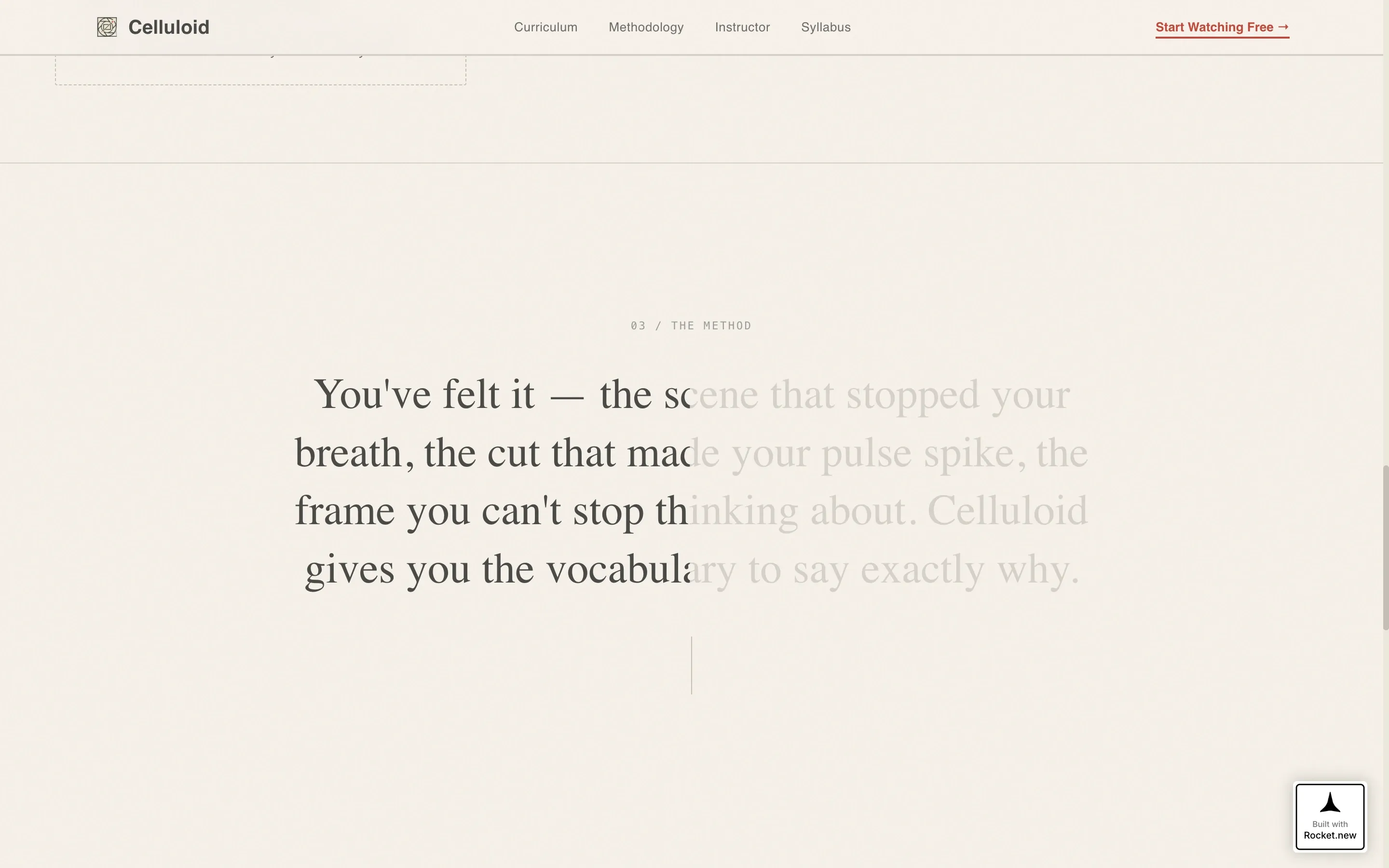
A sticky text-reveal section uses scroll-scrub animation to expose a mission paragraph phrase by phrase. This section connects the visitor's emotional experience of cinema to the analytical tools the course provides. It slows the scroll intentionally, creating a moment of reflection before the credibility section.
Inline Video Proof Embeds
Two video breakdowns play directly on the page without requiring navigation away. They function as proof of the instructor's analytical voice and teaching style. Visitors who watch even a portion of these arrive at the enrollment flow already familiar with the course's tone and rigor.
Recurring Red Call-to-Action Links
The primary call to action, "Start Watching Free," appears first below the hero and recurs as a red-underlined text link pinned inside masonry cards at rhythmic intervals. There is no form on this page. The click carries the visitor directly to the enrollment and payment flow, keeping the path frictionless.
Instructor and Syllabus Section
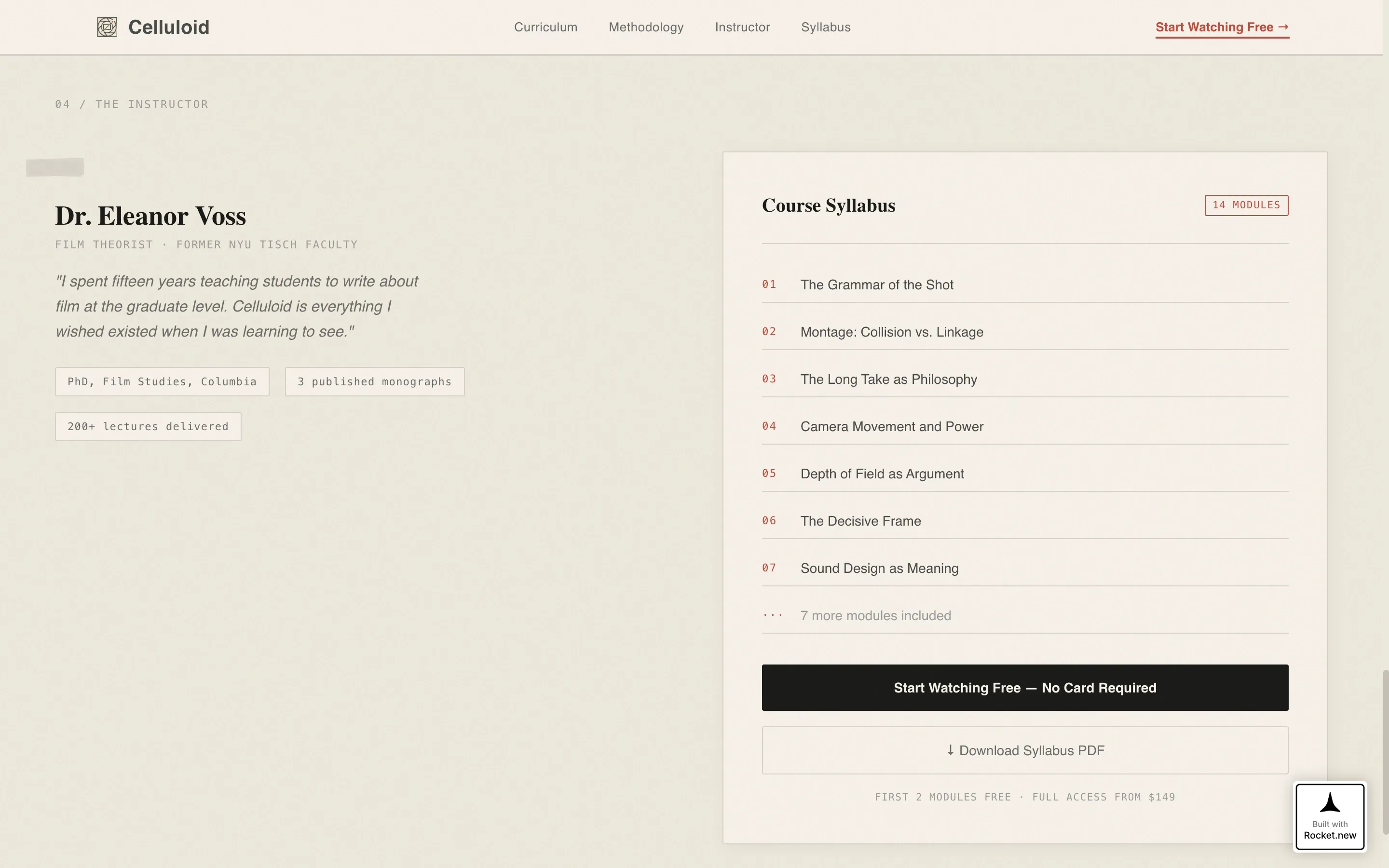
A dedicated credibility section introduces the instructor and offers "Preview the Syllabus" as a downloadable PDF link. The PDF link doubles as a soft lead-capture path for visitors who are not yet ready to enroll. This section uses the same Ink and Paper type hierarchy as the rest of the page.
Page sections overview
| Section | Purpose |
|---|---|
| Hero Header | Introduce course with film still, headline, and primary call to action |
| Filmmaker Names Marquee | Scroll-animating ticker of key theorist and filmmaker names |
| Masonry Research Wall | Mixed-content grid of lessons, quotes, stills, and annotations |
| Scroll-Scrub Mission | Sticky animated paragraph connecting feeling to analytical method |
| Instructor and Syllabus | Credibility block with instructor bio and syllabus PDF download |
| Page Footer | Dot-separated horizontal link row for navigation and legal links |
Design & branding system
The template uses an Ink and Paper theme built around the Cloud Canvas color system. The palette feels like a stack of warm mimeographed handouts on a seminar table, scholarly without being sterile.
- Colors: unbleached page cream (#F5F0E8) as background, graphite pencil gray (#4A4A48) for body text, soft cloud shadow (#D6D1C9) for section dividers, and marginal-note red (#C04A3B) reserved for accents and interactive highlights
- Typography: Fraunces for display headings, DM Sans for body copy, and IBM Plex Mono for annotations and margin notes
- Visual details: slightly rotated hero image styled as a pinned reference photo, faint cloud shadow rules between sections, and red used sparingly the way a professor's pen marks only what matters most
Mobile & speed optimization
The template is designed desktop-first, reflecting an audience of film scholars who typically work at a desk with a large screen. It scales responsively to mobile viewports so visitors on any device can still engage fully with the content.
- The masonry grid reflows into a single-column layout on smaller screens without losing the research-wall aesthetic
- Scroll-scrub animations and masonry stagger reveals are handled by client-side components, while static content uses server-side rendering to keep initial load fast
- Inline video embeds are positioned to load only when the visitor scrolls near them, reducing unnecessary resource use on page entry
How this template helps you convert
The page is structured as a progressive trust-building journey. It does not ask for commitment until the visitor has already experienced the instructor's thinking firsthand.
- The hero section establishes tone and curiosity immediately, with a bold cinematic visual and a direct red call-to-action link that invites a free first watch rather than a purchase decision.
- The masonry research wall gives away real analytical thinking, through pull-quotes, annotated diagrams, and inline video proof, so the visitor builds trust in the course before reaching the enrollment flow.
- The syllabus PDF link provides a lower-commitment exit ramp that still moves the visitor toward enrollment, capturing interest from those who need more time before clicking through to checkout.
Other information about this template
The Celluloid template sits within the Blog and Editorial category, specifically the Film and Cinema Analysis Content subcategory. It is built for the film and cinema analysis online course niche and carries a high intersection match between its design direction and its intended audience.
- The template uses the Origin Story creative direction, meaning the scroll narrative begins with an emotional film memory and progressively reveals the analytical tools that decode it
- The masonry layout style was chosen deliberately to mirror the associative, non-linear way film scholars build knowledge across stills, texts, and moving images
- Animation is set to a medium intensity, with scroll-scrub text reveals, masonry stagger entry, and a subtle parallax grain texture across the cream background
- Interactivity is set to high, with spotlight hover states on masonry cards, inline video playback, and masonry hover transitions that reward careful reading
Theme
Ink & Paper
Creative direction
Origin Story
Color system
Cloud Canvas
Style
Masonry/Pinterest
Direction
Click-Through
Page Sections
Half-page Hero with Film Still
Masonry Research Wall Grid
Scroll-scrub Mission Statement
Inline Video Proof Embeds
Recurring Click-through Call to Action Links
Instructor and Syllabus Section
Related questions
What type of course is this template built for?
Does the page include a sign-up form?
How many calls to action appear on the page?
What fonts does this template use?
Can this template work for a course on a different subject?