Teaching & Pedagogy Blog Landing Page Template
Chalk is a warm editorial landing page template built for teaching and pedagogy blogs. It opens like a well-loved journal, guides readers through a timestamped day-in-the-life narrative, and leads them into a five-question teaching-style quiz with instant results. The design feels personal, honest, and crafted for educators who are still in the room.
by Rocket studio
Quick summary
Chalk is an editorial landing page template for teaching and pedagogy blogs. It blends warm artisan design with a narrative scroll and an interactive teaching-style quiz. The page is built to make second-year teachers and career-changers feel understood before it ever asks for their email.
Who this template is for
This template is made for educators and education content creators who want to build a blog that feels genuine and lived-in rather than polished and distant.
- Second-year teachers who are overwhelmed by curriculum mandates and want a blog that speaks their language
- Career-changers who moved into teaching from law, engineering, or another field and are still finding their footing
- Department heads and veteran educators who want to share classroom craft in a format that earns reader trust
What problem this template solves
Most education blog templates look like corporate training portals. They push content behind gates and ask for an email before giving the reader anything of value. That approach fails with teachers.
- Readers leave before they feel seen, so the email prompt never lands
- Generic designs signal that the content inside will be just as generic
- A flat, section-less page fails to carry the emotional arc that moves a reader toward action
What you get with this template
This template delivers a fully structured editorial landing page with a book-chapter hero, a narrative scroll, a live interactive quiz, a social proof marquee, and an asymmetric article grid.
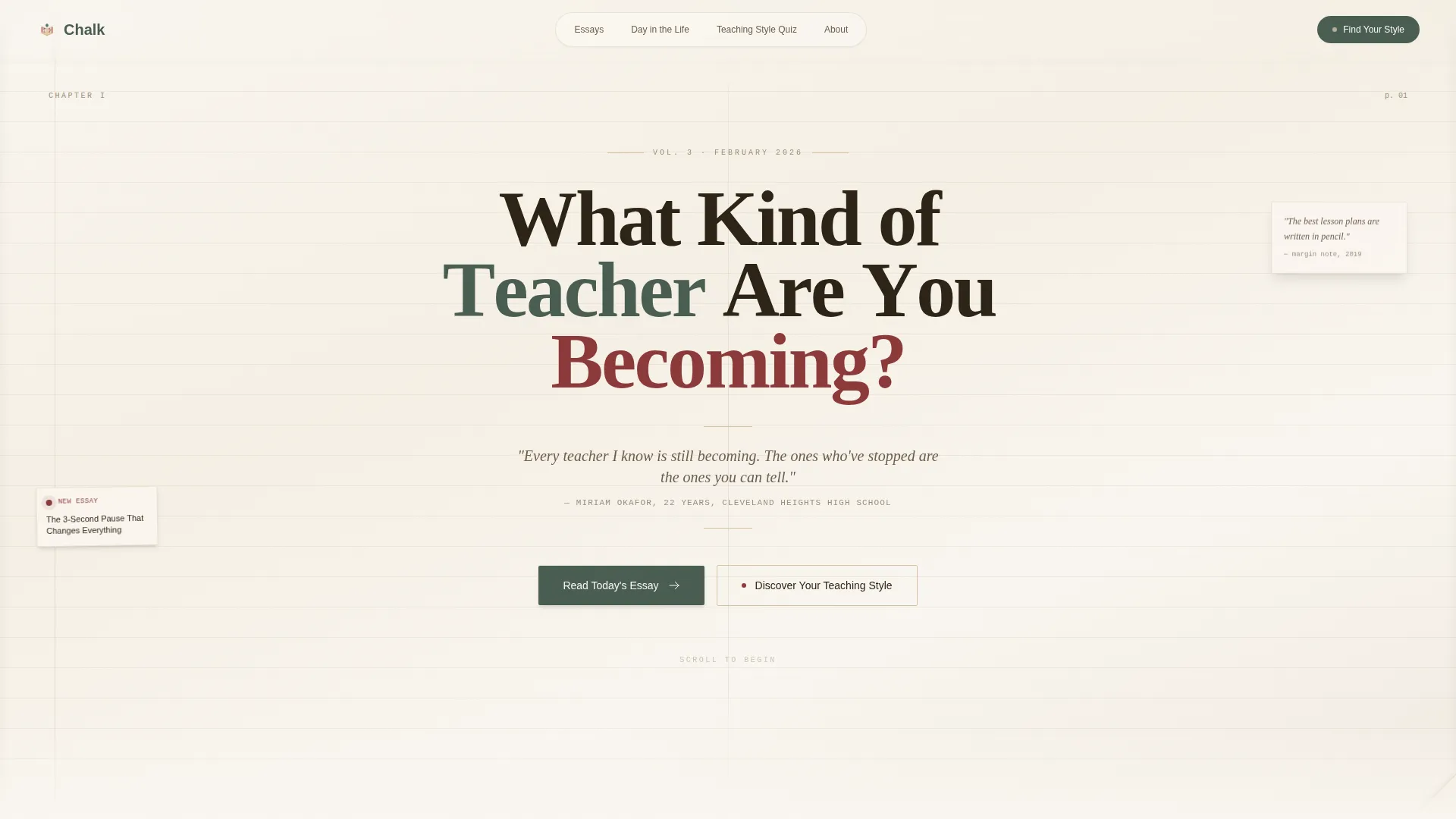
- A hero section styled as the opening page of a hand-lettered book, complete with paper texture, fold line, and an italic epigraph
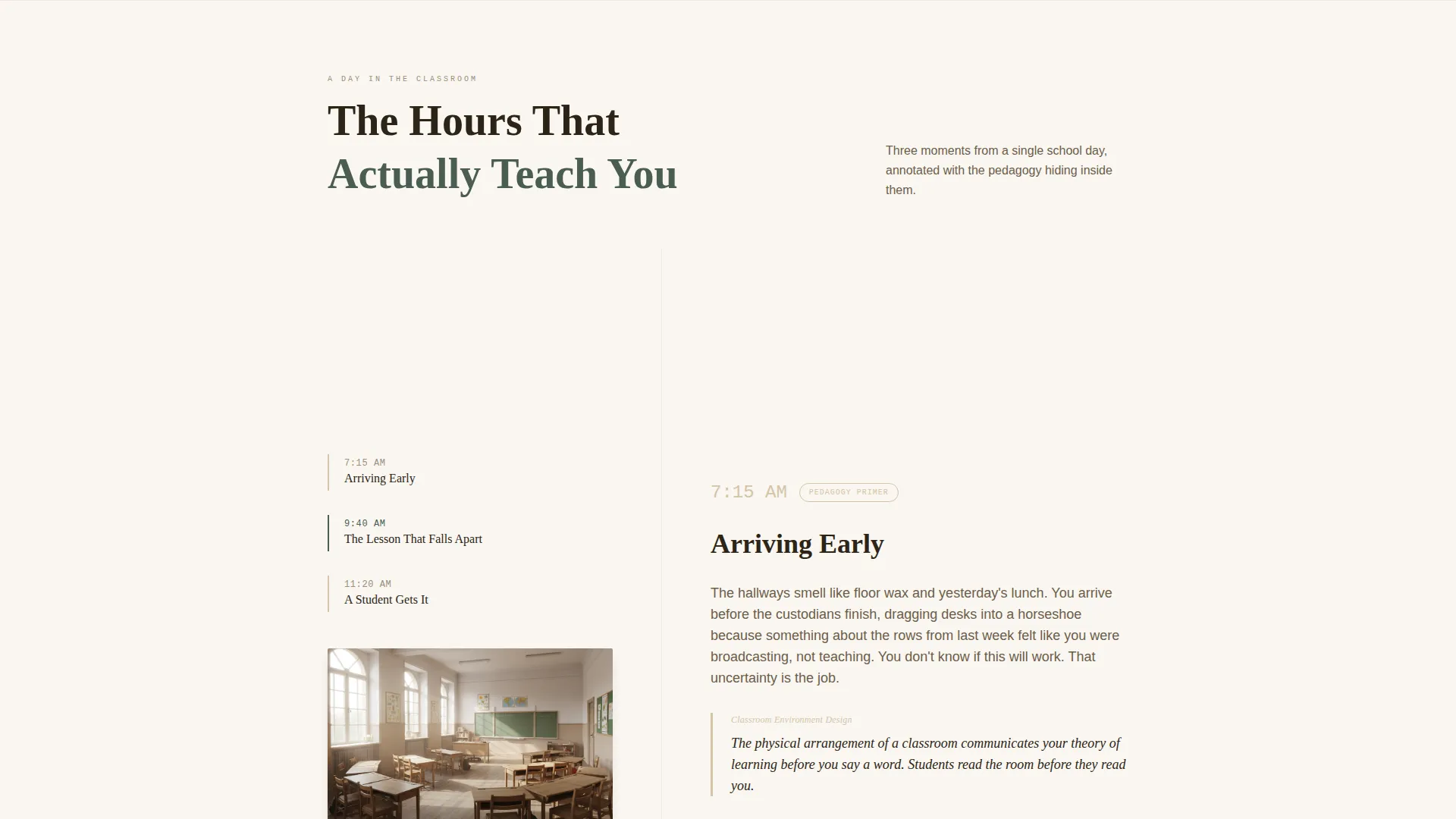
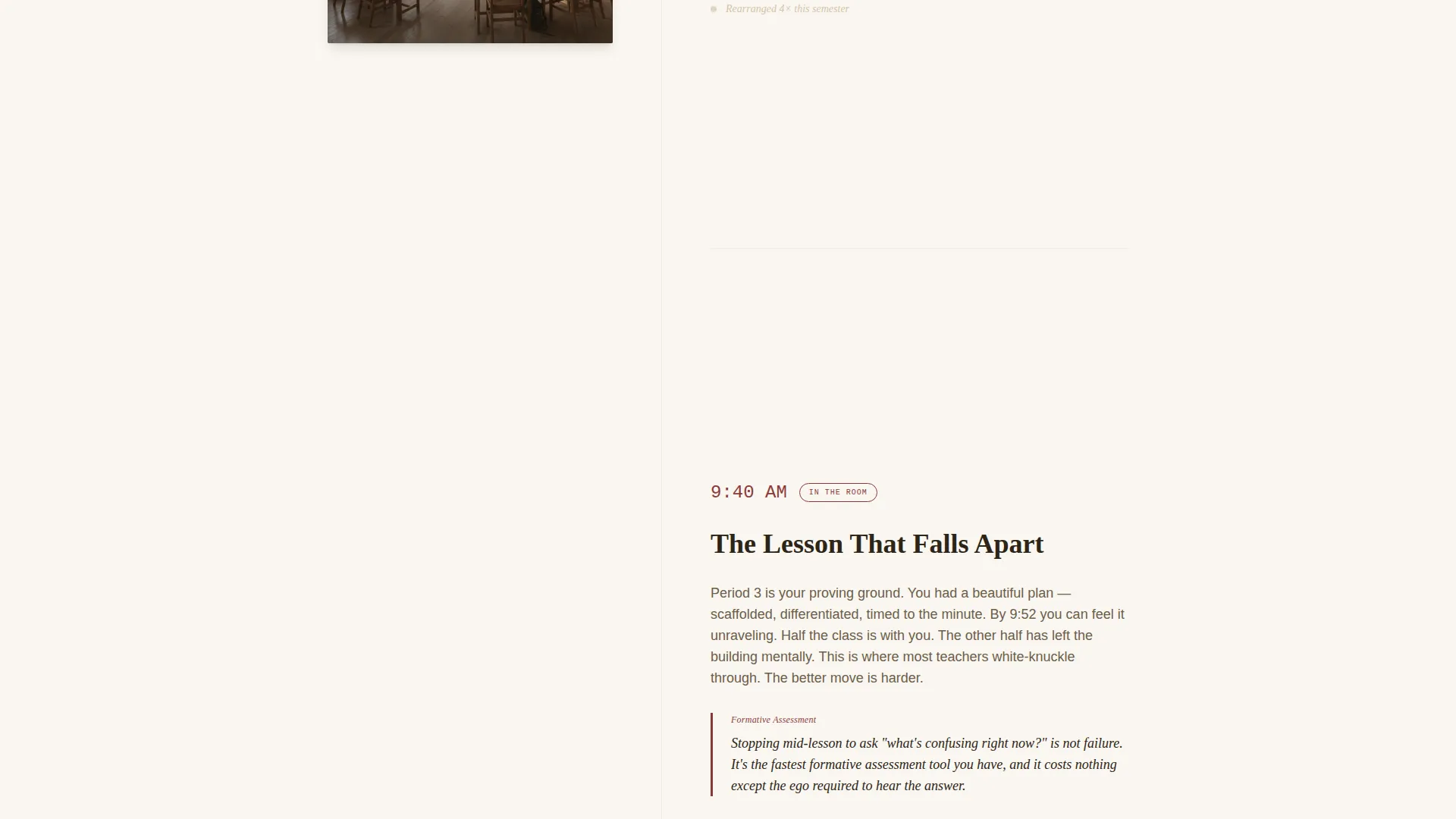
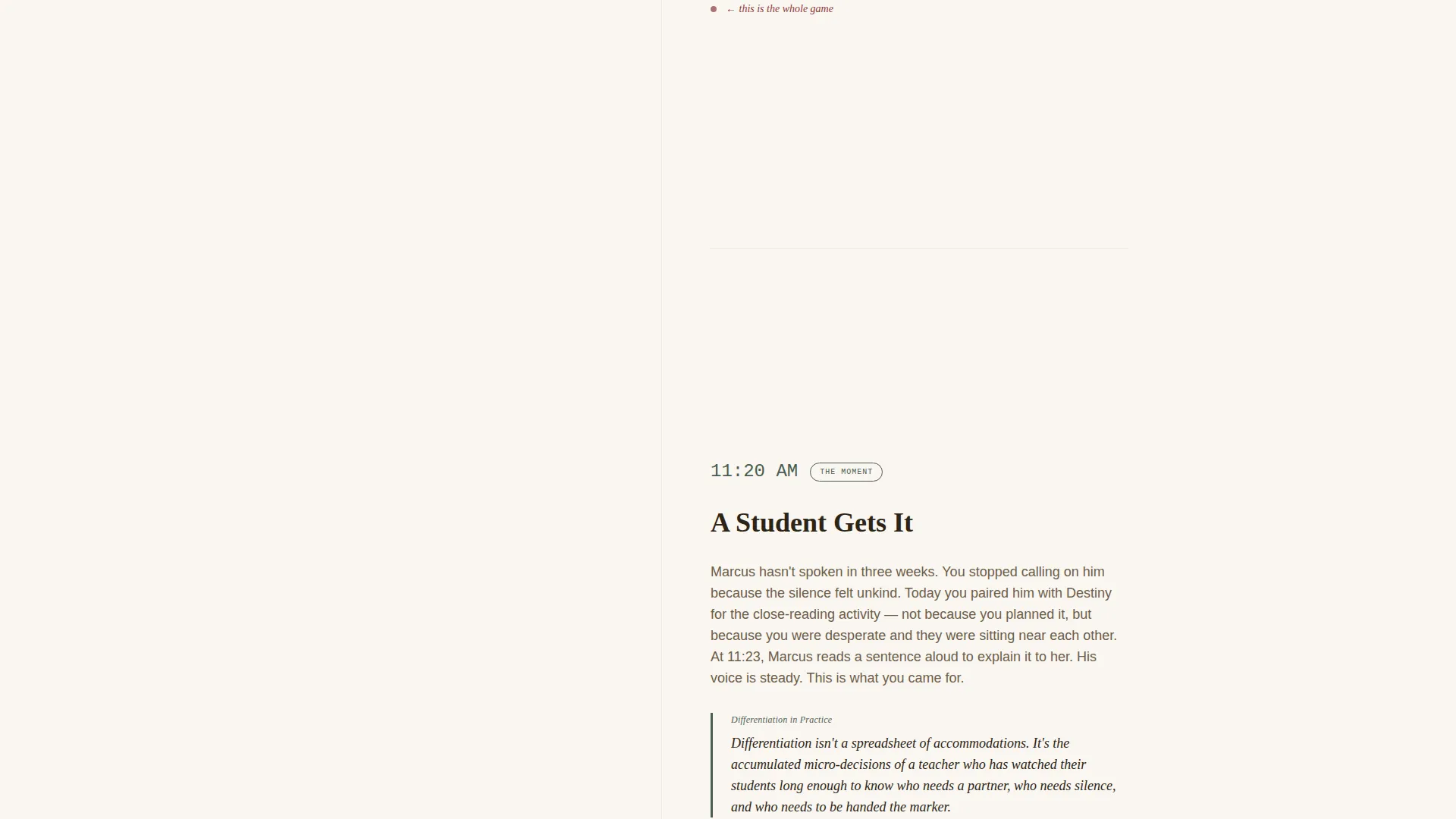
- A timestamped day-in-the-life scroll that introduces real pedagogical concepts through narrative, not lecture
- A five-question teaching-style quiz with illustrated scenario options and immediate, shareable results
Feature list
This template is packed with components that work together to create one connected reading and discovery experience.
Book-Chapter Hero with Paper Texture
The viewport opens as the first page of an open book. A hand-lettered chapter title in warm pressed serif type sits above an italic epigraph attributed to a working teacher. Subtle paper texture, a faint center fold line, and a soft page-corner shadow make it feel like the start of something worth reading.
Timestamped Day-in-the-Life Narrative Scroll
The page scrolls through a single teacher's day, from 7:15 AM through 11:20 AM, with each time-stamped beat introducing a real pedagogical concept. Classroom design, formative assessment, and differentiation are woven into the story, not dropped in as bullet points. The emotional arc moves from morning uncertainty to afternoon confidence.
Five-Question Teaching-Style Quiz
The quiz appears after the midday narrative, when reader identification is at its peak. Each of the five questions presents a classroom scenario with three response options styled as handwritten margin notes. Results display immediately with shareable illustrations, and no email is required to see them.
Warm Email Prompt After Results
Once the reader has seen their full teaching-style profile, a warm, low-pressure prompt invites them to enter their email to receive a personalized pedagogy playbook in PDF form. The ask arrives only after the reader already feels understood.
Dual-Row Marquee Testimonials
A Teaching Voices section displays opposing marquee rows of specific teacher quotes with school and year attribution. The quotes scroll continuously and feel like voices in a real staff room, not a polished review widget.
Asymmetric Editorial Article Grid
A bento-style grid of recent essays sits near the bottom of the page. Cards feature article bylines with teaching experience noted, which reinforces the credibility of the voices behind the content.
Page sections overview
| Section | Purpose |
|---|---|
| Book-Chapter Hero | Opens the page as a journal entry with serif title, epigraph, and paper texture |
| Day-in-Life Scroll | Walks through a timestamped teacher day with embedded pedagogical concepts |
| Teaching Voices Marquee | Scrolling dual-row teacher quotes with school and year attribution |
| Quiz Call to Action | Five illustrated scenario questions leading to an immediate teaching-style result |
| Editorial Article Grid | Asymmetric bento layout of recent essays with experienced-teacher bylines |
| Footer Split | Logo and tagline on the left, navigation links on the right |
Design & branding system
The visual identity follows a Warm Artisan editorial theme. Every color and type choice references something physical: chalk dust, dog-eared pages, ink annotations, autumn light.
- Color palette: warm cream (#FAF6F0) as the reading surface, sun-faded sandstone (#D4C4A8) for headers and pull-quotes, soft chalkboard green (#4A5D52) for navigation and interactive elements, and deep margin red (#8B3A3A) used sparingly on the most important moments
- Typography: Fraunces as the display serif for headings and chapter titles, DM Sans for readable body copy, and JetBrains Mono for timestamps and labels
- Texture and detail: paper grain on the hero, faint fold line down the center, ink-style annotations, and hover states on all cards
Mobile & speed optimization
The template is designed desktop-first to match how most teachers read during planning periods on laptops. Mobile support is also built in for readers who land during a commute or a break.
- Static sections use server components, while the quiz and animations are handled client-side for smooth interactivity
- High-motion features include character-reveal heading animation, scroll-linked word reveals, marquee scrolling, and subtle parallax on the hero texture
How this template helps you convert
The page is structured so that every section earns the next action. The reader is never asked for anything before they have received real value.
- The narrative scroll and quiz work together to create a moment of recognition, when the reader sees their own teaching day reflected back at them, which is the point of highest emotional engagement and readiness to act
- The quiz results display immediately without an email gate, which builds trust and demonstrates that the blog delivers on its promises before asking for anything in return
- Only after the full teaching-style profile appears does the warm email prompt arrive, asking readers to receive a personalized pedagogy playbook, making the opt-in feel like a natural next step rather than a transaction
Other information about this template
Chalk is built as a single editorial landing page with a clear, section-led flow. It is designed for English-language audiences in the United States and uses MM/DD/YYYY date formatting with no currency display.
- The template uses high animation levels throughout, including character-reveal, scroll-linked word reveal, marquee, and parallax effects
- Interactivity is high across the whole page, with quiz logic, hover states on all article cards, and shareable quiz result illustrations
- The page is localized for US English and is well suited to education content creators publishing in the K-12 teaching space
Theme
Warm Artisan
Creative direction
Day-in-the-Life
Color system
Warm Stone
Style
Editorial/Magazine
Direction
Quiz/Assessment
Page Sections
Book-chapter Hero Section
Day-in-the-life Narrative Scroll
Illustrated Teaching-style Quiz
Dual-row Marquee Testimonials
Asymmetric Editorial Article Grid
Post-results Email Prompt
Related questions
Can I use this template without running the quiz?
Do quiz results require an email address to display?
Is this template suitable for a newer teaching blog with less content?
Can the day-in-the-life timestamps be changed to a different schedule?
Is this template only for K-12 teachers?