History & Culture Blog Blog Website Template
Chronicle is a masonry-style social history blog landing page built for digital archives that recover forgotten working-class stories. It opens with a full-viewport manifesto quote, flows through thematic story-tile clusters, and funnels readers into a five-question personality quiz that sorts them into reader archetypes and connects them to a matched newsletter sign-up.
by Rocket studio
Quick summary
Chronicle is a single-page social history blog template shaped like a leather-bound journal brought to life on screen. It pairs a striking manifesto header with a masonry story grid, data visualisation strips, and a personality quiz that converts curious visitors into loyal newsletter subscribers sorted by archetype.
Who this template is for
Chronicle is built for people who believe history belongs to everyone, not only the powerful. It suits any creator running a content-led archive or social history blog with a strong editorial voice.
- Amateur genealogists tracing family lines through census records and parish registers
- History teachers who need human-centered lesson materials that go beyond textbook names
- Retired locals and community historians holding living memory of industrial heritage
What problem this template solves
Most history blog templates look like generic news sites. They give every post equal weight and offer no clear path for a first-time visitor to find their footing. Chronicle solves the orientation problem for a niche, deeply curious audience.
- Visitors arrive without knowing where to start; the manifesto header and thematic clusters give instant editorial direction
- Generic layouts lose readers who want depth; the masonry grid surfaces sepia photographs, census snippets, and oral testimony in one cohesive view
- No standard blog template nudges readers toward a relationship; the quiz call-to-action earns an email address by making each visitor feel personally seen
What you get with this template
Chronicle delivers a full single-page layout crafted for storytelling at depth. Every section has a clear editorial role, and the visual system is consistent from the first pixel to the footer.
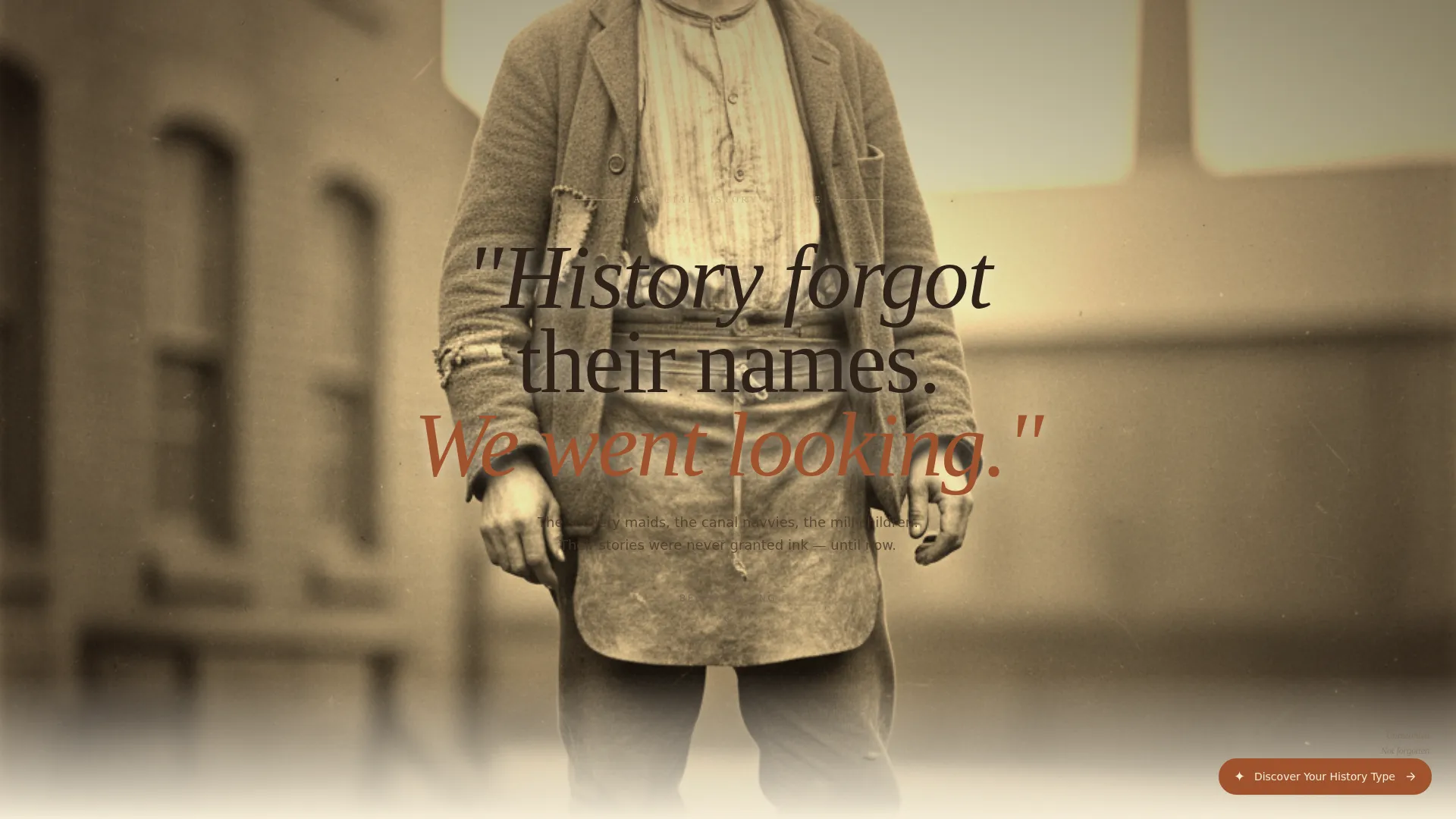
- A full-viewport quote manifesto header with cross-dissolving daguerreotype portrait imagery
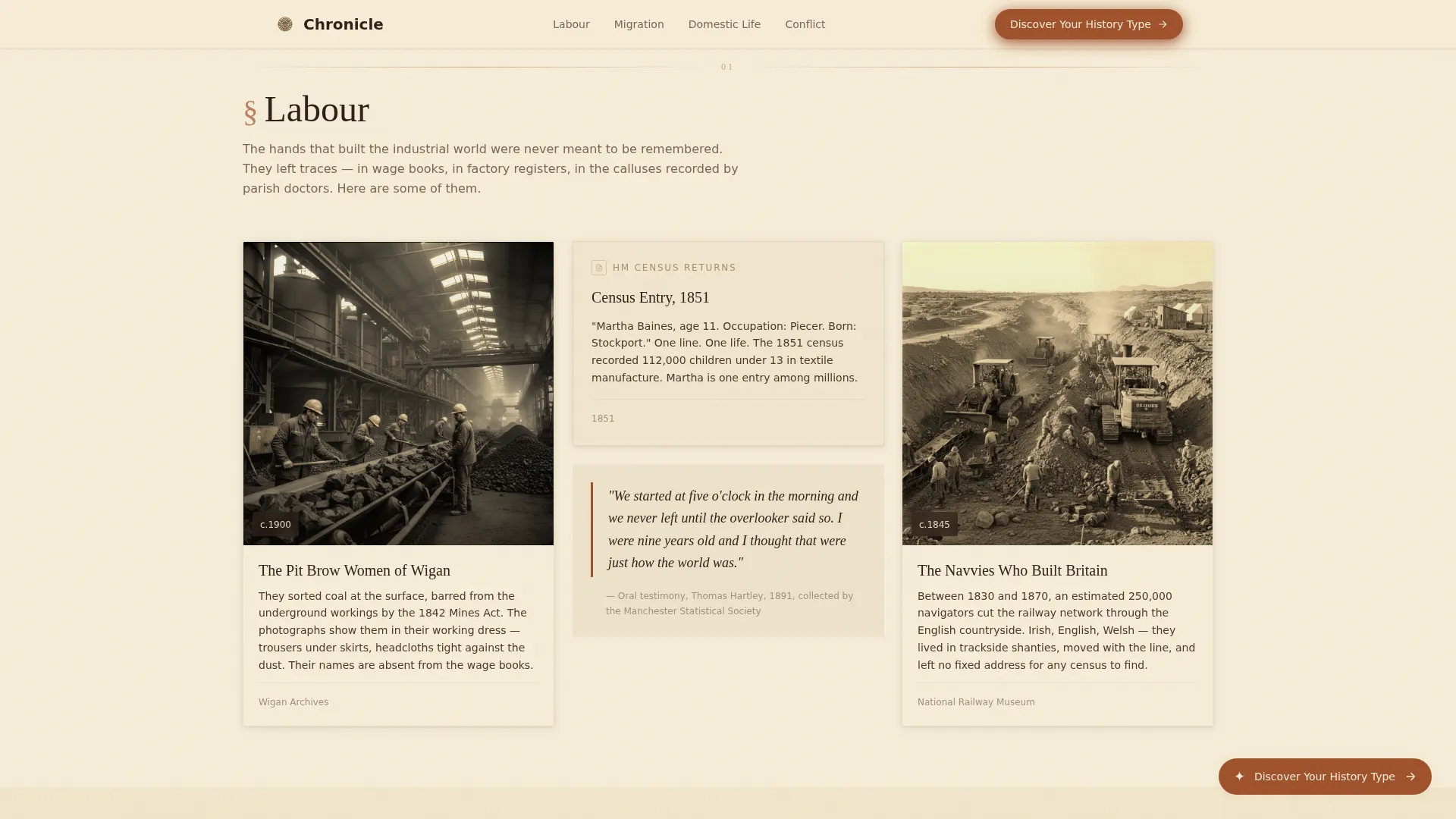
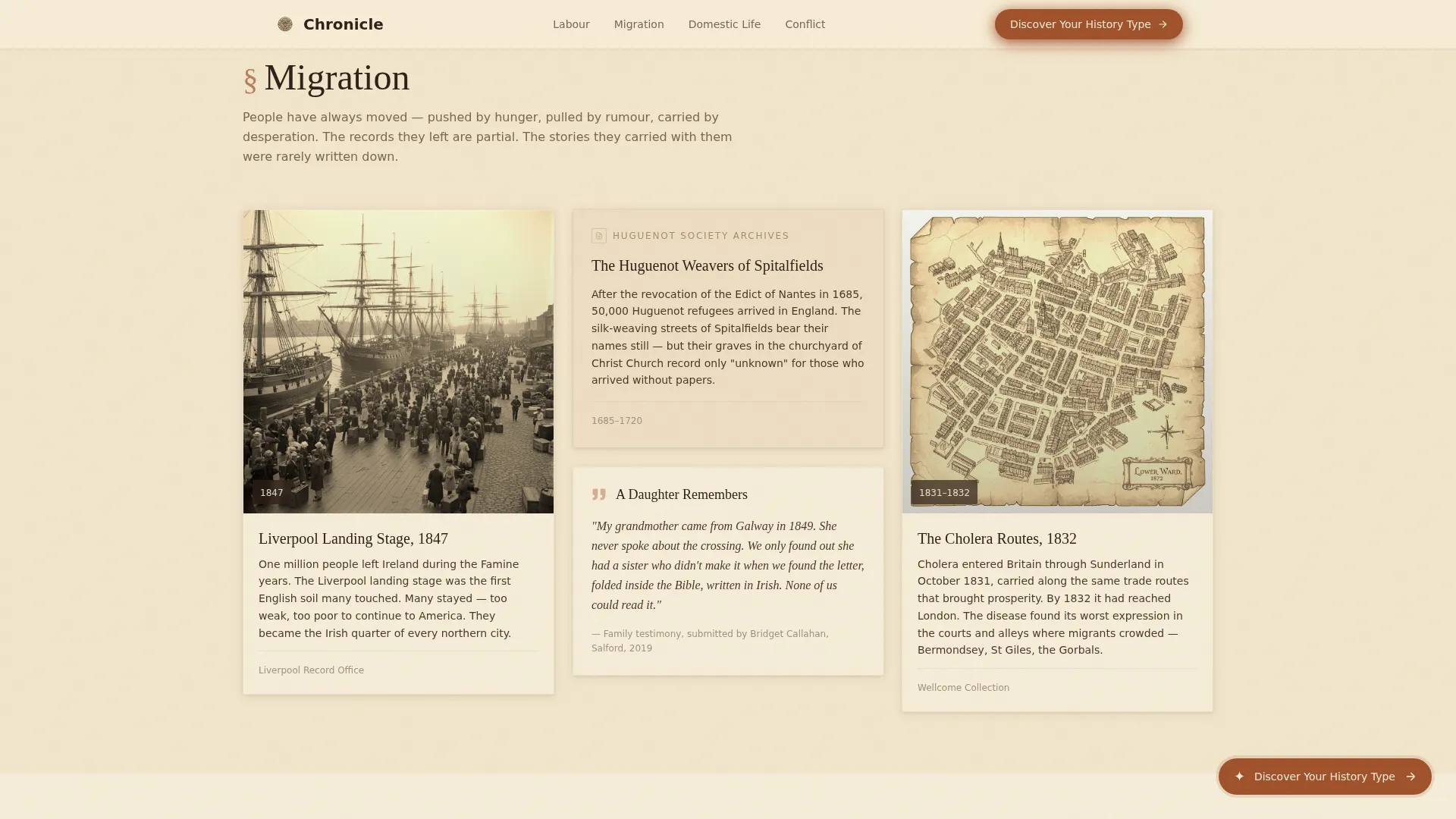
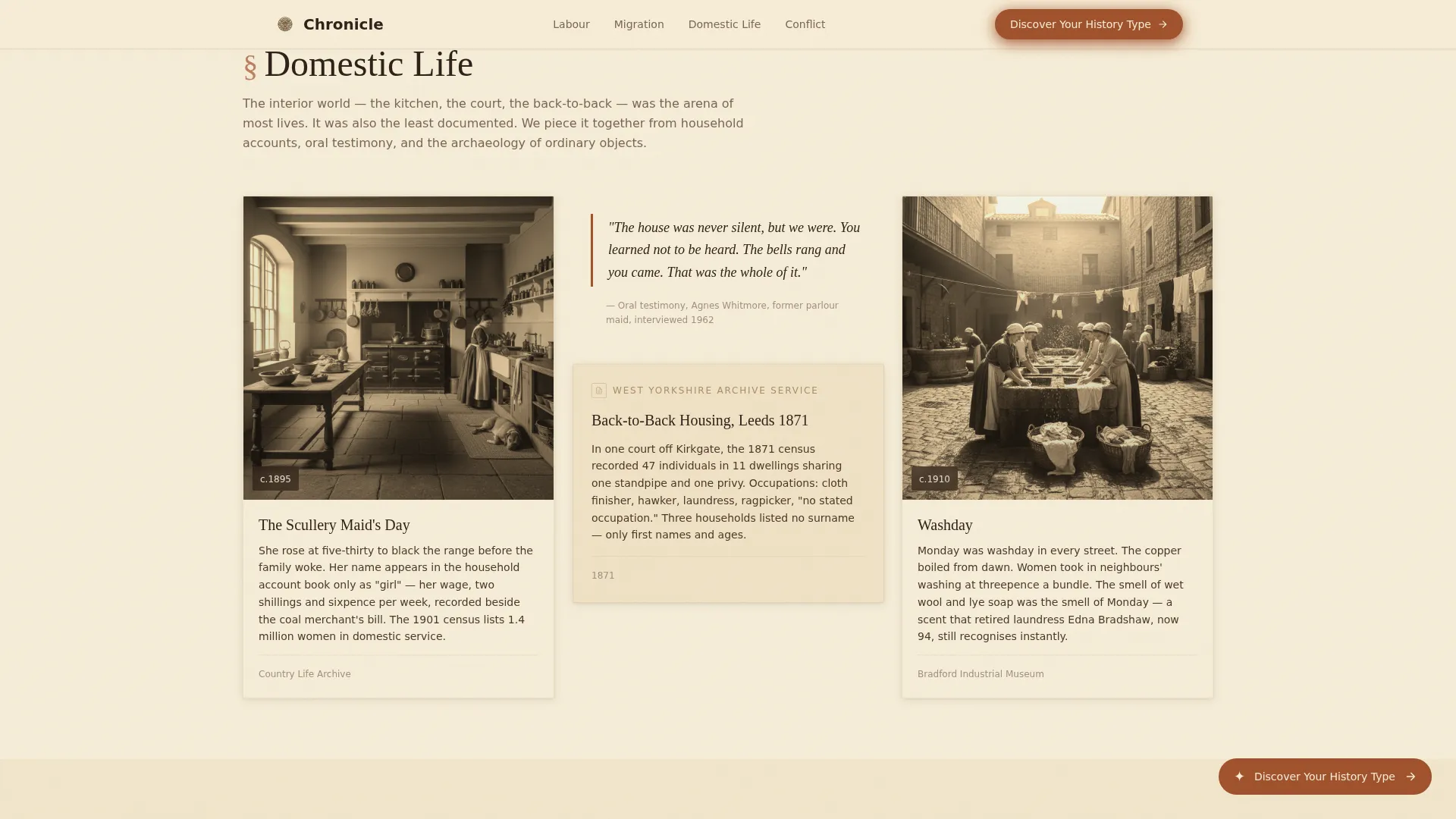
- A masonry story-tile grid organised into four thematic clusters: Labour, Migration, Domestic Life, and Conflict
- A five-question personality quiz leading to four named reader archetypes, each paired with a reading list and a newsletter sign-up pre-tagged to archetype type
Feature list
Chronicle's capabilities are built directly around the needs of a social history archive. Each feature serves a specific editorial or conversion purpose.
Full-Viewport Manifesto Header
The page opens with a single serif line set large against a textured parchment field. Below the quote, a daguerreotype-style composite of anonymous Victorian faces cross-dissolves between portraits in a slow, atmospheric loop. Navigation stays hidden until the visitor scrolls, giving the opening statement room to breathe.
Masonry Story-Tile Grid
Story tiles arrange into a fluid masonry layout with scroll-triggered stagger reveals. Each tile holds a sepia photograph, a census snippet, a hand-drawn map fragment, or a paragraph of oral testimony. Tiles cluster into four editorial themes, each introduced by a short chapter-heading paragraph.
Data Visualisation Strip
Between thematic clusters, the layout includes three embedded data pieces: a timeline of average wages in 1830s Lancashire, a population heat map tracing a cholera outbreak, and a family tree diagram that ends deliberately with a question mark. These strips add analytical depth without breaking the journal-like reading pace.
Personality Quiz Module
A floating ember-coloured button appears after the second story cluster and opens a five-question quiz modal. Questions cover era preference, preferred way of encountering history, family research habits, comfort with archival sources, and a final imaginative prompt about a burning museum. Results assign visitors to one of four archetypes: The Archivist, The Storyteller, The Detective, or The Witness.
Archetype Results and Newsletter Sign-Up
Each quiz result presents a named reader archetype with a curated reading list matched to that profile. The newsletter sign-up form is pre-tagged to the visitor's archetype, so the first email they receive already speaks their language. This pairing between personalisation and sign-up is the core conversion mechanism.
Heritage Typography and Animation System
Headlines use a large, unhurried serif typeface. Body copy uses a clean humanist sans-serif for comfortable reading at longer lengths. Scroll-linked blur, parallax depth effects, and intersection-observer-based reveals create the sense of descending through geological strata as the visitor reads downward.
Page sections overview
| Section | Purpose |
|---|---|
| Hero Manifesto Header | Opens with quote and cross-dissolving portrait imagery |
| Labour Story Cluster | Masonry tiles covering working-class labour histories |
| Migration Story Cluster | Tiles on movement, displacement, and settlement |
| Domestic Life Cluster | Stories from kitchens, households, and daily routines |
| Conflict Story Cluster | Accounts of war, hardship, and community resistance |
| Data Visualisation Strip | Wages timeline, cholera heat map, question-mark family tree |
| Quiz Call to Action | Floating button leading to five-question archetype quiz |
| Reader Archetypes Panel | Four archetype results with reading lists and sign-up forms |
| Social Proof Strip | Pull quotes, testimonials, and archive statistics |
| Footer | Logo and tagline left, minimal navigation links right |
Design & branding system
Chronicle's visual identity is built on a Warm Stone colour palette that feels aged, warm, and deliberately unhurried. Every colour choice reinforces the sense of handling something genuinely old.
- Backgrounds alternate between faded parchment (#F5ECD7) and quarry sandstone (#C4A882); body text is set in iron-gall ink (#2E2118) for high contrast and period authenticity
- Hearth ember (#A0522D) is used for links, pull quotes, call-to-action buttons, and hover states, drawing the eye like a wax seal on an envelope
- Fraunces serif headlines give chapter-heading weight to editorial introductions; DM Sans body text keeps long-form reading comfortable and clear
Mobile & speed optimization
Chronicle is designed desktop-first to match the research habits of genealogists, who typically work across multiple browser tabs on larger screens. A mobile-responsive fallback ensures the layout holds on smaller devices.
- The masonry grid collapses gracefully into a single-column stack on narrow viewports, preserving tile imagery and editorial introductions
- CSS animations handle the majority of scroll reveals and hover states, reducing reliance on heavy JavaScript and keeping transitions smooth
How this template helps you convert
Chronicle earns subscriber trust before it asks for anything. The conversion path is built around curiosity and personalisation, not pressure.
- The manifesto header creates an immediate emotional connection, making the visitor feel the archive's purpose before any call to action appears; this engagement primes them to keep scrolling through the story clusters
- The floating quiz button appears only after the visitor has moved through two full thematic clusters, so the prompt to act feels earned rather than intrusive; the five-question format makes the visitor feel understood, which lowers the barrier to sharing an email address
Other information about this template
Chronicle suits any editorial team or solo creator building a content-led community around social history, local heritage, or community memory projects.
- The template is built in English (UK) with British date formatting (DD/MM/YYYY) and is suited to projects where localisation and period-appropriate language matter
- The footer follows a split layout with the archive logo and tagline on the left and a minimal set of navigation links on the right, keeping the closing impression clean and unfussy
- The quiz modal is designed to work as a standalone interactive element, with result pages that can each carry a distinct reading list and a pre-tagged newsletter entry point
Theme
Heritage & Story
Creative direction
Industry Report
Color system
Warm Stone
Style
Masonry/Pinterest
Direction
Quiz/Assessment
Page Sections
Full-viewport Manifesto Header
Masonry Story-tile Grid
Data Visualisation Strip
Five-question Personality Quiz
Archetype Results with Newsletter Sign-up
Heritage Typography and Scroll Animation
Related questions
Who is the Chronicle template designed for?
What does the personality quiz do?
How are the story tiles organised on the page?
Can I replace the archetype names and reading lists with my own content?
Is this template suited to desktop or mobile use?