Cipher — Fintech Platform Landing Page Template
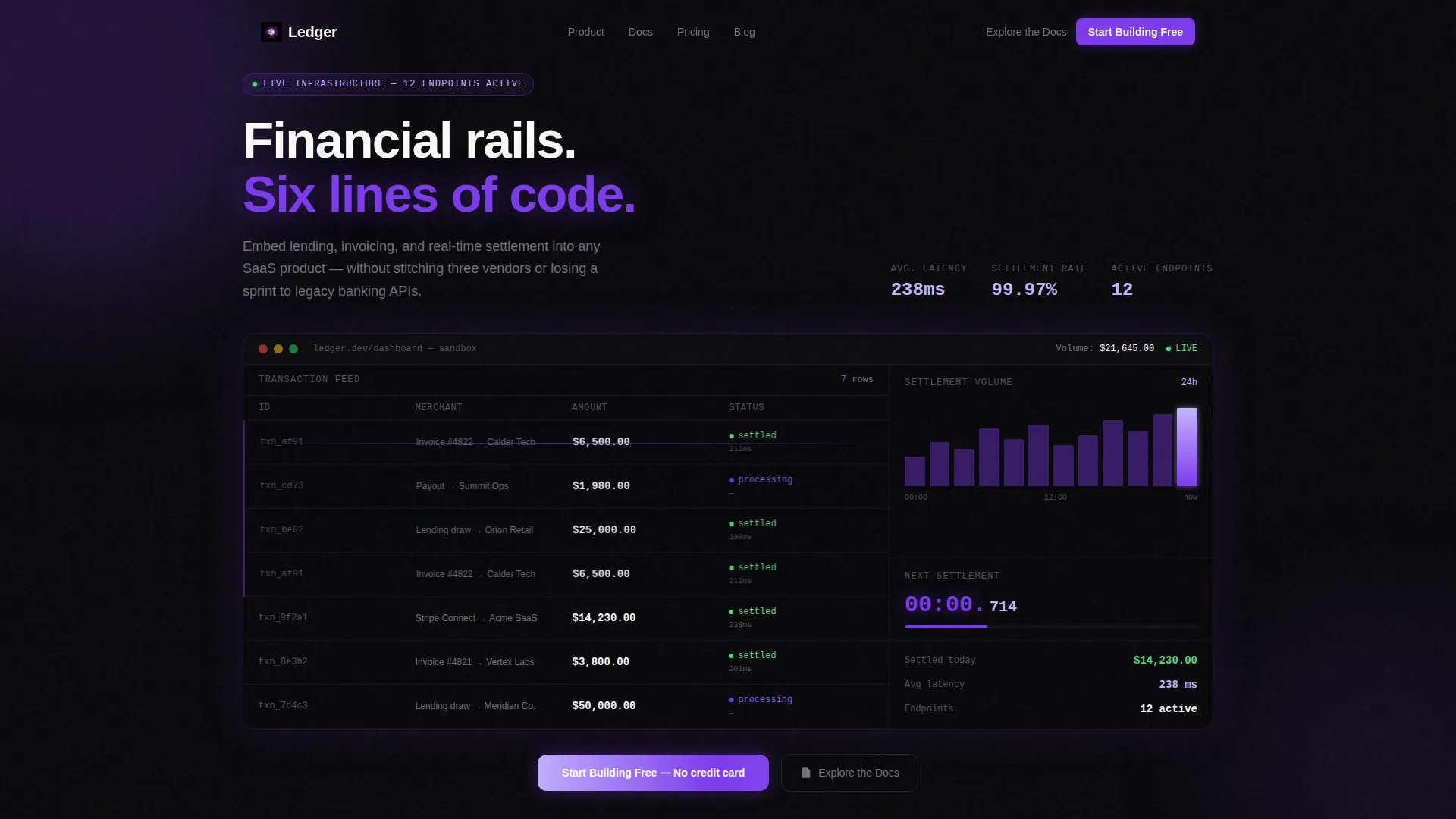
Ledger is a fintech landing page template built for payments infrastructure startups. It features a live-style mock dashboard, scroll-triggered data cards, and a freemium conversion flow. The Void and Violet color system gives every active element a mission-control intensity. Designed for Series A teams who need to show their API works before asking developers to sign up.
by Rocket studio
Quick summary
Ledger is a single-page fintech landing page template engineered for a payments infrastructure startup. It opens with an interactive mock dashboard, escalates through data-led sections, and converts visitors on a no-credit-card freemium model. The Void and Violet palette and dynamic motion theme make the product itself the hero.
Who this template is for
This template speaks directly to the technical founders and product leaders building financial tooling into existing software. It is designed for teams who need their landing page to earn developer trust before asking for a sign-up.
- Series A chief technology officers (CTOs) embedding financial rails into vertical software platforms
- Fintech product managers who want to eliminate multi-vendor checkout complexity
- Developer leads who have lost sprint time to legacy banking application programming interfaces (APIs)
What problem this template solves
Most fintech landing pages describe infrastructure in abstract terms. They lead with logos, taglines, and vague promises. That approach fails with technical buyers who want to see the product run before they read a single marketing claim.
- Developer audiences distrust landing pages that show illustrations instead of the actual product interface
- Payments integration pages rarely show latency benchmarks, transaction counts, or real API simplicity at a glance
- Conversion stalls when the path to trying the product involves a sales call or credit card entry
What you get with this template
This template delivers a complete, single-page conversion flow built around a dashboard-first layout and a data-driven narrative. Every section is designed to accumulate evidence until doing nothing feels more expensive than starting a free build.
- An interactive mock dashboard header showing a live transaction feed, settlement timers, and an animated volume graph
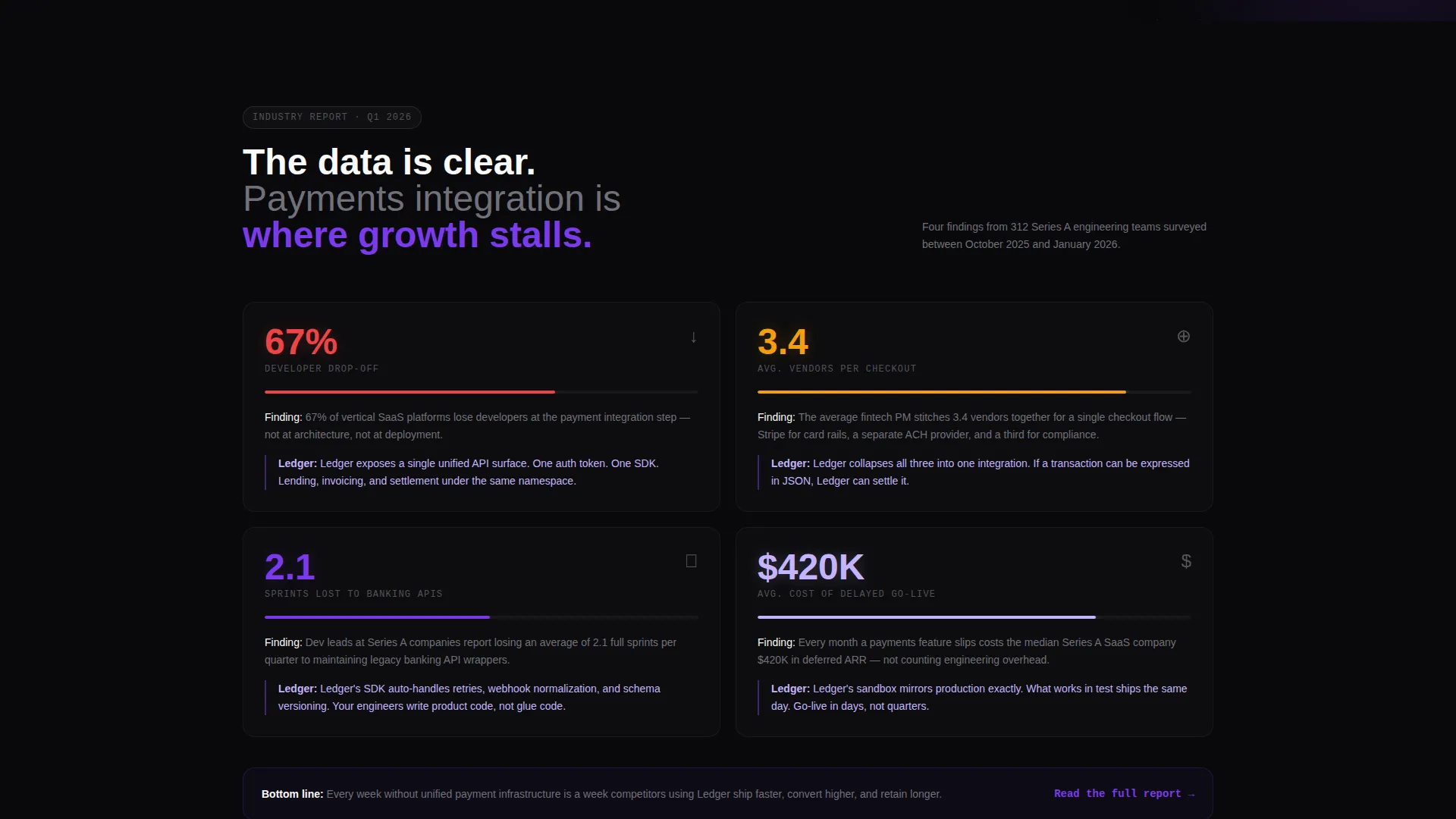
- Scroll-triggered two-column data cards with micro-animated charts and hard industry-finding copy
- A sticky freemium conversion bar with an email field, a GitHub OAuth button, and a secondary docs link
Feature list
This section outlines the core built-in capabilities that ship with the Ledger template.
Interactive Mock Dashboard Header
The header renders a functioning mock dashboard at full pixel density. It shows a live transaction feed, settlement timers counting down in real time, and a volume graph whose bars animate upward on page load. Numbers like "$14,230.00 settled," "238 ms latency," and "12 endpoints active" make the product feel operational before a visitor reads a single word of copy.
Scroll-Triggered Data Cards
Each content section pairs a hard data finding with a direct product response. The two-column card layout draws micro-animated charts on scroll, so the data literally appears as the visitor reaches it. The narrative escalates from problem scale to cost of inaction to integration simplicity.
Latency Benchmark Section
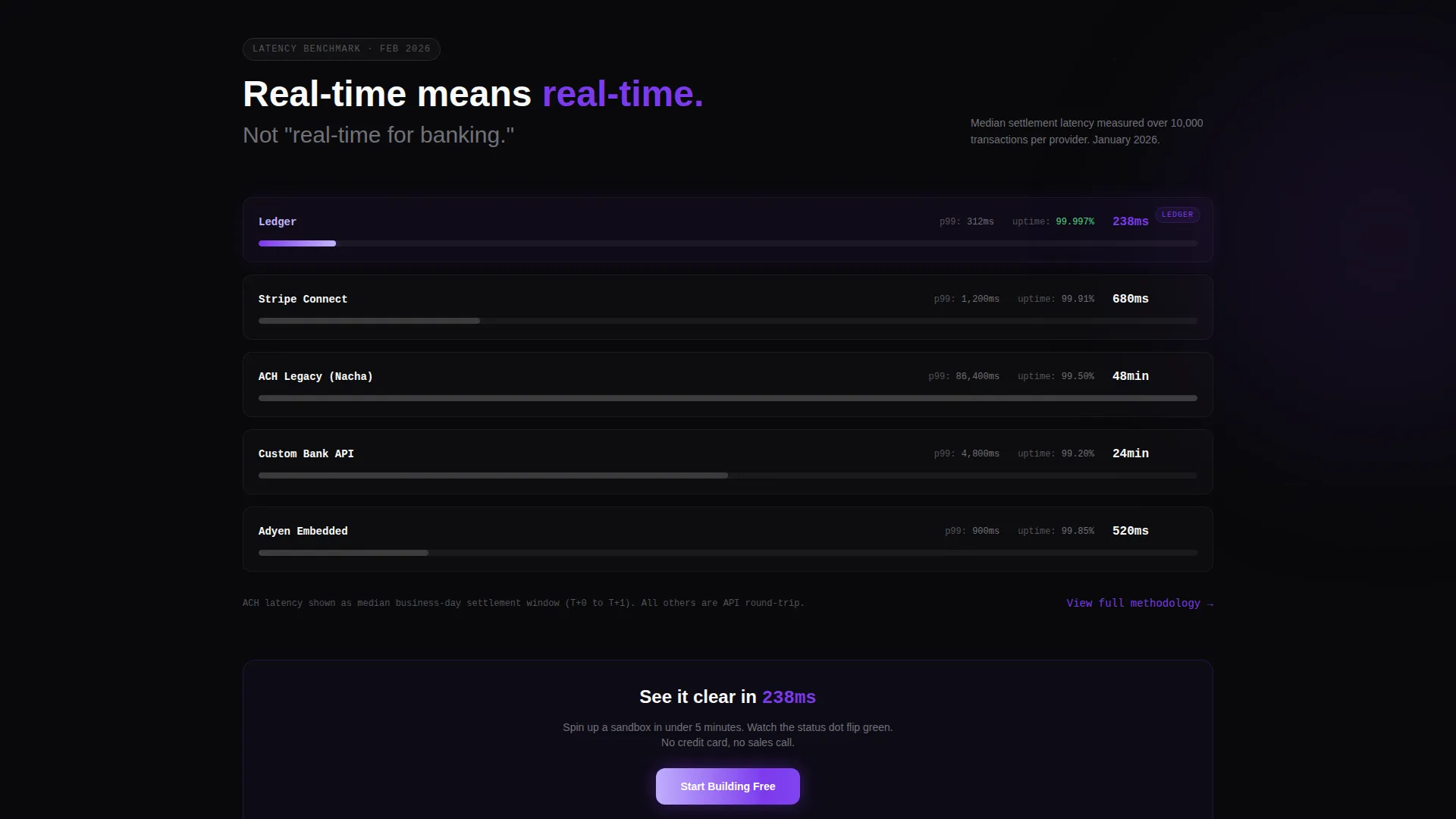
A dedicated section presents a side-by-side latency comparison against legacy providers. The layout mirrors a slide from a board deck, giving technical buyers a concrete reason to prefer this infrastructure over stitching together older banking APIs.
Sticky Freemium Conversion Bar
After the first scroll, a slim top bar pins itself to the viewport. It holds a single email input, a GitHub OAuth button, and an "Explore the Docs" secondary link. The bar stays visible throughout the full page scroll without interrupting the reading experience.
Dynamic Motion Theme
Every active element, progress bar, and confirmation state uses the deep interstellar violet color to signal that money is moving. Transaction rows emit a subtle violet glow as they stream in. The motion system is purposeful and tied to product states, not decorative.
Six-Line Code Integration Story
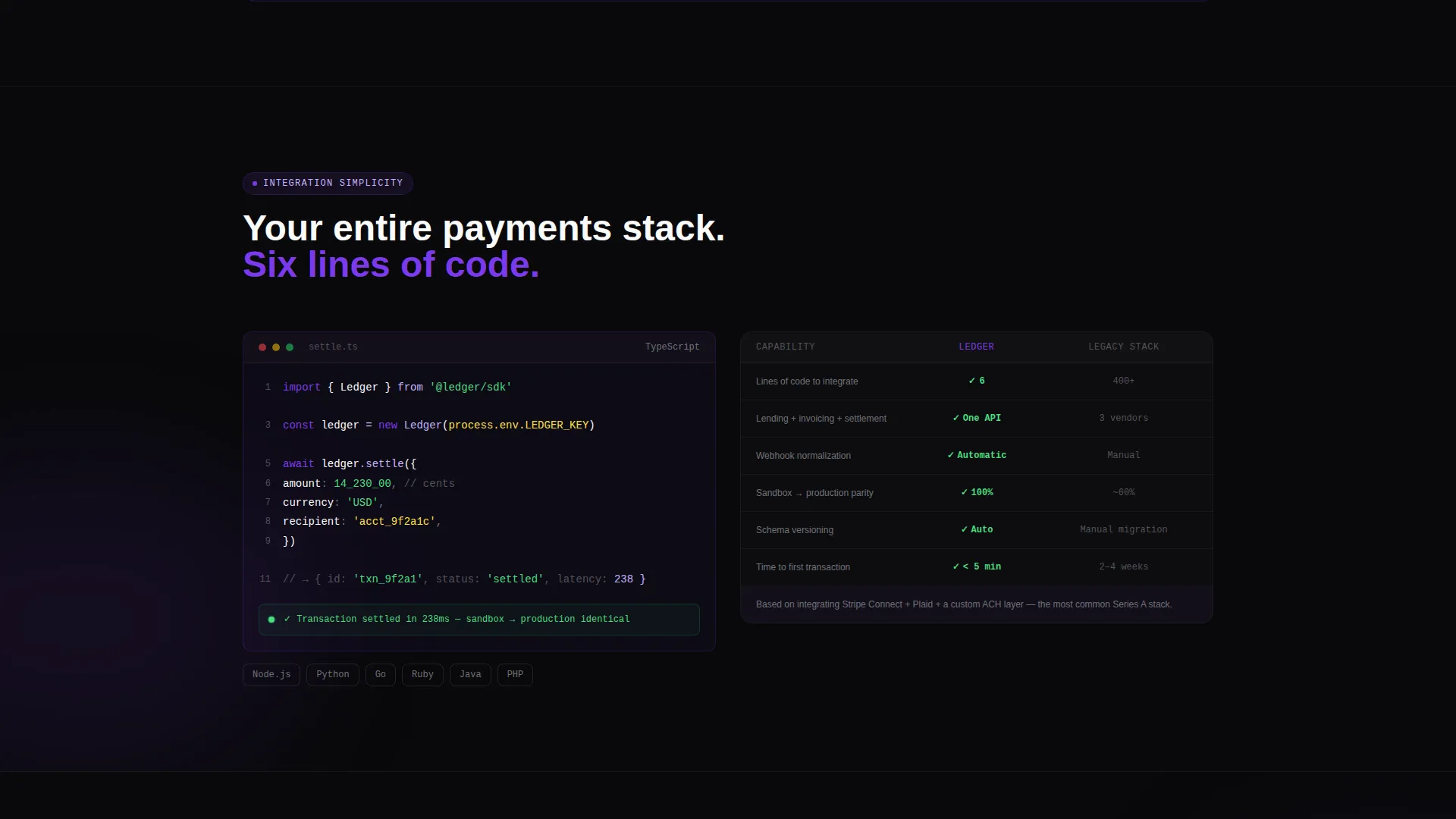
The page communicates that embedding lending, invoicing, and real-time settlement takes six lines of code. This integration simplicity claim is woven into the narrative arc so developers absorb it as evidence, not marketing copy.
Page sections overview
| Section | Purpose |
|---|---|
| Sticky conversion bar | Pins freemium call to action after first scroll |
| Mock dashboard header | Shows live transaction feed and metrics |
| Problem scale card | Quantifies developer drop-off at payment step |
| Cost of inaction card | Escalates urgency with data findings |
| Integration simplicity card | Demonstrates six-line code embed story |
| Latency benchmark section | Compares speed against legacy providers |
| Freemium sign-up footer | Closes page with primary and secondary call to action |
Design & branding system
The visual identity is built on the Void and Violet color system. The palette is engineered to feel like a mission-control screen at 2 a.m., where every glow carries meaning and every active state is unmistakable.
- Core colors: absolute void black (#09090B) for all backgrounds, deep interstellar violet (#7C3AED) for active elements and progress bars, phosphor lilac (#C4B5FD) for secondary metrics and hover states, and terminal white (#FAFAFA) for data text
- Motion principles: violet pulses where money is alive and moving; transaction rows receive a subtle violet glow on stream-in; chart bars animate upward on load; all motion is tied to product state changes, not decorative loops
Mobile & speed optimization
The template is designed so the dashboard-first layout reads cleanly at smaller viewport sizes. Data cards stack vertically on mobile without losing their two-column visual logic at tablet widths and above.
- The sticky conversion bar collapses gracefully on narrow screens, keeping the email field and GitHub button accessible without crowding the viewport
- Animated chart elements use scroll-triggered draw-on behavior so motion fires only when a section enters view, keeping the page feel intentional on all devices
How this template helps you convert
The page is structured as an evidence accumulation machine. Each section adds one more reason why building on this infrastructure is the rational choice, and each design decision removes one more reason to delay signing up.
- The mock dashboard header proves the product works visually before any copy makes a claim, building immediate developer credibility
- The sticky freemium bar with no credit card and no sales call requirement removes the two most common reasons technical buyers abandon a sign-up flow
Other information about this template
The Ledger template sits inside the Startup and Launch category, specifically built for the Fintech Series A niche. It pairs the Dashboard and Data Grid template style with the Industry Report creative direction, making it well suited for founders who need their landing page to function like a product demo and a pitch deck at the same time.
- The template uses the Dynamic Motion theme throughout, meaning animations are purposeful and tied to data states rather than ambient effects
- The header concept follows an Interactive Preview pattern, where the product interface itself replaces any hero illustration or photography
- The freemium and trial landing page direction shapes every call to action: the primary path is frictionless self-serve, and the secondary path leads developers to API documentation
- This template works well for payments infrastructure companies, embedded finance platforms, and developer-first fintech startups preparing for a Series A growth push
Theme
Dynamic Motion
Creative direction
Industry Report
Color system
Void & Violet
Style
Dashboard/Data Grid
Direction
Freemium/Trial
Page Sections
Interactive Mock Dashboard Header
Scroll-triggered Data Cards
Side-by-side Latency Benchmark
Sticky Freemium Conversion Bar
Dynamic Motion and Violet Glow System
Six-line Integration Narrative
Related questions
Is this template suitable for a developer audience?
Does the template include a working API or live sandbox?
Can I update the mock dashboard numbers to match my product metrics?
What conversion model does this template support?
How does the sticky conversion bar behave on the page?