Conspiracy Theory Analysis Content Professional Website Template
Codex is a horizontal scroll landing page template built for conspiracy theory analysis communities. It pairs a crosshatch panoramic illustration with a chronological gallery of case files, guiding visitors from ancient theories to modern ones. A gated archive call to action and a free featured dossier work together to earn trust before asking for commitment.
by Rocket studio
Quick summary
Codex is a single-page, horizontal scroll landing page template designed for research-driven online communities focused on conspiracy theory analysis. The layout walks visitors through a corridor of case files, building credibility with real content before presenting a gated archive sign-up. It blends editorial depth with immersive visual design.
Who this template is for
This template is built for people who take source-based research seriously and want a home for that work online. It suits communities that value primary documents, long-form analysis, and the kind of curiosity that keeps people reading past midnight.
- Community builders running a conspiracy theory analysis platform or research archive
- Independent editors and retired journalists launching a curated investigative reading room
- Graduate students, researchers, or educators who need a compelling destination for misinformation studies content
What problem this template solves
Most content templates treat research communities like blogs. They offer a header, a few cards, and a newsletter box. That approach fails for audiences who want depth, not headlines. Visitors leave before they trust the community because the page never shows them what the community actually does.
- Generic layouts cannot communicate editorial rigor or source-based credibility at a glance
- Standard vertical scroll pages give no sense of a curated journey through layered historical material
- Conversion forms placed too early ask for commitment before the visitor has seen any real value
What you get with this template
The template delivers a fully designed, single-page horizontal scroll experience with high interactivity and a clear conversion path. Every section is pre-structured and ready to populate with your own research content.
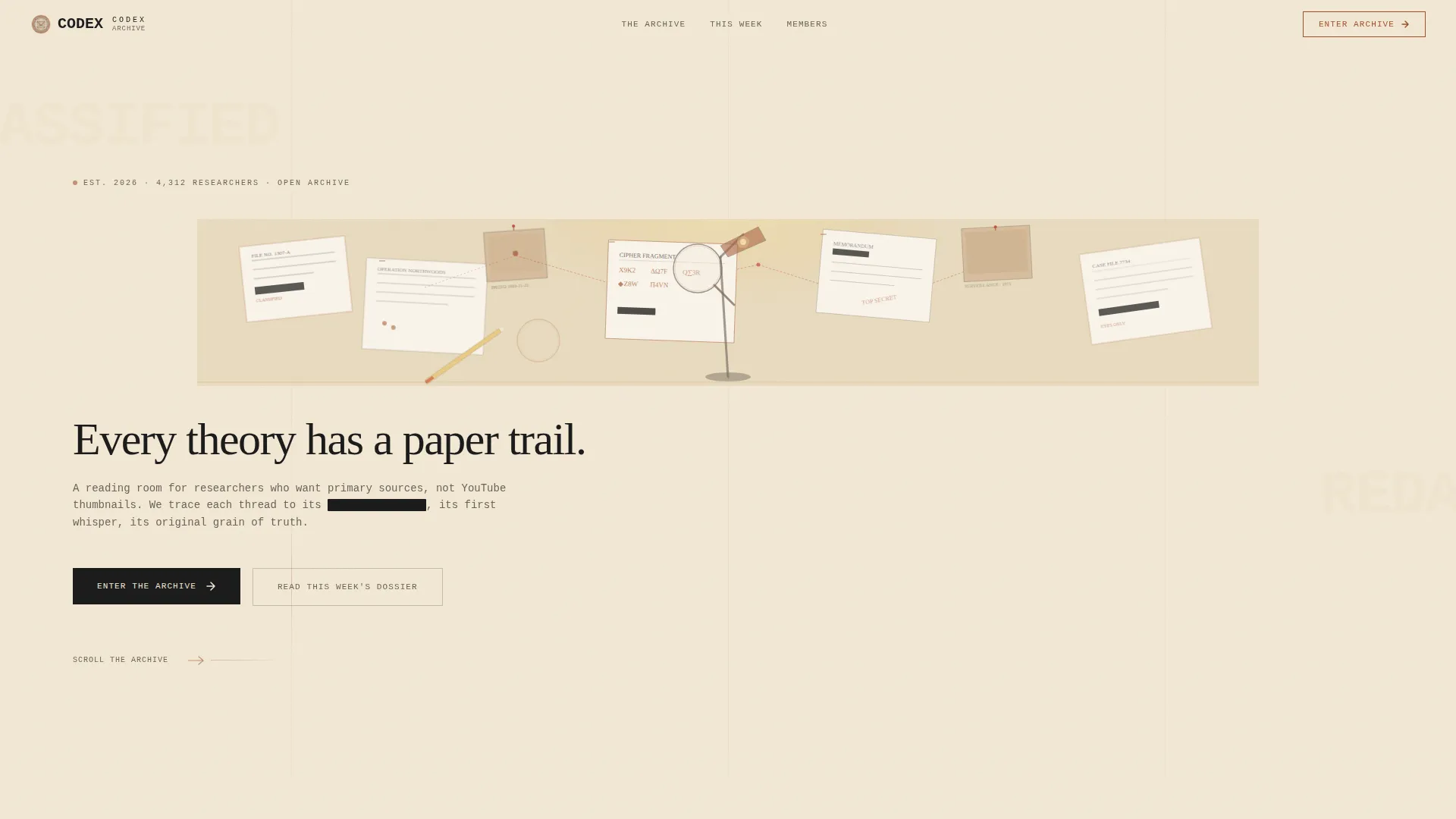
- A panoramic crosshatch desk illustration header with a typewriter headline animation and a community member count badge
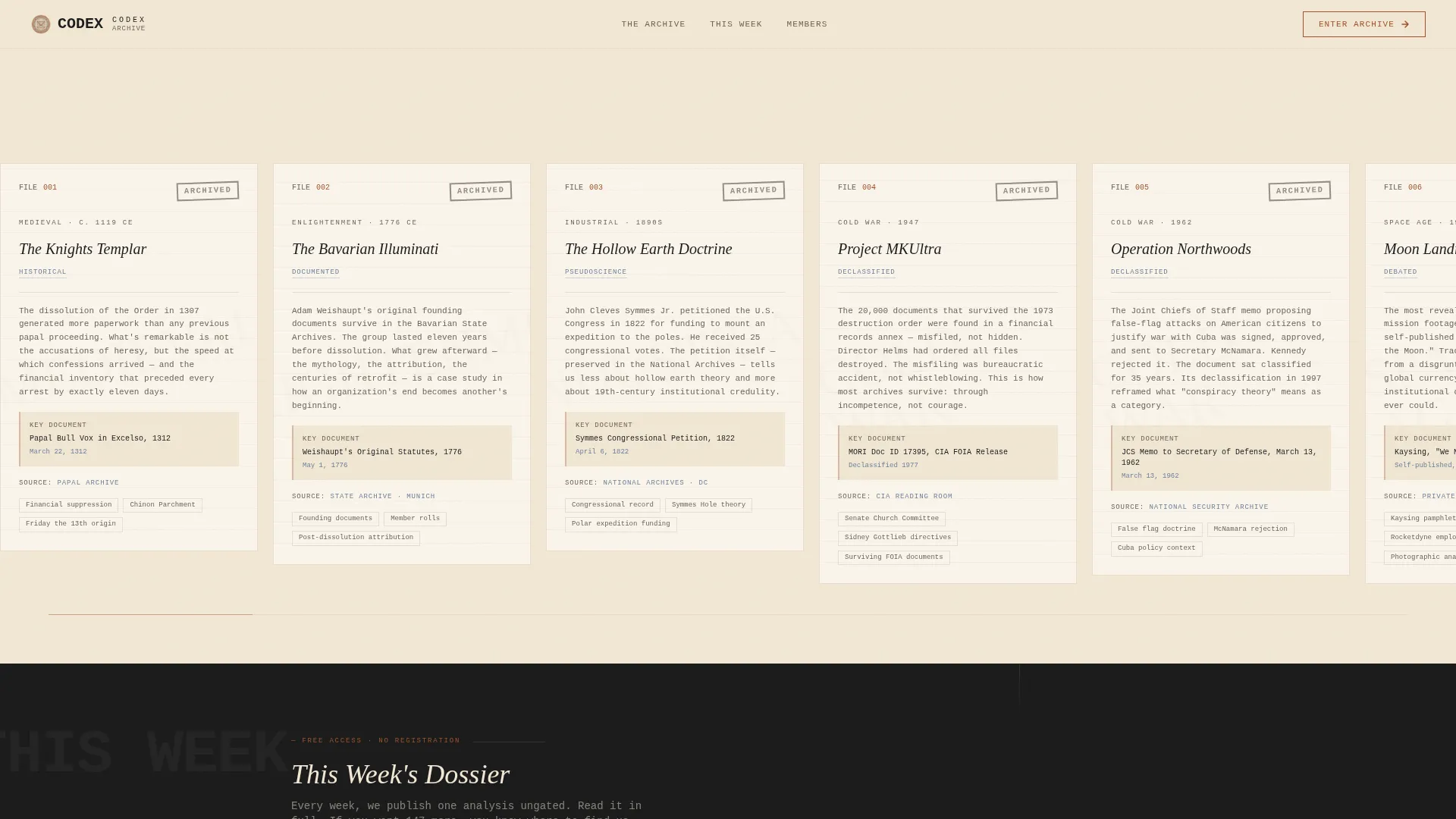
- A horizontal gallery of chronological case file frames spanning ancient, Cold War, and modern theories, plus a free featured dossier section
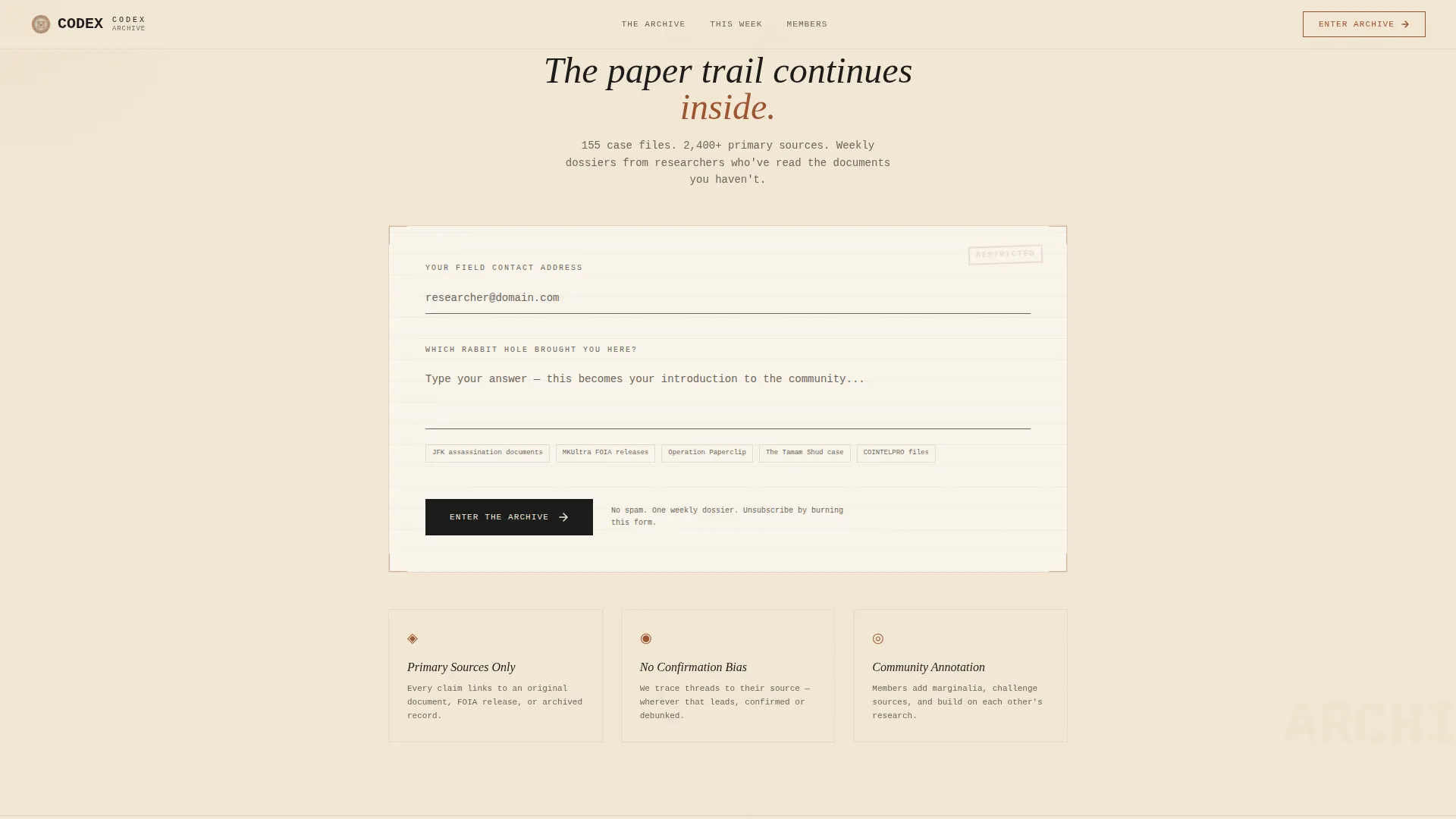
- A gated archive call to action with an email field and a custom onboarding question field, followed by a minimal horizontal flow footer
Feature list
This template is built around six core capabilities drawn directly from the source brief.
Horizontal Scroll Gallery with Snap Points
The primary layout moves visitors sideways through a corridor of case file exhibits. Each frame snaps cleanly into view, presenting a theory name, origin date, a key document reproduction, and a one-paragraph analysis excerpt. The progression runs chronologically, from the Knights Templar through Cold War programs to modern surveillance topics.
Typewriter Headline Animation
The hero headline fades in letter by letter, mimicking typewriter keys striking paper. This effect sets the editorial tone immediately and reinforces the aged-document aesthetic before the visitor scrolls a single pixel.
Panoramic Custom Illustration Header
A wide-format, hand-drawn crosshatch scene depicts a research desk viewed from above, complete with overlapping documents, red string, pinned photographs, a magnifying glass on a half-decoded cipher, and a hard circle of desk-lamp light. The illustration extends beyond the viewport on both sides, signaling the horizontal scroll interaction.
Gated Archive Sign-Up with Onboarding Field
The primary call to action gates the full research library behind an email form. A single open-ended question, "Which rabbit hole brought you here?", doubles as community onboarding data and makes the sign-up feel like an invitation rather than a transaction.
Free Featured Dossier Section
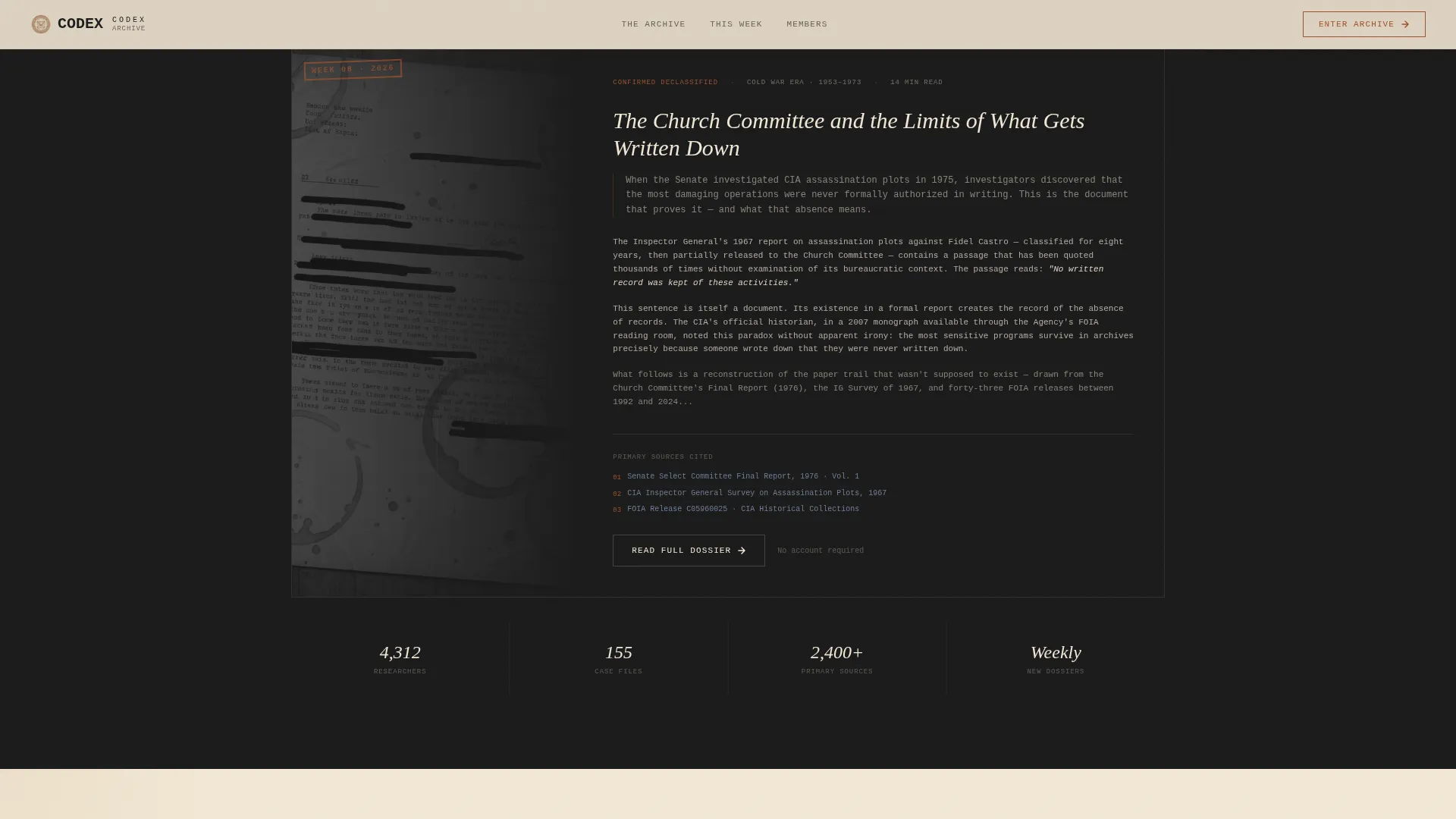
A secondary, ungated path lets visitors read a featured weekly analysis before committing. This section demonstrates the depth and sourcing quality of the community's work, building trust through content rather than promises.
Spotlight and Parallax Interaction Effects
Case file cards respond to hover with a spotlight effect. Parallax layers and staggered reveal animations run via Intersection Observer, giving the page a sense of physical depth without relying on heavy external libraries.
Page sections overview
| Section | Purpose |
|---|---|
| Hero Illustration | Panoramic desk scene, typewriter headline, horizontal scroll invitation, member count badge |
| Horizontal Case Gallery | Chronological case file corridor from ancient to modern theories |
| Featured Dossier | Ungated analysis excerpt building trust before the archive call to action |
| Enter the Archive call to action | Email sign-up form with custom onboarding question field |
| Minimal Footer | Horizontal flow footer with essential links |
Design & branding system
The visual identity follows a Heritage and Story theme built entirely around the feeling of a declassified file folder left in a humid archive. Every color, typeface, and texture choice reinforces that atmosphere.
- Color palette: aged vellum (#F2E8D5) for backgrounds, oxidized iron (#A0522D) for accents and section dividers, redacted-ink black (#1A1A1A) for body text, and faded dossier blue (#6B7F99) for hyperlinks and interactive marginalia
- Typography stack: Fraunces for display headings, JetBrains Mono for body copy and captions, DM Sans for user interface labels
- Negative space between case frames holds faint watermark text of redacted passages, rewarding visitors who pause and read slowly
Mobile & speed optimization
The template is designed desktop-first because horizontal scroll is the primary experience. A vertical fallback layout is included for smaller screens, so mobile visitors still access all content in a readable format.
- Smooth scroll behavior uses native CSS rather than heavy JavaScript libraries, keeping the interaction lightweight
- Intersection Observer drives all reveal animations, so elements load and animate only when they enter the viewport
How this template helps you convert
The conversion strategy is built on a show-first principle. Visitors experience real content before they see any sign-up request.
- The horizontal gallery delivers genuine analysis, real sourcing, and actual case file content across every frame, so by the time visitors reach the call to action, they have already been inside the archive in every meaningful sense.
- The free featured dossier acts as a trust layer, giving undecided visitors a complete, ungated sample of the community's editorial standard before asking for an email address.
Other information about this template
A few additional details are worth noting for anyone evaluating this template against their project needs.
- The template is categorized under Blog and Editorial, with a subcategory focus on conspiracy theory analysis content
- The onboarding question field, "Which rabbit hole brought you here?", is designed as a text input that can inform how you segment or welcome new community members
- Animation intensity is high throughout: typewriter effects, horizontal scroll snap, spotlight card hover states, parallax layers, and staggered reveals are all included
- The footer follows a horizontal flow pattern with minimal elements, keeping the exit experience consistent with the overall layout direction
- The template is built for an English-language audience using United States date formats, making it a natural fit for US-based research communities
Theme
Heritage & Story
Creative direction
Gallery Walk
Color system
Parchment & Rust
Style
Horizontal Scroll
Direction
Content/Resource
Page Sections
Horizontal Scroll Gallery with Snap Points
Typewriter Headline Animation
Panoramic Custom Illustration Header
Gated Archive Sign-up with Onboarding Field
Free Featured Dossier Section
Spotlight and Parallax Interaction Effects
Related questions
Who is the Codex template designed for?
Does the horizontal scroll work on mobile devices?
What is the Enter the Archive call to action?
Can I use this template for a research community outside the conspiracy theory niche?
What animations and interactions are included in this template?