DevTools Startup Professional Website Template
The Compile Interactive Devtools Pitch Deck Landing Page Template is a single-page, split-screen pitch deck built for developer tools companies. It uses live syntax-highlighted code, animated JSON API responses, and an interactive benchmark slider to show engineers exactly what the product does before they install anything. Dark glassmorphic styling, monospace typography, and friction-free calls to action make every scroll feel like hands-on product use.
by Rocket studio
Quick summary
This pitch deck template is purpose-built for developer tools startups. It replaces static slide shows with a fully interactive pitch that proves product value through live code, real API responses, and a draggable latency benchmark. The audience sees the product in action before they ever run a command. The result is a startup pitch deck that earns the install through evidence, not persuasion.
Who this template is for
This template is designed for technical founders and developer-relations teams who need to pitch a developer tool to a skeptical, technically literate audience. Standard pitch presentations often fall flat with engineers. This pitch deck template speaks their language from the first slide onward.
- Senior backend engineers evaluating tools late at night with many browser tabs open, who need proof before commitment
- DevRel leads building internal adoption cases and needing a pitch deck that can stand alone without a presenter
- CTOs and engineering managers who need to understand market opportunity, business model fit, and team credibility fast
What problem this template solves
Most startup pitch deck formats were designed for business audiences, not engineers. They rely on bullet points, financial projections summaries, and market slide abstractions. When the audience is technical, that approach loses them immediately. A pitch deck for developer tools needs to demonstrate the solution, not just describe it.
- Engineers distrust claims they cannot verify; a static deck with a problem statement and vague solution slide fails to build trust
- Traditional pitch presentations require a presenter to explain context; this template makes the product self-evident through interactive elements
- Without a clear, working demo, potential investors and technical evaluators move on in seconds; investors typically spend only 3 minutes and 44 seconds reviewing a deck
What you get with this template
You get a complete, single-page pitch deck landing page structured around progressive proof. Every section is a demonstration, not a declaration. The template is built to let the product's behavior speak louder than any headline.
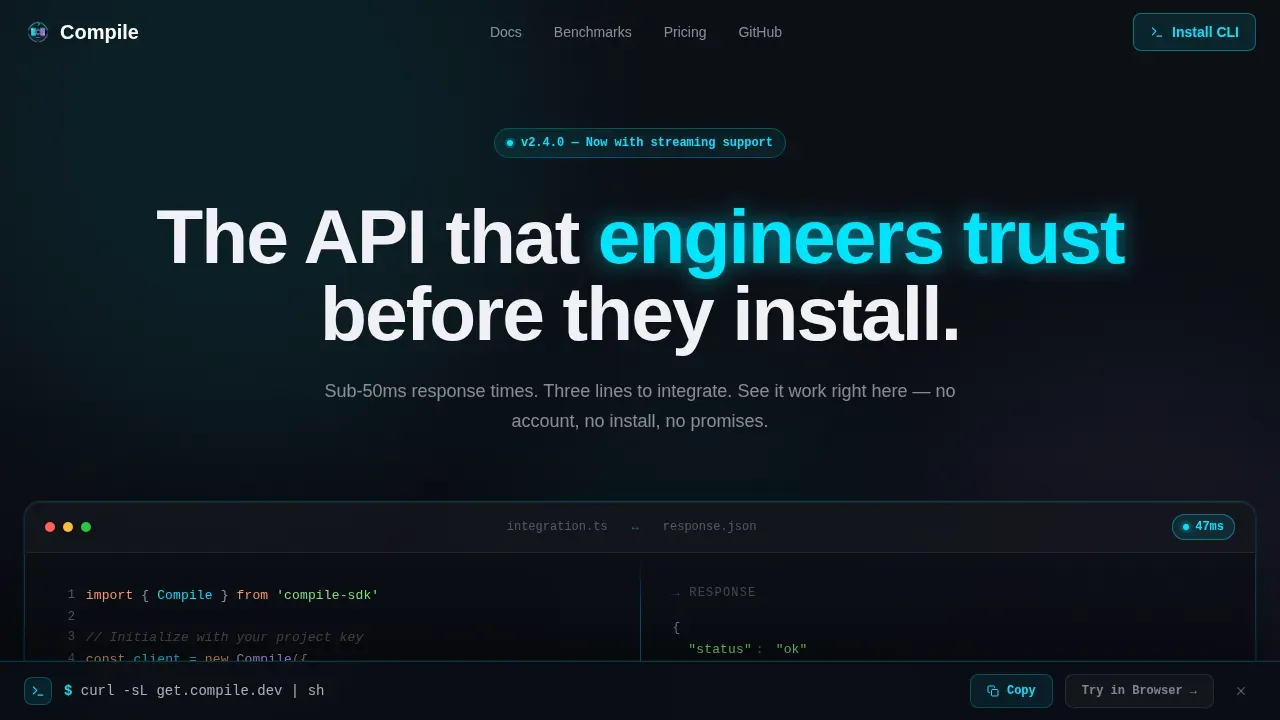
- A split-screen hero section with a live syntax-highlighted code block on the left and an animated JSON API response on the right, including a pulsing 47ms latency badge
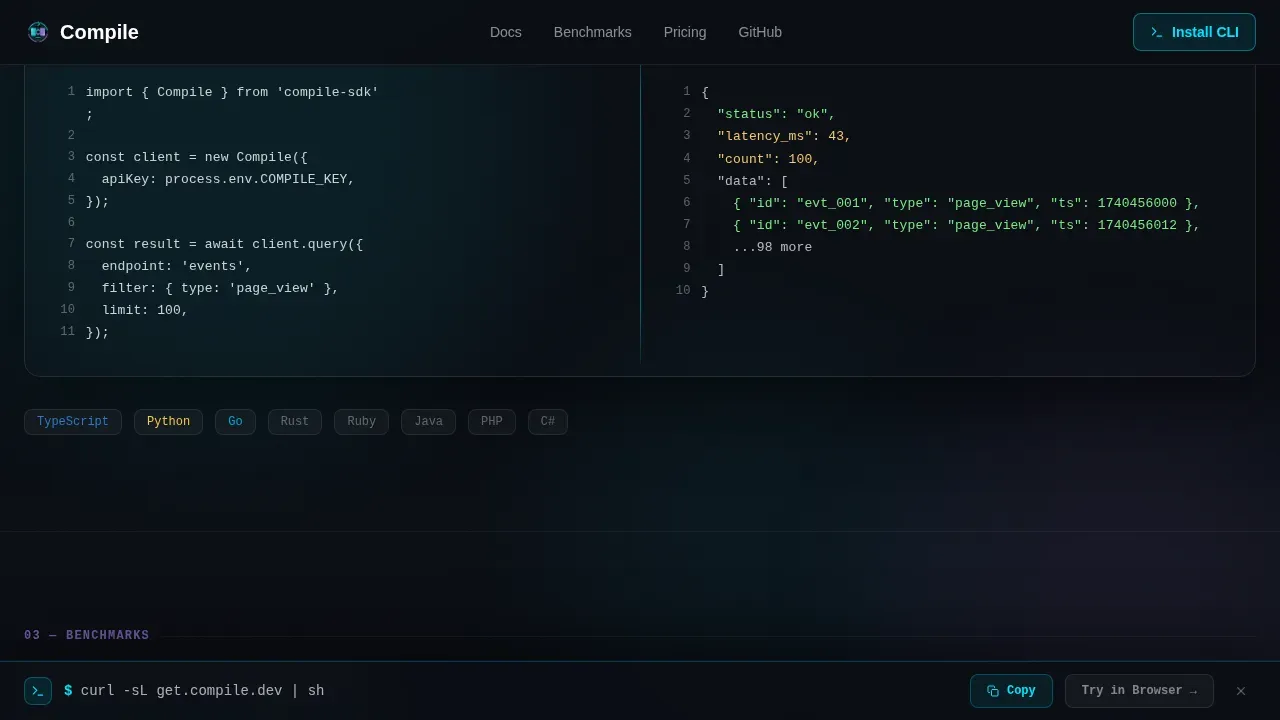
- An SDK Explorer fold with language tabs for Python, Go, and TypeScript that transform both the code snippet and the response output live on click
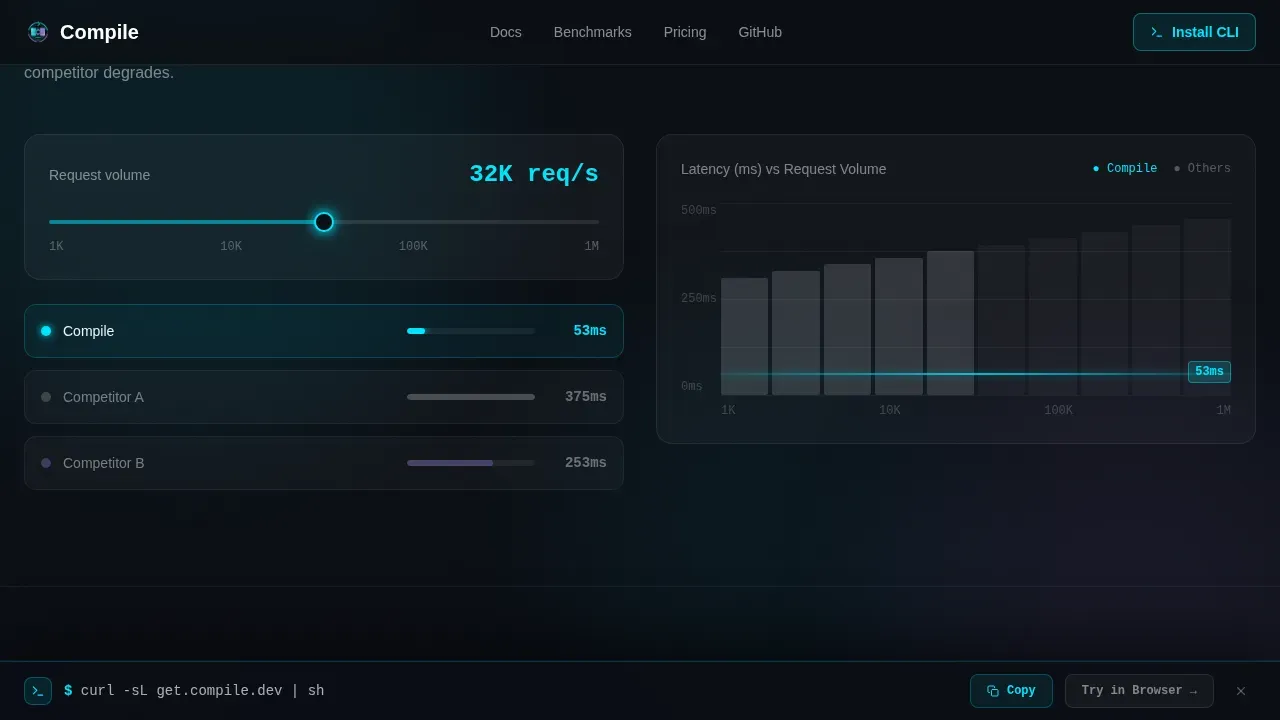
- A benchmark slider fold where dragging from 1K to 1M requests redraws a latency graph in real time, followed by a social proof section and a friction-free call to action bar with a one-line terminal install command
Feature list
This pitch deck template ships with a focused set of interactive and visual capabilities drawn directly from the Compile product brief. Each one is designed to serve the engineer-first audience without wasted motion.
Split-Screen Hero with Live Code Block
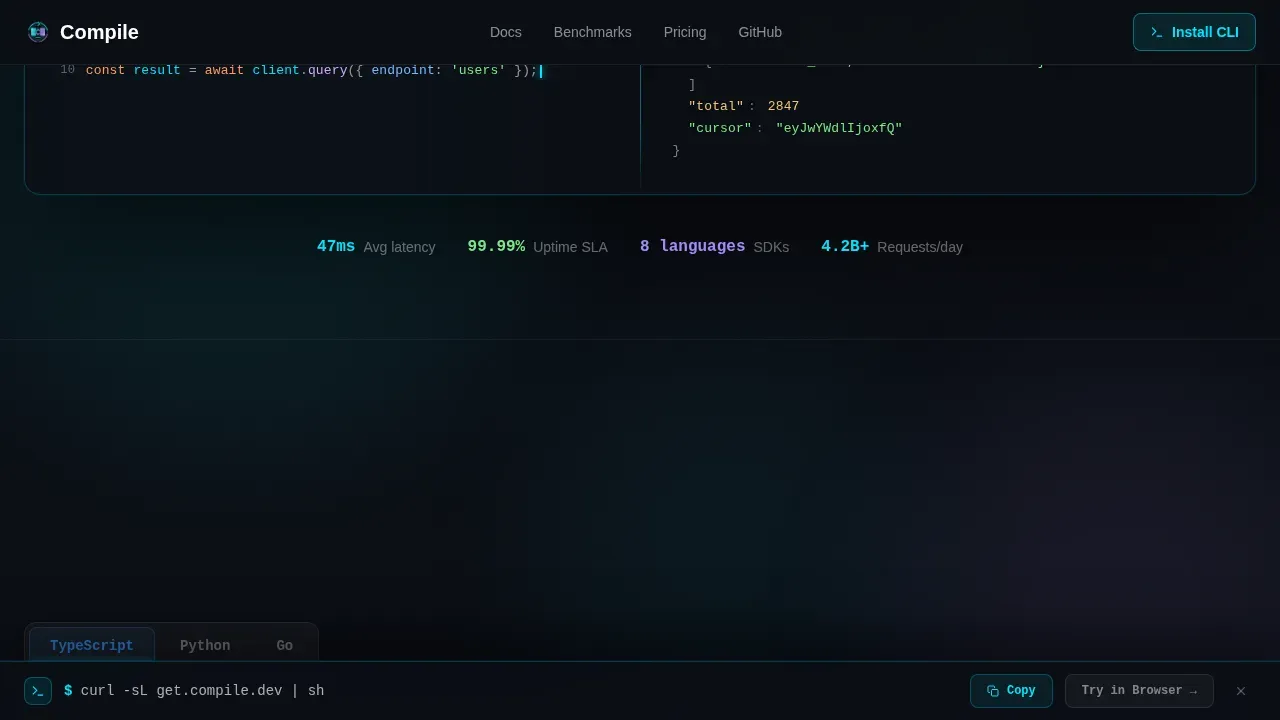
The hero section divides the viewport into two equal panels. The left panel holds a syntax-highlighted integration code snippet with line numbers and a blinking cursor. The right panel displays a formatted JSON API response that populates key by key with a staggered animation. A latency badge reading "47ms" pulses once in electric cyan to anchor the product's speed story at the very first slide.
Toggleable SDK Language Explorer
The second fold is an interactive pitch panel that lets visitors switch between Python, Go, and TypeScript tabs. Clicking a language tab transforms both the code example and the corresponding API response live. This section functions as an inline product slide and solution slide combined, showing integration depth without requiring a separate docs page.
Real-Time Benchmark Slider
The third fold features a draggable range slider that scales request volume from 1,000 to 1,000,000. As the visitor drags, the latency graph redraws in real time. This section communicates scalability and growth potential in a format engineers can manipulate themselves, covering the competitive advantage story without a single marketing claim.
Sticky Install call to action Bar
After the first interactive section, a sticky bottom bar anchors to the viewport. It displays the primary call to action, "Install the CLI," alongside a one-line terminal command the visitor can copy with a single click. A secondary path, "Try in Browser," links to a zero-auth sandbox. No form fields, no email gates. The template converts by removing friction at the exact moment intent is highest.
Social Proof and Adoption Stats Section
The fourth fold holds a dedicated block for latency numbers, request volume stats, named engineering team logos, and direct engineer quotes. Storytelling in pitch decks is crucial for engaging potential investors, and this section turns real usage data into the most credible story the deck can tell. Early traction and press mentions belong here.
Glassmorphic Dark user interface System
The entire pitch deck template uses a Tech Glass visual language. Frosted-panel cards float over a deep void black background. Electric cyan borders mark interactive states. Lavender highlights activate on hover and selection. JetBrains Mono renders all code blocks. Manrope handles interface text. The result is a well designed pitch deck aesthetic that feels native to the product it is selling.
Page sections overview
| Section | Purpose |
|---|---|
| Hero Split Screen | Show live code and animated API response side by side |
| SDK Explorer Panel | Let visitors switch languages and see code transform live |
| Benchmark Slider Fold | Demonstrate scalability by dragging request volume in real time |
| Social Proof Block | Present adoption stats, team logos, and engineer quotes |
| Final call to action Bar | Deliver the install command and sandbox link with zero friction |
| Ultra-Minimal Footer | Close the page cleanly without distraction |
Design & branding system
The design language is Tech Glass: a glassmorphic system built entirely on dark depth and translucent layering. Every visual decision serves the engineer audience. There is no stock imagery anywhere. The product is the visual.
- Color palette: deep void black (#0B0E14) background, frosted panel white at 12% opacity (#FFFFFF1F) for cards, electric cyan (#00E5FF) for live-state accents and interactive borders, muted lavender (#A78BFA) for hover and selection states, and high-contrast white (#F0F0F5) for all body text
- Typography: JetBrains Mono for all code blocks with faint cyan border glows, Manrope for all interface and presentation text; monospace code rendering throughout reinforces developer experience (DX) credibility
Mobile & speed optimization
This template is built desktop-first, matching how the primary audience evaluates tools: on large monitors, late at night, with full keyboard and mouse access. The interactive elements are optimized for pointer input. Mobile responsiveness is included so the pitch deck still presents cleanly on any screen size.
- Animations use GPU-accelerated transforms for the blinking cursor, key-by-key JSON population, latency ticker, and graph redraw; no third-party scroll libraries are included
- Native CSS smooth scroll handles all section transitions, keeping the interactive pitch feeling fast and direct without external dependencies
How this template helps you convert
This startup pitch deck template is designed to convert skeptical engineers into active users through accumulated evidence. The conversion path mirrors the way a great pitch deck builds momentum: each scroll delivers another verifiable proof point, and the install moment arrives only after trust is already established.
- The interactive pitch sequence moves visitors from passive readers to active product testers within the first two folds, replacing the need for a traditional elevator pitch with hands-on product experience that engineers can verify themselves
- The sticky call to action bar and one-click terminal command copy eliminate the moment of hesitation; by the time a visitor reaches the install prompt, they have already seen key metrics, run through SDK options, and stress-tested the benchmark slider
Other information about this template
This pitch deck template sits at the intersection of startup pitch deck craft and developer product marketing. Understanding both contexts helps you get the most out of it.
- Key elements of a strong pitch deck include a clear problem statement, a compelling solution, a defined market opportunity, honest financial projections, and a business model that shows how the company scales; this template structures those proof points as interactive sections rather than static slides
- A well-crafted pitch deck is essential for attracting investors and communicating a startup idea clearly; keeping the deck to 10 to 15 slides with one primary message per slide enhances scannability, and this template applies that discipline to a single scrollable page
- The competitive landscape for developer tools is dense; this template dedicates the benchmark slider fold to showing competitive advantage through live data rather than a competitive landscape comparison table, letting the numbers speak directly to direct competitors
- Successful pitch deck examples from companies like Airbnb and Dropbox, whose pitch deck is noted for its minimal text and powerful impact, prove that restraint and clarity convert better than density; this template applies the same principle to a developer-first context
- Figma offers a variety of pitch deck templates, and Genially provides interactive pitch deck templates with clickable buttons and responsive elements; this template goes further by embedding the actual product behavior into the pitch deck experience itself
- Slidebean features a collection of pitch deck templates designed to help startups communicate their business ideas to investors, and Slidebean's templates provide a fill-in-the-blank outline; this template instead gives you a fully designed, interaction-ready framework for a developer tools pitch
- For go to market strategy framing, the template supports a go to market slide narrative built around open-source-to-cloud adoption and developer sign-up velocity, which are the key metrics most relevant to venture capital and technical investor presentation contexts
- The team slide, traction slide, and go to market slide content areas can be adapted within the social proof and stats section to address potential investors who need to see early traction, growth potential, and the company's position in the market
- San Francisco and silicon valley developer tool companies often use this style of interactive pitch to captivate investors at demo days; the template's format is aligned with how successful startups in those ecosystems present technical products
- Additional resources, press mentions, and an investor presentation follow-up path can be linked from the footer using the ultra-minimal Vercel Horizontal Flow pattern included in the template
Theme
Tech Glass
Creative direction
Interactive Explorer
Color system
Glassmorphic
Style
Split Screen (50/50)
Direction
App Download
Page Sections
Split-screen Hero with Animated API Response
Toggleable SDK Language Explorer
Draggable Real-time Benchmark Slider
Sticky Friction-free Call to Action Bar
Social Proof and Adoption Stats Block
Tech Glass Glassmorphic Design System
Related questions
Can I adapt this template for a live investor presentation or slide deck format?
Does this template include the SDK language tabs out of the box?
How does the benchmark slider work?
Is this template suitable for a startup pitch deck aimed at venture capital investors?
Can I add financial projections or a go to market strategy section?