Hobby & Passion Content Blog & Content Website Template
Cure is a hub-and-spoke landing page template built for sausage making blogs and handcrafted food communities. It pairs a panoramic ink-and-watercolor workbench illustration with a sticky anchor navigation, five thematic content spokes, and a lightweight email signup. The warm Parchment and Rust palette, Atelier Studio layout, and masonry article grids give the page the unhurried feel of a well-loved reference book.
by Rocket studio
Quick summary
Cure is a single-page, hub-and-spoke landing page template designed for artisan sausage making journals and food communities. It opens with a panoramic hand-drawn workbench illustration, flows through five richly illustrated content spokes via sticky anchor navigation, and closes every visit with a low-friction email signup. The visual identity is warm, analog, and unapologetically craft-focused.
Who this template is for
This template was built for writers, educators, and enthusiasts who treat sausage making as a serious craft. Whether you document recipes for a small audience or run a thriving community of meat-curing obsessives, Cure gives you a home that matches the depth and care you bring to your work.
The template fits especially well for:
- Weekend hobbyists sharing their first attempts at fresh sausage, bratwurst, or pork butt blends with a growing readership
- Competitive sausage makers who want a professional-feeling hub to publish technique articles, competition recaps, and curated sausage recipes
- Charcuterie enthusiasts building a reference site around dry cured meats, curing chamber management, and preservation science
What problem this template solves
Most food blog templates are built for recipe cards and affiliate links. They were not designed for the layered, reference-book experience that serious sausage making content demands. A hobbyist or educator in this niche needs a page that can hold beginner guides, advanced technique articles, community posts, and a signup funnel all in one scrollable flow without feeling cluttered or generic.
Cure solves that problem directly:
- It organizes deep content into clearly labeled thematic spokes so readers can jump directly to the section that matches their skill level or interest
- It earns the email signup by displaying generous ungated content first, proving expertise before asking for a name and address
- It gives the page a visual identity that communicates craft, authenticity, and tactile knowledge from the first scroll
What you get with this template
Cure delivers a complete, ready-to-customize landing page built around five content spokes and a persistent conversion path. Every element in the template was described in the source brief and is present in the delivered layout.
You get:
- A full hub-and-spoke single page with sticky anchor navigation linking to six distinct sections: Hero, First Grind, The Spice Library, Smoke and Cure, Casing Room, and The Board
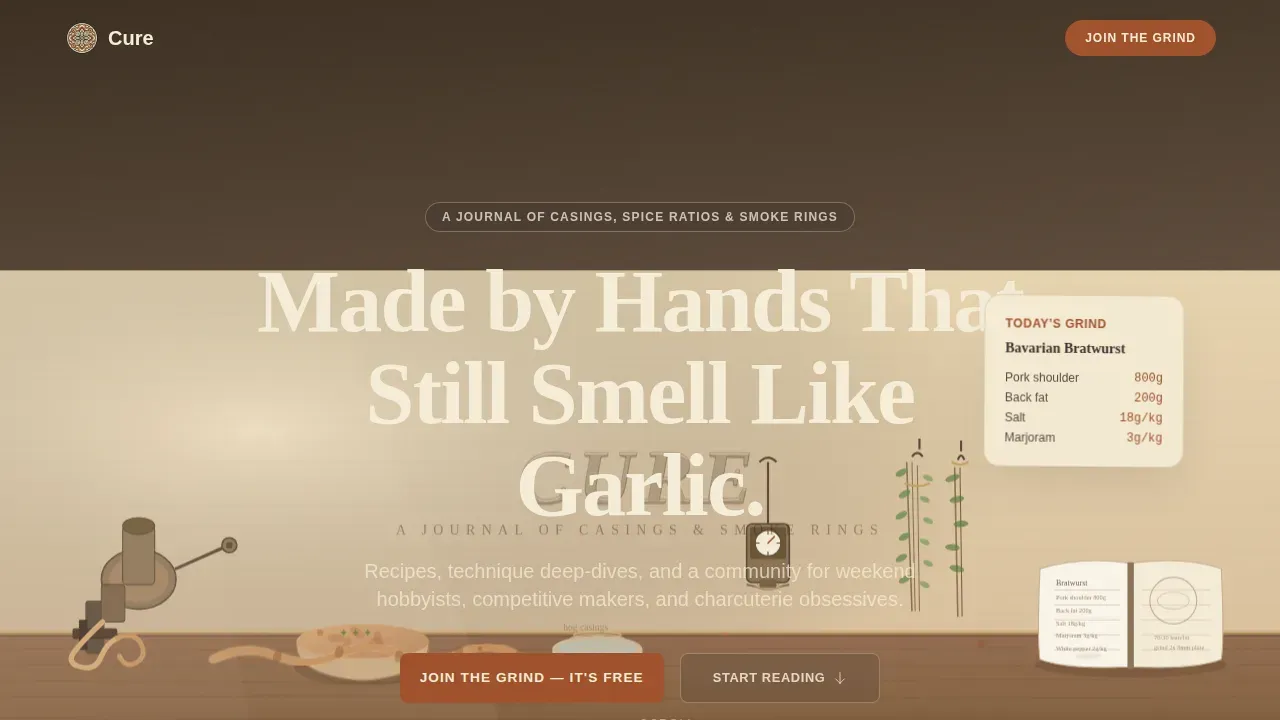
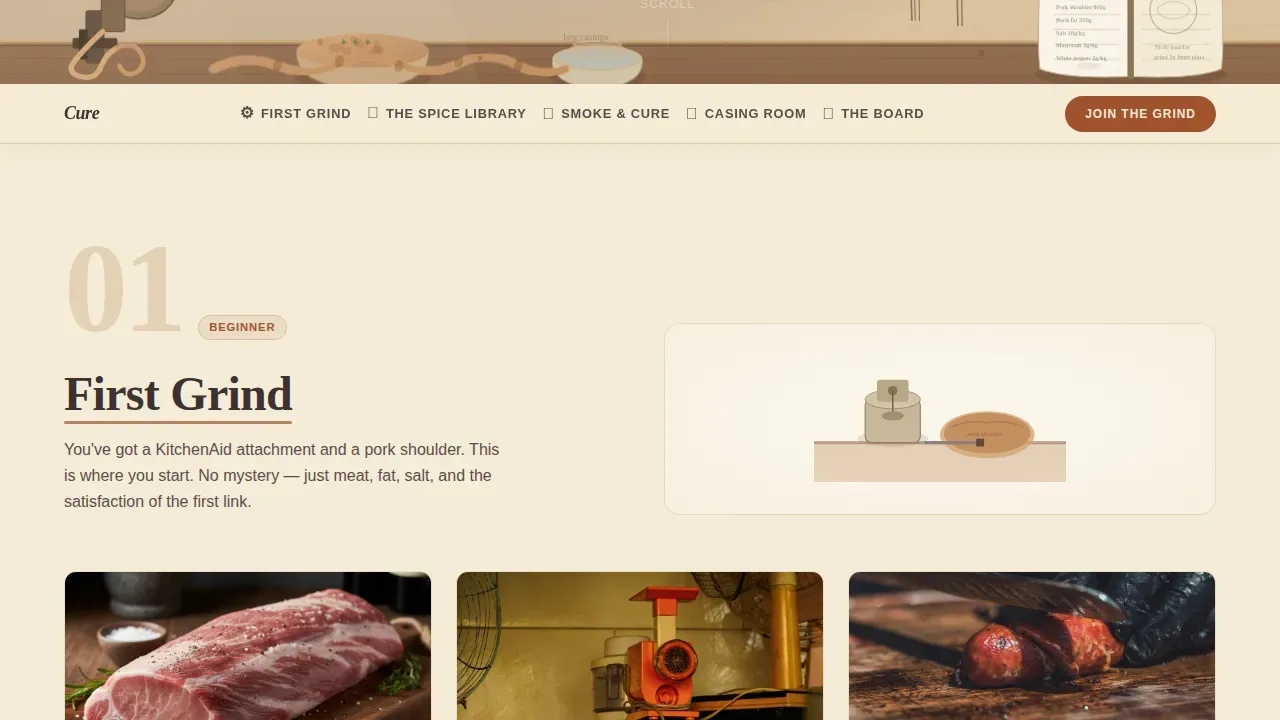
- A panoramic custom illustration header rendered in ink and muted watercolor showing a sausage maker's workbench complete with a manual grinder, forcemeat bowl, hog casings, hanging scale, dried herbs, and an open recipe notebook
- A dual-path email signup with a "Join the Grind" call-to-action button in both the header and anchor navigation, a free downloadable PDF ("The First Five: A Beginner's Sausage Recipe Collection"), and a newsletter preference checkbox
Feature list
This section outlines the core built-in capabilities of the Cure template. Every feature listed here is grounded in the source brief.
Panoramic Ink-and-Watercolor Hero Illustration
The header opens with a wide, hand-drawn workbench scene rendered in ink and muted watercolor. The style echoes a Victorian trades manual: botanically precise but warm and human. The blog title is lettered by hand within the illustration itself, integrated into the scene as though carved into the wooden bench surface. This approach gives the page an immediate visual identity that no stock photography template can replicate.
Sticky Anchor Navigation with Five Spoke Links
A sticky navigation bar sits at the top of the viewport throughout the scroll. It contains five anchor links, First Grind, The Spice Library, Smoke and Cure, Casing Room, and The Board, plus a persistent "Join the Grind" button. Each anchor link jumps directly to the matching spoke section below. This keeps navigation frictionless for readers who arrive knowing exactly what kind of sausage making content they want.
Thematic Spoke Sections with Masonry Article Grids
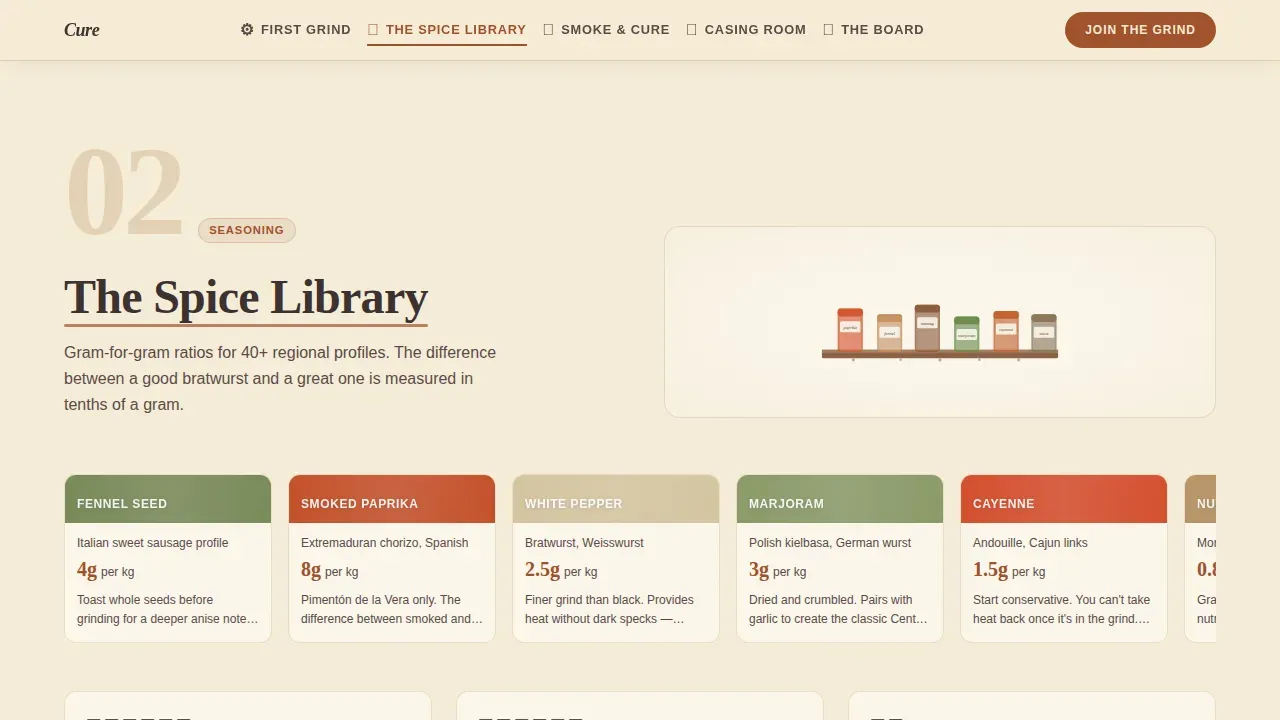
Each of the five content spokes opens with its own smaller illustration vignette before presenting article cards in a masonry grid layout. The spokes move from beginner territory in First Grind through seasoning ratios in The Spice Library, preservation techniques in Smoke and Cure, equipment deep-dives in Casing Room, and community posts in The Board. The progression mirrors the experience of turning through chapters of a reference book, rewarding curiosity with increasing depth and specificity.
Lightweight Dual-Path Email Signup
The conversion architecture is intentionally simple. Visitors who click "Join the Grind" encounter a modal that asks only for a first name and email address, plus a single checkbox to choose between a weekly recipe dispatch and a monthly technique deep-dive. A secondary path offers the free beginner PDF, gated behind the same lightweight form. Both paths lead to the same low-friction entry point.
Scroll Reveals, Parallax Hero, and Medium Animations
The template includes scroll reveal animations on section entries and a parallax effect on the hero illustration. Animation intensity is set to medium, giving the page a sense of momentum without distracting from the content. The sticky navigation transitions cleanly as sections enter and leave the viewport, and the email signup modal opens with a focused, uncluttered overlay.
Community Social Proof Layer
The Board section includes community post counts, competition recap thumbnails, and a featured reader quote. These elements work together to communicate that Cure is an active place, not a dormant archive. Social proof of this kind helps new visitors trust the community and feel comfortable signing up before they have read every article.
Page sections overview
| Section | Purpose |
|---|---|
| Hero Workbench Illustration | Opens with panoramic hand-drawn art, hand-lettered title, and primary "Join the Grind" call-to-action button |
| Sticky Anchor Navigation | Persistent top bar with five spoke links and a secondary signup button throughout the full scroll |
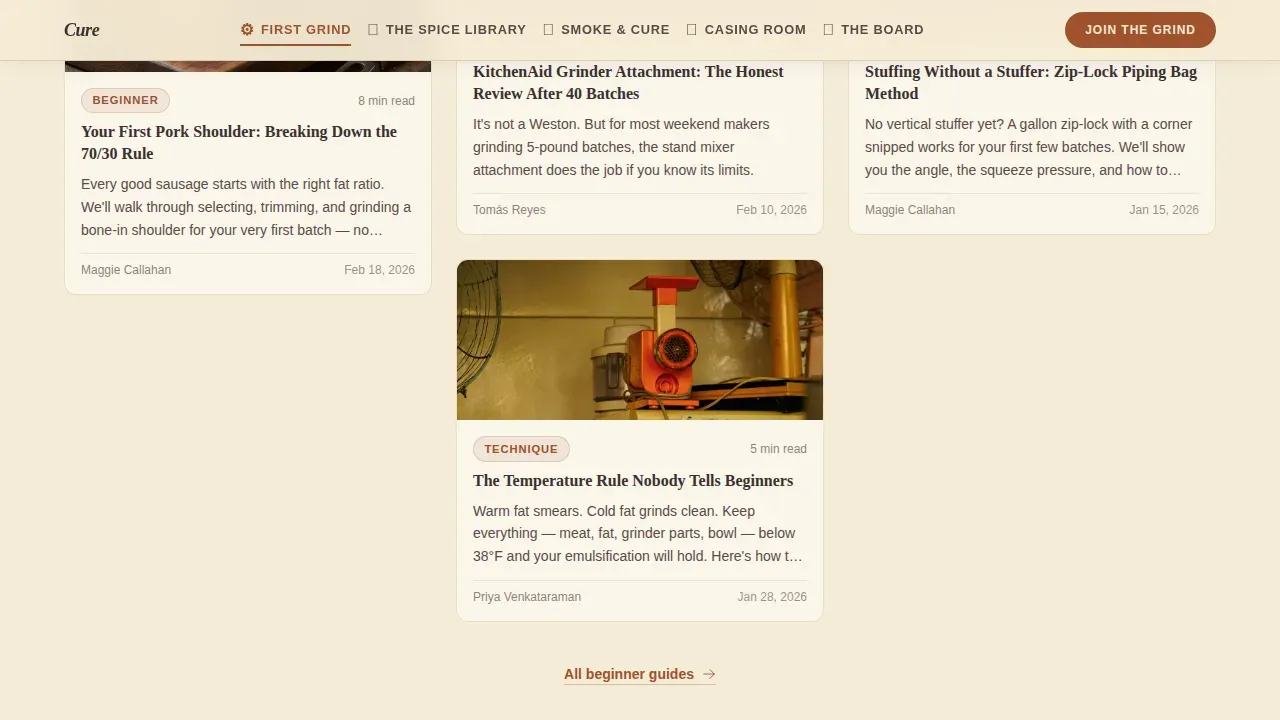
| First Grind Spoke | Beginner-focused articles with illustration vignette and masonry grid of entry-level sausage making guides |
| Spice Library Spoke | Seasoning ratio articles, regional spice profiles, and flavor-focused recipe cards |
| Smoke and Cure Spoke | Preservation technique articles covering smoked sausage, dry cured meats, curing chamber guides, and curing science |
| Casing Room Spoke | Equipment deep-dives covering grinders, stuffers, casings, smokers, and temperature tools |
| The Board Section | Community posts, competition recaps, reader quote, and secondary email signup call-to-action |
| Linear Footer Row | Single-row footer with navigation links and minimal supporting information |
Design & branding system
Cure uses an Atelier Studio visual identity built around the Parchment and Rust color system. The palette was chosen to evoke a farmhouse kitchen: warm, lived-in, and analog. Every color carries a specific role in the hierarchy.
The design system includes:
- Four palette values: aged parchment cream (#F5ECD7) as the canvas fill, butcher-paper tan (#D4B896) as a secondary surface, oxidized rust (#A0522D) for all accent links and hover states, and smoked iron (#3B3131) for body text, headlines, and navigation labels
- Two typefaces: Fraunces for headlines (which carry a hand-stamped, letterpress quality suited to the craft-food aesthetic) and DM Sans for body text (clean and readable at all paragraph sizes)
- A Victorian trades manual illustration style applied to the hero panorama and each spoke vignette, combining botanical-illustration precision with warm, human line quality
Mobile & speed optimization
Cure was designed desktop-first to honor the reference-book reading experience at full width. At the same time, the template includes full mobile support so that readers on smaller screens can still navigate the spokes, read articles, and complete the email signup without friction.
Key optimization details:
- Static content sections use server-rendered components, while interactive elements such as the sticky navigation, email signup modal, and masonry grid are handled client-side for smooth performance
- The sticky anchor navigation collapses cleanly on mobile viewports, preserving spoke access without crowding the screen
- The parallax hero illustration and scroll reveal animations scale and simplify appropriately on touch devices to avoid layout disruption
How this template helps you convert
Cure is built around a patient, content-first conversion philosophy. The page earns the signup by delivering real value before making any ask.
- The hero section and five spoke sections display generous, ungated content that demonstrates expertise immediately. Readers spend time with actual sausage recipes, technique guides, and community posts before they ever see a form field. This sequence builds trust organically.
- The "Join the Grind" button appears in both the hero and the sticky navigation, so a motivated visitor never has to scroll back to find the signup path. The modal is minimal: first name, email, and one checkbox. The free PDF incentive gives fence-sitters a concrete reason to act.
Other information about this template
Cure is a strong fit for creators who plan to publish content covering the full range of sausage making knowledge. The template's spoke structure scales naturally as the content library grows.
Here is additional context useful for evaluating whether Cure is the right template for your project:
- The template is designed for English-language content with a United States-centric focus on regional sausage styles, including American South traditions, Polish sausage profiles, summer sausage methods, and smoked sausage techniques rooted in US county fair and farmhouse culture
- The community layer in The Board section is designed to display user-generated content such as competition recap thumbnails and reader quotes, which is a proven way to build authenticity and belonging in food communities
- Recipe sharing is central to the community model here: the template layout accommodates article cards for different sausages ranging from fresh sausage and smoked sausage through specialty meats, bologna, salami, hot dogs, and summer sausage, giving readers a broad reference regardless of their skill level
- The Smoke and Cure spoke is particularly well-suited for content covering the science of meat curing: prague powder usage, pink salt ratios, curing chamber temperature and humidity management, cold smoke techniques, and dry cured fermentation projects
- The Casing Room spoke is designed for equipment-focused content covering grinders, manual stuffers, collagen casings and natural hog casings, smokers, vacuum seal and vac seal storage methods, and temperature controllers
- The First Grind spoke is deliberately approachable, with a layout that suits beginner-focused articles about grinding pork butt, managing salt content, stuffing without air pockets, avoiding burst casings, and cooling finished links in an ice water bath
- The Spice Library spoke accommodates deep seasoning content: black pepper ratios, regional spice profiles, personal preference guides, and the differences in flavor that different texture choices and different sausages bring to the table
- Content on the page can naturally address cold smoke versus hot smoking, liquid smoke as a shortcut ingredient, ambient conditions in a curing room, air flow management, high humidity versus low humidity drying environments, relative humidity targets, and how cool climates affect the curing process for dry aged products
- The PDF lead magnet "The First Five: A Beginner's Sausage Recipe Collection" is a built-in incentive that aligns with the template's beginner-entry spoke and gives new subscribers immediate, tangible value
- Sausage making has deep roots in communal and extended family traditions. The American South, in particular, has a long history of seasonal slaughter days and family-led preservation work. Cure's editorial and community framing honors that history while welcoming modern hobbyists
- Readers who progress through the spokes will find content that moves from making sausage for the first time through advanced topics like making salami, managing natural fermentation, and understanding how salt content, prague powder, and ambient conditions interact during the curing process
- The template footer uses Pattern 1 (Linear Single-Row layout) for a clean, minimal close that keeps the page focused on content rather than boilerplate navigation
- Creators building long-form reference content should plan to showcase many recipes across the masonry grids, using the card layout to highlight variety across pork, beef, and ground meats without overwhelming any single section
- The idea behind Cure is that a reader should feel like they are visiting a real workshop, not scrolling through a generic food blog. Every design and layout decision in the template supports that idea from the first pixel to the footer
Theme
Atelier Studio
Creative direction
Curated Collection
Color system
Parchment & Rust
Style
Hub & Spoke (Anchor Nav)
Direction
Content/Resource
Page Sections
Panoramic Hand-drawn Workbench Hero
Sticky Five-spoke Anchor Navigation
Illustrated Masonry Article Grid Spokes
Dual-path Lightweight Email Signup Modal
Community Social Proof Layer in the Board
Scroll Reveals and Parallax Hero Animation
Related questions
What kind of content works best in each spoke section?
Can the email signup support both a newsletter and a free PDF at the same time?
Is Cure suitable for a site that covers many different sausage recipes?
Does the template include any community or social proof features?
How does curing science content fit within the template structure?