Crease — Premium Origami Blog Landing Page Template
Fold is a heritage-styled origami and paper craft blog landing page template built for teachers, hobbyist folders, and craft therapists. It blends editorial magazine storytelling with a warm Parchment and Rust visual identity, delivers two lead capture paths, and presents illustrated fold diagrams, a seasonal project grid, and a community gallery in one beautifully paced single-page layout.
by Rocket studio
Quick summary
Fold is a single-page editorial blog landing page template designed around the art and culture of paper folding. It pairs a full-bleed overhead photograph with rich Heritage and Story design, a curated seasonal project grid, scroll-animated technique diagrams, a reader gallery mosaic, and two free email capture forms that offer a weekly fold PDF and a beginner mini-book download. Every section earns trust before asking for anything.
Who this template is for
This template is built for anyone who wants to publish origami and paper craft content with the warmth and authority of a printed magazine. It suits creators who care about both education and visual craft.
- Elementary school art teachers who need rainy-day lesson plans, fun classroom projects, and resources to help children discover origami for the first time
- Hobbyist folders who want a home base to display their work, share crease patterns, and connect with a wider paper folding community
- Craft therapists and mindfulness practitioners who use origami as a grounding practice and want to present that purpose to new readers
What problem this template solves
Most blog templates are built for text-heavy posts or product listings. They do not handle the visual and educational rhythm that origami content actually needs. A paper craft blog must show, not just tell, and it must earn trust before asking a visitor to subscribe.
- Generic blog layouts squeeze rich illustrated diagrams and photography into narrow columns, making fold instructions hard to follow and less fun to read
- Standard lead capture forms feel transactional, which conflicts with the slow, thoughtful energy that origami readers expect from a site they want to return to
- Teachers and therapists need content organized around skill levels and themes, not just chronological post archives, so seasonal and thematic grouping is essential
What you get with this template
You get a fully designed, single-page editorial landing page template that is ready to customize and publish. Every section is pre-built and purposeful, with no filler layouts or generic placeholder blocks.
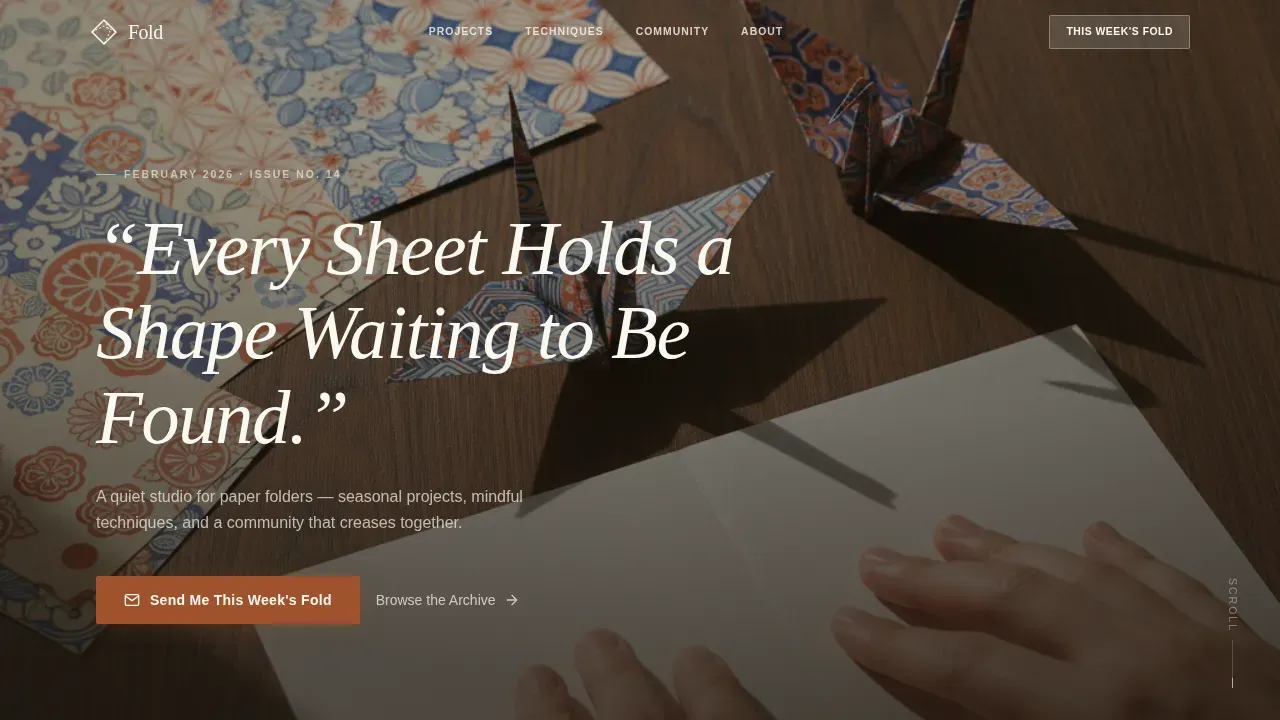
- A full-bleed hero with an overhead photograph, a fade-in serif headline, and a primary call-to-action button reading "Send Me This Week's Fold"
- A seasonal projects editorial grid, a scroll-animated technique spotlight, a community gallery mosaic, and a PDF preview lead capture section, all arranged in one flowing page
- Two distinct email capture forms: one inline prompt after the second editorial section, and one secondary offer targeting visitors who scroll past the halfway point without converting
Feature list
This template was designed with a specific editorial vision in mind. Every feature listed here is present in the template as described in the source brief.
Full-Bleed Hero with Fade-In Headline
The hero section fills the entire viewport with a warm overhead photograph of a dark walnut table scattered with half-folded paper. Loose chiyogami squares in persimmon and indigo fan across the surface. A pair of hands presses a valley crease into white cardstock in the lower third. A serif headline fades in over the negative space as the page loads, setting an immediately analog and unhurried tone before the visitor reads a single word.
Seasonal Projects Editorial Grid
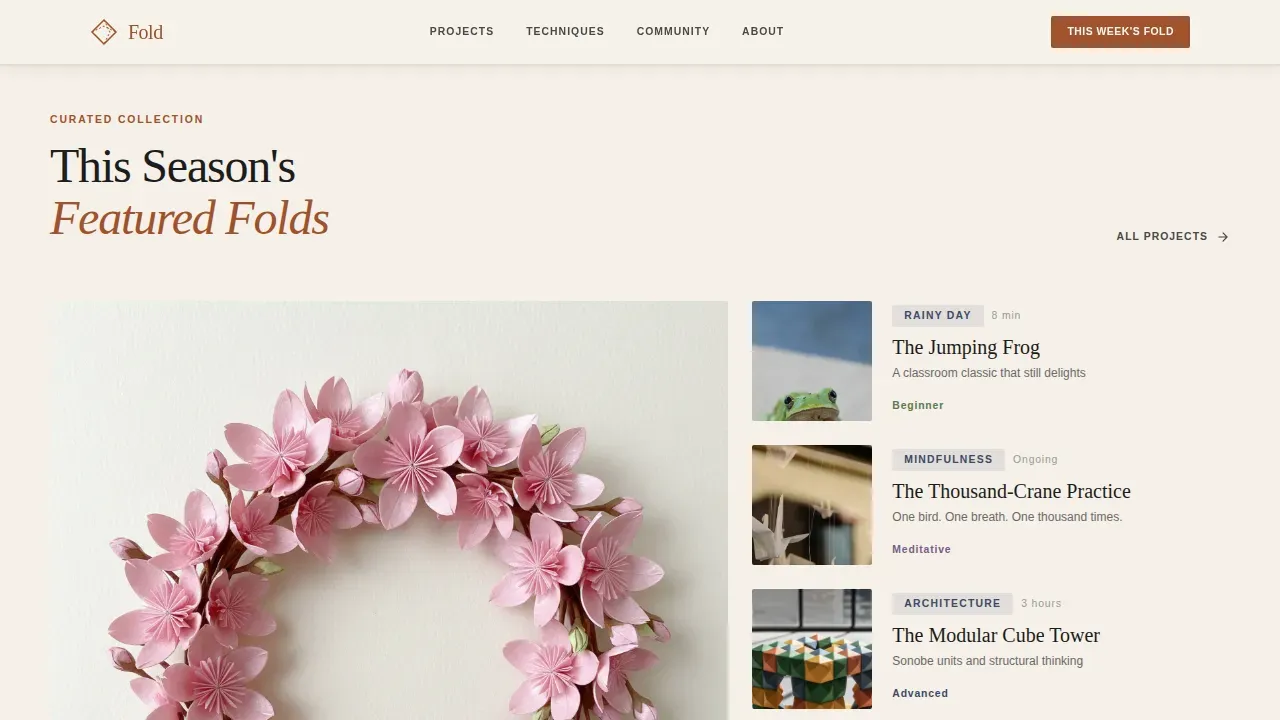
The seasonal grid presents origami projects as cover stories rather than simple post links. Each card features large photography and a pull-quote caption styled like a magazine spread. The grid is designed to display thematic groupings naturally, so teachers can find fall projects, World Origami Days content, and holiday-specific work at a glance. Children's models and beginner-friendly designs sit alongside more intricate origami models without the layout feeling cluttered.
Scroll-Animated Technique Spotlight
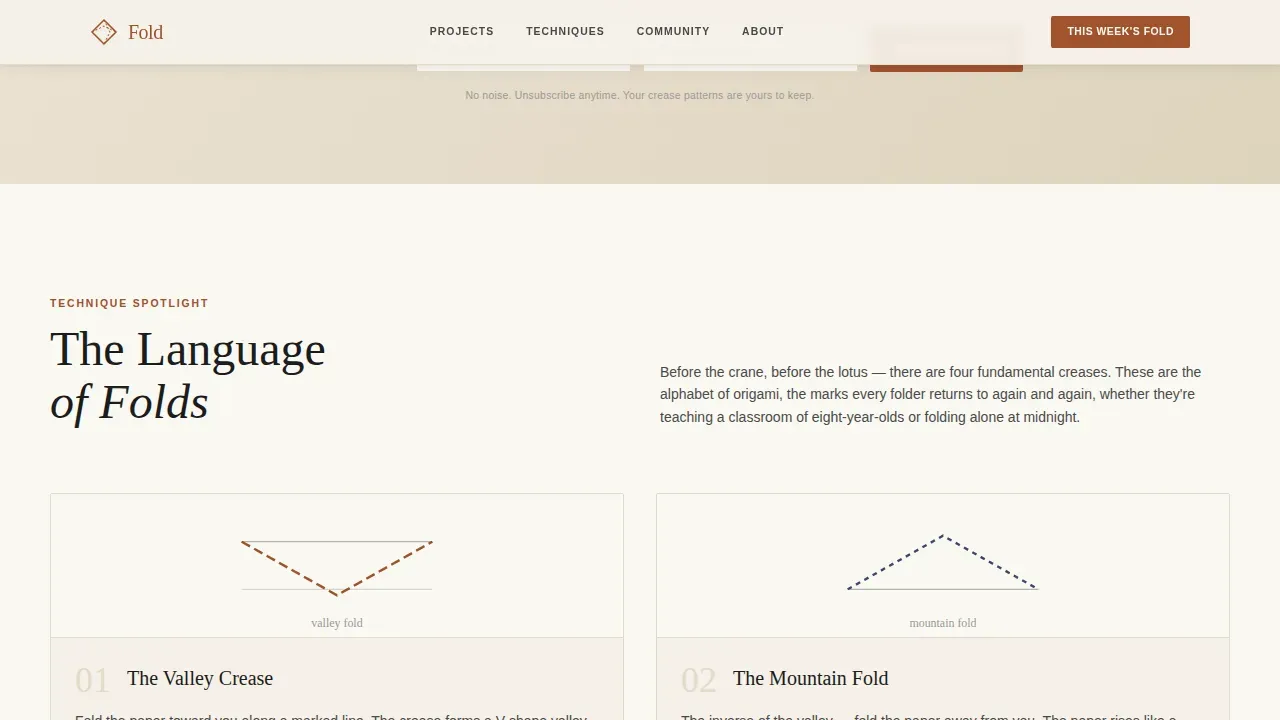
A dedicated technique spotlight section breaks a single fold type into illustrated, step-by-step diagrams that reveal on scroll. Each step is shown as a clear illustrated frame, guiding the reader from the first crease to the finished model. This section works especially well for explaining concepts like the center line, valley folds, triangle bases, and simple twists that appear repeatedly across origami designs. The animation is subtle and purposeful, designed to feel like turning pages rather than watching a loading screen.
Community Gallery Mosaic
The community gallery is laid out as a pinboard mosaic of reader-submitted photographs. It provides immediate social proof by showing real artwork created by real people. The staggered layout animates on scroll, presenting each new picture in a natural, unhurried rhythm. Visitors who are folding for the first time see a wide range of skill levels represented, which builds confidence and reinforces the welcoming tone of the blog.
Dual Email Capture with PDF Preview
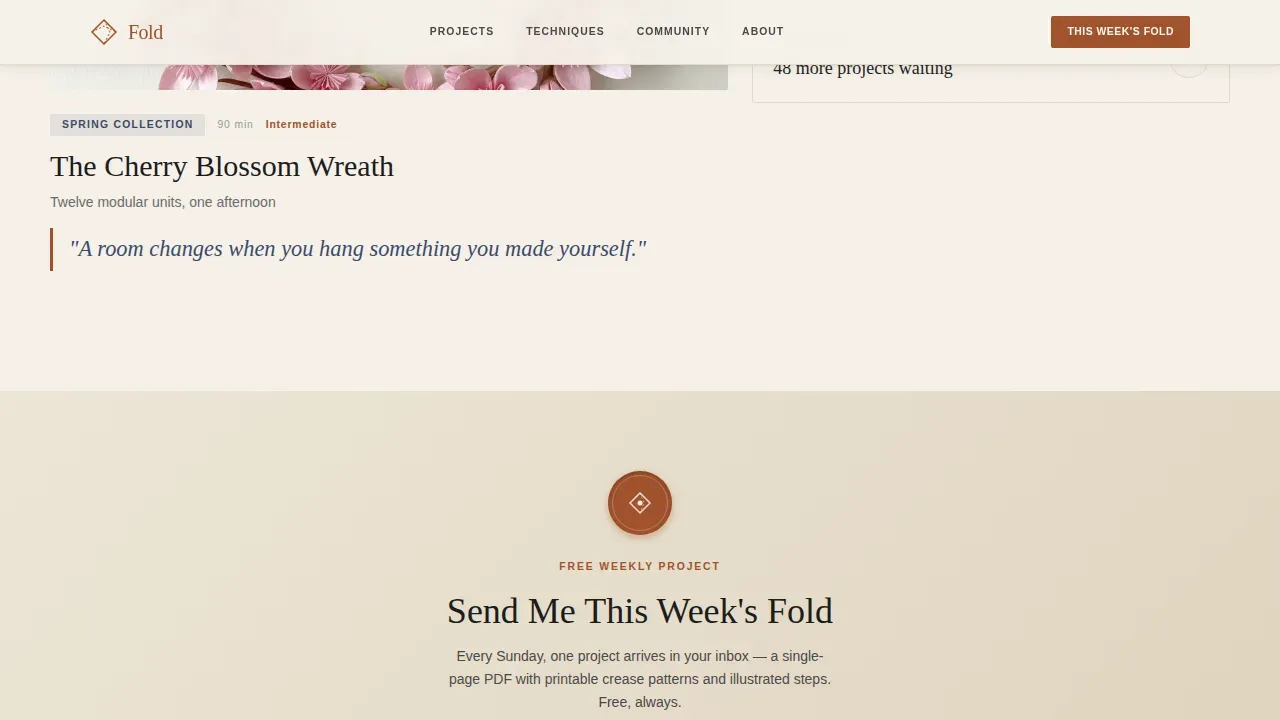
The first email capture prompt appears inline after the second editorial section, framed as a free subscription to a weekly single-project PDF with printable crease patterns. The second capture targets visitors who scroll past the halfway mark without converting, offering a free download of the "Beginner's First 10 Folds" mini-book. Both forms ask only for a first name and email address. Critically, three visible pages of illustrated instructions are displayed before the form appears, so visitors can see exactly what they are about to receive before committing.
Heritage Editorial Typography and Color
The template uses Fraunces as the serif display face for headlines and DM Sans for body copy and interface elements. The Parchment and Rust color system places aged cream at background level, deep iron rust on headlines and accent borders, faded indigo on navigation and category tags, and soft graphite on body text. The result is a visual language that feels like a letterpress workshop rather than a digital product, helping the page display a distinct personality that generic blog templates cannot replicate.
Page sections overview
| Section | Purpose |
|---|---|
| Hero Full-Bleed | Establishes editorial tone, displays overhead photograph, delivers fade-in headline and primary call-to-action |
| Seasonal Projects Grid | Presents thematic origami projects as cover-story cards with large photography and pull-quote captions |
| Technique Spotlight | Breaks down a single fold into scroll-animated illustrated step-by-step diagrams |
| Community Gallery Mosaic | Displays reader-submitted origami artwork in a staggered pinboard layout with scroll animation |
| PDF Lead Capture | Offers free beginner mini-book download with visible PDF preview pages before the email form |
| Linear Footer Row | Provides a single-row footer with site navigation links |
Design & branding system
The visual identity follows a Heritage and Story theme. Every color, typeface, and spacing decision reinforces the feeling of a treasured analog publication rather than a modern digital platform. The design balances generous white space with dense visual clusters, so the eye rests and then feasts in a rhythm that mirrors the slow, deliberate pace of folding paper.
- Color system: aged cream (#F5F0E8) dominates backgrounds, deep iron rust (#A0522D) marks headlines and borders, faded indigo (#3B4A6B) anchors navigation and category tags, and soft graphite (#4A4A4A) keeps body copy legible without feeling cold or screen-native
- Typography: Fraunces serif display face for all headlines and editorial pull quotes, paired with DM Sans for body paragraphs, labels, and form interface elements
- Texture and motif: subtle paper-inspired backgrounds and geometric line art evoke the tactile quality of traditional folding, while the layout draws on the F-pattern reading flow to ensure key information lands naturally as the eye moves down the page
Mobile & speed optimization
The template is designed with a mobile-first approach. The sticky footer call-to-action on mobile ensures the primary conversion prompt stays visible without interrupting the reading experience. The desktop layout provides an equal experience with no features gated to one device.
- Static-first build with optimized images and minimal JavaScript, keeping the page light and responsive without sacrificing the richness of the editorial design
- Scroll-linked animations, the staggered gallery reveal, and the hero headline fade-in are all implemented to be smooth and purposeful, not decorative weight that slows the page
- The sticky mobile footer call to action displays the "Send Me This Week's Fold" form prompt persistently, ensuring the primary conversion path is always one hand's reach away on any screen size
How this template helps you convert
Every element on this page is arranged to guide a visitor toward one of two free subscription offers. Trust is built visually and editorially before the form ever appears, following the principle that an origami blog must show its value before asking for anything.
- The primary inline capture form appears after the second editorial section, placed at the natural scroll point where a reader has already seen the seasonal grid and feels the quality of the content. The form asks only for a first name and email, and the framing emphasizes a free weekly PDF with printable crease patterns rather than a generic newsletter sign-up.
- The secondary capture offer targets visitors who scroll past the halfway mark without subscribing. The "Download the Beginner's First 10 Folds" mini-book is presented alongside a visible three-page PDF preview of illustrated instructions, so the visitor can see the actual diagrams and judge the value for themselves before entering any details.
Other information about this template
The Fold template is a strong fit for origami content creators who want their blog to reflect the depth and heritage of the craft. This section covers additional context about the template's broader relevance, including cultural references, community connections, and educational applications that make this template especially well-suited to its niche.
- World Origami Days is celebrated on October 24th each year, and the template's seasonal projects grid is well-suited to building special editorial features around that date. Origami is celebrated globally, with World Origami Days encouraging participation across communities of all ages and backgrounds. Teachers who plan classroom activities around World Origami Days will find the thematic grid layout especially practical for organizing and displaying those special issues.
- The template supports a blog format that can naturally cover origami convention summaries and event recaps. Origami convention events, including international gatherings where artists present new work, are a rich source of editorial content. A blog using this template can cover origami convention news, special guest folders, and exhibition highlights in the seasonal grid section, presenting each event as a cover story rather than a plain post.
- The CDO convention (Convention of Origami Organizations in Europe) and similar international origami convention events bring the global paper folding community together. Blog posts covering CDO convention proceedings, special guest presentations, and new book releases fit naturally into the editorial grid and technique spotlight sections of this template.
- The British Origami Society is one of the world's most established origami organizations. Content inspired by British Origami Society publications, diagrams, and exhibitions can be featured in the template's editorial grid and displayed in the community gallery.
- The template is well-suited to covering the work of artists like Leyla Torres, whose accessible instructional videos and approachable folding style align closely with the template's educational tone. Leyla Torres content, including tutorials and project ideas, can be featured in the technique spotlight and seasonal grid sections.
- Origami tessellations and more advanced folding concepts, including Shuzo Fujimoto's hydrangea, can be presented in the technique spotlight section with illustrated diagrams and scroll-animated steps. Origami tessellations are a natural fit for the template's step-by-step format, which breaks complex patterns into readable, individual frames.
- The template is designed to display a wide range of origami models, from a simple butterfly or cute box for children to complex origami cranes, hanging mobiles, and architectural forms. Origami cranes are especially meaningful, as the crane is a significant symbol in Japanese culture representing peace and good fortune. The crane has deep roots in Japan, and its cultural significance makes it a recurring and powerful subject for editorial storytelling.
- Content about traditional origami models that appear in cultural rituals, such as wedding butterflies or samurai etiquette folds, can be featured as standalone editorial pieces with illustrated step-by-step diagrams and cultural context paragraphs.
- Koi-nobori, the carp streamers displayed on Boy's Day on May 5th in Japan, are an example of thematic origami content that can be created and displayed as a seasonal cover story. Thematic origami projects tied to holidays and cultural events enhance the festive atmosphere of any classroom or community setting.
- Origami is also an educational tool. It can support teaching of geometry, spatial reasoning, and fine motor development in children. Simple origami models like the paper cup are suitable for preschoolers. The template's thematic grid makes it straightforward to organize and present projects by age group and skill level, which is practical for teachers who want to quickly identify appropriate models for their class.
- The template can also serve as a home for instructional videos and short animated demonstrations. Embedded instructional videos can demonstrate complex folding techniques in motion, capturing attention more quickly than text alone. Digital tools that offer interactive tutorials and visual aids enhance the origami folding experience, and the template's layout accommodates that kind of rich media naturally.
- AI can assist in generating origami designs by interpreting natural language prompts, and AI-powered tools can help users create complex origami models by providing step-by-step instructions. As the integration of AI in origami grows, blog content covering new AI-assisted origami designs and innovative folding techniques will find a natural editorial home in this template's curated collection format.
- The template is fully customizable. The color system, typography, section photography, and all body copy can be edited to fit a specific origami theme, community focus, or creative direction. The blog banner sections, headline slots, and category tag system are all designed to be replaced without rebuilding the layout.
- For protection of your original designs and artwork, always watermark or include a byline on any published crease patterns or illustrated diagrams you display in the template. The template provides clear picture and photograph placement areas that make it straightforward to include attribution alongside each image.
Theme
Heritage & Story
Creative direction
Curated Collection
Color system
Parchment & Rust
Style
Editorial/Magazine
Direction
Lead Generation
Page Sections
Full-bleed Hero with Fade-in Headline
Seasonal Editorial Projects Grid
Scroll-animated Technique Spotlight
Community Gallery Pinboard Mosaic
Dual Email Capture with PDF Preview
Heritage Typography and Parchment Color System
Related questions
Who is this template designed for?
What lead capture features does the template include?
Can I use this template for classroom and educational origami content?
Does the template support illustrated step-by-step fold diagrams?
Can the template be customized to match my origami blog's brand?