Legal & Policy Blog Pre-Launch Website Template
Docket is a coming-soon landing page template built for a criminal justice publication written by insiders. It uses an asymmetric 60/40 grid, an Ink and Paper visual identity, and a fixed waitlist call-to-action to convert curious visitors into committed subscribers before launch day.
by Rocket studio
Quick summary
Docket is a single-page waitlist template for a criminal justice editorial publication. It pairs a manifesto-style hero with a Creator Spotlight section, a landmark case timeline, sample article previews, and a sticky email capture button. The design draws from court documents and legal paper to signal depth, credibility, and insider access.
Who this template is for
This template is built for editorial publishers, newsletter founders, and legal journalists who want to grow a waitlist before launch. It works especially well when the product is content-driven and the audience values substance over spectacle.
- Law-focused newsletters and criminal justice publications preparing a public launch
- Independent journalists, public defenders, or policy writers building a reader base early
- True-crime and legal-policy content creators who want to signal credibility before publishing
What problem this template solves
Most coming-soon pages feel generic. They ask for an email and offer nothing back. Docket solves this by giving visitors a reason to trust the publication before a single issue ships.
- Visitors arrive with no context and leave without converting because the page doesn't earn their attention
- Editorial publications struggle to communicate voice and credibility on a single page
- Niche audiences like law students and policy wonks need substance, not just a countdown timer
What you get with this template
You get a fully structured, single-page layout that moves visitors from curiosity to commitment. Every section has a clear job, and the design system does the heavy lifting so the writing stays at the center.
- A manifesto hero section with ruled-line texture and large serif typography
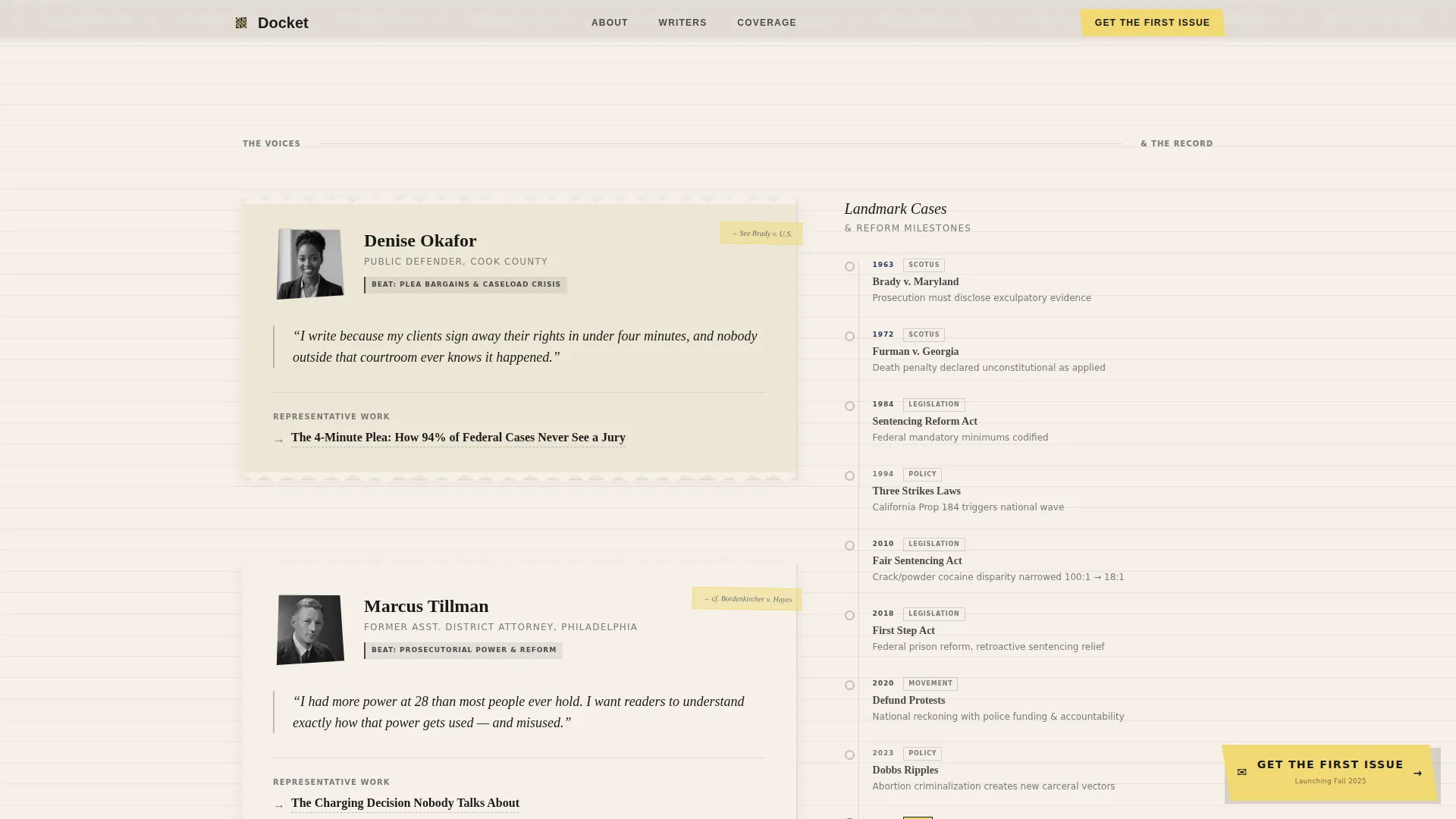
- A 60/40 asymmetric grid featuring writer spotlight cards alongside a vertical case timeline
- A sticky waitlist button and modal form with email capture and an optional audience research field
Feature list
Manifesto Hero Section
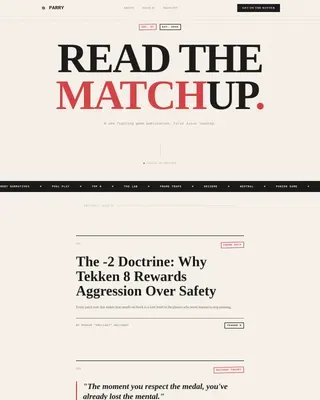
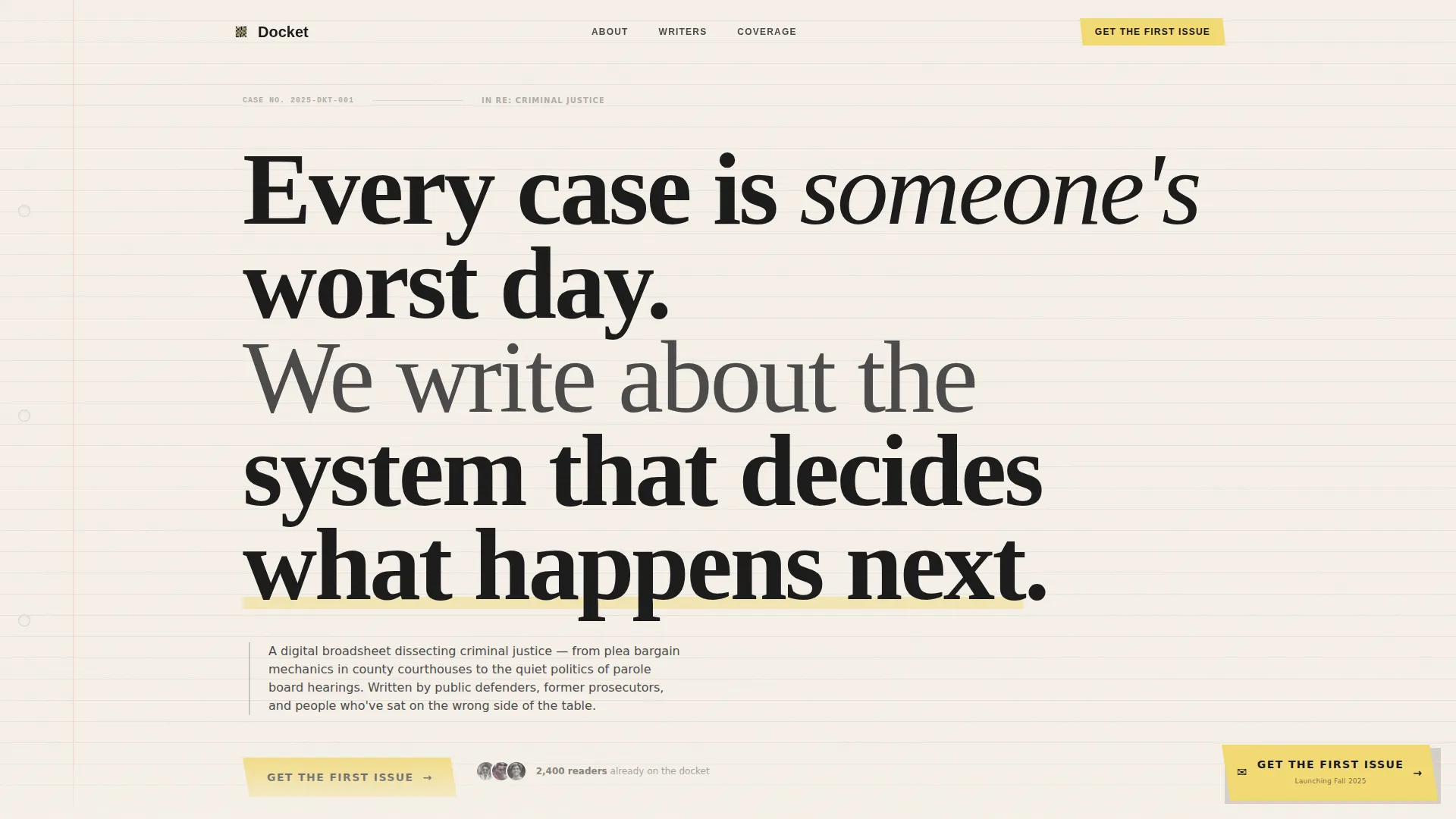
The hero opens with stark black type on a parchment background, typeset like a broadside pinned to a courthouse wall. A faint ruled-line texture runs behind the text. No images, no illustrations. Just letterforms large enough to hold the full viewport and a single line that frames the entire publication's purpose.
Asymmetric 60/40 Creator Grid
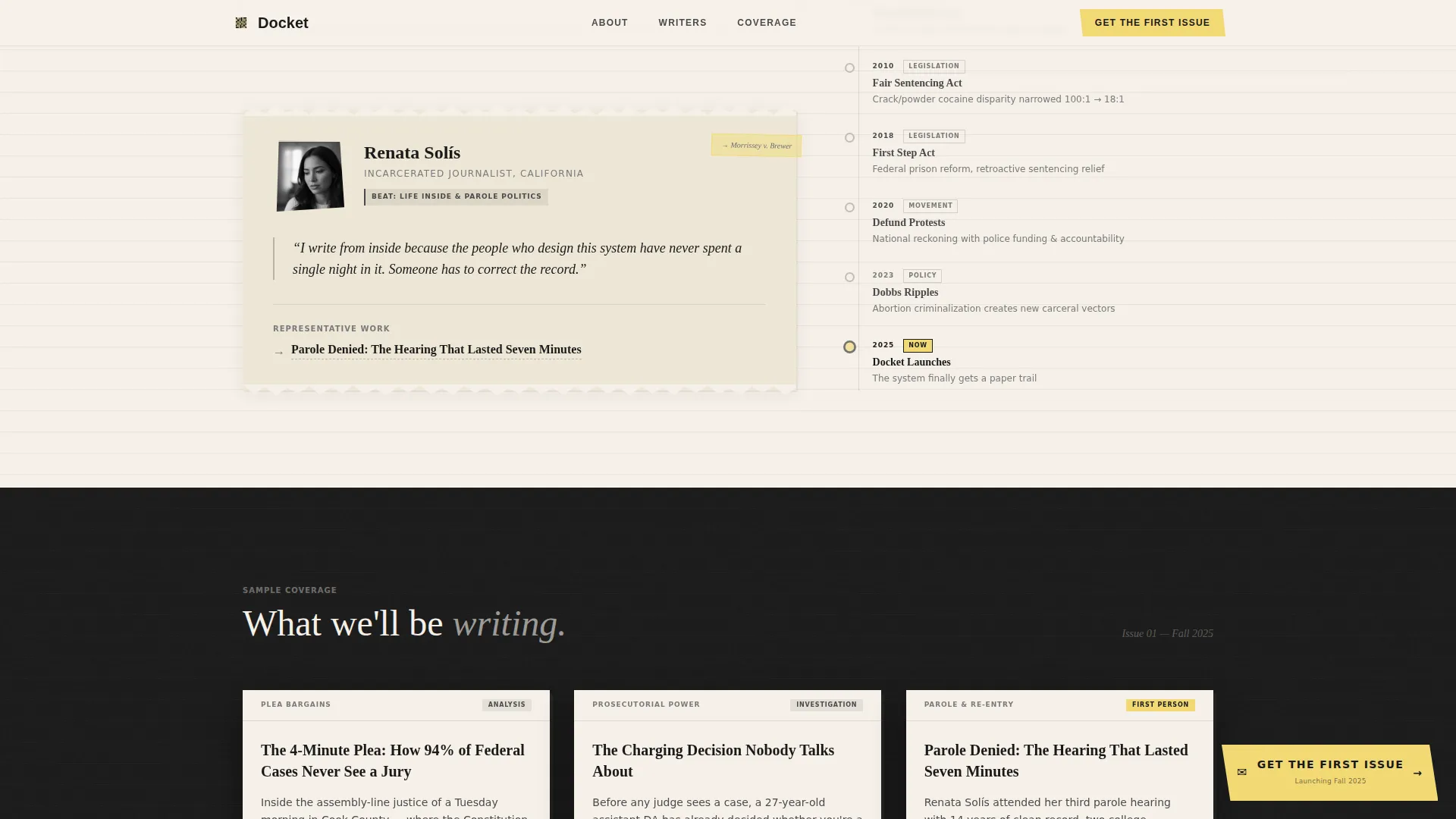
The 60-column introduces founding writers one at a time. Each card uses a torn-paper edge treatment, a short first-person paragraph, and a single representative headline. The 40-column beside it runs a vertical timeline of landmark cases and reform milestones, giving readers context for every voice they encounter.
Scrolling Topics Marquee
A continuous marquee band runs between sections, looping through the publication's coverage beats in graphite type on a parchment background. It signals editorial range at a glance and keeps momentum between the hero and the creator grid.
Sample Coverage Cards
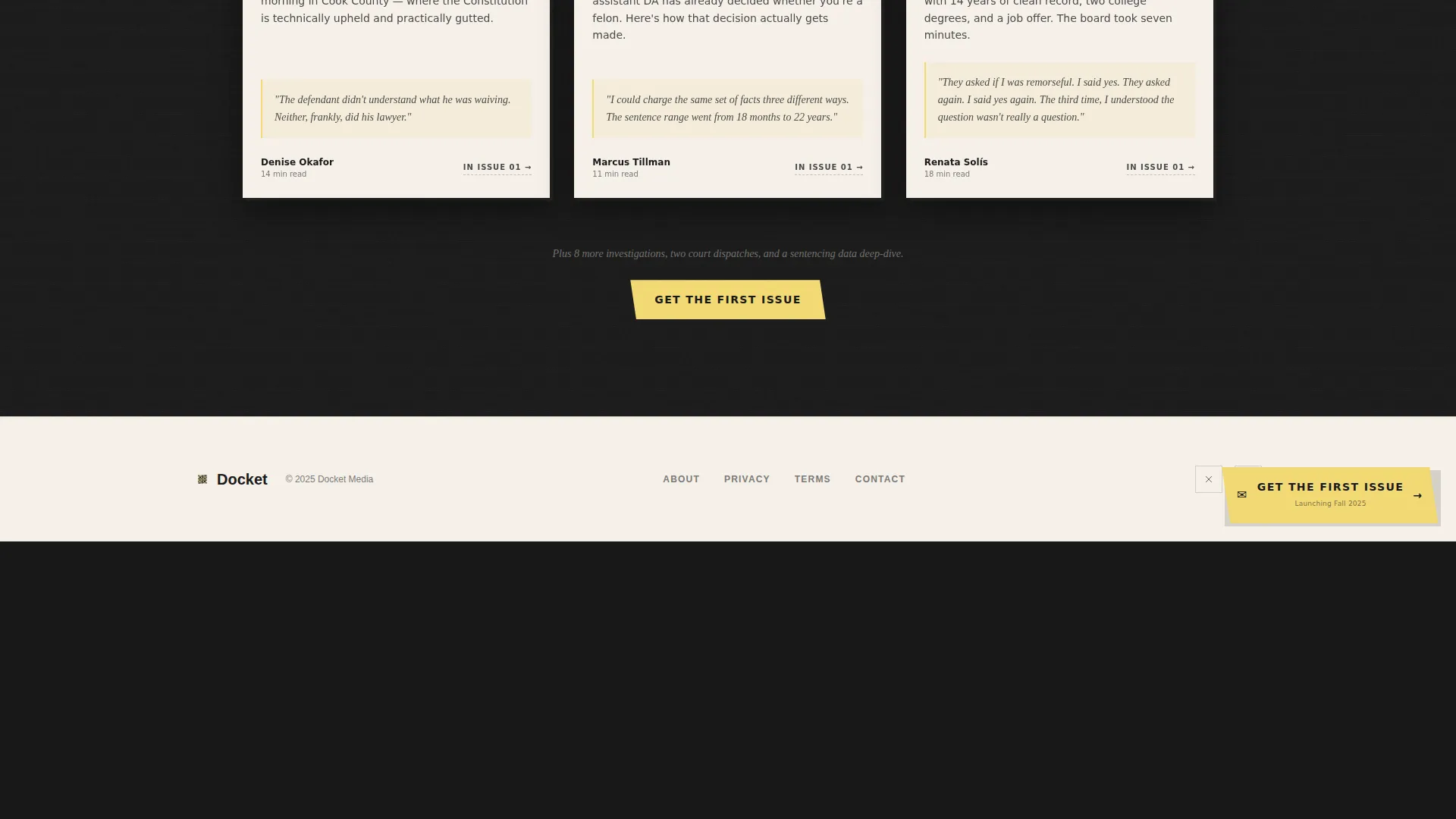
Article preview cards show what the publication actually covers. Each card uses a pull-quote treatment to surface a single compelling line from the piece, giving visitors a taste of the editorial voice before they commit to the waitlist.
Sticky Waitlist Call to Action
A fixed button sits in the bottom-right corner of the page at all times. It opens a lightweight modal with a single required email field and one optional free-text question: what part of the system the reader wants covered. This doubles as audience research and lowers the barrier to sign up.
Social Proof Inline Copy
The phrase "2,400 readers already on the docket" sits directly beneath the waitlist form. It converts hesitant visitors by showing that an audience already exists, making the decision to join feel like joining something rather than waiting for something.
Page sections overview
| Section | Purpose |
|---|---|
| Manifesto Hero | Opens with a bold editorial statement to establish voice and intent |
| Scrolling Topics Band | Loops coverage beats to signal editorial range between sections |
| Creator Spotlight Grid | Introduces founding writers alongside a landmark case timeline |
| Sample Coverage Cards | Previews article style and editorial tone with pull-quote treatment |
| Sticky Waitlist Button | Keeps the primary call to action visible throughout the scroll |
| Waitlist Modal Form | Captures email and an optional audience research response |
| Minimal Footer | Closes the page with clean horizontal layout and no visual clutter |
Design & branding system
The visual identity is built around an Ink and Paper editorial theme. Every design choice references the physical texture of court documents: aged paper, ink pressure, and the occasional highlighter line that changes everything.
- Color palette: parchment white (#F5F0E8) as background, redaction black (#1A1A1A) for primary text, pencil-graphite gray (#4A4A4A) for secondary text, and legal-pad yellow (#F2D974) reserved for highlights, pull-quotes, and hover states
- Typography: Fraunces serif for display headings and DM Sans for body text and interface elements
- Texture and motion: torn-paper edge effects on writer cards, staggered scroll reveals, and a continuously looping marquee animation
Mobile & speed optimization
The template is designed desktop-first to match how its primary audience, law students at desks and policy researchers in offices, actually reads long-form editorial content. Mobile layouts are included and structured for solid usability on smaller screens.
- Staggered scroll reveals and marquee animation use client-side components only where interactivity is required
- Static sections use server-rendered components to keep the page lightweight and fast to load
- The sticky call-to-action button and modal are optimized for touch interaction on mobile devices
How this template helps you convert
The page is engineered around a single goal: turning first-time visitors into waitlist subscribers before the publication has published a single issue.
- The manifesto hero earns attention immediately with a strong editorial statement, so visitors understand the publication's voice within seconds of arriving.
- The Creator Spotlight section builds credibility by introducing the people behind the writing, giving the audience a human reason to trust the product.
- The sticky call-to-action button keeps the sign-up option visible at every scroll point, reducing the friction between interest and action.
Other information about this template
This template is part of a broader editorial and newsletter template category. It is particularly well-suited for publications in the legal journalism and criminal justice niche, but the layout and design system can adapt to other insider-written, credibility-led publications.
- The optional audience research field in the waitlist form doubles as a community-building tool, helping founders understand reader priorities before the first issue launches
- The landmark case timeline in the 40-column can be updated to reflect any relevant historical or policy context specific to the publication's beat
- The footer follows a horizontal flow pattern for a clean, minimal close to the page with no visual noise competing against the call to action
- The Cloud Canvas color system and Ink and Paper theme are cohesive enough to carry through to a full publication design system beyond this landing page
Theme
Ink & Paper
Creative direction
Creator Spotlight
Color system
Cloud Canvas
Style
Asymmetric Grid (60/40)
Direction
Waitlist/Coming Soon
Page Sections
Manifesto Hero with Ruled-line Texture
Asymmetric 60/40 Creator Spotlight Grid
Sticky Waitlist Button and Modal
Inline Social Proof Copy
Scrolling Topics Marquee Band
Sample Coverage Preview Cards
Related questions
Who is this template designed for?
Can I change the writer cards and timeline content?
Does the waitlist form connect to an email platform?
Is this template suitable for a publication that has already launched?
What does the optional form field do?