Authentic Wilderness Survival Landing Page Template
Kindling is a heritage survival prepper podcast landing page template built for shows launching with a waitlist. It pairs a leather-bound journal aesthetic with a masonry card layout, guiding visitors from a parchment chapter header through an origin story arc, episode previews, listener testimonials, and a dual-form email waitlist. The warm stone color system and serif typography make every scroll feel intentional and earned.
by Rocket studio
Quick summary
Kindling is a coming-soon landing page template for prepper and survival podcast creators who want to build an email waitlist before their first episode drops. The design channels a heritage editorial feel, handwritten field notes, parchment textures, and ember-lit typography, while delivering two conversion points, an episode preview arc, and a free lead magnet PDF offer that gives hesitant visitors a concrete reason to sign up.
Who this template is for
This template is built for podcast creators working in the prepper, survival, homesteading, or heritage skills space who are not yet live but want to grow an audience before launch. It suits hosts who want their page to feel earned and human, not polished and corporate.
- Podcast hosts building a waitlist for a prepper, survival, or heritage skills show
- Homesteaders, former military, and off-grid lifestyle creators launching a new audio series
- Content creators who want a story-driven page that converts curious visitors into email subscribers
What problem this template solves
Most people launching a podcast start with a generic link-in-bio or a plain landing page that gives visitors no reason to stay. For survival and prepper content, that matters even more. The audience is skeptical of hype. They have heard a lot of noise. They need to feel something before they commit. A bland page does not do that.
This template solves the gap between having a great show concept and having a page that makes people actually wait for it. It builds the story first, then asks for the email.
- Generic podcast pages do not reflect the depth or character of heritage survival content
- Visitors bounce quickly when they land on a page that only says "coming soon" with a countdown clock
- Prepper and homesteader audiences respond to authenticity, narrative, and proof, not stock photo layouts
What you get with this template
The template is a fully structured single-page layout with clearly defined sections, a dual email capture system, a masonry card grid, and a complete visual identity built on the Warm Stone color system. Everything is arranged to scroll like a story, not a product brochure.
- A parchment-style chapter header, masonry origin story arc, episode preview section, listener archetype cards, two waitlist forms, and a footer
- A dual conversion path: primary waitlist signup and a secondary free PDF lead magnet download
- A complete Heritage and Story design system with Warm Stone palette, serif typography, and field-note card styling
Feature list
This template is built around a set of purposeful features. Each one serves the broader goal of turning a curious visitor into a committed waitlist subscriber. Below is what makes it work.
Chapter-Style Parchment Hero Header
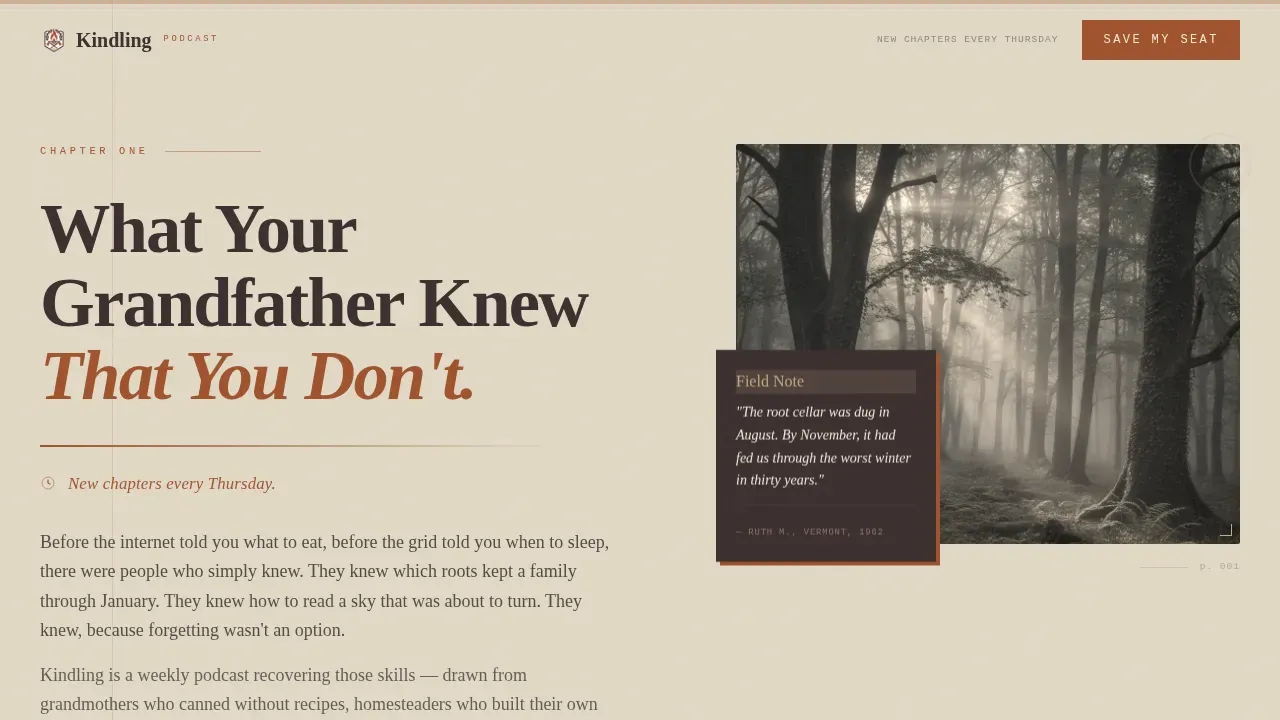
The header opens like the first page of a leather-bound journal. A textured parchment background holds a large serif chapter heading that reads like the opening of a novel. Three lines of body text below the heading tease the podcast's premise without giving everything away. A thin ember-red rule separates the chapter heading from a handwritten-style margin annotation noting when new episodes arrive. There is no play button yet, no episode list, just the opening of a story that makes visitors feel something before they scroll. This is one aspect of the design that sets the tone for every card that follows.
Masonry Origin Story Card Grid
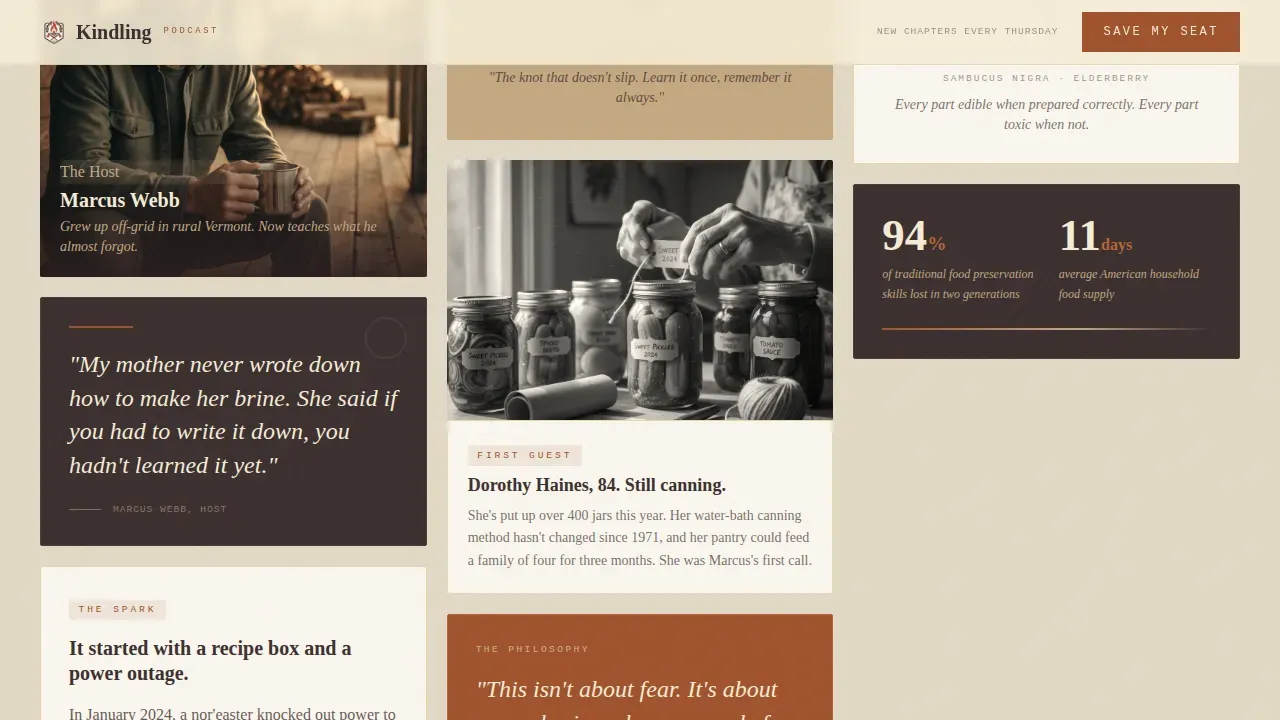
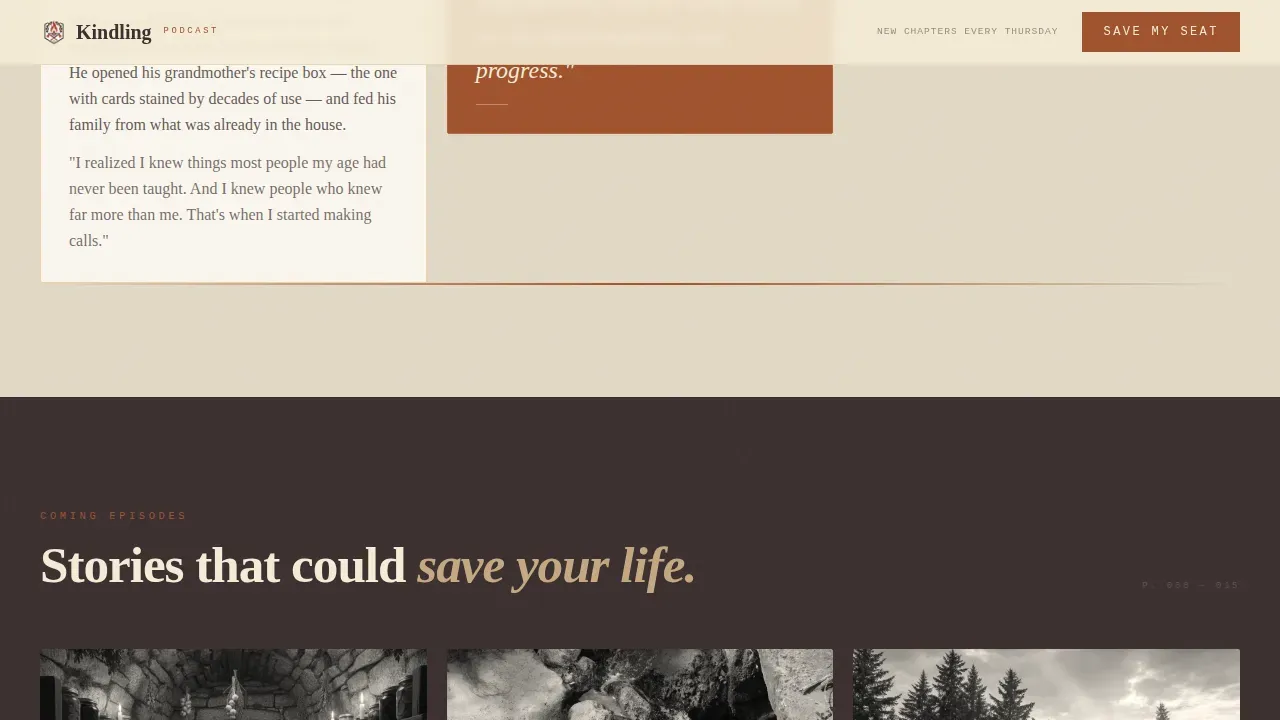
The main body of the page is a masonry grid that feels like a wall of pinned field notes. Each card is a different size. Some cards hold episode art. Some hold single pull quotes in ember red. Some hold hand-drawn style illustrations of knots, edible plants, or fire-starting tools. The grid scrolls through three arcs: personal narrative from the host, episode previews, and listener testimonials. The rhythm moves from intimate to communal to urgent, building trust through accumulated human detail rather than production stats. The masonry layout gives the whole thing a tactile, almost analog quality that most people do not expect from a web page.
Dual Email Waitlist Forms
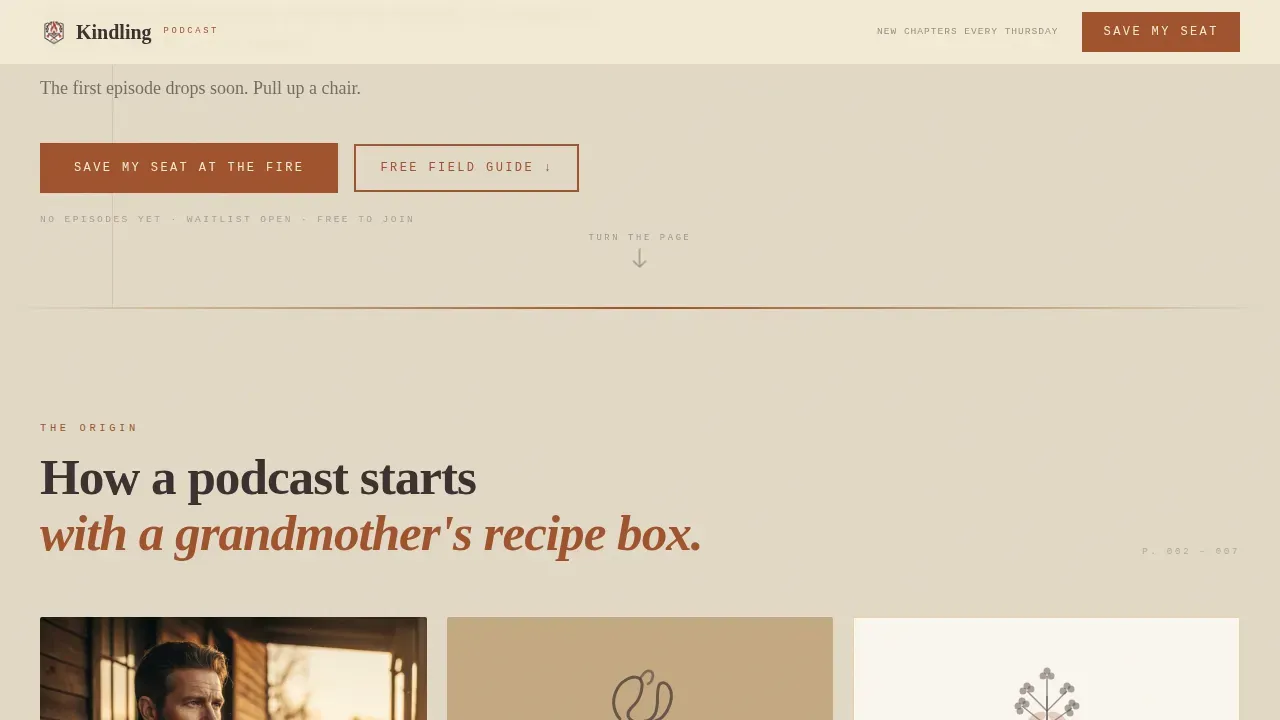
The template includes two email capture points. The first appears beneath the origin story arc. The second is pinned at the bottom of the page, framed as an invitation rather than a transaction. Both forms include a single email field and a toggle that asks visitors how long they have been prepping: Just Starting, A Few Years, or Lifelong. That simple toggle does two things, it makes the form feel conversational, and it gives the host useful audience data without asking for anything extra. Each form is designed to feel like pulling up a chair at a fire, not filling out a registration document.
Free PDF Lead Magnet Integration
A secondary conversion path sits alongside the primary waitlist form. Visitors who are not ready to commit can download a free field guide titled "The 12 Skills We've Forgotten" in exchange for their email address. This is a common sense approach to hesitant visitors: give them something tangible and useful before the show even launches. The lead magnet offer appears at both form positions, so visitors who scroll past the first form still encounter it at the bottom. It is a practical way to deal with audience skepticism without lowering the emotional register of the page.
Listener Archetype and Testimonial Cards
The template includes a dedicated section for listener archetype cards and testimonial pull quotes. These are not generic five-star reviews. They are character sketches, a suburban dad quietly building a go-bag in the garage, a young couple on a five-acre plot learning to pressure-can for the first time, a former military planner mapping bug-out routes on weekends. Each card gives a visitor a mirror to look into. When they see themselves in one of those archetypes, the decision to sign up becomes easy. Featured testimonials should reflect listeners who have effectively used real-world preparedness techniques, which gives the social proof section real weight.
Heritage Warm Stone Design System
The visual identity is built on four colors: hearthstone tan (#C4A882), smoked timber (#3B2F2F), tallow cream (#F5ECD7), and ember red (#A0522D). Backgrounds alternate between tallow cream and smoked timber. Body text sits in deep timber on light cards. Inverse cards use cream on dark. Ember red is reserved for buttons, episode markers, and pull quotes. The typography system pairs Fraunces serif headings with Crimson Text body copy and JetBrains Mono for labels and metadata. The result feels like a fieldstone fireplace at dusk, the kind of warmth that comes from things that have survived weather, use, and time.
Page sections overview
| Section | Purpose |
|---|---|
| Chapter Parchment Hero | Opens the story with a serif chapter heading, body teaser text, and ember-red rule annotation |
| Origin Story Arc | Masonry cards tell the host's personal narrative: off-grid upbringing, the spark moment, founding philosophy |
| Episode Preview Grid | Curated masonry cards showcase 3 to 5 episode previews with descriptions and visual markers |
| Primary Waitlist Form | First email capture with a toggle asking how long the visitor has been prepping |
| Archetype and Testimonial Cards | Listener character sketches and pull quote testimonials building community recognition |
| Final call to action Section | Second email form framed as an invitation, with the free PDF field guide offer displayed prominently |
| Footer | Horizontal flow footer with social links and minimal navigation |
Design & branding system
The design system is rooted in a Heritage and Story theme that feels intentional in every detail. Nothing here looks like a generic podcast template. The visual language is analog, tactile, and warm. It communicates that the host has lived something worth talking about.
- Warm Stone palette: tallow cream (#F5ECD7) as the primary background, smoked timber (#3B2F2F) for dark sections and body text, hearthstone tan (#C4A882) as a mid-tone, and ember red (#A0522D) for all interactive and accent elements
- Typography trio: Fraunces for serif headings that feel like a book spine, Crimson Text for body copy and quotes, and JetBrains Mono for labels, metadata, and episode markers
- Masonry card system: cards vary in size and content type, episode art, single-line pull quotes in ember red, hand-drawn style illustrations of knots, edible plants, and fire-making tools, with staggered reveal animations on scroll
Mobile & speed optimization
The template is built desktop-first with full mobile responsiveness. The masonry grid reflows cleanly on smaller screens. Buttons are sized for easy tapping, and both email forms work correctly on mobile devices. The overall structure uses server components for static content and client-side interactions only for the form toggle and reveal animations, keeping the page light and fast.
- Masonry grid reflows to a single-column layout on mobile, preserving card hierarchy and visual rhythm
- Both waitlist forms are fully functional on mobile with tap-friendly toggle inputs and high-contrast ember-red submit buttons
- Scroll-reveal animations and parallax effects are set to medium intensity, keeping the experience smooth without creating lag on lower-powered devices
How this template helps you convert
The template is structured around a conversion logic that mirrors how trust actually builds: story first, proof second, invitation third. Visitors do not hit a form the moment they arrive. They walk through a narrative arc that makes the ask feel earned by the time it appears.
- The chapter hero and masonry origin story arc build emotional investment before any form appears, so visitors arrive at the first email field already engaged rather than cold
- The dual conversion path handles two types of visitors, those ready to commit to the waitlist immediately, and those who need a tangible reason first, which the free PDF field guide provides
- The second form at the bottom of the page catches visitors who scrolled all the way through, framing the final ask as an invitation to be part of the next chapter rather than a last-ditch popup
Other information about this template
This section covers additional context that helps buyers understand how the template fits into a broader ecosystem of tools, practices, and considerations relevant to the prepper and survival podcast niche.
Prepping can be combined with hobbies to make it productive and fun. Camping is a natural example. Going camping is like putting yourself into a controlled survival situation. Much of what you need when you go camping is a direct parallel to being prepared, food, fire, shelter, and the knowledge to use all these things without a manual open in front of you. Camping helps you test and improve survival skills like starting a fire, forecasting the weather, and cooking over an open flame. It does not matter when you go camping, as you should try camping at different times of the year to stress-test your gear and knowledge in cold mornings, wet nights, and heat.
If you have children, teaching them survival skills appropriate for their age is a big deal. Camping at home in your yard, or even in your living room, can be a good way to ease younger kids into the idea of camping in the wilds. Camping is a great way to take your kids exploring and getting them used to doing things the old-fashioned way. Learning survival skills can help build confidence in children and prepare them for future challenges. That is one point the Kindling podcast is built around: these skills are not relics. They are living knowledge.
Food storage is a primary concern for many preppers, especially in light of recent global events. The food system has come under strain in ways that were not common to worry about twenty or thirty years ago. Discussions around the world economy, supply chain fragility, and local food security have made food storage planning feel less like fringe thinking and more like common sense. Engaging in community gardening can be a practical way to build local food security and reduce dependence on a fragile supply chain.
The ethical considerations in survival practices often include the balance between self-reliance and the impact on the community and environment. The rise of technology in agriculture has led to debates about the sustainability and ethical considerations of food production. There is a growing concern about the environmental impact of local food production methods. Questions about carbon emissions from shipping and logistics have made local growing and preservation more appealing to a wider audience, not just preppers. The ethical implications of modern survival practices often involve the impact of technology on traditional methods, and those conversations are increasingly entering mainstream life.
Dryer lint is a well-known fire-starting material in the prepper community. The idea sounds simple, but dryer lint is genuinely effective as tinder. A small wad of dryer lint can catch a spark faster than most people expect. If you stuff dryer lint into an egg carton section and pour a little melted wax over it, you get a fire-starting block that lasts well past what most purchased fire starters deliver. Guys who have been doing this for years ago knew what they were doing. Dryer lint collected from the trap after a few loads of laundry compresses into a bundle roughly a half inch thick and lights reliably even in cold conditions. That is the kind of low-cost, high-value stuff that heritage survival content is built around. You do not need to spend a lot of money to be prepared. You need to know what to do with what you already have.
Dryer lint works because it is essentially pre-broken-down cellulose fiber with a surface area that catches light quickly. A small piece of dryer lint, about the size of a cotton ball, is enough to bring a fire from spark to flame in the middle of a damp night if you protect the ground around it from moisture. Dryer lint from synthetic fabrics may produce a faster but shorter burn, while dryer lint from natural fibers tends to sustain heat a little longer. Either way, dryer lint is a resource that most people throw away without a second thought, and that is precisely the point of heritage survival thinking: forget nothing.
Dryer lint as a fire starter is one of the first pieces of advice heard by almost anyone entering the prepper world. It is the kind of tip that sounds too simple to be real until you actually try it. Dryer lint represents a broader idea: the stuff you already have is often enough. You do not need a fully stocked bunker to feel prepared. You need knowledge, practice, and the humility to learn things from people who have already figured them out. That is the whole thing the Kindling podcast is designed to pass on.
Dryer lint might seem like a small deal, but it is a gateway idea. Once somebody realizes that dryer lint works as tinder, they start to see the rest of their house differently. The dog hair caught in the vacuum filter. The candle stubs in the junk drawer. The half-used bag of rice in the back of the pantry. All these things have a role in a prepared household. That moment of realization is what a good survival podcast can spark in a listener. It is why the Kindling landing page template is designed to build that emotional arc, card by card, from the opening chapter header to the final invitation to join the waitlist.
Dryer lint is also a useful point of entry for talking about fire safety with kids. If children learn early that fire starts with something as ordinary as dryer lint, they begin to understand fire as a tool rather than just a hazard. Teaching fire safety alongside practical fire-starting gives kids a grounded relationship with one of the most essential human skills. Going camping is a great context for that lesson. Even if you have not camped before, start out by going to one of the established campsites that have toilets and running water. You can walk your children through fire safety and basic camp cooking in a low-stakes environment before heading into the wilds.
The idea that most people sleep through the gap between knowing and doing is one of the underlying tensions the Kindling podcast addresses. You might have a go-bag in the garage. You might have some food stocked in the pantry. But do you know how to pressure-can? Do you know what to eat from your yard if the food system broke down for a month? Could you keep your family warm through a cold night without the grid? These are not hypothetical questions anymore. They are the kind of questions that keep a certain type of person awake at night, and they are exactly what the show is built to answer.
The Kindling heritage survival prepper podcast landing page template is built for creators who understand that their audience is not looking for fear-based content. They want to learn things from real people who have actually done the work. The audience is concerned, but not panicked. They hope for the best and prepare for the rest. That emotional register is baked into every layer of the template, from the chapter-style hero to the intimate testimonial cards to the final form that frames sign-up as joining a community around the fire.
Preppers often focus on self-reliance and independence as core principles of their lifestyle. One aspect of that self-reliance is knowing how to deal with disruptions at the level of the household, the neighborhood, and the community. Survival practices can raise questions about the morality of resource use and the treatment of others in crisis situations. A good podcast addresses those questions honestly. The Kindling template gives podcast hosts the room to present that nuance through the origin story arc, where personal narrative and founding philosophy can be communicated card by card without feeling preachy.
No-code platforms enable users to build applications without traditional programming skills. Preppers can leverage technology to enhance their preparedness strategies, and the integration of technology in survivalism can lead to innovative solutions for emergency situations. Artificial intelligence tools can assist in creating resources and applications for survival use cases. The Kindling template reflects that intersection: it is built with modern web technology while communicating a message that is fundamentally about human knowledge and resilience.
The template also supports broader content ecosystem thinking. Incorporating additional blog or reference content alongside the landing page can provide long-term value to visitors and help a creator build authority in the heritage skills space. A podcast landing page should clearly communicate its value proposition, and Kindling does that through the masonry arc rather than through a bullet list of features. Social media links in the footer keep the community connection point visible. The template is designed so that each element earns its place in the story, and nothing is there just to fill room.
- The template is localized for English-language audiences in the United States, using imperial measurements and USD where applicable
- Animation intensity is set to medium: scroll-reveal text, masonry card stagger, and a subtle noise texture overlay are included without overwhelming the content
- The footer follows a horizontal flow pattern with social links, keeping navigation minimal and on-brand
- Prepping involves the elimination of starvation and ensuring food security, and the template's lead magnet, a free PDF field guide titled "The 12 Skills We've Forgotten", speaks directly to that concern
- Community engagement is built into the page through listener archetype cards and testimonial pull quotes that reflect real audience segments
- The page is desktop-first in its design priority, with full mobile responsiveness built in
- Fonts used: Fraunces (headings), Crimson Text (body and quotes), JetBrains Mono (labels and metadata)
- The two thirds of the page that follows the hero section is dedicated to story and proof before conversion, which is intentional: it delays the ask until trust is built
- Three quarters of the color palette is warm and light-toned, with smoked timber used selectively as a contrast background for key sections
- A parking lot of reserved visual elements, hand-drawn knot illustrations, edible plant sketches, coffee-ring textured card backgrounds, gives the designer flexibility to populate the masonry grid with authentic imagery
- The page is not supposed to feel like a podcast directory listing. It is supposed to feel like discovering something in an old cabin that was left for you to find
Theme
Heritage & Story
Creative direction
Origin Story
Color system
Warm Stone
Style
Masonry/Pinterest
Direction
Waitlist/Coming Soon
Page Sections
Chapter-style Parchment Hero Header
Masonry Origin Story Card Grid
Dual Email Waitlist Forms
Free PDF Lead Magnet Path
Listener Archetype and Testimonial Cards
Heritage Warm Stone Design System
Related questions
Does this template include the actual email form functionality?
Can I customize the masonry card content for my own podcast story?
Is the free PDF lead magnet included in the template?
Who is this template best suited for?
Can I change the toggle question options in the waitlist form?