History & Culture Blog Blog Website Template
Fieldwork is a masonry-style landing page template built for cultural anthropology blogs and academic content hubs. It pairs a manifesto-led hero with a Pinterest-style field desk of pinned essay cards, photo essays, and audio artifacts. A quiet sticky newsletter bar and a syllabus download gate convert curious readers into subscribers without interrupting the reading experience.
by Rocket studio
Quick summary
Fieldwork is a single-page landing page template designed for cultural anthropology blogs that need to feel like a living archive. The Atelier Studio aesthetic, masonry card grid, and manifesto hero create an environment where long-form fieldwork earns the attention it deserves. Two gentle conversion paths capture both general readers and academics looking for a syllabus resource.
Who this template is for
This template is built for writers and researchers whose work lives between disciplines. It suits anyone publishing fieldwork-driven content that deserves more than a generic blog layout.
- Graduate students and adjunct professors who publish original ethnographic research and need a professional content hub
- Academic writers and cultural journalists covering topics such as kinship, language, ritual, and market economies
- Curious generalists who found their way in through a podcast or citation and want a home base for deep reading
What problem this template solves
Most blog templates are built for speed, not depth. They flatten every post into the same card size, strip context from content, and push readers toward a single action before they have time to settle. A cultural anthropology blog carries essays, photo work, hand-drawn diagrams, and audio clips that resist that kind of uniformity.
- Long-form and mixed-media content gets buried in templates designed for short news cycles
- Conversion tools like newsletter bars feel intrusive when readers need time to trust the source first
- Academic readers need a clear secondary path, such as a curated reading list, before they will share an email address
What you get with this template
You get a complete, single-page landing page with every section pre-designed and ready to populate. The layout moves from a breathing hero statement down through a dense masonry grid and into a featured essay, reader responses, and a quiet sticky newsletter bar.
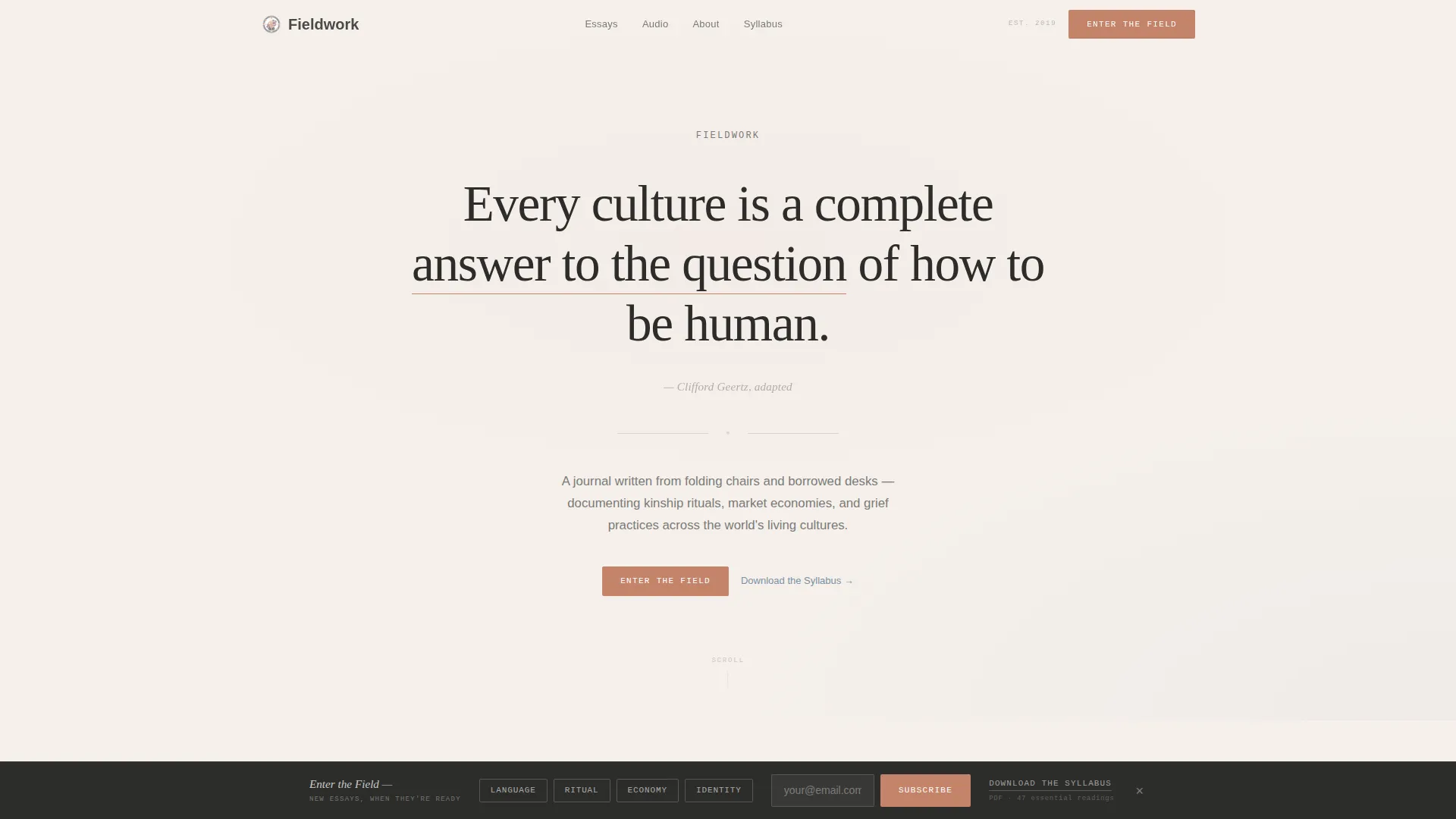
- A manifesto hero section with a large serif headline, italic attribution, and a thin graphite rule
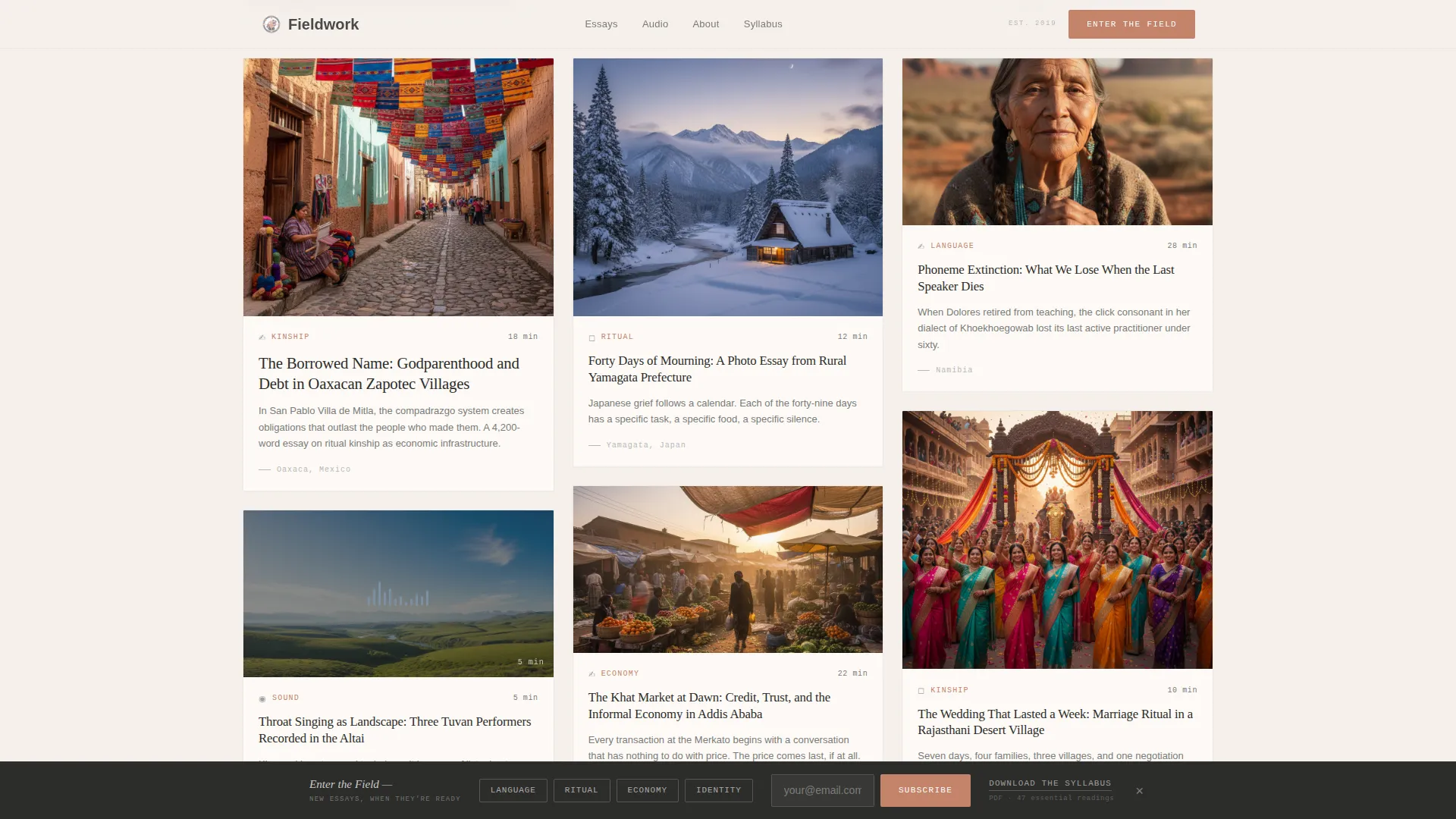
- A masonry field desk grid with category tags, reading-time estimates, and one-sentence card hooks
- Two email capture paths: the "Enter the Field" sticky newsletter bar and the "Download the Syllabus" gated PDF
Feature list
This template ships with a focused set of components built specifically for content-heavy academic publishing. Each one is grounded in how real fieldwork readers actually browse and decide to subscribe.
Manifesto Hero Section
A single serif headline fills a bare linen background with no navigation, no image, and no decoration. The emptiness is deliberate. Below the headline sits a small italic attribution and a thin graphite rule that signals depth before a single card loads.
Masonry Field Desk Grid
Cards appear in a Pinterest-style variable-height masonry layout that simulates a pinned field desk. Each card carries a terracotta category tag, a reading-time estimate, and a one-sentence hook. The staggered entrance animation builds accumulation as the visitor scrolls.
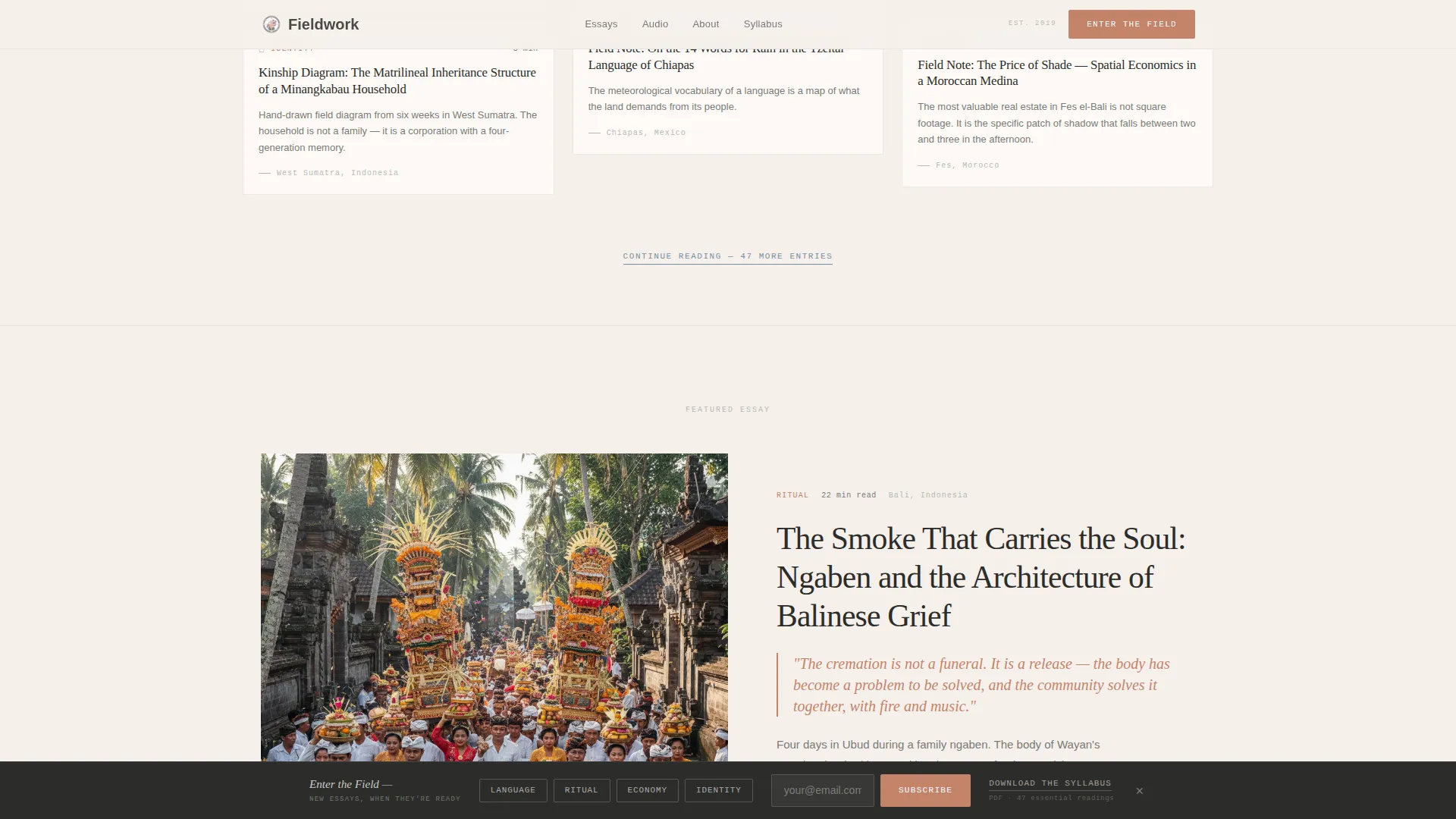
Featured Essay Split Section
A full-width cinematic split layout highlights one essay at a time. A pull quote rendered in muted terracotta anchors the reader's eye and signals the quality of the writing before they click through.
Sticky Newsletter Bar
The "Enter the Field" bar appears only after three scroll depths, keeping early reading uninterrupted. It asks for an email address and a single-select curiosity tag from four options: language, ritual, economy, and identity.
Syllabus Download Gate
A secondary conversion path offers a curated PDF reading list gated behind the same email capture. It gives academics an immediate, practical reason to subscribe on the same visit.
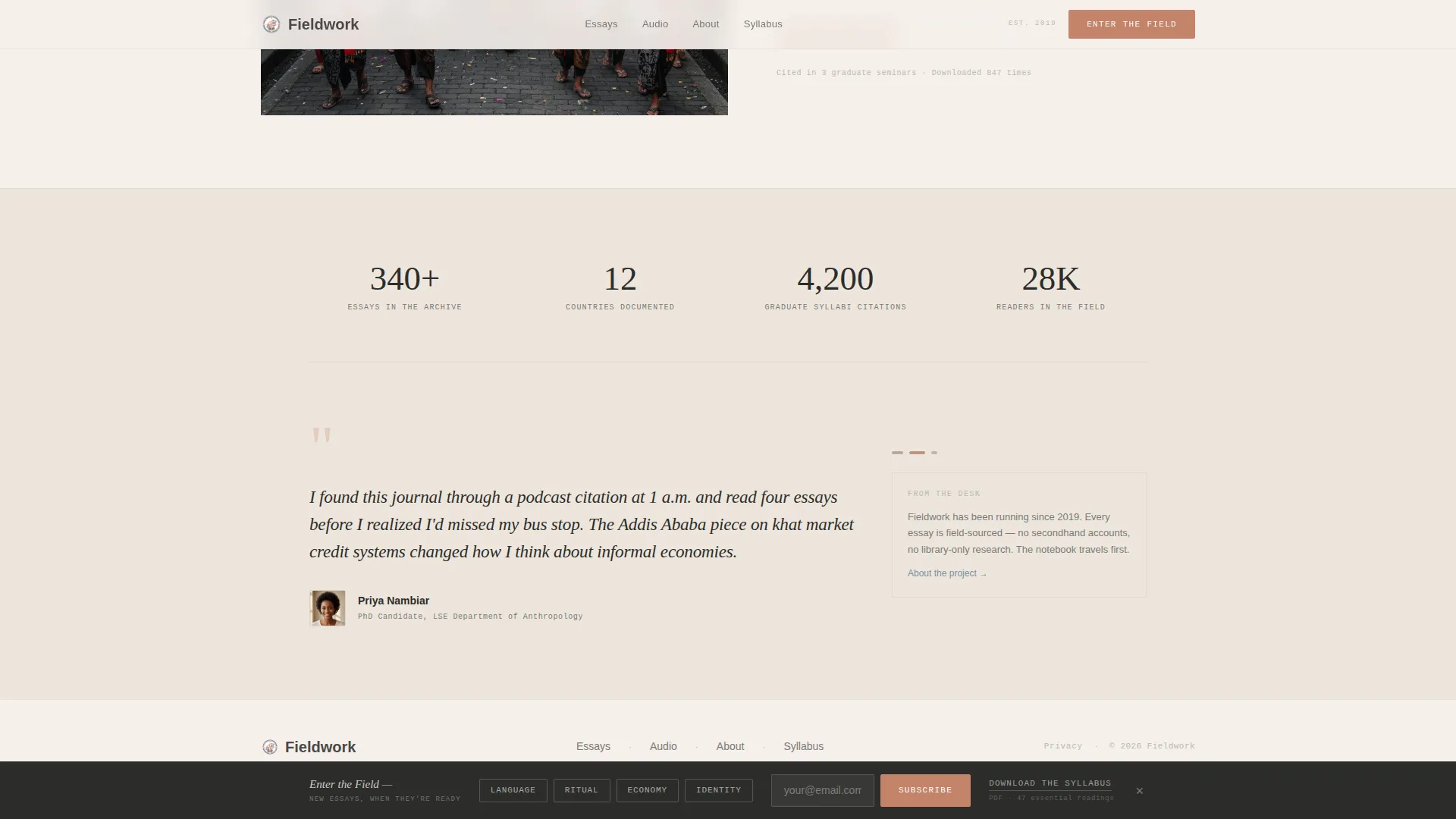
Reader Responses Section
A rotating testimonials block displays reader quotes, citation counts, and download metrics. It provides social proof grounded in the academic community without breaking the journal's editorial tone.
Page sections overview
| Section | Purpose |
|---|---|
| Manifesto Hero | Opens with a single serif statement on bare linen to establish editorial tone |
| Field Desk Grid | Masonry card layout presenting essays, photo work, and audio artifacts as pinned artifacts |
| Featured Essay Split | Full-width cinematic section spotlighting one essay with a terracotta pull quote |
| Reader Responses | Rotating reader quotes and engagement metrics serving as social proof |
| Sticky Newsletter Bar | Scroll-triggered email capture with curiosity tag selector |
| Syllabus Download | Secondary email gate offering a curated PDF reading list for academic visitors |
| Footer | Horizontal flow footer with navigation and publication context |
Design & branding system
The visual language draws from an Atelier Studio aesthetic, evoking a studio table at golden hour. Every color choice and typeface decision reinforces the sense of a well-traveled, handmade literary journal.
- Color palette: warm linen (#F5F0EB) backgrounds, pencil graphite (#4A4A48) body text, washed indigo (#7B8FA1) for links and navigation, and muted terracotta (#C4836A) reserved for hover states, pull quotes, and category tags
- Typography: Fraunces as the serif display face for headlines and manifesto text, DM Sans for readable body copy, and IBM Plex Mono for category tags and reading-time labels
- Texture and grain: a cursor grain texture and scroll-linked reveals reinforce the handmade paper quality throughout the page
Mobile & speed optimization
The template is designed desktop-first to match how academic readers typically engage with long-form content on laptops. The layout adapts responsively so mobile visitors still receive a clean, readable experience.
- Masonry grid reflows to a single or double column on smaller screens, preserving card legibility and tag visibility
- Scroll-linked animations use IntersectionObserver so entrance effects trigger only when elements enter the viewport, reducing unnecessary rendering
- Server Components handle static content sections, keeping the initial page load lean and the reading experience uninterrupted
How this template helps you convert
The conversion strategy is built around patience. The template earns reader trust through depth first, then presents two low-friction subscription paths at the right moment.
- The sticky newsletter bar delays its appearance until three scroll depths have passed, so it reaches visitors who are already invested in the content rather than interrupting a first impression
- The syllabus download gate targets academic visitors with a concrete, immediately useful resource, lowering the perceived cost of sharing an email address
Other information about this template
This template sits at the intersection of editorial design and academic publishing. It is suited for publishers who want their content hub to feel like a genuine scholarly artifact rather than a standard content marketing page.
- The template is categorized under Blog and Editorial, with a History and Culture Blog subcategory and a Cultural Anthropology Blog niche focus
- The Soft Mist color system and Atelier Studio theme are consistent visual frameworks that can be adapted to related journals, zines, or academic magazines
- Global content references baked into the design direction include fieldwork settings across Japan, Ethiopia, Mexico, and Bali, reflecting the international scope typical of ethnographic publishing
- The masonry layout accommodates mixed content types in the same grid: written essays, photo essays, hand-drawn diagrams, and short audio clips can all live as cards without one format dominating
Theme
Atelier Studio
Creative direction
Day-in-the-Life
Color system
Soft Mist
Style
Masonry/Pinterest
Direction
Content/Resource
Page Sections
Manifesto Hero with Breathing Whitespace
Masonry Field Desk Card Grid
Sticky Newsletter Bar with Curiosity Tags
Syllabus Download Email Gate
Featured Essay Cinematic Split
Rotating Reader Responses Block
Related questions
Who is this template designed for?
Can the template handle mixed content types like audio and photo essays?
How does the newsletter subscription work?
Is the template desktop-first or mobile-first?
Can I use this template for a literary journal or cultural magazine?