Book Reviews & Literary Criticism Content Expert Booking Website Template
Folio is a horizontal scroll landing page template built for a literary criticism blog. It pairs a broadsheet masthead header with a curated book card collection, a critic's manifesto pull quote, and a taste-first waitlist form. The warm parchment and rust palette, editorial serif typography, and handcrafted visual details make it feel less like a website and more like a found object worth keeping.
by Rocket studio
Quick summary
Folio is a single-page, horizontal scroll landing page template designed for a book reviews and literary criticism blog. It leads with a full-viewport broadsheet masthead, unfolds into a lateral curated book card collection, and closes with a waitlist form that converts serious readers into first-edition subscribers. Every design decision prioritises editorial atmosphere over digital convention.
Who this template is for
This template is built for critics, essayists, and literary voices who want their online presence to feel as considered as their writing. It suits independent creators launching a taste-led reading publication or coming-soon blog.
- English literature graduates, writing students, and indie bookstore regulars who want a home for serious criticism
- Book reviewers and literary essayists launching a waitlist before their first publication date
- Independent publishers or solo writers who need a coming-soon page that proves taste before it asks for trust
What problem this template solves
Most blog templates are built for content volume, not editorial voice. They flatten every publication into the same grid and the same sans-serif neutrality. Folio solves the problem of first impressions for a literary audience that distrusts anything that feels algorithmically assembled.
- Readers with high taste thresholds leave generic templates immediately; Folio holds attention through atmosphere and typographic conviction
- Coming-soon pages usually offer nothing in exchange for an email address; Folio earns the signup by demonstrating critical range through its book card collection before the form ever appears
- Standard landing page layouts present information vertically and predictably; Folio's horizontal scroll mirrors the physical act of browsing a shelf, creating a memorable and fitting experience
What you get with this template
You get a complete, ready-to-customise single-page layout with every section needed to launch a literary criticism blog waitlist. The design system, typography, and copywriting structure are all defined and consistent from top to bottom.
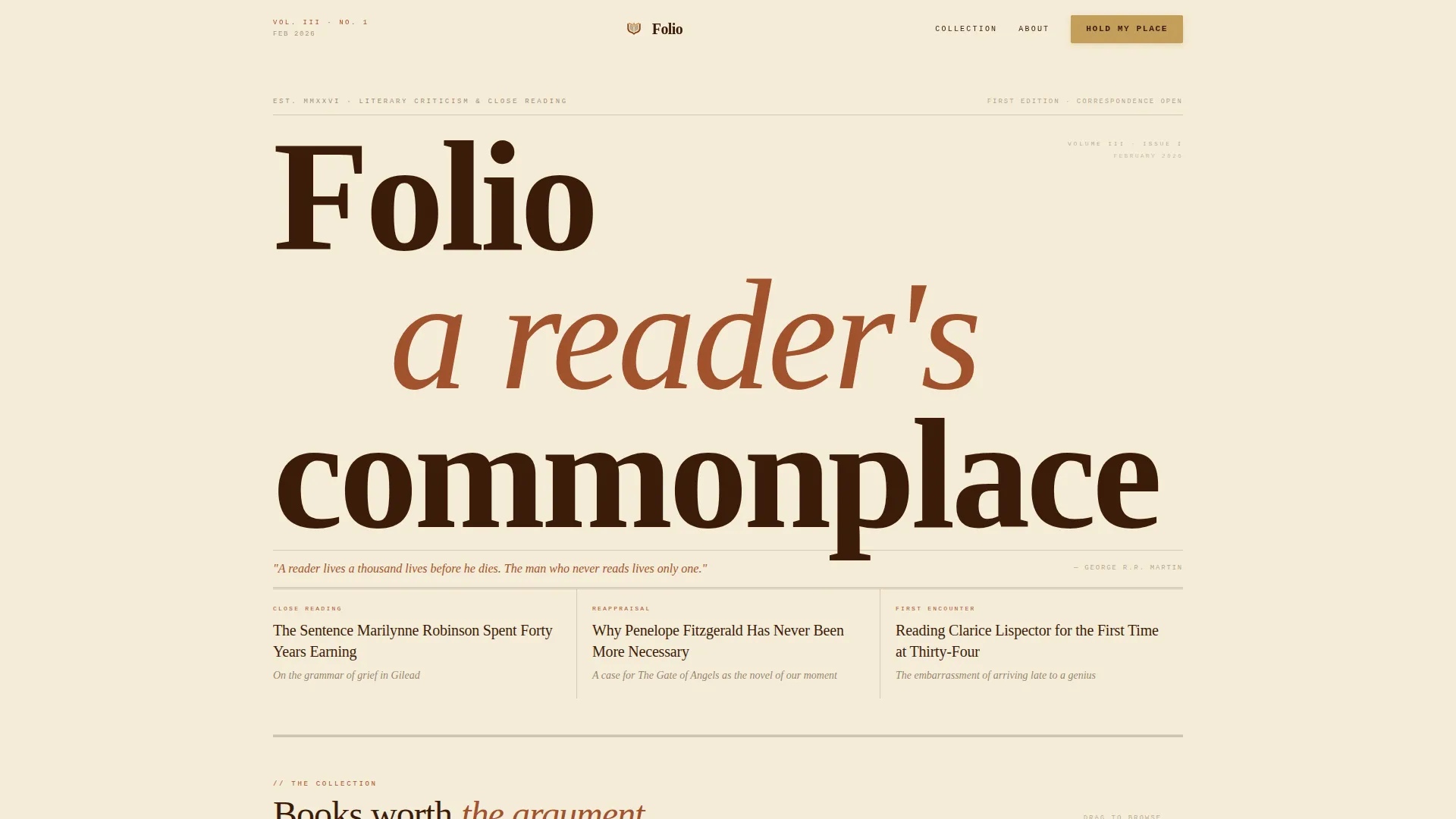
- A broadsheet hero masthead with volume metadata, a three-column teaser layout, and a horizontal rule divider
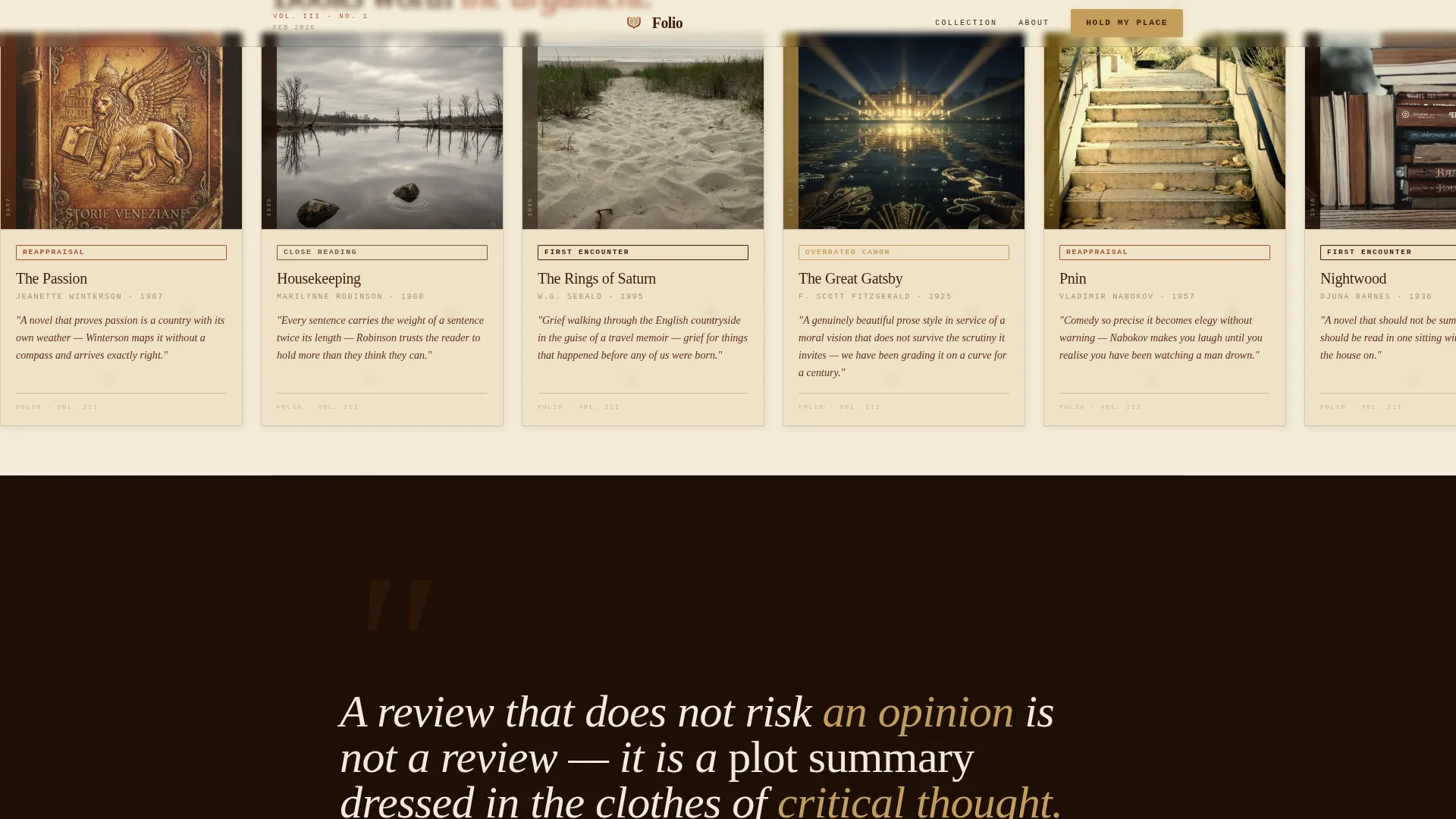
- A horizontal scroll book card collection featuring six collector-style cards plus a final handwritten-note panel
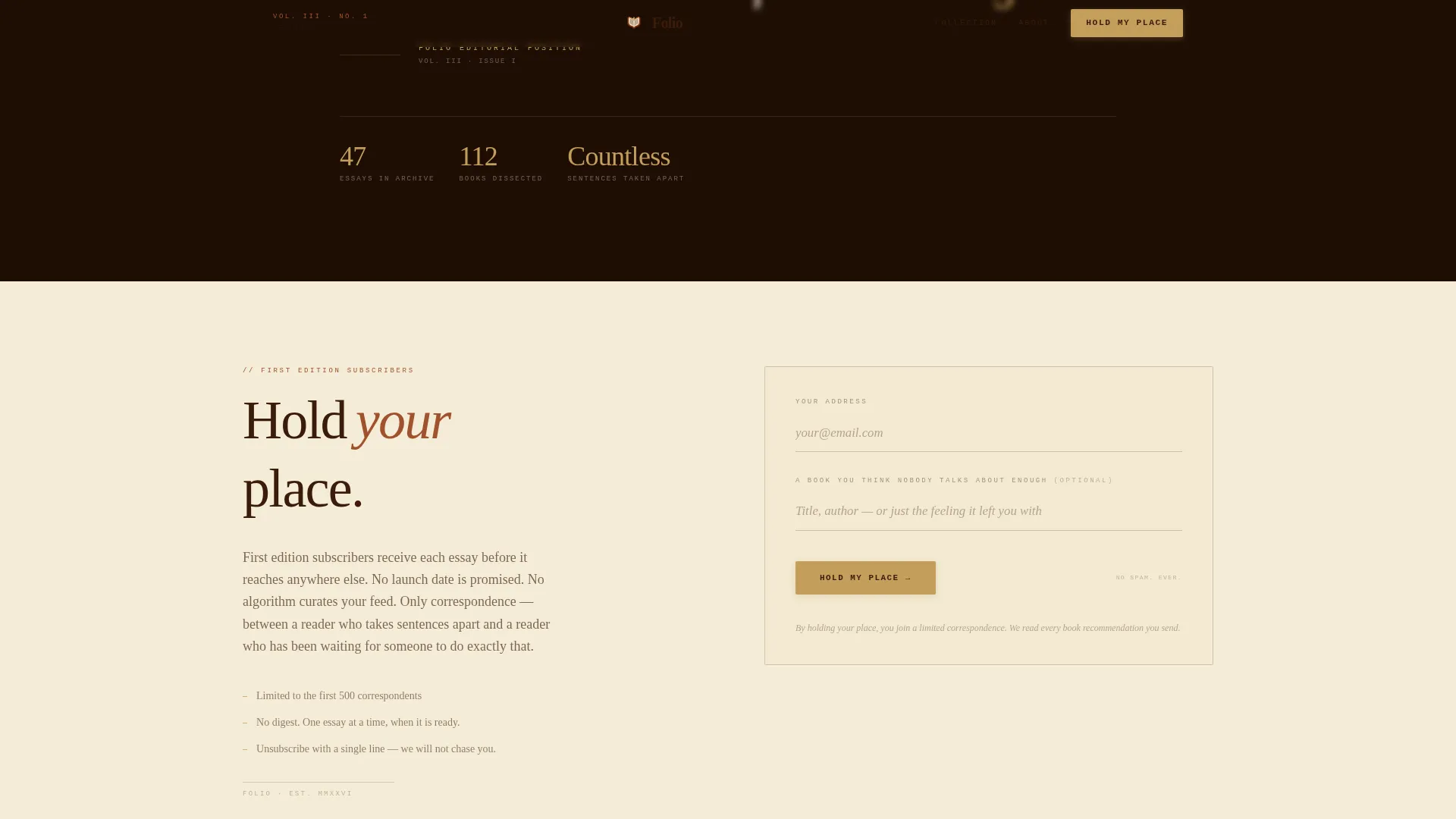
- A waitlist form section with a primary call to action, an email field, and one optional reader-contribution field
Feature list
This section covers the core built-in capabilities of the Folio template as delivered.
Broadsheet Masthead Header
The hero section is styled as a full-viewport publication masthead. It displays the blog name in large-scale serif type alongside a fictitious volume number, issue date, and a single-line author epigraph. Three column headlines below the masthead tease forthcoming reviews, typeset like a literary supplement front page. A faint horizontal rule divides the masthead from the body, evoking a fold in newsprint. No images are used; the typography carries the full visual weight.
Horizontal Scroll Book Card Collection
The template's centrepiece is a laterally scrolling collection of seven panels. Six panels each present a single book as a collector's card, complete with hand-textured cover illustration, a one-sentence italic verdict, and a classification tag such as Reappraisal, Close Reading, First Encounter, or Overrated Canon. The seventh panel breaks the pattern with a handwritten-style note indicating the collection is still being built, reinforcing an ongoing editorial identity.
Taste-First Waitlist Form
The waitlist section is built around the primary call to action "Hold My Place." It asks only for an email address, keeping friction minimal. One optional field invites readers to share a book they feel nobody talks about enough, deepening engagement without creating a barrier. Scarcity language such as "first edition subscribers" and "limited correspondence" implies exclusivity without promising a specific launch date.
Sticky Brass Call-to-Action Button
A sticky button anchored in the brass accent colour appears after the visitor scrolls past the third horizontal panel. It persists as a persistent prompt throughout the rest of the scroll experience, keeping the signup action reachable without interrupting the editorial flow.
Pull Quote Manifesto Panel
A dedicated dark atmospheric panel sits between the book card collection and the waitlist form. It presents the critic's manifesto as a typographically prominent pull quote, reinforcing voice and editorial conviction before the reader reaches the conversion section.
GSAP-Powered Scroll Interactions
The template is built with GSAP horizontal scroll, scroll-linked parallax movement, and staggered reveal animations. Book cards animate into view as the reader scrolls laterally. The sticky call to action and card hover states provide interactivity throughout the experience without breaking the editorial mood.
Page sections overview
| Section | Purpose |
|---|---|
| Broadsheet Masthead Hero | Establishes editorial identity with full-viewport serif display, volume metadata, three-column teasers, and a newsprint rule |
| Horizontal Scroll Collection | Presents six book collector cards plus a handwritten closing panel in a lateral browsing experience |
| Critic's Manifesto Quote | Reinforces editorial voice through an atmospheric dark pull-quote panel between collection and form |
| Waitlist Form Panel | Converts readers with the "Hold My Place" call to action, email field, and optional book-recommendation input |
| Footer | Closes the page with a horizontal flow footer pattern |
Design & branding system
The visual identity follows a Warm Artisan theme. Every colour, typeface, and surface choice evokes aged print materials rather than digital interfaces.
- Colour palette: aged vellum (#F5ECD7) as the dominant background, foxed-page rust (#A0522D) for headlines and pull quotes, deep library mahogany (#3B1C0A) for body text, and tarnished brass (#C49E5C) for interactive elements and hover states
- Typography: Fraunces is used for all serif display headings, Crimson Text handles body prose, and JetBrains Mono is used for metadata labels and classification tags, keeping a clear typographic hierarchy across all editorial registers
- Visual texture: hand-textured book cover illustrations, no photography, and a surface language that carries the memory of touch, wear, and time
Mobile & speed optimization
The template is designed desktop-first to deliver the full horizontal scroll experience on larger screens. A considered fallback keeps the content accessible on smaller devices.
- The horizontal scroll container reverts to a vertical layout on mobile, preserving all section content without requiring a separate page or design system
- Static sections use server components for efficient rendering, while scroll interactions and animation logic are handled client-side, keeping the interactive experience smooth without loading unnecessary code on static elements
- GSAP scroll interactions, parallax movement, and stagger reveals are scoped to client components, so they load only where and when the experience calls for them
How this template helps you convert
Folio is structured around a trust-first conversion path. By the time a visitor reaches the waitlist form, they have already moved through five sections of editorial evidence.
- The broadsheet masthead and three-column teasers establish credibility and signal editorial range immediately, before a single scroll interaction begins
- The horizontal book card collection demonstrates taste across genres and eras, giving readers a reason to stay before they are ever asked for their email address
- Scarcity framing in the waitlist copy, combined with the low-friction form structure, converts engaged readers without pressure, using language that speaks directly to the audience's dislike of algorithmic or mass-market publishing
Other information about this template
Folio is suited to literary voices launching in the blog and editorial space, particularly within book reviews and literary criticism content. A few additional details are worth noting before you build with it.
- The template supports an English language register mixing both UK and US literary conventions, making it suitable for critics writing across either tradition
- The colour system and typographic choices are fully customisable; the hex values, font pairings, and classification tag labels can all be adjusted to match a specific publication identity
- No launch date, pricing, or subscription tier is built into the template; all commitment language is deliberately ambiguous, giving you control over how and when you communicate those details
- The optional book-recommendation field in the waitlist form doubles as a lightweight audience research tool, gathering reader input before the publication launches
- The template is intended as a coming-soon page rather than a full multi-page blog build; it is designed to hold an audience and build anticipation ahead of a first publication date
Theme
Warm Artisan
Creative direction
Curated Collection
Color system
Parchment & Rust
Style
Horizontal Scroll
Direction
Waitlist/Coming Soon
Page Sections
Broadsheet Masthead Hero Section
Horizontal Scroll Book Card Collection
Taste-first Waitlist Form
Sticky Brass Call-to-action Button
Critic's Manifesto Pull Quote Panel
GSAP Scroll Animations and Interactions
Related questions
Is this template suitable for a blog that has already launched?
Can I change the book card content and classification tags?
Does the horizontal scroll work on mobile devices?
Can I use this template without committing to a launch date?
How many sections does this landing page include?