Construction Blog & Media Booking Website Template
Hardhat is a hub-and-spoke landing page template built for a construction trades podcast brand. It combines a cinematic book-spread hero, anchor navigation, a conviction-building manifesto, and a waitlist form with role segmentation. The warm stone color palette and heavy serif typography give it the worn, honest weight of a field notebook, built to earn trust before it asks for anything.
by Rocket studio
Quick summary
Hardhat is a coming-soon landing page template for a construction podcast and media brand. It guides visitors through an origin story, a trade-worker manifesto, and a show format overview before presenting a segmented waitlist form. Every section earns the ask by building genuine conviction first.
Who this template is for
This template is made for anyone launching a podcast, media brand, or content platform aimed at the construction and trades industry. It works especially well when the brand has a strong story to tell before it has episodes to share.
- Podcast founders and co-hosts building early audience momentum before launch
- Tradespeople, foremen, estimators, or industry veterans turning field experience into media
- Construction media brands that want a compelling coming-soon presence with email capture
What problem this template solves
Most coming-soon pages ask for an email before they earn it. In the trades, that approach falls flat. This template solves the trust gap by building a full narrative arc before any form appears. Visitors understand who made this, why it matters, and what they will get, in that order.
- Tradespeople scroll past generic landing pages; this one feels made specifically for them
- A live waitlist counter and trade-role selector replace passive signups with a sense of community
- The anchor navigation keeps mobile visitors oriented across a long, story-driven page
What you get with this template
The template delivers a fully structured, single-page layout with five distinct content spoke sections connected by an anchor navigation bar styled as a table of contents. Every section has a defined job in the visitor journey.
- A book-spread hero section with a cinematic photo layout, heavy serif headline, and chapter marker
- A manifesto section with punchy "We believe..." paragraph format and dual waitlist form placements
- A sticky footer call-to-action bar that slides up after thirty seconds on the page
Feature list
This template packs purposeful interactive and visual components drawn directly from the brief. Each one serves the waitlist and brand-awareness goals of a launching construction podcast.
Book-Spread Hero with Anchor Navigation
The header is designed as a hardcover book interior spread. The left page holds a sepia-toned jobsite photograph. The right page carries a heavy serif headline. Below the image, the anchor navigation reads like a table of contents with links to Episodes, The Crew, Blueprint, and Get Early Access.
Origin Story Timeline Section
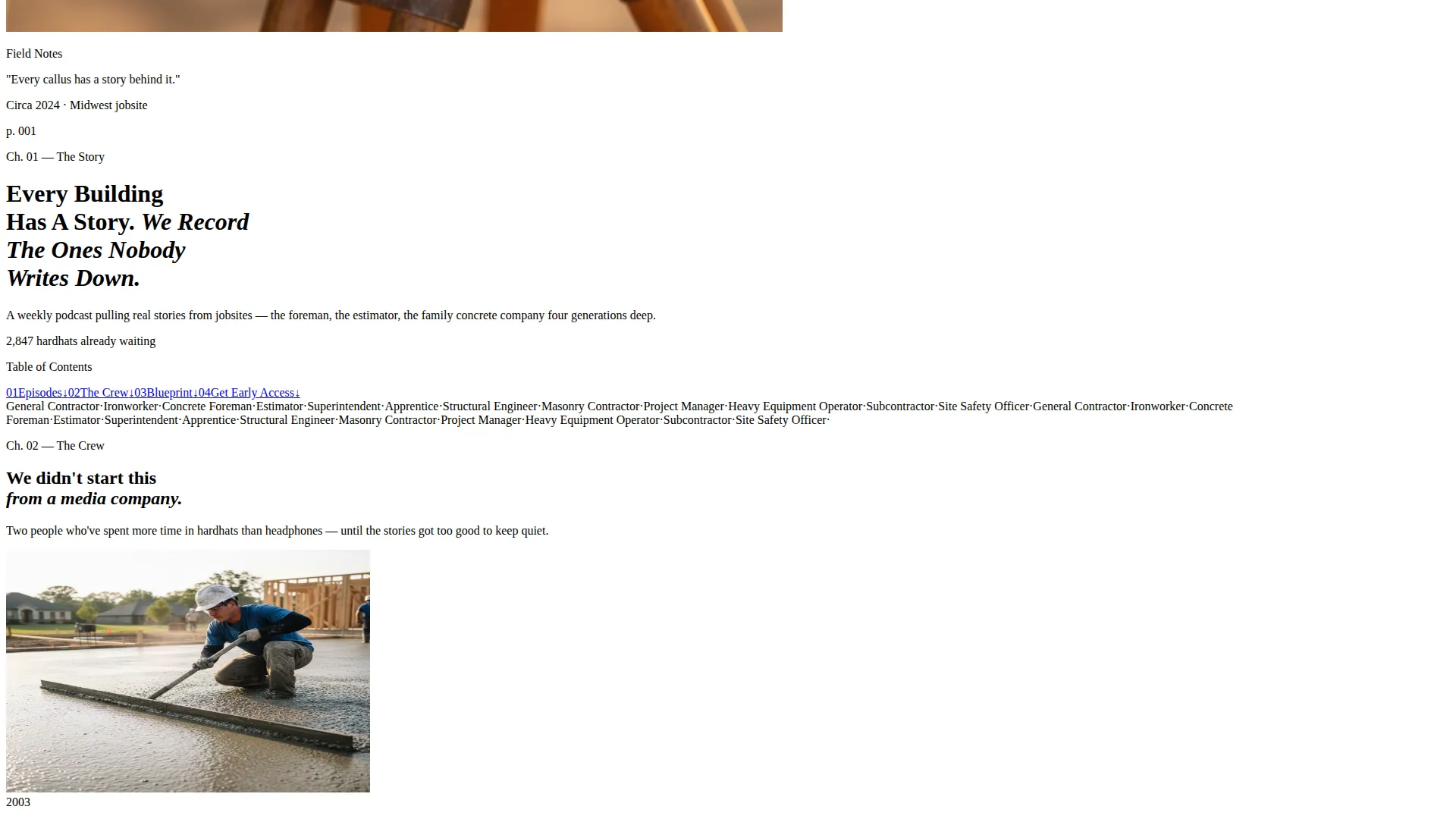
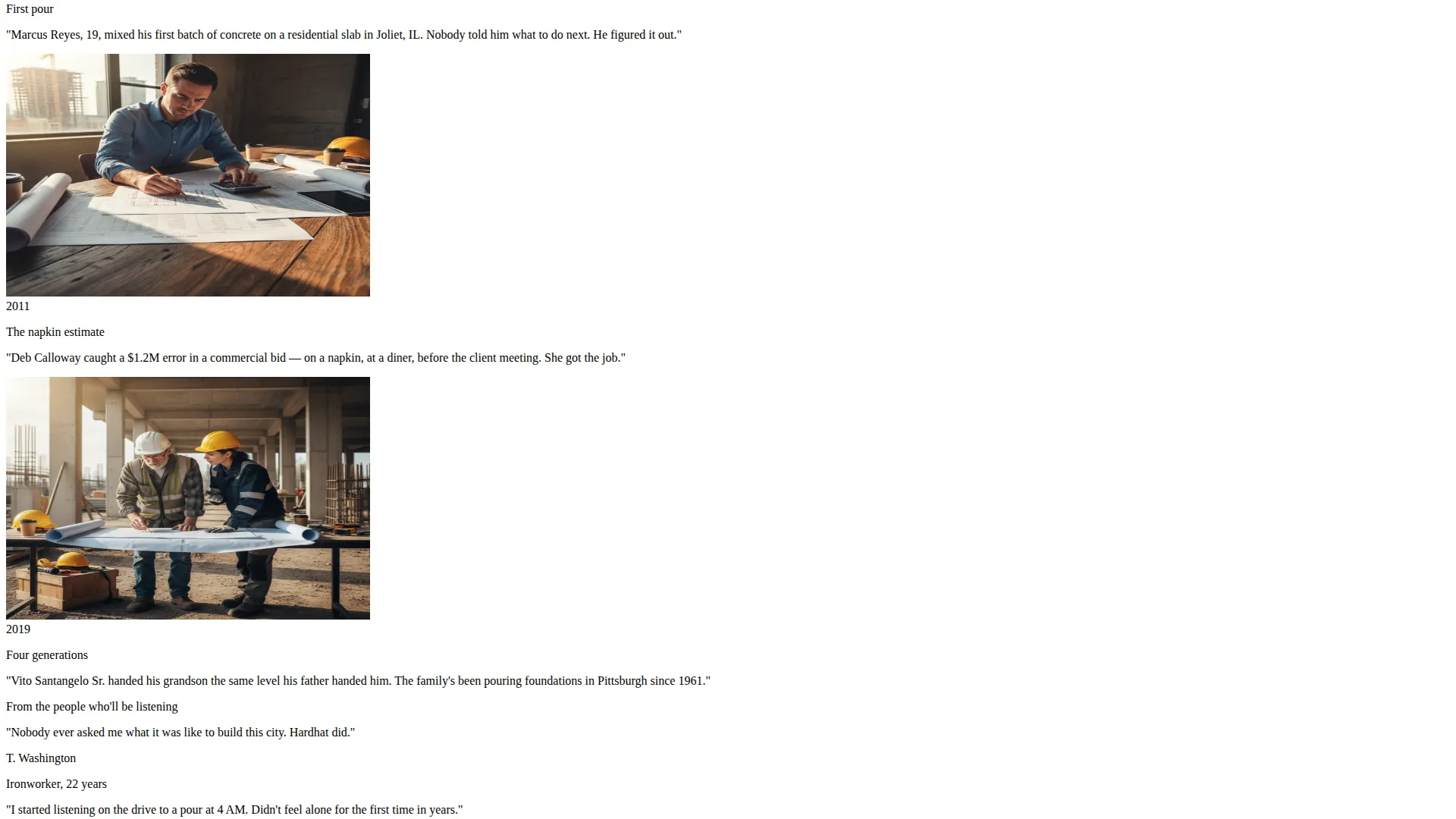
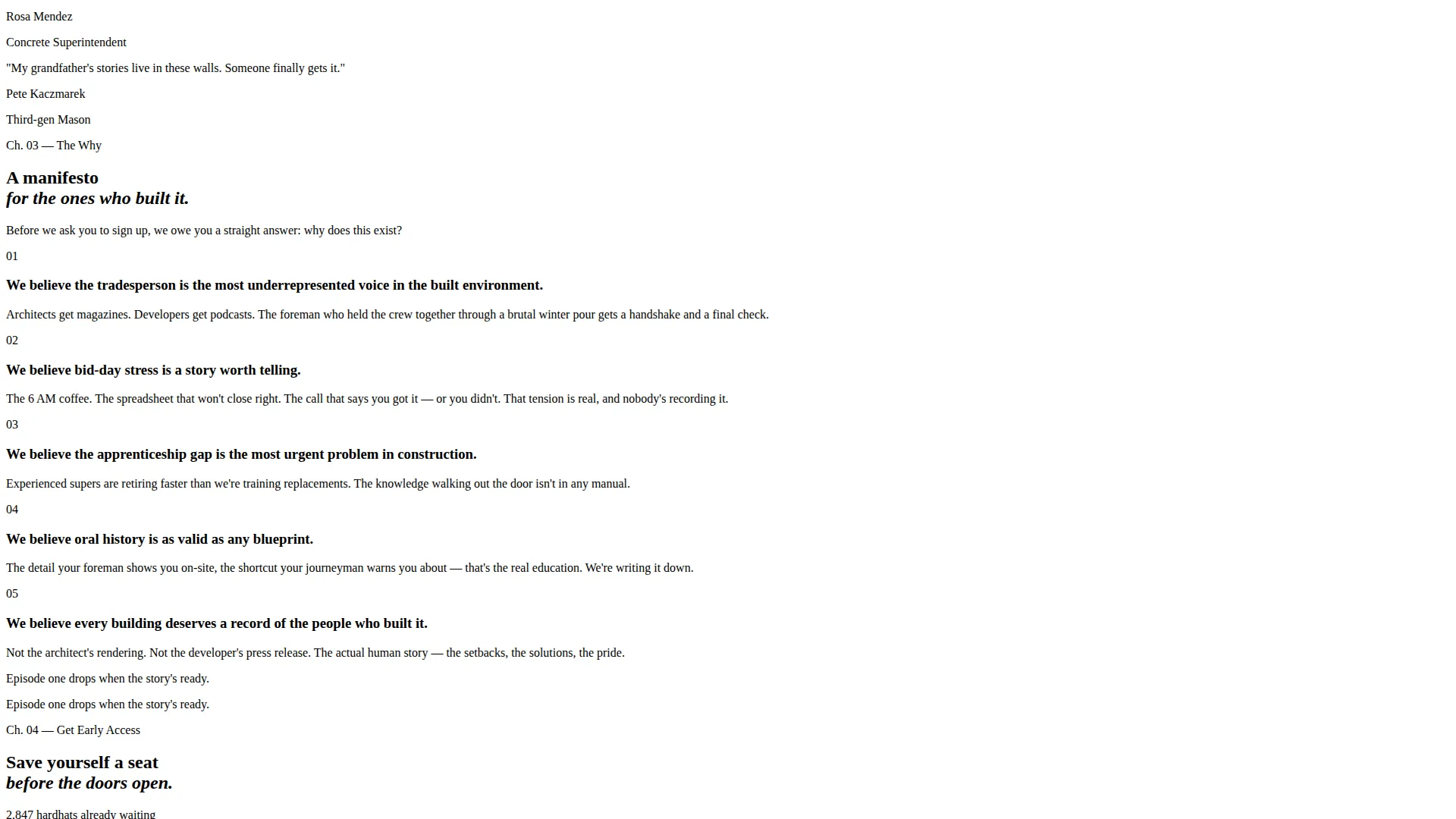
The Crew section tells the hosts' backstory through a timeline of jobsite photos paired with pull-quotes from real tradespeople. It answers "Is this for me?" before the visitor has to ask.
Trade-Worker Manifesto Block
The manifesto section uses a series of short, punchy paragraphs each beginning with "We believe..." The format grounds every statement in specific industry realities, bid-day stress, the apprenticeship gap, jobsite knowledge that never gets written down.
Segmented Waitlist Form
The waitlist form captures an email address alongside a trade-role selector. Role options include general contractor, subcontractor, supplier, architect, and fan. The form appears twice: once after the manifesto and once in the sticky footer bar.
Live Waitlist Counter
A dynamic counter displays the current number of people who have joined the waitlist. The counter creates forward momentum and social proof without overpromising a launch date.
Sticky Footer Call-to-Action Bar
A call-to-action bar slides up from the bottom of the screen after the visitor has been on the page for thirty seconds. It presents a condensed version of the waitlist form so the signup opportunity is always within reach.
Page sections overview
| Section | Purpose |
|---|---|
| Hero book spread | Establish visual identity and anchor navigation |
| The Crew timeline | Build host credibility through origin story |
| Manifesto statements | Articulate the show's mission and values |
| Blueprint show format | Explain episode structure and listener value |
| Waitlist signup form | Capture email and trade-role data |
| Sticky footer bar | Persistent low-friction signup prompt |
Design & branding system
The visual identity follows a Heritage and Story theme. Every color and type choice references the honest textures of a real construction environment, nothing decorative that does not earn its place on the page.
- Color palette: quarried limestone (#C8B89A), rebar shadow (#3B3028), fresh-pour gray (#A09E97), and safety-orange accent (#DA6A2C) used on interactive elements and hover states
- Typography: Fraunces heavy serif for headlines, DM Sans for body text, weighted authority paired with clean readability
- Visual style: worn field notebook aesthetic with a hardcover book-interior layout, sepia photography, gutter line, and chapter markers
Mobile & speed optimization
The template is built mobile-first, reflecting the primary listening context of its audience. Project managers and apprentices access this page between sites, on phones, with limited time and attention.
- Anchor navigation collapses cleanly for mobile, keeping section links accessible without crowding the viewport
- Scroll-triggered animations including fadeInUp and float effects are set to medium intensity, keeping motion purposeful without slowing the scroll experience
- The sticky footer call-to-action bar is designed to appear without disrupting content reading on smaller screens
How this template helps you convert
The page is structured as a Vision and Mission arc. Each section deepens the reason to care before presenting a reason to sign up. This sequence is deliberate and specific to the trades audience.
- The origin story and manifesto sections build personal and communal identity first, so when the waitlist form appears, visitors feel invited into a movement rather than added to a mailing list.
- The dual form placement, once after the manifesto and once in the sticky footer bar, keeps the conversion opportunity present at the two moments when conviction is highest.
- The live waitlist counter and the trade-role selector together signal that real people with real roles are already signed up, making the decision to join feel natural and low-risk.
Other information about this template
This template is categorized under Blog and Editorial, specifically the Construction Blog and Media subcategory, with a niche focus on Construction Podcast and Media. It is part of a Hub and Spoke (Anchor Nav) template style family.
- The template style is Hub and Spoke with anchor navigation, making it well suited for long-form single-page storytelling with multiple scroll destinations
- The creative direction is Vision and Mission, meaning sections are sequenced to build belief before making an ask
- The header concept is Chapter and Book, a layout convention that sets editorial tone from the first viewport
- No launch date is hardcoded; the copy uses the line "Episode one drops when the story's ready" to keep anticipation open-ended
- The footer follows a Linear Single-Row pattern for a clean, uncluttered close to the page

Theme
Heritage & Story
Creative direction
Vision & Mission
Color system
Warm Stone
Style
Hub & Spoke (Anchor Nav)
Direction
Waitlist/Coming Soon
Page Sections
Book-spread Hero with Chapter Marker
Origin Story Timeline
Trade-worker Manifesto Block
Segmented Waitlist Form
Live Waitlist Counter
Sticky Footer Call-to-action Bar
Related questions
Can I change the waitlist counter number in this template?
Does this template work for a podcast that has not launched yet?
Can I adjust the trade-role options in the signup form?
Is this template suitable for mobile visitors?
Can this template support a construction media brand beyond a podcast?