Hobby & Passion Content Blog & Content Website Template
Furrow is a warm artisan kitchen garden blog landing page template built for masonry-style storytelling. It pairs a manifesto-driven scroll flow with Pinterest-style photo grids, botanical SVG illustrations, and a parchment-textured chapter header. The single call to action leads visitors to a free community membership, earning trust through belief statements before asking for anything.
by Rocket studio
Quick summary
Furrow is a single-page, masonry-layout landing page template for kitchen garden blogs and growing communities. It opens like a chapter from a well-loved cookbook, moves through three belief-statement sections paired with member photo grids, and closes with a persistent community call-to-action bar. The design is warm, literary, and rooted in real life, built for growers who want their corner of the web to feel as honest as the soil under their fingernails.
Who this template is for
Furrow speaks directly to people who grow food and want to share that life with others who understand it. The template is designed for blog founders, community builders, and passionate home growers who have stories to tell and an audience ready to listen.
- Kitchen garden bloggers who want a landing page that feels like a place, not a pitch
- Community organizers building a free membership around seasonal growing, organic methods, and harvest-to-plate content
- Home growers of any scale, from apartment balcony herb growers tending a single pot toward pesto to retired teachers converting half a lawn into heritage beet rows, to young parents helping toddlers eat something they watched grow from seed
What problem this template solves
Most blog landing pages feel like brochures. They list features, show a stock photo, and ask for an email before they have earned a single nod from the reader. For a kitchen garden blog, that approach lands wrong. The audience is tactile, skeptical of polish, and loyal to voices that feel genuinely lived-in.
Furrow solves this by leading with conviction rather than conversion copy. It earns trust through manifesto-style belief statements, then supports each statement with visual proof in the form of member garden photos, handwritten seed-packet labels, and harvest-to-plate sequences. By the time a visitor reaches the call-to-action button, they have already agreed three times.
- Removes the cold, corporate landing-page feeling that pushes garden community visitors away before they scroll past the first section
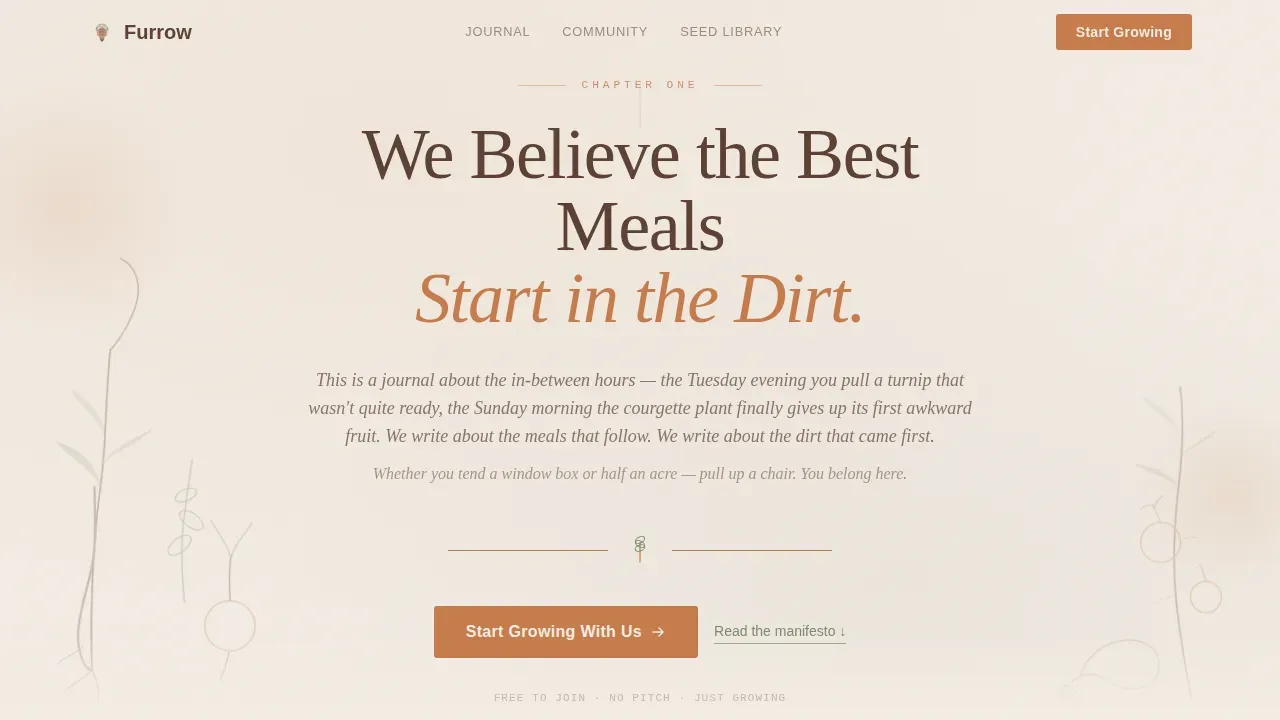
- Replaces generic hero imagery with a parchment-textured, typography-led chapter opener that immediately signals warmth, craft, and a real point of view
- Gives small-community founders a professional, conversion-ready page without requiring a form, a complicated funnel, or technical setup beyond the template itself
What you get with this template
Furrow delivers a fully structured, single-page masonry layout ready to adapt to your garden blog's voice and visual identity. Every section is intentional and connected, flowing from manifesto to proof to community invitation without a wasted beat.
- A complete five-section landing page: chapter-style hero, three alternating manifesto-plus-grid sections, and a community proof section with a persistent bottom call-to-action bar
- A warm artisan design system built around sun-baked terracotta, aged linen, weathered oak, and fresh sage green, complete with Fraunces serif display typography, DM Sans body text, and IBM Plex Mono for labels and captions
- Scroll-reveal animations, masonry card hover states, grain texture overlays, botanical SVG illustrations, and a persistent bottom bar that appears after the third grid section
Feature list
The five main capabilities below are drawn directly from the template brief. Each one reflects a deliberate design and layout decision, not a generic feature checkbox.
Chapter-Style Manifesto Header
The hero section opens as a full-width parchment-textured spread, styled to feel like the first page of a garden memoir. A hand-lettered chapter label sits above a warm serif headline. Below it, a short italic passage reads like an opening paragraph from a book you already trust. Delicate botanical SVG line illustrations of root vegetables and herb sprigs frame the text. There is no photography in this section. The warmth comes entirely from typography, texture, colour, and the promise of a story unfolding downward. This approach lets the blog's point of view do the heavy lifting before a single image loads. Visitors who respond to this section are already aligned with the community's values.
Alternating Manifesto and Masonry Grid Sections
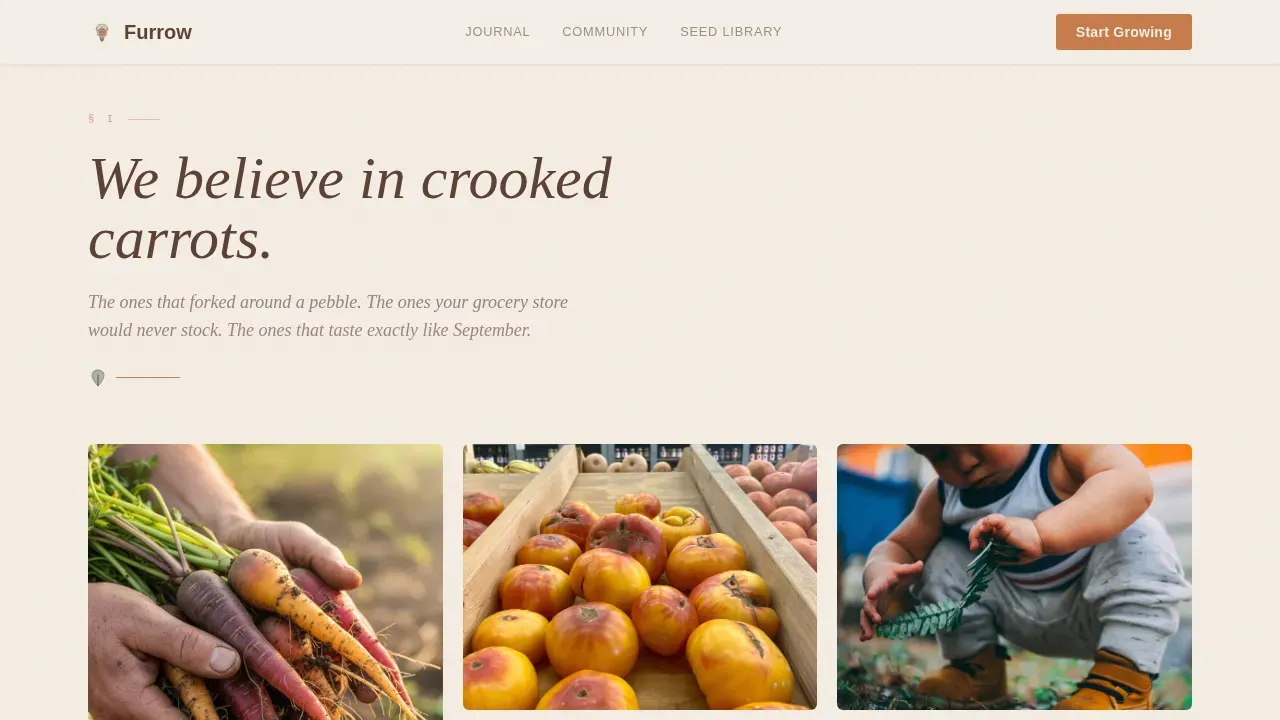
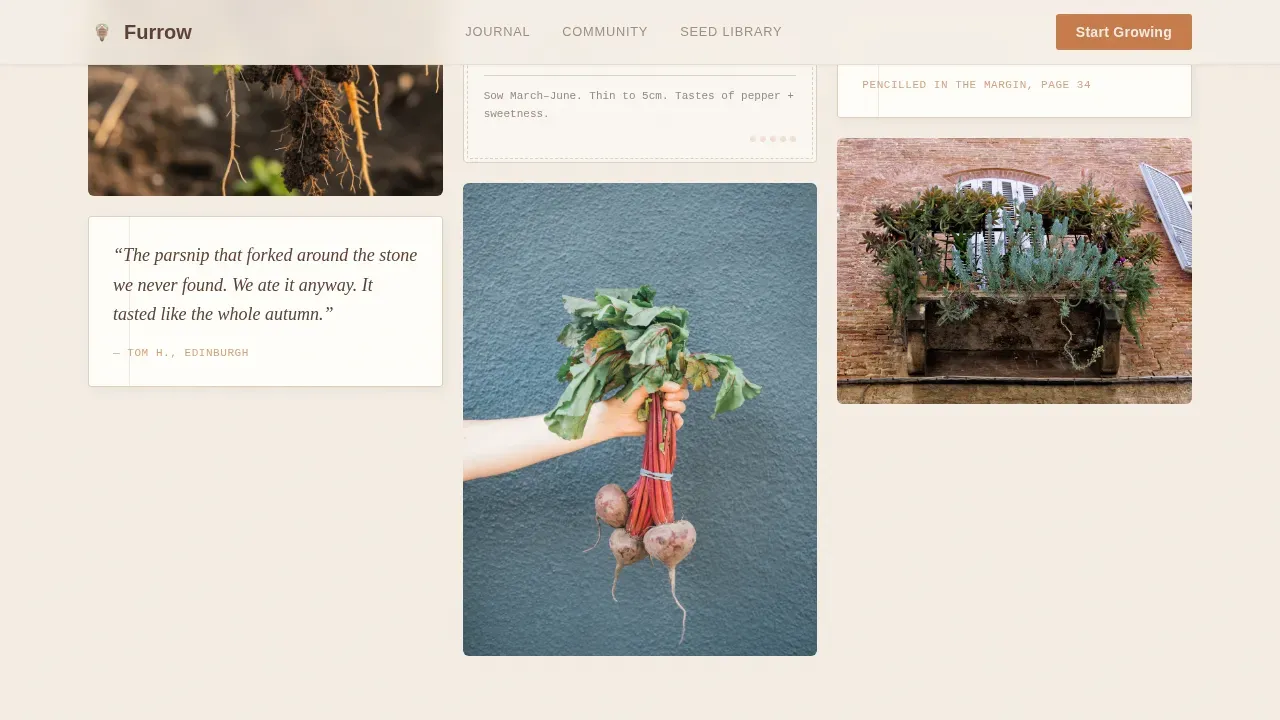
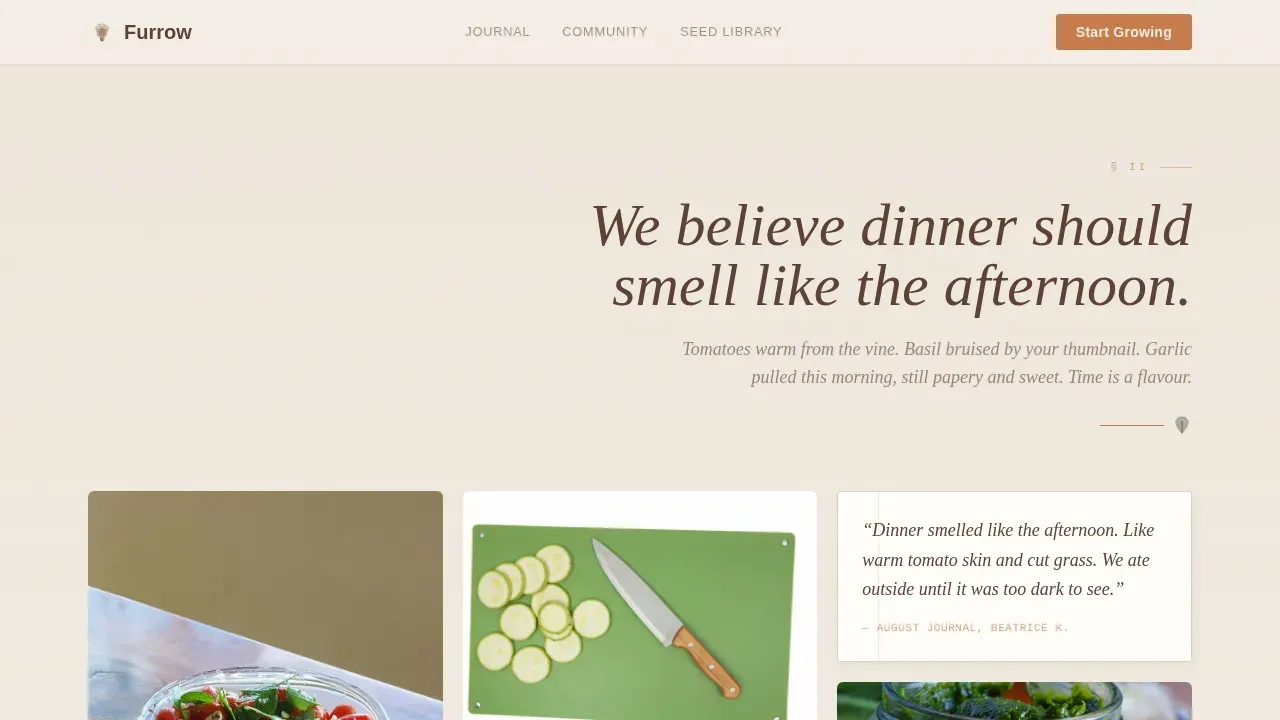
Three mid-page sections each open with a belief statement, then immediately bloom into a Pinterest-style masonry photo grid. The first grid features imperfect garden harvests and raised bed scenes. The second features harvest-to-plate sequences showing vegetables moving from soil to cutting board. The third features handwritten seed-packet labels, crop planning notes, and recipe moments. Each grid is built to hold member-submitted content, creating a community feel from the first scroll. The rhythm of word and image, conviction and proof, pulls visitors deeper the way a good book makes you forget you are turning pages. The masonry layout means images of different heights sit naturally together without forced cropping or empty space.
Persistent Bottom Call-to-Action Bar
After the third grid section, a sticky bottom bar appears and stays visible for the remainder of the scroll. It carries the primary call to action, "Start Growing With Us," rendered in sage green on terracotta for maximum colour contrast against the linen background. This bar does not interrupt reading. It sits quietly at the bottom of the viewport, ready when the visitor is ready. Because the page earns trust before it asks, visitors who reach this bar have already moved through three rounds of manifesto belief and visual proof. The bar is a gentle reminder, not a demand.
Warm Artisan Colour and Typography System
The entire template runs on a four-colour palette drawn from a kitchen garden in late summer: sun-baked terracotta (#C67B4B) as the primary colour, weathered potting-bench oak (#5C4033) as the foreground, aged linen (#F4EDE4) as the background, and fresh sage green (#7A8B6F) reserved for links, buttons, and growing-season highlights. Typography pairs Fraunces, a warm optical serif with ink-trap personality, with DM Sans for readable body text and IBM Plex Mono for seed-packet-style labels and captions. The result is a visual language that feels handcrafted, literary, and deeply specific to this niche, without requiring any design skill from the person deploying the template.
Community Proof Section with Member Count and Quote
The fifth section before the footer combines social proof elements to close the page with warmth and credibility. A member count statistic and a single authentic member quote are displayed alongside the final call-to-action invitation. Social proof of this kind is important for building trust on a landing page. It shows prospective members that real people with real gardens have already joined and found value. The section does not over-explain. It states the number, shares the voice, and makes the invitation. The footer follows immediately after, built on an ultra-minimal horizontal flow pattern that keeps the page from ending with visual noise.
Scroll Animations and Interactive Masonry Cards
Furrow includes medium-intensity scroll-reveal animations throughout the page. Masonry grid cards stagger into view as the visitor scrolls, giving the photo grids a sense of life and momentum rather than a static dump of images. Individual cards respond to hover states, adding a layer of tactile interactivity that rewards curiosity. A grain texture overlay runs across the background throughout the page, reinforcing the warm, slightly imperfect aesthetic. These effects are built to feel organic, not flashy. They support the cookbook-and-craft atmosphere rather than competing with it.
Page sections overview
| Section | Purpose |
|---|---|
| Chapter header hero | Opens the page as a book chapter with parchment texture, botanical SVGs, manifesto headline, and the first call-to-action button |
| Belief statement one | Declares "We believe in crooked carrots" above Masonry grid one, featuring imperfect garden harvest photos |
| Belief statement two | Declares "We believe dinner should smell like the afternoon" above Masonry grid two, featuring harvest-to-plate sequences |
| Belief statement three | Declares "We believe soil is a recipe ingredient" above Masonry grid three, featuring seed packets and handwritten labels |
| Community proof bar | Displays member count statistic and a single authentic member quote alongside the final call-to-action |
| Persistent call to action bar | Sticky bottom bar appearing after the third grid section, carrying the "Start Growing With Us" button |
| Ultra-minimal footer | Closes the page with a horizontal flow pattern, keeping the ending clean and uncluttered |
Design & branding system
Furrow's design language is built to feel like a clay pot left out all summer: heat-soaked, honest, and slightly imperfect in the best possible way. Every colour, typeface, and texture decision reinforces the warm artisan identity.
- Colour palette: terracotta (#C67B4B) primary, aged linen (#F4EDE4) background, weathered oak (#5C4033) foreground text, and sage green (#7A8B6F) for links, buttons, and seasonal highlights; the combination creates natural depth and contrast without feeling designed
- Typography system: Fraunces serif for display headlines and chapter labels, DM Sans for all body paragraphs, and IBM Plex Mono for labels, captions, and seed-packet-style annotation text; together they create a warm layering of voices on the page
- Texture and illustration layer: a grain texture overlay sits behind all sections, botanical SVG line illustrations of root vegetables and herb sprigs appear in the hero, and parchment-style surface treatment reinforces the cookbook-chapter feeling throughout
Mobile & speed optimization
The template is described as desktop-first with strong mobile adaptation. The cookbook-and-journal aesthetic translates naturally to tablet and phone reading, which matters because a large share of gardening and food content is consumed on mobile devices. Over sixty percent of landscaping-related searches happen on mobile, and a garden community landing page needs to hold its warmth and legibility at every screen width.
- Masonry grid layouts reflow gracefully at smaller screen widths, maintaining the visual rhythm of the photo grids without collapsing into a single flat column
- Server Components handle static content sections, keeping the JavaScript footprint minimal; a lightweight scroll observer powers the persistent bottom bar and stagger animations
- Typography scales are set to preserve the literary warmth of Fraunces display headings and DM Sans body text at both large desktop viewports and compact phone screens
How this template helps you convert
Furrow is a click-through landing page. There is no form on the page itself. The entire scroll experience is built to earn enough trust that the visitor clicks willingly, carrying themselves to a simple signup asking only for a first name and an email address.
- The manifesto structure earns agreement before it asks for action: each belief statement invites a small internal nod from the visitor, and three nods accumulate into genuine readiness to join
- The masonry photo grids provide visual social proof at every stage of the scroll, showing real gardens, real harvests, and real community members rather than polished stock imagery
- The persistent bottom call-to-action bar ensures the invitation is always visible after the third section, so a visitor who becomes ready mid-scroll never has to hunt for the button
Other information about this template
Furrow draws on a set of ideas that matter to the kitchen garden community it serves. The sections below cover practical context that helps you understand the full range of content this template is built to support and the values it was designed to reflect.
- Seasonal growing focus: the template is built around a blog that covers the full growing calendar, from planning a garden layout during winter snow, to planting cover crops in fall to protect and feed the soil, to the first seed trays of spring, through the heavy fruit of early summer and the long warm weeks of the main growing season, all the way to early October frost watches and the final harvest before the ground freezes
- Sustainable and organic values: the Furrow community is rooted in organic growing practices, including composting kitchen scraps back into nutrient-rich soil, planting cover crops to prevent erosion and improve soil health, rotating crops to keep beds productive across seasons, and using organic fertilizers to nourish plants without synthetic inputs; these values are woven into the blog's manifesto and reflected in the kind of content member photo grids will naturally display
- Community and local sourcing: the template supports a growing community that connects people to each other and to local food systems; community supported agriculture, known as CSA shares, farmers markets, and the act of eating locally sourced food are all natural topics for the content this page will promote; locally sourced ingredients carry superior flavour and nutritional value, and organic farming practices enhance biodiversity and improve soil health across local ecosystems
- Garden variety and seasonal planting depth: a kitchen garden blog built on this template will naturally cover fruit trees in the back garden, shade-tolerant crops planted under taller plants, green manure crops, purple heritage vegetables, ornamental flowers grown alongside edible crops, spring bulbs pushing through the last of the snow, summer vines climbing walls and trellises, fall root vegetables pulled before frost, and winter planning sessions held at the kitchen table with seed catalogues and a pencil
- Colour and aesthetic depth: the warm colour palette of this template, anchored in terracotta, linen, oak, and sage green, is deliberately evocative of organic textures; the grain overlay adds depth to every background, the botanical SVGs add line-art lightness, and the parchment header adds a sense of history and craft that generic blog templates cannot replicate; using warm colours in garden decor and design consistently enhances the inviting atmosphere of a kitchen garden space, and this template applies the same principle to the screen
- Local artists and community contributors: the masonry photo grids are designed to hold member-submitted garden photos, handwritten seed-packet labels, and harvest-to-plate sequences; this positions the community as one that is created by its members, not just for them; local artists, illustrators, and garden photographers could contribute content that deepens the visual library of the blog over time
- The Furrow warm artisan kitchen garden blog landing page template is positioned for blog founders who want a literary, conversion-ready starting point without sacrificing the handcrafted warmth that makes a kitchen garden community feel like home; it sits within a front range of artisan blog templates that prioritise storytelling over sales mechanics, and it is built for readers who will feel the difference
- Paths, seating, and defined garden spaces: content supported by this template can cover the practical side of creating a kitchen garden, including how to define outdoor spaces with gravel paths, where to add a simple wood bench for morning coffee beside the herb bed, how to use raised beds to make planting more accessible, and how to add trellises or arbors to give climbing crops room to grow vertically; these topics give the blog's content depth and make the landing page a genuine resource as well as a community invitation
- Birds, insects, and garden life: a real kitchen garden is full of other insects beyond common pests, from ground beetles hunting under mulch to pollinators working the summer flowers; birds drop seeds into unexpected corners and pull worms from freshly turned soil; these details belong in a kitchen garden journal, and the template's masonry grids have room for the kind of photography that captures this life honestly
- Weather, frost, and the growing year: the blog content this template is built for covers weather honestly, including fingers crossed moments before the last frost date, the energy of an early spring morning when the first green shoots appear, the shade cast by fruit trees over beds that need replanting, the contrast between a snow-covered garden in winter and the same bed filled with summer crops weeks later, and the quiet sense of satisfaction when a harvest makes it to the table before the temperature drops; climate change increasingly shapes growing seasons, and a kitchen garden community that talks honestly about shifting weather patterns earns deeper trust from its readers
- Knowledge and craftsmanship: an artisan kitchen garden blog should evoke a sense of craftsmanship, sustainability, and rustic elegance; this template embodies that by putting words and ideas first, trusting that knowledge and authenticity are more persuasive than high-gloss design; the art of growing food, preserving it, cooking it, and writing about it honestly is what this page is built to celebrate
Theme
Warm Artisan
Creative direction
Manifesto
Color system
Warm Stone
Style
Masonry/Pinterest
Direction
Click-Through
Page Sections
Chapter-style Manifesto Hero Header
Alternating Belief and Masonry Grid Layout
Persistent Bottom Call-to-action Bar
Warm Artisan Colour and Typography System
Community Proof Section
Scroll Animations and Botanical SVG Illustrations
Related questions
Is Furrow suitable for a brand-new kitchen garden blog with no existing content?
Does this template include a signup form on the landing page itself?
Can I rewrite the manifesto belief statements to match my garden blog's voice?
How does the masonry grid work with member-submitted garden photos?
Is this template designed only for kitchen garden content, or can it support broader food and growing topics?