Authoritative Entertainment Report Landing Page Template
Byline is an editorial landing page template built for entertainment industry intelligence publications. It combines a broadsheet-inspired masthead, a manifesto scroll, named editorial pillars, a founding editor's letter, and a five-question quiz funnel into one authoritative, conversion-focused page. The result is a landing page that feels like a premium print publication and converts like a precision-built lead capture tool.
by Rocket studio
Quick summary
Byline is a single-page editorial landing page template designed for entertainment industry report publications. It opens with a full-viewport broadsheet masthead, moves through a manifesto and editorial pillars, and closes with a personalized quiz funnel that segments visitors into curated reading tracks. Every element on the page serves a single conversion action: capturing qualified leads via email subscription.
Who this template is for
This landing page template is built for a precise, professional audience. It speaks directly to people who consume and produce serious entertainment industry analysis, not casual fans browsing headlines.
- Development executives and entertainment journalists scanning for greenlight trends and cross-referencing deal intelligence as part of their daily workflow.
- Film school graduates and industry aspirants trying to decode the machinery behind what gets made, greenlighted, or quietly shelved.
- Independent editorial publishers and media founders who want a landing page that signals authority and builds a loyal subscriber base from day one.
What problem this template solves
Most editorial landing pages fail because they look like every other blog signup page. They do not signal credibility. They do not match the intelligence of their audience. For publications covering box office forensics, streaming strategy, or talent deal anatomy, a generic page design actively hurts conversion rates.
An authoritative entertainment industry report landing page must balance high-level professional credibility with high-conversion design. That balance is exactly what this template solves.
- Weak editorial positioning: Generic landing pages produce generic results. The Byline template replaces placeholder credibility with a broadsheet-grade visual system and a manifesto that explains why surface-level trade reporting fails the industry.
- Low trust for a skeptical B2B audience: B2B landing pages often need to provide more information and build more trust upfront, especially when longer sales cycles and multiple decision makers are involved. This template layers trust signals across every scroll section.
- No clear conversion path: Visitors without a clear next step leave. The built-in quiz funnel gives visitors a low-risk, action-oriented reason to engage and share their email without feeling sold to.
What you get with this template
This template delivers a fully structured, editorially styled landing page with five distinct content sections, a personalized quiz engine, and a footer email capture. Every section is content-ready and visually intentional.
- Five pre-built page sections: Broadsheet masthead, manifesto column, editorial pillars block, editor's letter with signature treatment, and the "Find Your Industry Blind Spot" quiz module, plus an Arc-pattern footer with masthead branding.
- Three quiz result tracks: Box Office Analyst, Deal Decoder, and Platform Strategist, each paired with a curated sample report and a personalized email opt-in to increase conversions from the quiz.
- A complete typographic system: Fraunces for editorial serif display, DM Sans for body and user interface copy, and IBM Plex Mono for datelines and labels, all pre-configured to deliver a letterpress broadsheet aesthetic.
Feature list
This landing page template is built with six core capabilities, each grounded in the editorial and conversion requirements of the Byline concept.
Broadsheet Masthead Hero Section
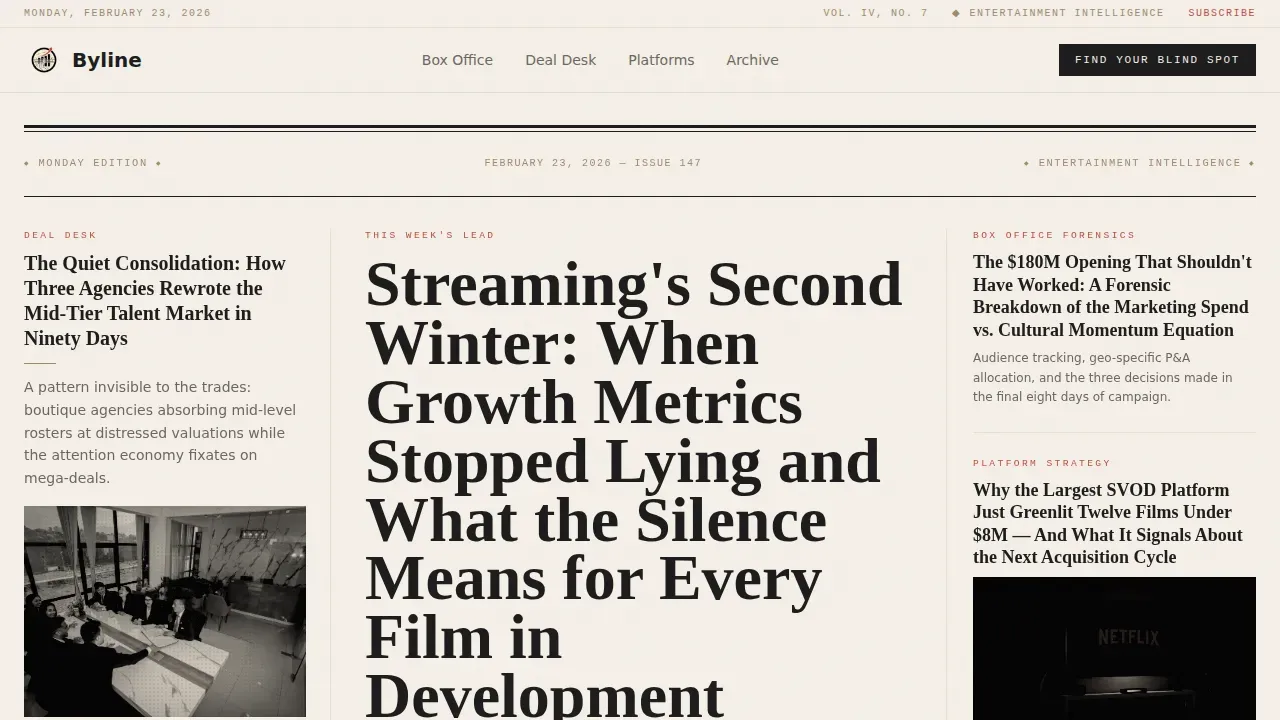
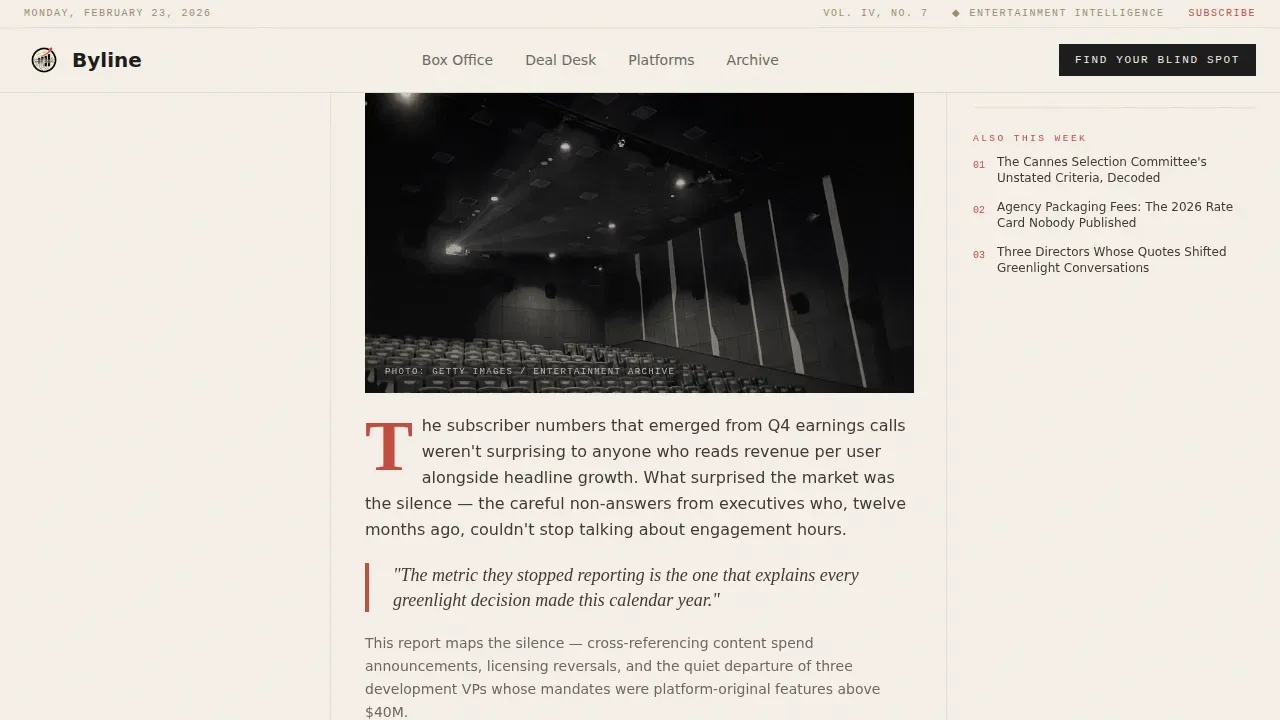
The hero section opens as a full-viewport broadsheet front page. A hand-drawn serif masthead sits above a running dateline. A dominant headline is set at 72-point type over a halftone-filtered editorial still. Secondary column heads tease deeper reports on either side. There is no hero image carousel and no animation. The typography IS the hero image, and its density grabs attention within seconds, preventing the bounce that plagues most editorial landing pages.
Manifesto and Vision Column
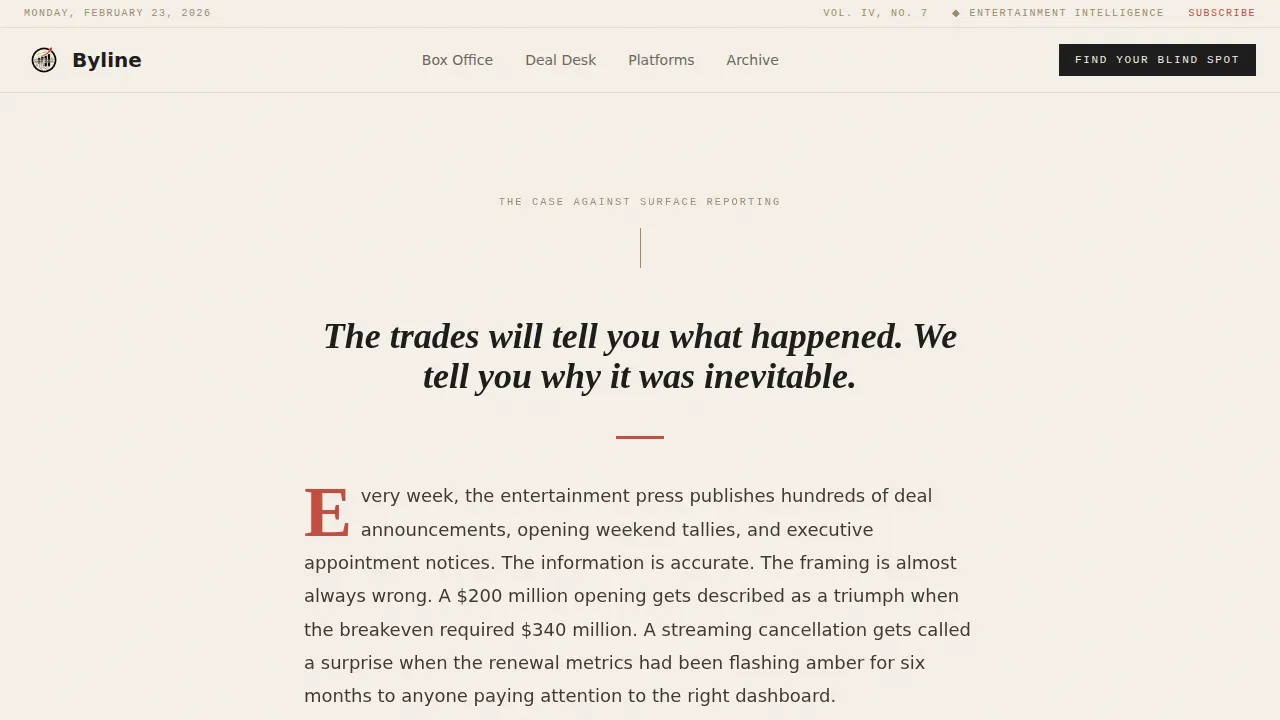
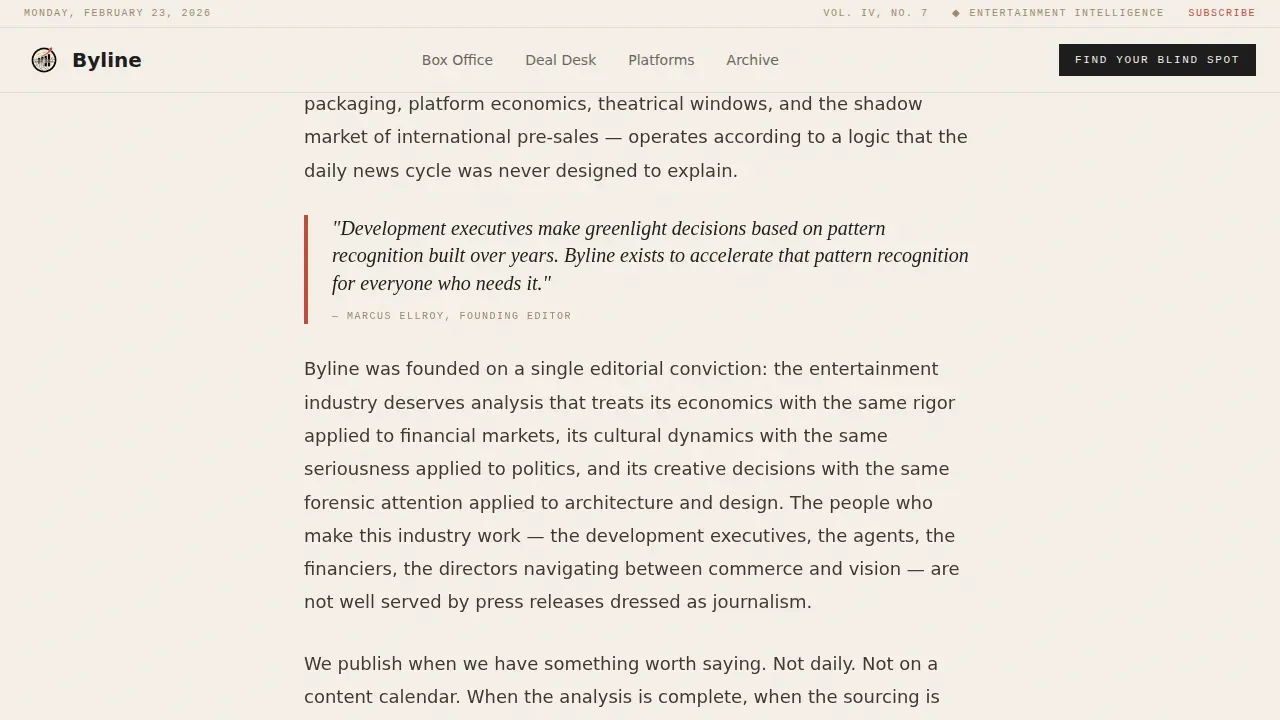
The second section is a single centered column, set in generous leading, that explains why fast trade reporting fails serious industry readers. This particular section slows the scroll deliberately. It forces the reader to breathe and absorb the publication's value proposition before anything is asked of them. This editorial pause builds emotional appeal and trust before the conversion ask appears.
Editorial Pillars Block
The third section introduces three named editorial pillars: box office forensics, deal anatomy, and platform strategy. Each pillar is presented as a magazine section opener with its own typographic treatment. These pillars function as trust signals and as a clear demonstration of the template's product capabilities, giving visitors a concrete sense of what the publication covers. This is a good example of using structured content blocks to reduce perceived risk for a professional audience.
Editor's Letter with Signature
The fourth section is a founding editor's letter. It is set in a warm, voice-driven editorial tone and includes a handwritten signature treatment. Immediate trust can be established through prominent author credentials, and this section does exactly that. The editor's name, title, and editorial voice are all clearly presented to establish credibility before the quiz call to action appears.
Five-Question Quiz Funnel with Result Tracks
The primary conversion engine is a five-question diagnostic quiz. Visitors answer questions about which sector they follow, how they source intelligence, what decisions they make from entertainment data, how often a greenlight surprises them, and what single metric they wish they understood better. Results deliver one of three personalized reading tracks. This interactive element is a great example of a primary call to action that is action-oriented but not aggressive. It uses a low-risk entry point to reduce friction and capture qualified leads through a personalized email opt-in.
Arc Footer with Dual Email Capture
The footer follows an Arc layout pattern with masthead branding and a secondary "Subscribe to the Broadsheet" email capture. Security badges and links to a privacy policy can be placed near this form to reassure users, following best practices for landing page lead capture forms. The footer anchors the sales funnel with a secondary conversion action for visitors who scroll past the quiz without engaging.
Page sections overview
| Section | Purpose |
|---|---|
| Broadsheet Masthead | Opens with a full-viewport editorial hero, dominant headline, dateline, and three-column grid |
| Manifesto Column | Delivers the editorial philosophy in a single centered column with generous leading |
| Editorial Pillars | Introduces box office forensics, deal anatomy, and platform strategy as named section openers |
| Editor's Letter | Establishes voice and credibility with a personal letter and handwritten signature treatment |
| Quiz Call to Action | Presents the five-question "Find Your Industry Blind Spot" diagnostic and three result tracks |
| Arc Footer | Anchors the page with masthead branding, minimal links, and a secondary email capture |
Design & branding system
The Byline template uses a Warm Artisan theme built on an Ink and Paper color system. Every design decision mirrors the experience of unfolding a letterpress-printed broadsheet, where imperfection signals craft and every typographic choice is deliberate.
- Color palette: Deep editorial black (#1A1A1A) for body type and structure, aged parchment cream (#F5F0E8) for backgrounds, marginal-note sepia (#A0896C) for secondary labels and ruled lines, and pull-quote vermillion (#C44A3F) reserved for accent rules, drop caps, and interactive highlights.
- Typography system: Fraunces handles all editorial serif display headings, DM Sans covers body copy and user interface elements, and IBM Plex Mono is used exclusively for datelines and category labels, keeping the page design consistent with print editorial conventions.
- Visual rhythm: The page alternates between dense typographic sections and wide whitespace sections, mimicking the rhythm of flipping through a beautifully art-directed print issue and holding the visitor's attention through contrast rather than animation.
Mobile & speed optimization
The Byline template is designed desktop-first, reflecting the workflow of development executives who scan on laptops over morning coffee. Full mobile support is built in, because a significant portion of professional traffic arrives from mobile devices and the quiz must be easy to complete on a phone.
- Static hero, JS-only quiz: The hero section loads with no animation and no heavy assets, keeping initial load fast. JavaScript is loaded only for quiz interaction, which means the editorial sections render immediately while interactive elements load in the background.
- Scroll-triggered reveals and staggered cards: Low-to-medium animation is used through scroll-triggered section reveals and staggered editorial card appearances. This approach keeps the page feeling alive without creating the performance drop that heavy animation causes on mobile devices.
How this template helps you convert
Landing pages exist to reduce friction, clarify value, and guide visitors toward a measurable outcome. The Byline template is structured to do all three for a professional editorial audience that resists generic sales tactics.
- Credibility before conversion: The page builds trust through four full sections before the quiz appears. By the time the visitor reaches the primary call to action, they have read the manifesto, absorbed the editorial pillars, and met the editor by name. Trust signals, editorial voice, and social proof all accumulate before any conversion action is requested. This approach addresses the longer sales cycles typical of B2B landing pages, where multiple decision makers need to feel confident before they share an email address.
- Personalized quiz as a low-friction entry point: The five-question quiz reduces the perceived risk of subscribing by framing the email opt-in as a result delivery. Visitors are not asked to "sign up." They are invited to discover their industry blind spot and receive a personalized reading track. Completion rates for quiz-based landing pages are typically higher than for static form pages because the interactive format grabs attention and creates investment before the ask. The quiz also supports qualified lead capture by segmenting visitors into three tracks, saving time for both the publication and the subscriber.
- Dual capture with footer fallback: For visitors who engage with the content but do not complete the quiz, the Arc footer delivers a secondary "Subscribe to the Broadsheet" email capture. Every element on this page is aligned with one goal and one message, increasing the overall conversion rate without trying to overwhelm visitors with competing offers.
Other information about this template
This section covers additional practical details about the Byline landing page template that are useful for buyers evaluating it against other options.
- B2B conversion context: B2B landing pages typically see conversion rates in the 1 to 3 percent range, compared to B2C pages. This template is designed to push toward the upper end of that range by combining strong trust signals, a clear value proposition, and a quiz funnel that increases engagement before the email ask. The conversion action here is email subscription, not an immediate purchase, which aligns with best practices for B2B editorial landing pages.
- Quiz segmentation supports editorial success stories: The three result tracks (Box Office Analyst, Deal Decoder, and Platform Strategist) function as mini case studies in reader self-identification. They are designed to generate success stories and reader-specific value proposition statements that can be built out over time into testimonials and social proof assets.
- Client logos and security placement: The template supports the addition of client logos, partner publication marks, or media mention badges as trust signals in the editorial pillars section or masthead area. Security badges and privacy policy links can be placed near the footer email capture form to reassure users about data handling, following standard landing page practices.
- No navigation bar by design: Navigation menus and external links are excluded from the page design. This is a deliberate best practice for landing pages. Removing links that could lead visitors away keeps the sales funnel clean and the visitor's attention on the content and conversion path.
- Drag and drop customization-ready: The template's section structure is modular and compatible with drag and drop page builder environments, making it straightforward to swap brand colors, update editorial pillar details, or replace the editor's letter copy without redesigning the page from scratch.
- Search engine optimization and search rankings: The vertical content structure, heading hierarchy, and concise landing page content all support good practices for search engine optimization. A well-structured editorial landing page with clear value proposition copy and strong heading architecture can improve search rankings for niche editorial keywords over time.
- User count and social proof display: As the publication grows, the user count of active subscribers can be displayed as a data-driven social proof element alongside testimonials from industry experts. Case studies drawn from reader outcomes, such as greenlights attributed to Byline intelligence, can be added to strengthen credibility and emotional appeal for new visitors.
- Online store compatibility note: While this is an editorial subscription landing page and not an online store, the footer and pillar sections can be adapted to feature paid report downloads or premium tier upgrade links if the publication adds a paid product layer.
- Competitive edge through editorial specificity: Industry-specific landing pages significantly outperform generic designs because they speak directly to the audience's expectations and decision-making processes. The Byline template is a clear example of that principle applied to entertainment industry intelligence publishing. Generic landing pages produce generic results. This template is built for a specific niche, a specific reader, and a specific conversion goal, and that specificity is its core value and competitive edge.
- Real business impact through niche positioning: High-converting landing pages are built through intentional choices and continuous testing. The Byline template gives publishers a structured starting point with intentional page design choices already made, enabling real business impact from launch rather than from months of iteration.
Theme
Warm Artisan
Creative direction
Vision & Mission
Color system
Ink & Paper
Direction
Quiz/Assessment
Page Sections
Broadsheet Masthead Hero Section
Manifesto and Editorial Vision Column
Named Editorial Pillars Block
Editor's Letter with Signature Treatment
Five-question Quiz with Personalized Result Tracks
Arc Footer with Dual Email Capture
Related questions
Who is the Byline template designed for?
Does the quiz funnel actually capture email addresses?
Can I customize the editorial pillars and editor's letter?
How does this template build trust with a skeptical professional audience?
Is this template suitable for a publication that is just launching?