FoodTech Startup Professional Website Template
Hunt is a dark-glassmorphic foodtech landing page template built for restaurant operations platforms. It leads with a live metrics dashboard, drives scroll through a staggered feature card grid, and closes with a frictionless app download call to action. Built for head chefs, restaurant group COOs, and ghost kitchen operators who need to see ROI before they act.
by Rocket studio
Quick summary
Hunt is a single-page foodtech landing page template designed for restaurant operations and inventory intelligence platforms. It opens with animated count-up metrics, builds confidence through a modular feature card grid, and drives toward a no-friction app download. The layout is built for mobile-first kitchen operators and desktop-based multi-location managers alike.
Who this template is for
This template is purpose-built for founders and teams launching a foodtech or restaurant operations product. If your platform helps kitchen operators cut waste, track inventory, or manage multiple locations, Hunt speaks directly to your audience.
- Head chefs and kitchen managers who track inventory daily and need a mobile-first product page
- Restaurant group COOs managing multiple locations who want to see ROI before booking a demo
- Ghost kitchen operators focused on unit economics and fast, low-friction onboarding
What problem this template solves
Most SaaS landing pages bury the value proposition under stock photography and vague feature lists. For restaurant operators, that approach fails completely. They need proof before they commit a single tap.
- Generic templates do not communicate operational urgency or real kitchen-floor context
- Visitor trust is lost when metrics and ROI proof are hidden below the fold
- Multi-audience products struggle to serve both a hands-on chef and a data-driven COO in one page layout
What you get with this template
Hunt delivers a complete, production-ready landing page structure tailored for a foodtech product launch. Every section is designed to build conviction progressively, from raw numbers to feature depth to a single clear action.
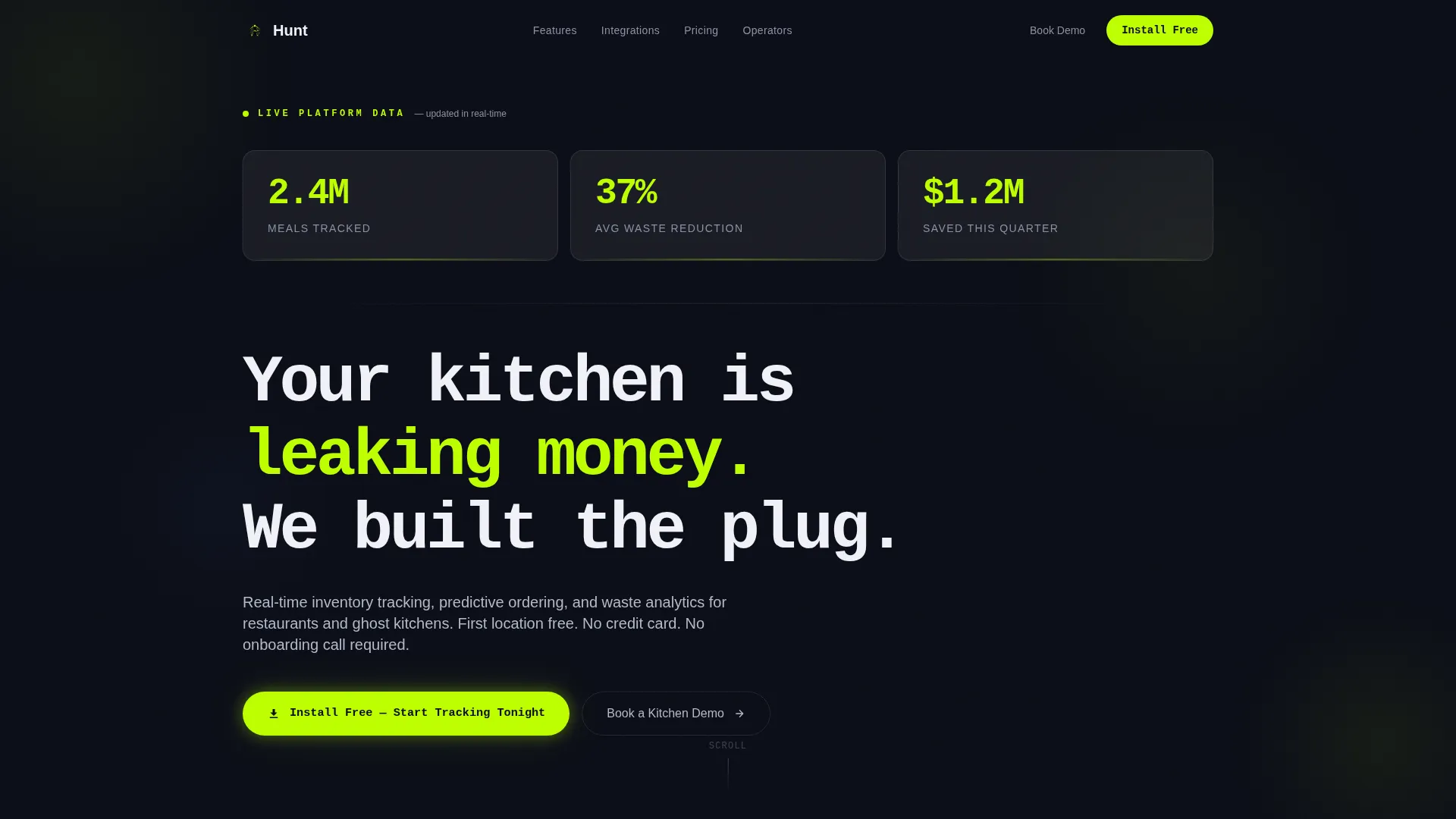
- A live stats and metrics hero section with count-up ticker animations that fire on page load
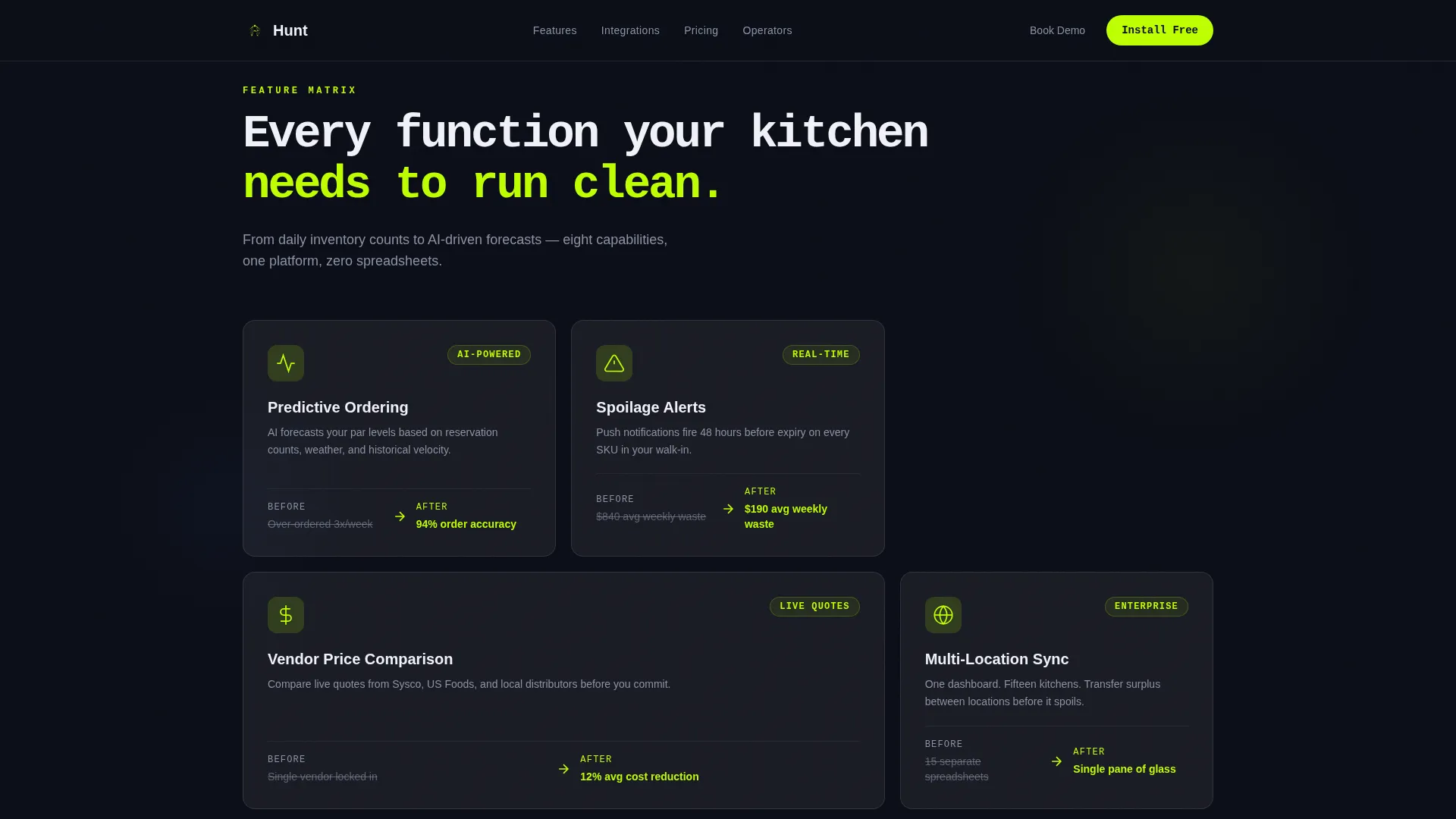
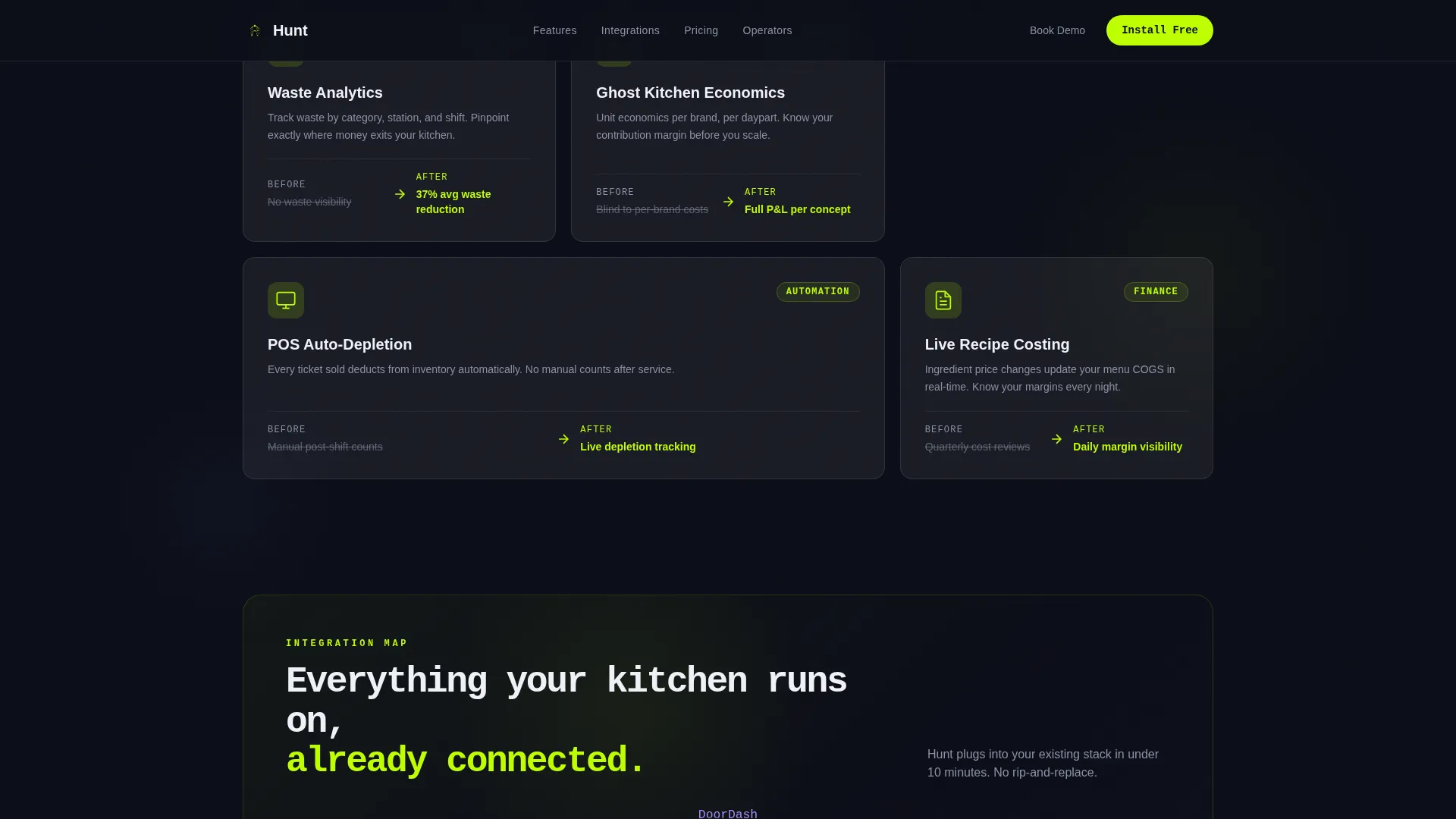
- A staggered eight-card feature matrix grid with before-and-after metrics and micro-illustrations per card
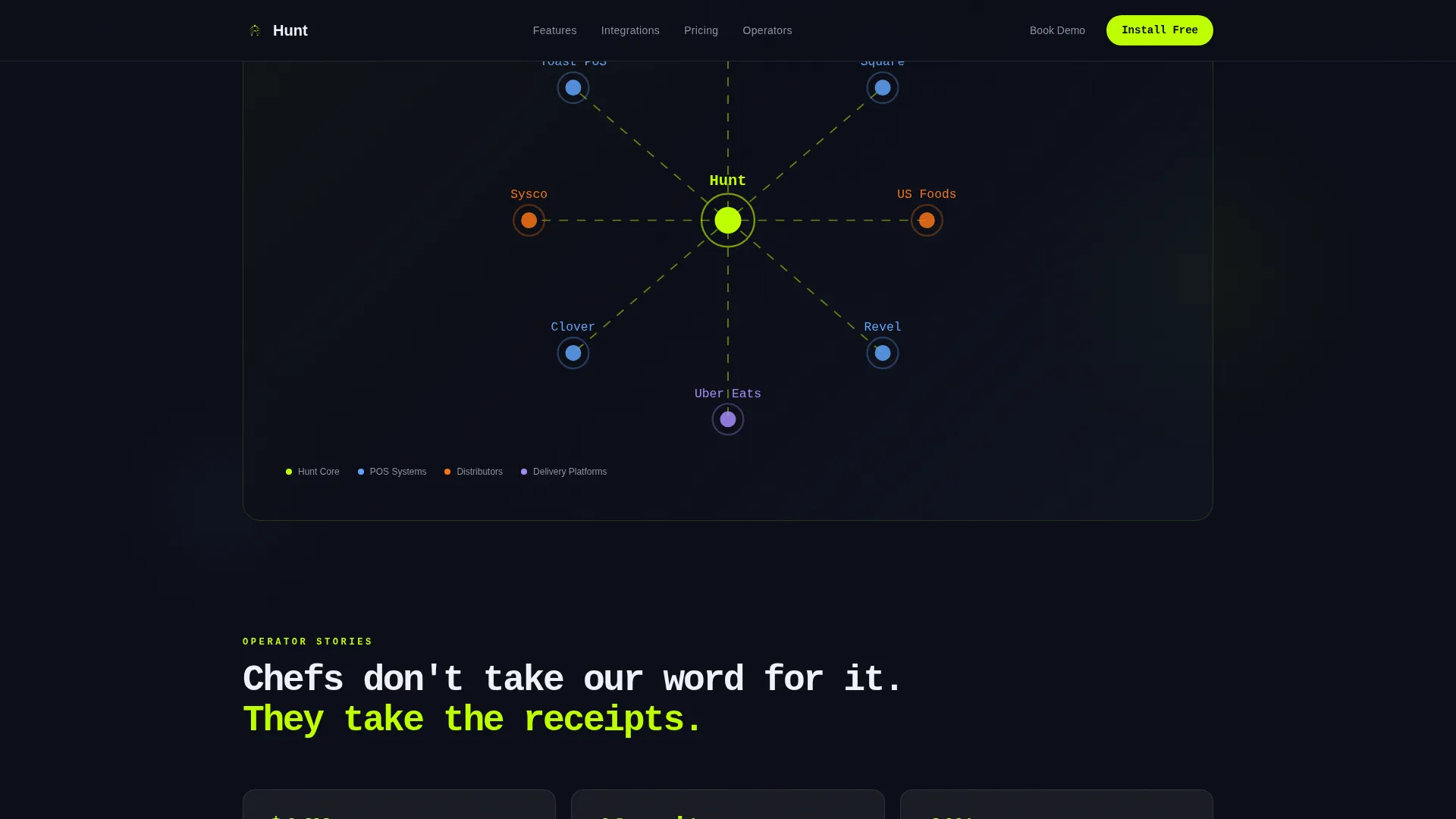
- A full-width integration break card with an animated connection map showing platform touchpoints
- An asymmetric social proof section with operator testimonials and real savings figures
- A full-width app download call to action block with paired App Store and Google Play badges
- A sticky mobile bottom bar that keeps the primary call to action visible throughout the scroll
Feature list
This template includes six core structural and design capabilities built around the foodtech product launch use case.
Animated Metrics Hero Dashboard
The header section is a live-data glass panel displaying three headline figures: meals tracked, average waste reduction, and quarterly savings. Each number animates with a count-up ticker the moment the page loads. No hero image is used. The data itself is the visual centerpiece.
Staggered Feature Card Grid
Eight modular cards are arranged in a progressive bento-style grid. Each card isolates a single platform capability, such as predictive ordering or spoilage alerts, and pairs a micro-illustration with a one-line description and a before-and-after metric. Cards load with a GSAP stagger reveal as the user scrolls.
Integration Break Card
A full-width card interrupts the feature grid midway. It displays an animated map of connected systems, including point-of-sale systems, suppliers, and delivery platforms, all linked by glowing lime-colored threads. This section visualizes the platform's infrastructure scope without requiring a written explanation.
Social Proof Section
An asymmetric testimonial layout presents operator stories alongside specific performance metrics. Named restaurants, waste reduction percentages, and dollar savings figures give the section concrete credibility rather than generic quotes.
Frictionless App Download Block
A full-width section at the bottom of the page presents the primary call to action alongside App Store and Google Play download badges. No form fields are used. The design removes every friction point: no credit card required, no onboarding call needed, and the first location is free forever.
Glassmorphic Dark Design System
The visual language uses void black backgrounds, frosted glass cards at eight percent opacity with a twelve-pixel blur, electric lime accents for calls to action and live data, and cool slate for secondary text. A faint grain texture runs across backgrounds. Card borders carry a subtle luminance to lift them off the dark layer beneath.
Page sections overview
| Section | Purpose |
|---|---|
| Metrics Hero Dashboard | Opens with animated real-time figures to establish platform credibility instantly |
| Feature Matrix Grid | Eight staggered cards build the platform's capability case progressively |
| Integration Break Card | Full-width animated map shows connected systems mid-scroll |
| Social Proof Layout | Operator testimonials with named restaurants and hard savings numbers |
| App Download Block | Full-width call to action with App Store and Google Play badges, zero friction |
| Sticky Mobile Bar | Persistent bottom bar keeps the primary download action visible on phones |
| Footer | Linear single-row dark footer with minimal navigation |
Design & branding system
Hunt uses a command-center midnight aesthetic built around glassmorphic layers and terminal-style typography. Every design decision reinforces the idea that this is infrastructure software, not a lifestyle app.
- Color palette: void black (#0B0D17) as the base, electric lime (#BEFF00) for calls to action and live data accents, cool slate (#8B92A5) for secondary text, and frosted glass panels at eight percent white opacity with a twelve-pixel blur
- Typography: JetBrains Mono for headlines and data figures, DM Sans for body copy, with oversized mono type used for the hero tagline
- Texture and motion: grain texture on backgrounds, glowing lime thread animations on the integration map, card hover states, and GSAP stagger reveals on the feature grid
Mobile & speed optimization
The template is built mobile-first because the primary user, a head chef, is likely holding a phone in a walk-in cooler at five in the morning. The desktop layout serves COO-level operators who want a fuller dashboard view.
- Sticky mobile bottom bar keeps the "Install Free" call to action always accessible during scroll on small screens
- Card grid and section layouts adapt from a single-column mobile stack to a multi-column desktop grid
- Server Components handle static sections while Client Components power animated dashboard elements, reducing unnecessary client-side load
How this template helps you convert
Hunt earns the download by sequencing proof before the ask. Every section exists to remove a reason not to tap the install button.
- The metrics hero fires count-up animations immediately on load, creating a data-first first impression that replaces skepticism with curiosity before a single word is read
- The progressive feature card grid escalates from operational basics to AI-powered insights, building the case that this platform is a genuine infrastructure shift rather than another SaaS dashboard
- The app download block removes every remaining friction point with no form fields, no credit card requirement, no onboarding call, and a free-forever first location offer
Other information about this template
Hunt is categorized under Startup and Launch with a FoodTech Startup subcategory, making it a strong fit for Product Hunt launch days and early-stage go-to-market campaigns. The template style is a card grid modular layout with a Startup Velocity theme.
- The template is built for English-language markets using United States dollar formatting and United States date conventions
- The intersection niche is FoodTech Product Hunt Launch, meaning the design and copy structure are specifically tuned for high-intent launch traffic
- Animation level is high: count-up tickers, GSAP stagger reveals, glowing SVG lime threads, and grain texture are all included in the template structure
- The secondary conversion path, "Book a Kitchen Demo," is built in for multi-location operators who need a guided walkthrough before committing
Theme
Startup Velocity
Creative direction
Feature Matrix
Color system
Glassmorphic
Style
Card Grid (Modular)
Direction
App Download
Page Sections
Live Metrics Hero Dashboard
Progressive Feature Card Grid
Animated Integration Map Card
Operator Social Proof Section
Frictionless App Download Block
Glassmorphic Dark Visual System
Related questions
Who is this landing page template designed for?
Do visitors need to fill out a form to convert?
Can I update the metrics shown in the hero dashboard?
Is this template suited for a Product Hunt launch?
What makes this template different from a standard SaaS landing page?