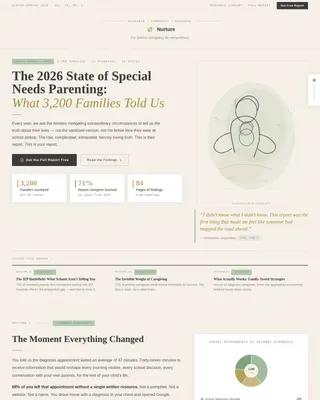
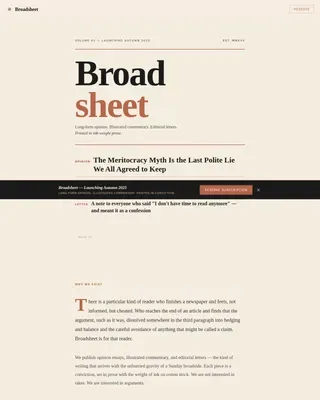
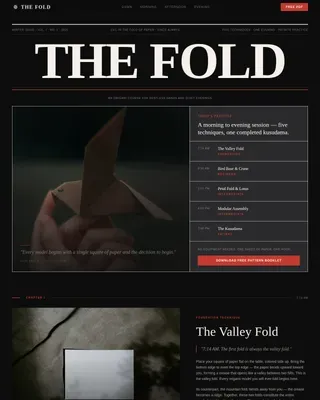
Expert Exotic Pet Landing Page Template
Burrow is a single-column landing page template built for an exotic pet field journal community. It uses a Victorian naturalist aesthetic, parchment backgrounds, serif typography, and saffron accents, to introduce a literary brand before launch. The page captures waitlist signups through a "Claim Your Chapter" call to action, a species-interest selector, and a narrative creator spotlight scroll that builds genuine emotional investment.
by Rocket studio
Quick summary
Burrow is a pre-launch landing page template for an exotic pet field journal. It opens like the interior cover of a cloth-bound volume, introduces real keeper stories through literary vignettes, and closes with a waitlist form. The design feels like a Victorian naturalist's notebook: warm parchment, deep loam, and saffron gilt. People discover something rare here before it goes wide.
Who this template is for
This template is made for editorial creators, niche community founders, and passionate keepers who want to launch something that feels genuinely different. If you have a story to tell and an audience to earn, Burrow gives you the page to do it.
- First-time and veteran reptile, amphibian, and invertebrate owners who want to build a literary community around their keeping practice
- Herpetoculturists, breeders, and quietly obsessed keepers, the people who care for Java earth tiger tarantulas, frilled lizards, and sulcata tortoises, who want more than care sheets and forum threads
- Editorial founders and niche bloggers who want a coming-soon page that earns signups through intimacy and storytelling rather than urgency countdowns
What problem this template solves
Most pre-launch pages for niche communities look like placeholder sites. They announce without earning trust. They ask for an email before giving the reader a reason to care. Exotic pet owners have heard that pitch before, and they scroll past it without a second thought.
- The template replaces generic countdown pages with a scroll that reads like the opening chapters of a journal, making people feel they have discovered something worth waiting for
- It gives the founder a structured way to introduce real contributors and their animals through narrative vignettes, building social proof before a single issue publishes
- It solves the cold-start problem by letting the page itself demonstrate the quality and voice of the journal, so the signup feels like joining, not subscribing
What you get with this template
You get a fully structured, single-column landing page with every section pre-built and ready to personalize. The page flows from a typographic hero through three narrative sections and into a waitlist call to action, all wrapped in a consistent design system rooted in natural history illustration and Victorian bookmaking.
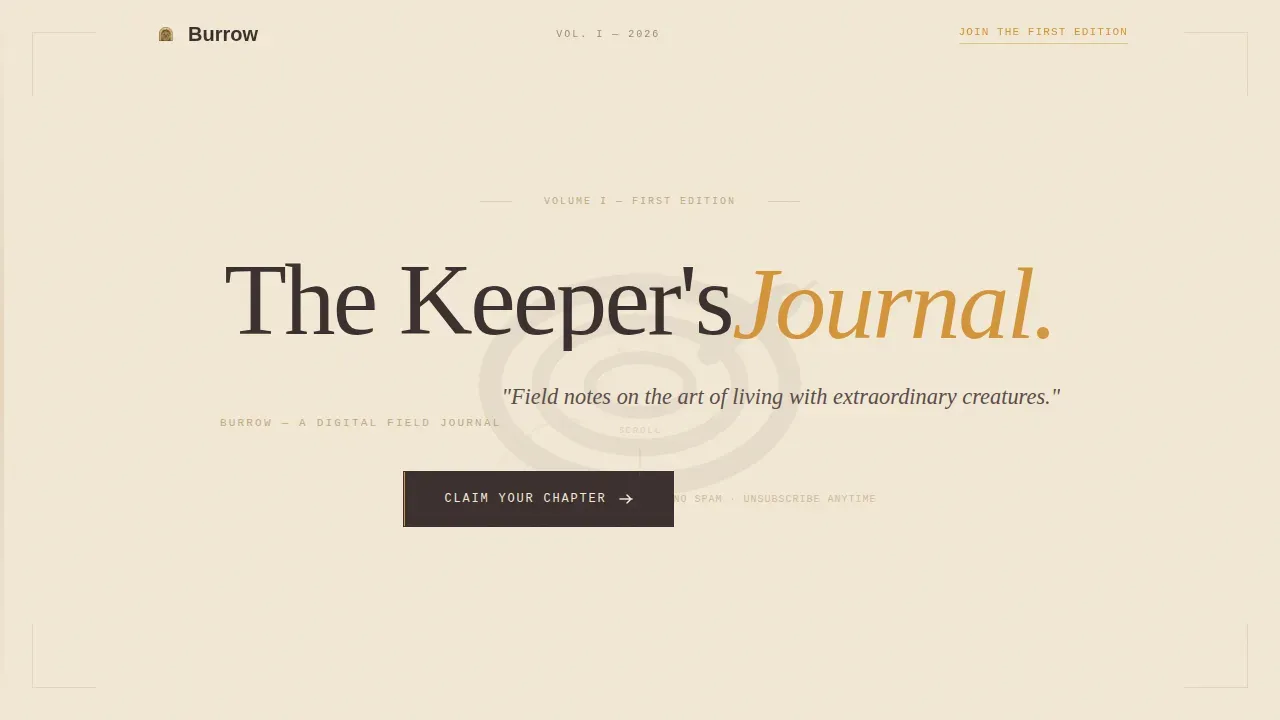
- A book-cover hero section styled as a cloth-bound frontispiece, complete with a decorative serif title, italic subtitle, and a watermark illustration of a coiled snake or perched chameleon
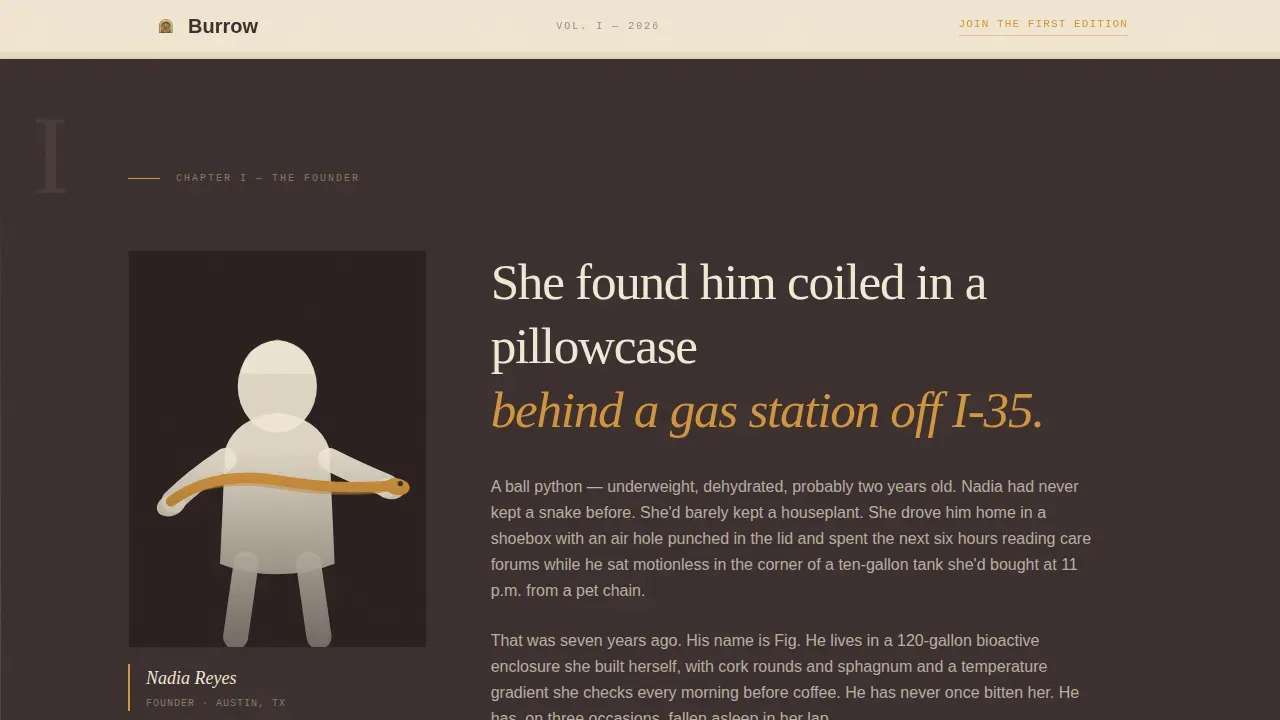
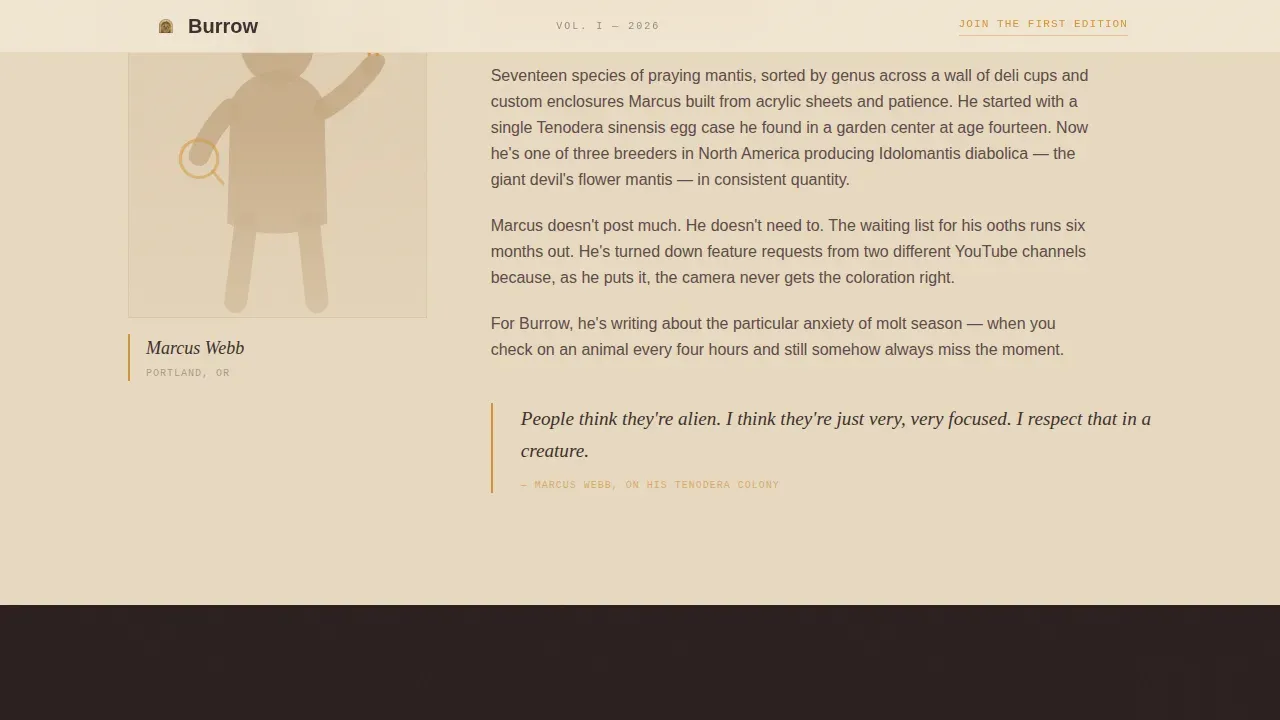
- Three narrative sections, a founder story vignette and two creator spotlights, each built around a portrait silhouette, a literary quote, and a short written profile
- A waitlist conversion section with a single email field, a species-interest selector covering reptiles, amphibians, invertebrates, and all of the above, and a magnetic "Claim Your Chapter" call-to-action button
Feature list
This section details the core built-in capabilities of the Burrow template. Every feature listed here is grounded directly in the source brief.
Book-Cover Hero Viewport
The hero section is styled as the interior cover of a cloth-bound volume. A decorative typographic title reads "Volume I: The Keeper's Journal." Below it, a hand-lettered italic subtitle describes the journal's purpose. A faint watermark illustration, a coiled snake or perched chameleon, anchors the page as a frontispiece. There is no photography. The entire section relies on pure typography and illustration to set mood and expectation. This approach immediately communicates the journal's editorial quality to any owner who lands on the page.
Creator Spotlight Scroll
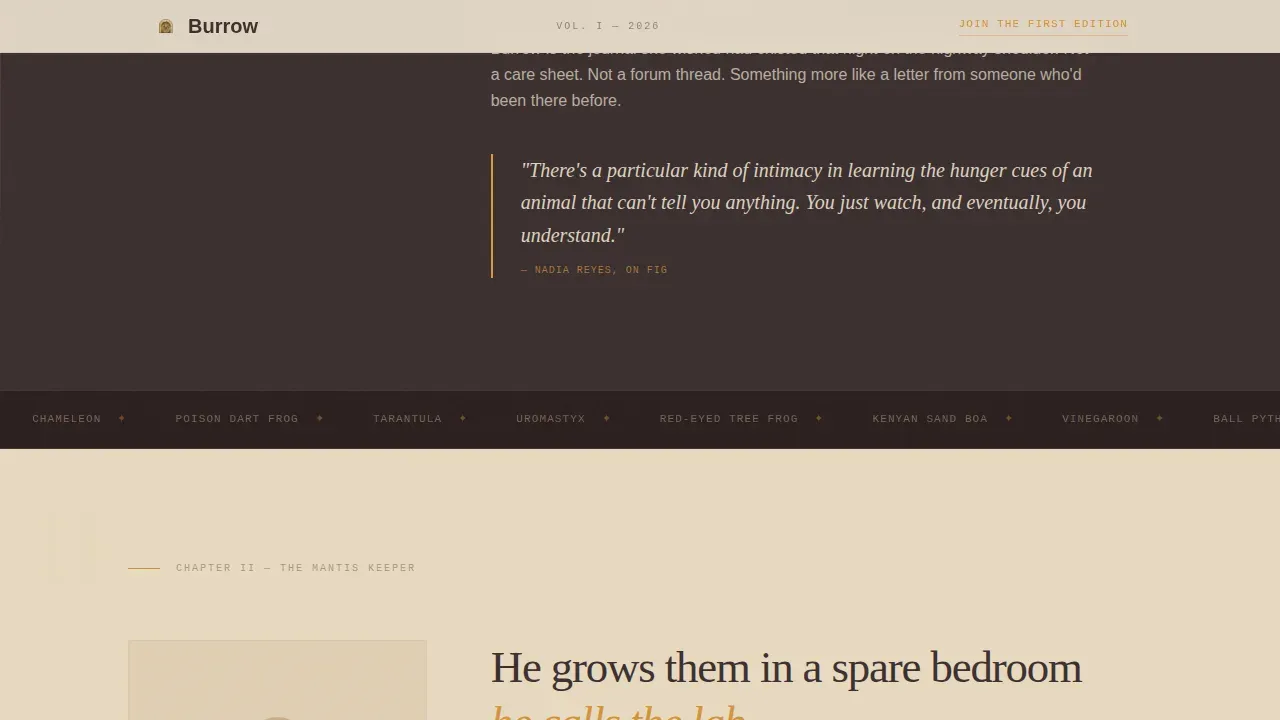
Each scroll section introduces a real keeper and their animal through a short literary profile. The founder's section opens with a rescue ball python narrative and a portrait silhouette. Subsequent spotlights feature a mantis breeder in Portland and a poison dart frog conservationist in Miami, each paired with a silhouette and a single compelling quote. The scroll builds a cast of characters naturally. People who read through it feel they are joining a community of storytellers, not just opting into a mailing list. This is social proof built through voice, not star ratings.
Waitlist Conversion Form
The "Claim Your Chapter" call to action appears after the third creator spotlight, precisely when emotional investment peaks. It includes a single email input field and a species-interest selector with four options: reptiles, amphibians, invertebrates, and all of the above. A secondary micro-call-to-action appears earlier in the header as a subtle "Join the first edition" text link. Together, these two touchpoints create a layered conversion path without pressure or manufactured scarcity.
Warm Stone Design System
The entire template uses a curated four-color palette rooted in natural history illustration. Sun-baked sandstone (#C4A882), deep terrarium loam (#3B2F2F), aged parchment (#F2E8D5), and muted saffron (#D4943A) work together across every section. Backgrounds alternate between parchment and loam. Text lives in deep brown and sandstone. Saffron appears sparingly, reserved for links, highlights, and interactive accents, like gilt on a book spine. Typography pairs Fraunces for serif display headings, DM Sans for body copy, and IBM Plex Mono for labels and captions.
Intersection Observer Animations
The template uses IntersectionObserver-based scroll reveals, masked text animations, parallax grain effects, and a marquee scroll divider above the footer. Interactive elements include hover states throughout and a magnetic call-to-action button on the waitlist form. These motion behaviors are handled through client-side components, while static sections are built as server components for cleaner performance characteristics. The animation intensity is calibrated to feel editorial, purposeful and unhurried, like turning a page.
Footer with Marquee Divider
The footer follows a horizontal layout pattern with a scrolling marquee divider positioned above it. This detail carries the naturalist notebook aesthetic through to the very end of the page. It gives the page a sense of completeness and craftsmanship rather than a hard stop. An owner reading to the end of the page encounters a finish that feels as considered as the opening.
Page sections overview
| Section | Purpose |
|---|---|
| Hero Book Cover | Opens the page as a typographic cloth-bound frontispiece with watermark illustration |
| Founder Story Vignette | Introduces the journal founder through a literary rescue narrative and portrait silhouette |
| Creator Spotlight One | Profiles a mantis breeder contributor with a portrait silhouette and literary quote |
| Creator Spotlight Two | Profiles a poison dart frog conservationist with a portrait silhouette and literary quote |
| Waitlist Call to Action | Captures email signups via species selector and "Claim Your Chapter" form |
| Footer with Marquee | Closes the page with a horizontal footer and scrolling marquee divider |
Design & branding system
The design language takes its cues from Victorian naturalist study rooms and hand-annotated field notebooks. Every detail, from the typeface pairings to the saffron accents, reinforces the idea that this journal is something made with care, not assembled from templates. People who have heard of similar editorial products immediately notice the difference in craft.
- The four-color Warm Stone palette uses parchment (#F2E8D5) and loam (#3B2F2F) for alternating section backgrounds, sandstone (#C4A882) for secondary text, and saffron (#D4943A) sparingly for links, interactive accents, and highlights
- Typography uses Fraunces for editorial display headings, DM Sans for readable body copy, and IBM Plex Mono for captions and label text, a trio that communicates both literary authority and technical precision
- Illustration and watermark graphics replace photography entirely, making the visual language feel like a natural history specimen plate rather than a lifestyle blog header
Mobile & speed optimization
The Burrow template is built desktop-first, with the journal aesthetic prioritized for wider screens where the typographic frontispiece and silhouette portraits have the most visual impact. Careful mobile adaptation preserves the core reading experience for owners who encounter the page on smaller devices.
- The single-column layout adapts cleanly to mobile viewports, keeping the narrative scroll readable and the waitlist form accessible without horizontal scrolling or layout breakage
- Mobile responsiveness of the landing page ensures accessibility for keepers on mobile devices, so no owner who discovers the page on their phone is turned away before they can sign up
- Static sections are built as server components and interactive elements, animations and the waitlist form, are handled as client components, keeping the overall page structure lean
How this template helps you convert
The page earns its signups by making the reader feel something before asking for anything. Every structural decision is built around emotional investment, not urgency tactics. People who scroll to the waitlist form have already met the founder, heard two contributor stories, and decided they want to be part of what comes next.
- The book-cover hero creates immediate intrigue by positioning the journal as a rare object worth waiting for, using a compelling headline and subheadline to clearly state the unique value of the journal from the very first viewport
- The creator spotlight scroll builds trust progressively, each section adds a new voice and a new animal, so the reader learns that this community includes real keepers with real expertise, from mantis breeders to poison dart frog conservationists
- The "Claim Your Chapter" form appears at peak emotional investment, after three human stories have landed, with a species selector that makes the signup feel personalized rather than generic
Other information about this template
The Burrow template sits at the intersection of niche editorial publishing and exotic pet community building. It is designed to work for any keeper-led journal concept, not just the specific animals mentioned in the original brief. An owner keeping gargoyle geckos, chameleons, or sulcata tortoises can adapt the creator spotlight sections just as easily as someone working with the original ball python narrative.
- The template supports detailed species profiles in the creator spotlight sections. Detailed species profiles allow for habitat and temperature requirements to be documented for specific burrowing species, making the narrative sections genuinely useful reference material as the journal grows
- Environmental tracking is core to exotic keeping. This journal concept focuses on specific environmental parameters like humidity, temperature, and light cycles for non-domesticated animals. The waitlist form species selector reflects that specificity, letting the owner segment their early audience by interest group
- An exotic keeper field journal is a specialized notebook used to document the daily health, behavioral, and environmental conditions of exotic pets. The Burrow landing page template positions a digital version of this concept as an editorial product rather than a simple log sheet, giving it stronger market appeal
- The journal can be personalized with the keeper's name and pet's information, including species and acquisition date. The template's creator spotlight format makes this kind of personalization feel editorial rather than administrative
- Trust indicators and social proof can be enhanced by including testimonials from experts or other exotic keepers. The creator spotlight sections serve exactly this function, giving future contributors a structured home on the pre-launch page
- The Burrow exotic keeper field journal landing page template is also an excellent reference for anyone learning how to structure a coming-soon editorial page for a niche community. People building similar products in adjacent niches, urban foraging journals, birding field notes, mycology logs, have heard enough about generic waitlist tools to recognize when something is built with more intention
- Scientific documentation within a keeper journal may include sketches, photos, and detailed notes on animals' size and coloration. The Burrow template reflects this through its illustration-forward design system, which uses watermark drawings rather than photography to evoke the naturalist documentation tradition
- Sulcata tortoises have specific natural history traits that affect their suitability as pets, and frilled lizards require specific care to thrive in captivity. The template's flexible vignette sections can accommodate keeper stories from any species, making it broadly useful across the exotic keeping community
- Java earth tiger tarantulas can be kept and bred successfully with proper care, and chameleons often suffer from common care mistakes related to hydration and enclosure setup. These are exactly the kinds of natural history observations that the Burrow journal's field-note format is designed to capture and share with readers who want to learn from experienced keepers
- The gargoyle gecko is another example. Gargoyle gecko habitats should be designed with specific enclosure requirements in mind, and a journal like Burrow gives an owner the editorial framework to document and share those requirements in a way that is engaging rather than purely technical
- No-code tools enable users to build applications without traditional programming skills. The Burrow template is designed for creators who want to launch a polished editorial page without writing code from scratch, making it accessible to keepers who have the story but not the development background
Theme
Heritage & Story
Creative direction
Creator Spotlight
Color system
Warm Stone
Style
Single Column Flow
Direction
Waitlist/Coming Soon
Page Sections
Book-cover Hero with Typographic Frontispiece
Creator Spotlight Narrative Scroll
Layered Waitlist Conversion Flow
Warm Stone Color and Typography System
Scroll Animations and Interactive Accents
Footer with Scrolling Marquee Divider
Related questions
Can I adapt the creator spotlight sections for my own keeping niche?
Does the template include the waitlist form and species selector?
Is this template built for desktop or mobile?
What does the illustration-based design mean for customization?
Can this template work for a journal covering invertebrates or amphibians, not just reptiles?