Hobby & Passion Content Blog & Content Website Template
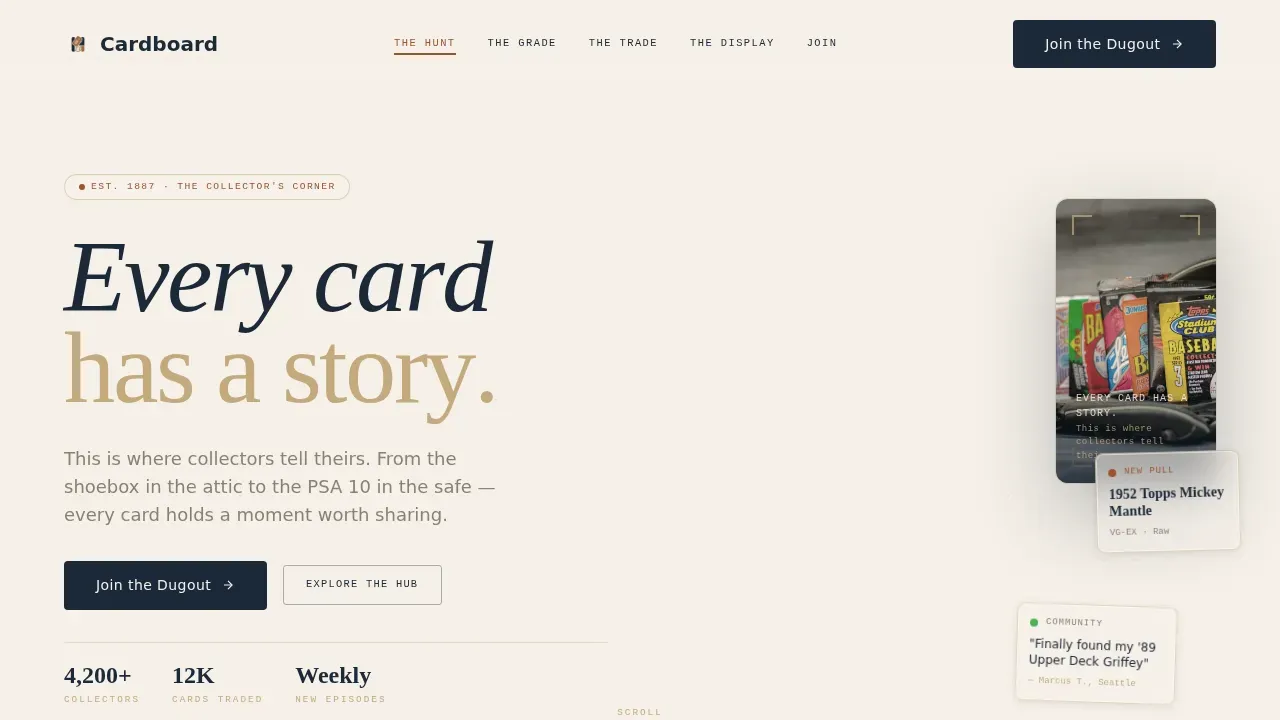
The Cardboard template is a heritage-themed hub and spoke landing page built for baseball card collecting blogs and communities. It guides visitors through a collector's week with cinematic video, sticky anchor navigation, warm vintage colors, and micro-conversion calls to action at every section. The page is designed mobile-first, with a free community signup as the primary goal.
by Rocket studio
Quick summary
Cardboard is a single-page hub and spoke landing page template made for baseball card collecting blogs and community sites. It opens with a looping handheld video, guides visitors through four immersive spoke sections, and earns signups by giving real value first. The warm, analog visual identity feels like pulling a heritage card from a pack you have been saving for weeks.
Who this template is for
This template is built for people who live and breathe the hobby. It meets collectors where they are, whether they are cracking their first pack at the kitchen table or hunting short prints at a regional show. The tone, layout, and content structure all reflect the real rhythms of collecting baseball cards.
- The nostalgic re-entrant: a parent in their 30s or 40s who rediscovered a childhood shoebox and wants a place to belong again.
- The weekend show grinder: an experienced collector who flips through dollar bins with purpose and wants tactical resources fast.
- The new collector: someone just learning what centering means, curious about the hobby, and looking for a trustworthy guide.
What problem this template solves
Most hobby blogs look like generic content sites. They do not feel like the hobby itself. They lose collectors in the first scroll because nothing on the page captures the anticipation of cracking a fresh pack or the quiet pride of slotting a graded card into a personal collection. Visitors bounce before they ever see the value buried deeper in the content.
- No sticky navigation means visitors miss the hub structure and cannot jump to the section that speaks to them.
- Generic layouts fail to communicate the warmth, story, and heritage that keep collectors loyal to a community.
- Scattered calls to action leave visitors unsure of what to do next, so they leave without signing up or engaging.
What you get with this template
You get a complete single-page layout that functions as a content and community hub. Every section is built from the source brief and matches how real collectors actually move through a hobby site. The page gives before it asks, so the signup feels like joining a conversation rather than entering a form.
- A hero section with a cinematic looping video, a single memorable tagline, and a sticky anchor navigation bar linking to all four spoke sections.
- Four fully built content sections: The Hunt, The Grade, The Trade, and The Display, each with its own moment, copy direction, and micro-conversion call to action.
- A minimal horizontal footer and a primary community signup prompt that asks only for a first name, an email address, and one fun qualifier question.
Feature list
This template is rich with purposeful components. Each one is grounded in the source brief and chosen to serve the collector audience specifically.
Cinematic Hero with Looping Video Letterbox
The hero opens with a fifteen-second handheld video letterboxed into the page. Hands break a wax pack seal, thumb through the cards one by one, and pause on a pull. Natural window light and shallow depth of field give the clip an intimate, documentary feel. The video loops silently while a single tagline fades in: "Every card has a story. This is where collectors tell theirs."
Sticky Anchor Navigation Bar
A navigation bar pins to the top of the viewport as the visitor scrolls. It carries four spoke labels: The Hunt, The Grade, The Trade, and The Display. Visitors can jump directly to the section most relevant to them. The nav uses deep dugout navy text with faded red clay hover states, keeping it readable and on-brand at every scroll depth.
Day-in-the-Life Spoke Sections
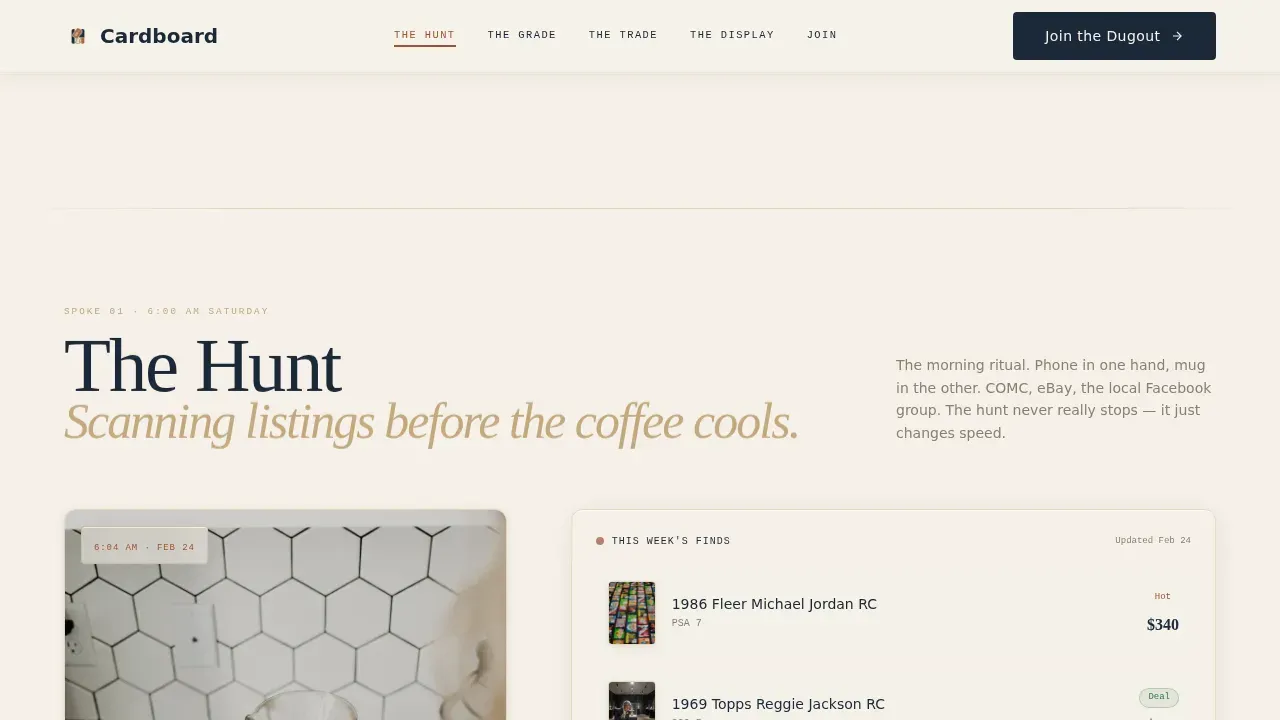
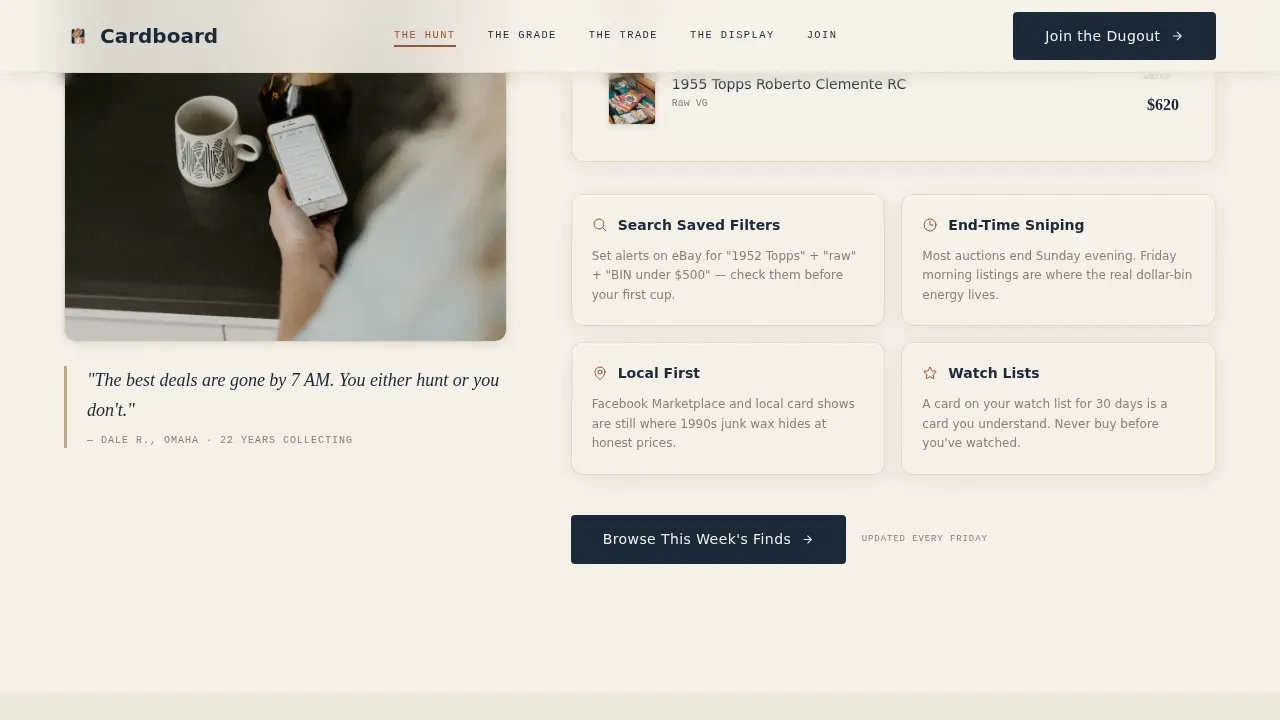
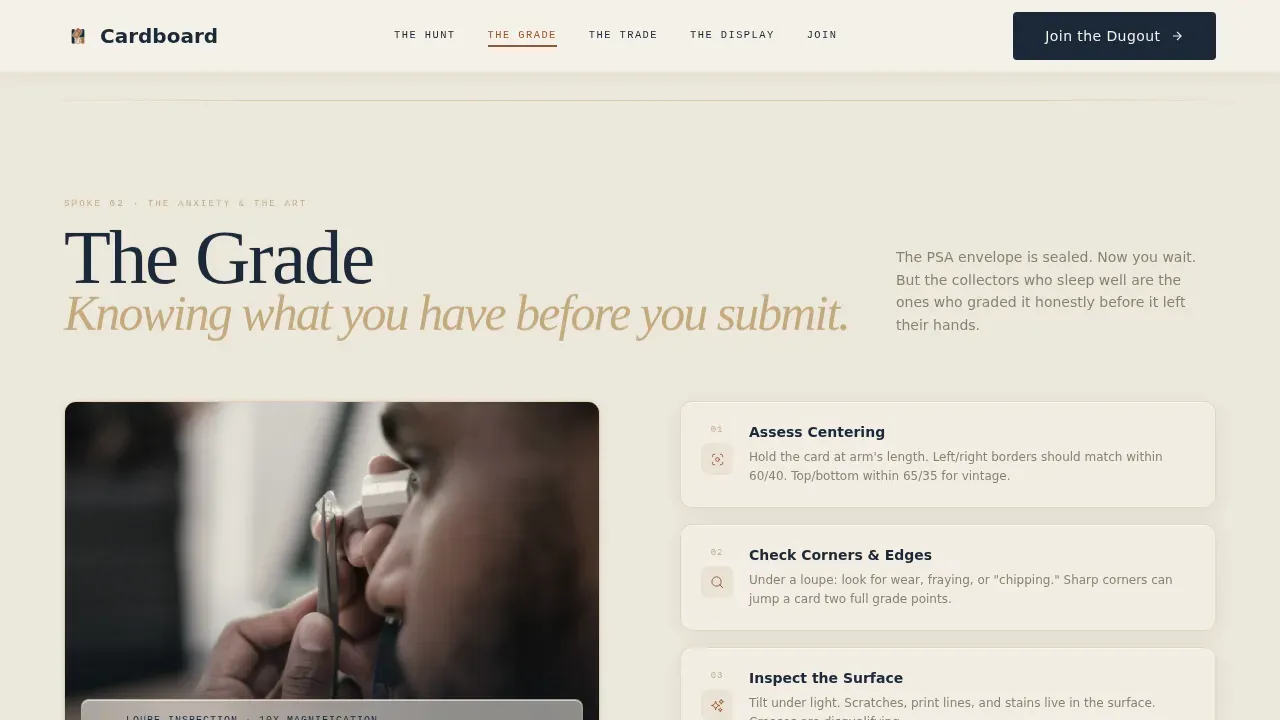
Each of the four spoke sections immerses the visitor in a specific collector moment. The Hunt opens at 6 AM with coffee steam and new listings. The Grade captures the anxiety of submitting a raw card for professional evaluation. The Trade puts you on a show floor with handshakes and community energy. The Display closes with the quiet pride of adding a graded card to a personal collection. Photography direction is warm, close-cropped, and human throughout.
Micro-Conversion calls to action Per Section
Every spoke section earns its own call to action rather than pointing everything at the signup. The Hunt offers a browse prompt for this week's finds. The Grade delivers a downloadable grading checklist. The Trade links to the latest podcast episode. The Display leads to the primary community signup. Each call to action gives the visitor something useful before asking for anything in return.
Testimonial Marquee with Pause Interaction
The Trade section features a dual-marquee ticker of collector testimonials and pull stories. The marquee scrolls continuously but pauses on hover, letting visitors read a specific story without losing the flow. This social proof component reinforces community trust at the exact point where visitors are deciding whether to engage.
Collector Community Signup Form
The primary conversion form appears in The Display section. It asks for three things only: first name, email address, and the answer to a single fun qualifier, "What's the card you will never sell?" This low-friction entry point makes the community feel personal and welcoming rather than transactional.
Page sections overview
| Section | Purpose |
|---|---|
| Hero Video Letterbox | Opens with looping handheld pack-break video and tagline |
| Sticky Anchor Nav | Pins four spoke labels to top for quick in-page jumping |
| The Hunt | Morning listing browse moment with This Week's Finds call to action |
| The Grade | PSA submission anxiety, grading education, checklist download |
| The Trade | Show floor community energy, testimonial marquee, podcast call to action |
| The Display | Personal collection reverence, bento display, community signup |
| Minimal Footer | Horizontal pattern footer with essential links |
Design & branding system
The visual identity is built around a Cloud Canvas color system that feels like a binder that has not been opened since 1993. Every color choice is deliberate. The palette earns its softness through decades of reference, not through trend-chasing. Typography layers a classic serif for headlines with a clean sans-serif for body text and a monospaced font for labels and captions, giving the page a tactile, print-era quality in a digital space.
- Soft eggshell white (#F5F0E8) as the primary background, echoing the cardboard stock of a vintage card.
- Warm tobacco tan (#C4A97D) for section dividers and card-edge accents, and deep dugout navy (#1B2838) for headlines and anchor nav text.
- Faded red clay (#A0522D) on hover states and active links, with Fraunces for serif headlines, DM Sans for body copy, and JetBrains Mono for captions and labels.
Mobile & speed optimization
The template is built mobile-first because collectors browse on their phones at shows, in dollar bins, and in line at the post office. The scroll pacing, section heights, and tap targets are all calibrated for a small screen first, then expanded for desktop. Animations are handled through native CSS and IntersectionObserver, which means reveals, marquee scrolls, and parallax effects load without heavy third-party libraries pulling the page down.
- Char-reveal headline animations, scan-line effects, stagger-grid photo reveals, and marquee tickers all run on native CSS smooth scroll with IntersectionObserver triggers.
- Sticky anchor navigation collapses gracefully on smaller screens so the spoke labels remain accessible without eating viewport space.
- The looping hero video is letterboxed to maintain the vertical-format reel feel on mobile while scaling naturally on wider displays.
How this template helps you convert
The page is designed so that every section earns micro-engagement before the primary ask. Visitors who reach The Display have already interacted with multiple smaller calls to action. By the time they see the community signup, the page has already demonstrated value. The signup asks for very little and offers a sense of belonging in return.
- The four spoke sections each carry their own micro-conversion call to action, so visitors who are not ready to sign up still take a meaningful action, download a checklist, browse finds, or listen to an episode, keeping them in the content ecosystem.
- The community signup form in The Display section uses a single fun qualifier question to make the act of joining feel personal and story-driven rather than like filling out a lead form.
Other information about this template
This section covers the broader collecting context that the template is designed to serve and reference in its content. Understanding the hobby landscape helps you populate each spoke section with the right depth and detail.
The history of baseball card collecting began in the late 19th century, with non-sports cards actually predating baseball cards. Cards grew popular through the 1930s and 1940s as baseball became America's pastime. The 1952 Topps set is widely considered a landmark moment in the hobby, both for its design and for the iconic player names it featured. The hobby evolved significantly through the 1980s as inserts and premium cards entered the market. By the 1990s and 2000s, the internet transformed collecting by enabling online trading and sales at scale. Cards today span everything from traditional base sets to modern digital formats.
When it comes to understanding what makes a heritage set special, Topps Heritage is the most recognizable example in the modern hobby. The 2022 Topps Heritage Baseball set was designed after the 1973 Topps Baseball cards and included a base set of 500 cards, with 100 short prints falling at a rate of roughly 1 in 3 packs. Each hobby box of the 2022 set contained one hit, which could be an autograph, auto relic, or relic card. The set also included parallel cards such as Chrome editions numbered to 999 and French Text variations numbered to 73. Insert sets like Baseball Flashbacks and New Age Performers added more cards short of the base to chase. The 2024 Topps Heritage Baseball set echoed the 1975 Topps design, using color combinations on card borders that the original set made famous. The 1975 Topps set itself is a beloved vintage set for its bold multi-color borders, and its revival through 1975 Topps-inspired heritage cards has been a point of excitement every release date cycle.
Player collectors make up a large share of any collecting community. Player collecting means focusing on one or more specific players and acquiring every card you can find of them. Many player collectors find it overwhelming to complete a checklist for popular players like Mike Trout because the number of cards continues to grow each year. Mike Trout alone has thousands of documented cards across base cards, parallel cards, short prints, inserts, and variations. A practical strategy for player collectors is to focus on flagship base cards from each year's main set to keep the collection manageable and cost-effective. Many player collectors also choose to limit their scope to certain brands or certain types of cards, like base cards only, rather than chasing every variation.
The template's content sections can naturally reference and educate visitors on the kinds of cards they are likely to collect or encounter. Here is a brief overview of relevant context for populating those sections:
- Topps Heritage: The heritage set line combines classic Topps designs with current rosters. Topps cards in the heritage line replicate the look of favorite sets from decades past, making the heritage pack feel like a time capsule for collectors.
- Heritage card variations: Topps Heritage cards often include Chrome parallels, French Text variations, and image variations. These variations are cool to pull from a heritage pack and drive significant secondary market interest.
- Short prints: Short prints fall less frequently than base cards. In the 2022 set, the first 100 cards in the numbering were short-printed. The 2024 Topps Heritage set also features short prints among the first 100 cards in the set.
- Heritage set legends: A complete set of Topps Heritage often features current stars alongside retired legends. Reggie Jackson, Tom Seaver, and Rickey Henderson have all appeared in tribute or featured contexts within heritage and vintage-inspired sets. Reggie Jackson is closely associated with the Oakland A's and New York Yankees eras that heritage sets frequently evoke. Tom Seaver's Mets career overlaps with several vintage sets that Topps Heritage has replicated over the years.
- Team collecting: Many collectors organize their collection around team names rather than individual players. Team collectors chase every card from a favorite club, whether that means building a complete Red Sox collection, hunting every Atlanta Braves card from a given year, or tracking down Blue Jays and White Sox cards from a heritage run. The Red Sox, Atlanta Braves, Blue Jays, and White Sox all have deep collecting histories and dedicated fan bases in the hobby.
- Hobby box structure: A hobby box typically contains a fixed number of packs. Opening a hobby box is a ritual for many collectors, and the guaranteed hit per box is a major driver of hobby box purchases.
- Upper deck era: Upper deck entered the market in the late 1980s and changed expectations around card quality. Many collectors associate the upper deck era with the shift toward premium card stock and photography.
- Trading card database: A trading card database is a valuable resource for collectors tracking a complete set, verifying print runs for parallel cards, or researching a specific heritage card's variations. Linking to or referencing a trading card database within your blog content adds genuine educational value for visitors.
- Flip stock: The term flip stock refers to cards purchased specifically for resale or trade. Separating flip stock from personal collection cards is a habit many experienced collectors develop early.
- Burlap design: Some limited insert and parallel sets have incorporated a burlap design texture on the card surface, giving them a tactile, craft-like appearance that stands out from standard card stock.
- All star cards: All star cards are a consistent feature across many base sets and heritage sets. They are cool to complete as a standalone subset and often feature the most recognized player names in the hobby.
- Two autographs: Some hobby box configurations include two autographs per box, which is a significant pull and a major selling point for high-end configurations.
- Star cards and inserts: Beyond the base set, star cards and inserts give collectors more cards to chase. A complete set that includes all inserts and star card subsets is a serious collecting achievement.
- Single card focus: Sometimes the best approach is to focus on one card: the single card that started your collection, or the one you have been chasing for years. This kind of story is exactly what the template's community sections are designed to surface and celebrate.
The template is ready to support content organized by decade or theme, which helps collectors navigate a blog that covers everything from early cardboard history to cards today. An interactive timeline connecting baseball cards to major historical moments, from the late 1800s through the 1950s, is the kind of educational feature this template's hub structure can frame well. A trading card database link, educational posts about variations, and collector profile posts all fit naturally into the spoke sections. High-quality visuals, close-ups of vintage cards, and interactive galleries that show both the front and back of cards all align with the template's creative direction and help build the trust that turns a first visit into a community signup.
Theme
Heritage & Story
Creative direction
Day-in-the-Life
Color system
Cloud Canvas
Style
Hub & Spoke (Anchor Nav)
Direction
Content/Resource
Page Sections
Cinematic Hero with Looping Video Letterbox
Sticky Anchor Navigation Bar
Day-in-the-life Spoke Sections
Micro-conversion Ctas Per Section
Scrolling Testimonial Marquee with Hover Pause
Collector Community Signup Form
Related questions
Is this template suitable for a personal collector blog or a larger community site?
What kind of video content works best in the hero section?
Can I use this template without video in the hero?
How do I populate the testimonial marquee in The Trade section?
Is there a right way to collect cards for someone just starting out?