Local Hobby & Passion Content Professional Website Template
Molt is a landing page template built for serious freshwater shrimp keepers who want to publish a digital journal and grow a subscriber community. It combines a newspaper masthead aesthetic with an asymmetric 60/40 grid, an ink-and-paper visual identity, and a focused lead generation flow built around email subscription and community contribution.
by Rocket studio
Quick summary
Molt is a single-page template for hobbyist blog creators focused on freshwater shrimp keeping. It pairs a broadsheet-style masthead with a naturalist field notebook aesthetic, delivering a Vision and Mission content flow that builds reader conviction and captures email subscribers through a dual call-to-action structure.
Who this template is for
This template was made for passionate hobbyists who want to publish serious, slow-knowledge content about freshwater shrimp keeping. It suits anyone building a digital journal, community periodical, or editorial blog around invertebrate care and colony breeding.
- Advanced shrimp keepers who breed Neocaridina or Caridina and want a credible publication home
- Biology-adjacent hobbyists crossing into invertebrate keeping who want to document and share their process
- Community builders who want to collect contributor journals and grow a committed subscriber base
What problem this template solves
Most blog templates are built for fast content and casual readers. They do not feel right for a niche hobby that rewards patience, precision, and deep knowledge. Molt solves the mismatch between generic blog layouts and the specific identity of a serious shrimp keeping publication.
- Generic layouts undermine credibility for a niche audience that values rigor over viral appeal
- Standard newsletter forms feel transactional, not editorial, reducing subscriber trust
- Hobby content often lacks a visual identity that reflects the tactile, careful nature of the subject
What you get with this template
You get a fully structured single-page layout that moves readers from discovery to subscription in a natural, conviction-building scroll. Every section is designed to deepen reader trust before asking for anything in return.
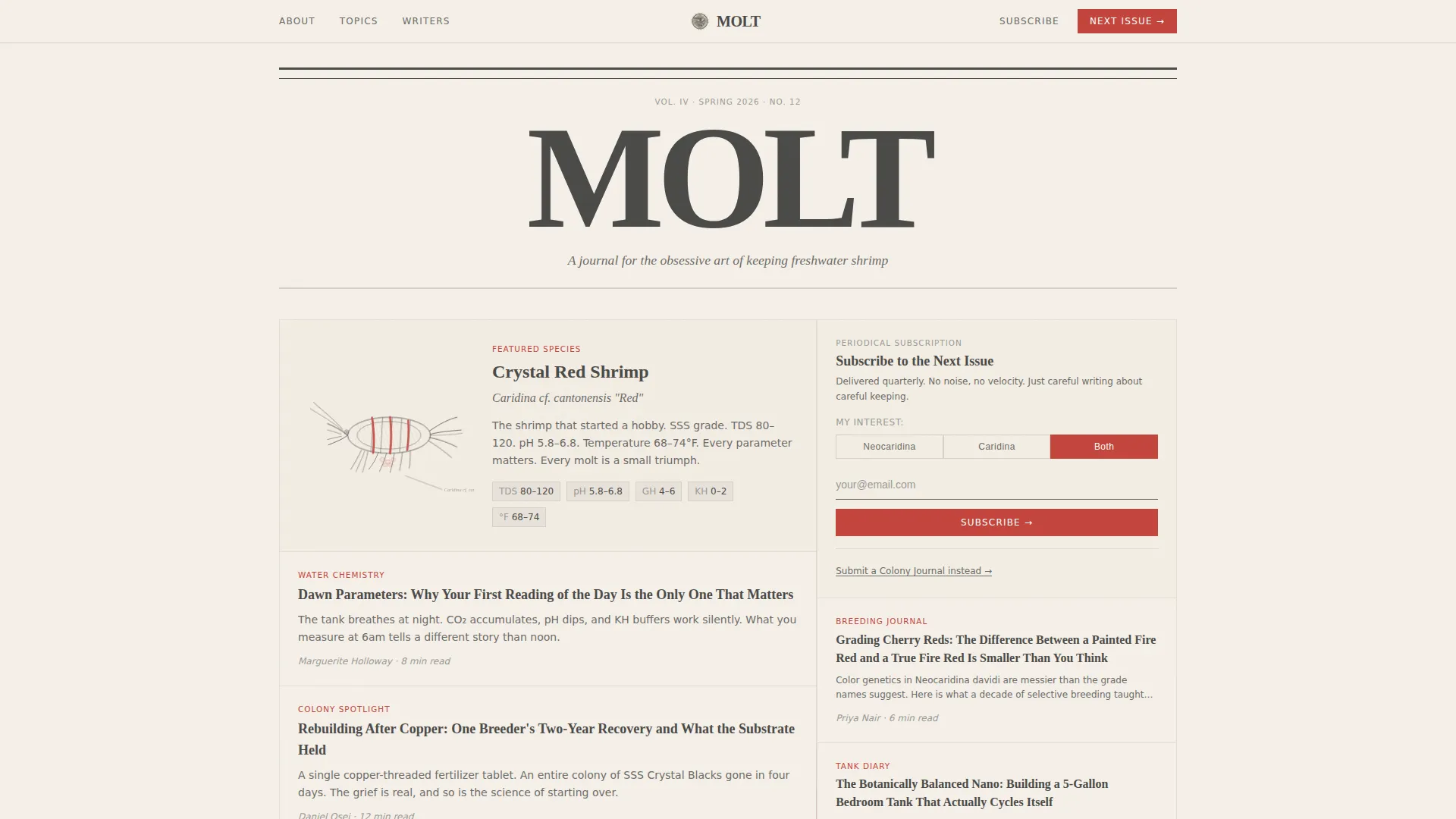
- A newspaper broadsheet masthead with an asymmetric 60/40 grid, article teasers, and an inline subscribe form
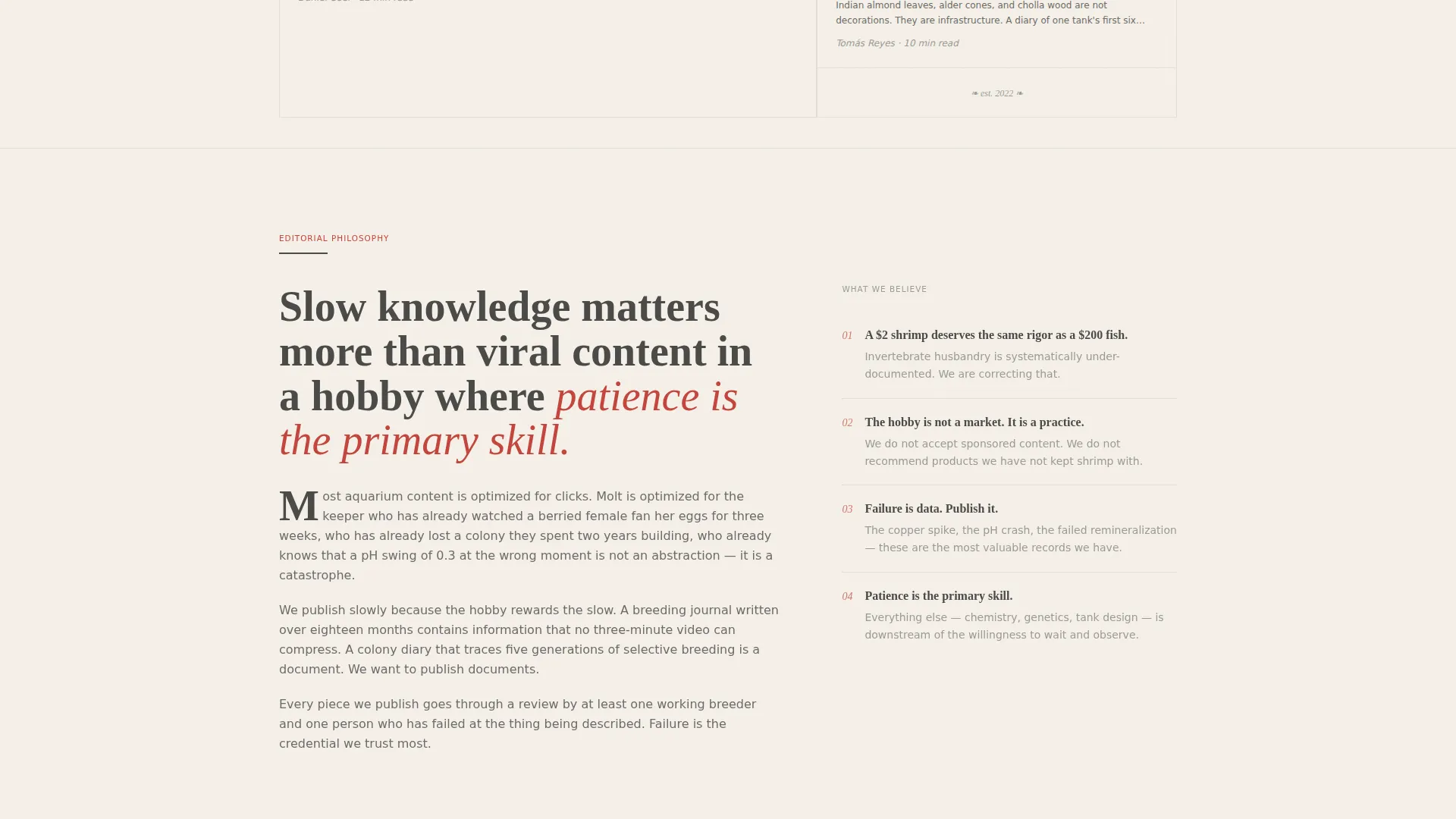
- An editorial philosophy section, a content category grid, contributor cards, and a dual call-to-action subscribe block
- A warm ink-and-paper visual identity using parchment, graphite, cloud gray, and a single cherry red accent
Feature list
This section covers the core built-in capabilities of the Molt template.
Newspaper Broadsheet Masthead
The header presents "MOLT" in a large serifed display typeface across the top, styled like a broadsheet title. A hand-illustrated crosshatch ink drawing of a Crystal Red shrimp sits beneath it, alongside a seasonal dateline. Two article teasers fill the space below the fold line in a 60/40 column split.
Asymmetric Bento Content Grid
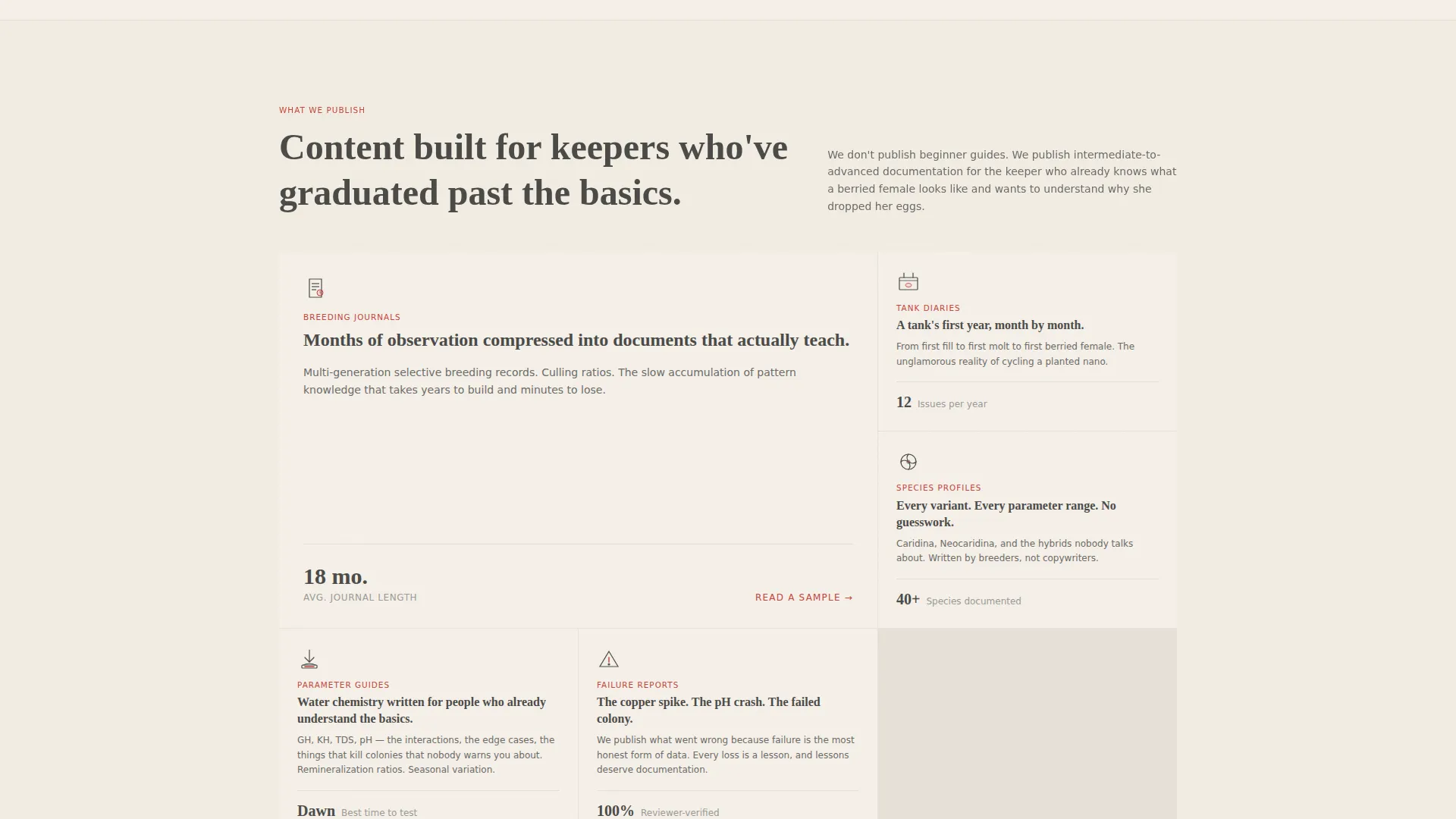
The "What We Publish" section uses an asymmetric bento-style grid to present content categories. Breeding journals, tank diaries, species profiles, and parameter guides each occupy their own cell, making the editorial range easy to scan at a glance.
Dual Subscription Call-to-Action
The lead generation flow includes two subscription form placements. The first appears in the masthead sidebar; the second follows the mission statement. Each form includes a single email field and an interest toggle letting readers choose between Neocaridina, Caridina, or both.
Contributor Cards Section
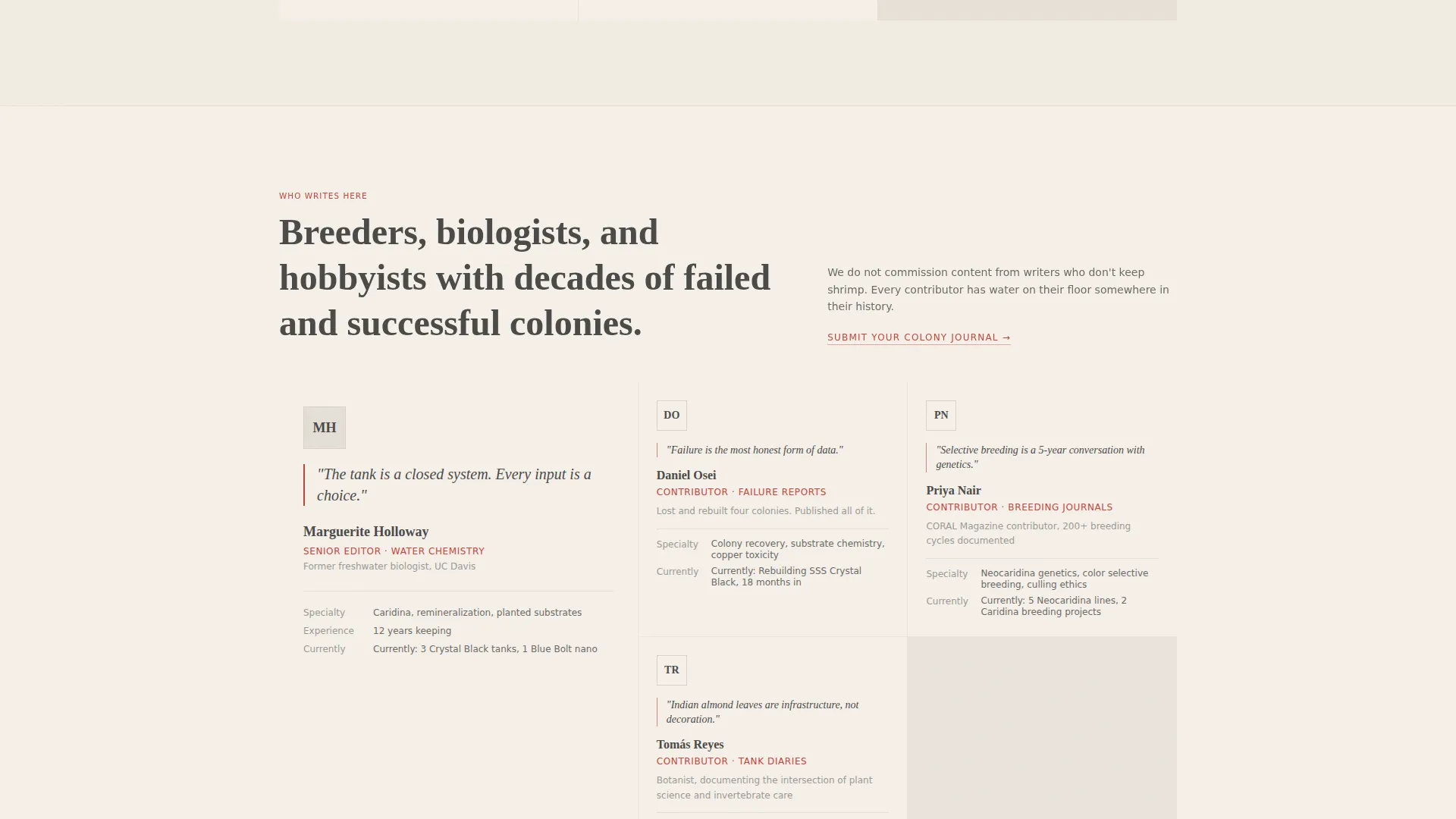
The "Who Writes Here" section presents contributor credentials through individual cards that display each writer's specialty. This builds social proof by grounding the publication in real breeders, biologists, and long-term hobbyists.
Community Submission Path
A secondary call-to-action invites readers to submit a Colony Journal before they have even received their first issue. This path seeds community contribution early and signals that the publication is a two-way conversation, not a broadcast.
Scroll-Reveal Animation System
The template includes medium-intensity scroll-reveal animations using a fadeSlideIn pattern, beam border CSS animations, and staggered section reveals. Hover states and beam borders add interactive depth without heavy JavaScript.
Page sections overview
| Section | Purpose |
|---|---|
| Hero Masthead | Establish editorial identity and capture initial subscriber interest |
| Editorial Philosophy | Communicate the slow-knowledge mission and build reader conviction |
| What We Publish | Show content categories in an asymmetric bento grid |
| Who Writes Here | Display contributor cards with specialties and credentials |
| Subscribe Call-to-Action | Collect email addresses with interest toggle and secondary contribution path |
| Footer | Provide horizontal dot-separated navigation links |
Design & branding system
The visual identity follows an Ink and Paper theme. Everything on the page is designed to feel like a naturalist's desk at night: cream cotton paper under a warm lamp, fountain pen ink still drying, and one living creature in the corner pulling your eye.
- Color palette: warm parchment (#F5F0E8), faded graphite (#4A4A48), soft cloud gray (#D6D2CA), and cherry shrimp red (#C4453C) used exclusively for links, icons, and calls to action
- Typography: Fraunces for serifed display headings and masthead text, DM Sans for body copy and interface elements
- No photography anywhere on the page; all illustration uses hand-drawn ink crosshatch style SVG artwork for a fully tactile, printed feel
Mobile & speed optimization
The template is built desktop-first, matching where most shrimp hobbyists browse: seated at their tank desk with a full screen. It still responds gracefully to smaller screens so the reading experience holds on mobile.
- Server Components handle all static content, keeping JavaScript to a minimum across the page
- Scroll-reveal animations and beam border effects are implemented with CSS-first approaches to reduce render weight
- The asymmetric 60/40 grid collapses cleanly on narrower viewports without losing section hierarchy
How this template helps you convert
Molt is designed around a conviction-building scroll rather than a hard sell. Every section earns the reader's trust before the subscription form appears a second time.
- The masthead sidebar places the email form at the very top of the page, capturing readers who are ready to subscribe immediately on arrival
- The Vision and Mission content flow builds editorial credibility section by section, so readers who scroll deeper are already invested by the time they reach the second subscribe block
- The secondary "Submit a Colony Journal" path converts readers who are not yet ready to subscribe into active contributors, keeping them engaged inside the community
Other information about this template
This template is a strong fit for anyone launching a freshwater shrimp keeping blog, digital periodical, or editorial community page. The design language is intentional and niche-specific rather than general-purpose.
- The Cloud Canvas color system and Ink and Paper theme are pre-configured and work together without modification
- The Vision and Mission creative direction is built into the scroll sequence, meaning the editorial philosophy layout is not a separate page but a scrolling narrative within the single landing page
- The footer follows a horizontal dot-separated link pattern for a clean, publication-style close to the page
- This template does not include a built-in content management system or blogging engine; it is a front-end landing page designed to present an editorial identity and capture leads
Theme
Ink & Paper
Creative direction
Vision & Mission
Color system
Cloud Canvas
Style
Asymmetric Grid (60/40)
Direction
Lead Generation
Page Sections
Newspaper Broadsheet Masthead
Asymmetric Bento Content Grid
Dual Subscription Call-to-action
Contributor Credential Cards
Community Submission Path
Scroll-reveal Animation System
Related questions
Can I change the color palette and typography?
Does the interest toggle actually filter subscriber lists?
Is this template suitable for a blog with multiple pages?
Do I need illustration skills to use the crosshatch shrimp artwork?
Can someone without coding experience customize this template?