Philosophy & Spirituality Blog Advanced Blog Website Template
Oracle is a masonry-layout landing page template built for tarot and divination writers who treat the cards as serious literary subjects. It opens with an editorial newspaper masthead, unfolds through a two-paragraph manifesto, and blooms into a growing essay grid. Two email capture paths turn deep readers into subscribers, all wrapped in a warm, antiquarian atelier aesthetic.
by Rocket studio
Quick summary
Oracle is a single-page masonry landing page template for tarot and divination blogs. It pairs an editorial newspaper masthead with a vision-led manifesto, a growing essay grid, and two distinct email signup paths. The design draws from Renaissance atelier aesthetics, using parchment cream, deep umber, and gold leaf to create a reading experience that feels intimate, unhurried, and authoritative.
Who this template is for
This template is built for writers and creators who want their tarot or divination content to feel like serious literary work, not a quick listicle. It suits anyone building a long-form spiritual reading practice online.
- Practicing tarot readers and symbolism writers publishing deep-read essays on individual cards
- Spiritual bloggers and independent editors building a subscriber list around a slow-publishing philosophy
- Curious new voices in the divination space who want their first page to carry the weight of genuine craft
What problem this template solves
Most blog templates flatten spiritual content into generic feeds. Oracle solves the credibility gap between serious esoteric writing and the visual language readers expect from a trusted literary voice.
- Commodity blog layouts undercut depth by making every post look equally disposable
- Generic newsletter opt-ins feel transactional and earn low trust from spiritually aligned readers
- Writers with a long-form library need a page that demonstrates volume, craft, and editorial intention at a glance
What you get with this template
You get a complete, single-page layout designed to establish editorial authority and convert readers into email subscribers through demonstrated depth. Every section is purposeful and sequence-driven.
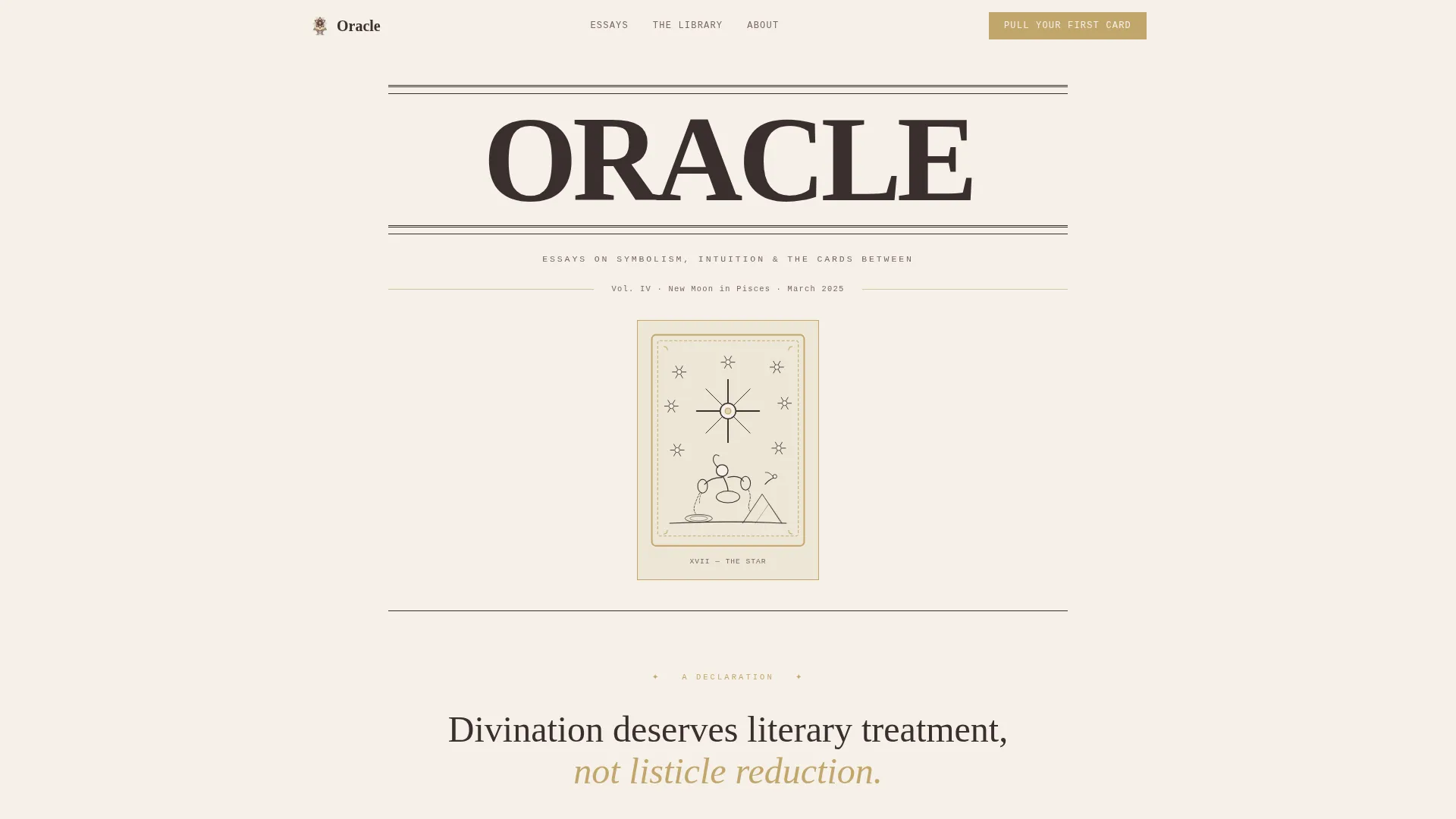
- An editorial newspaper masthead with a hand-illustrated card motif, dateline, and subhead in small caps
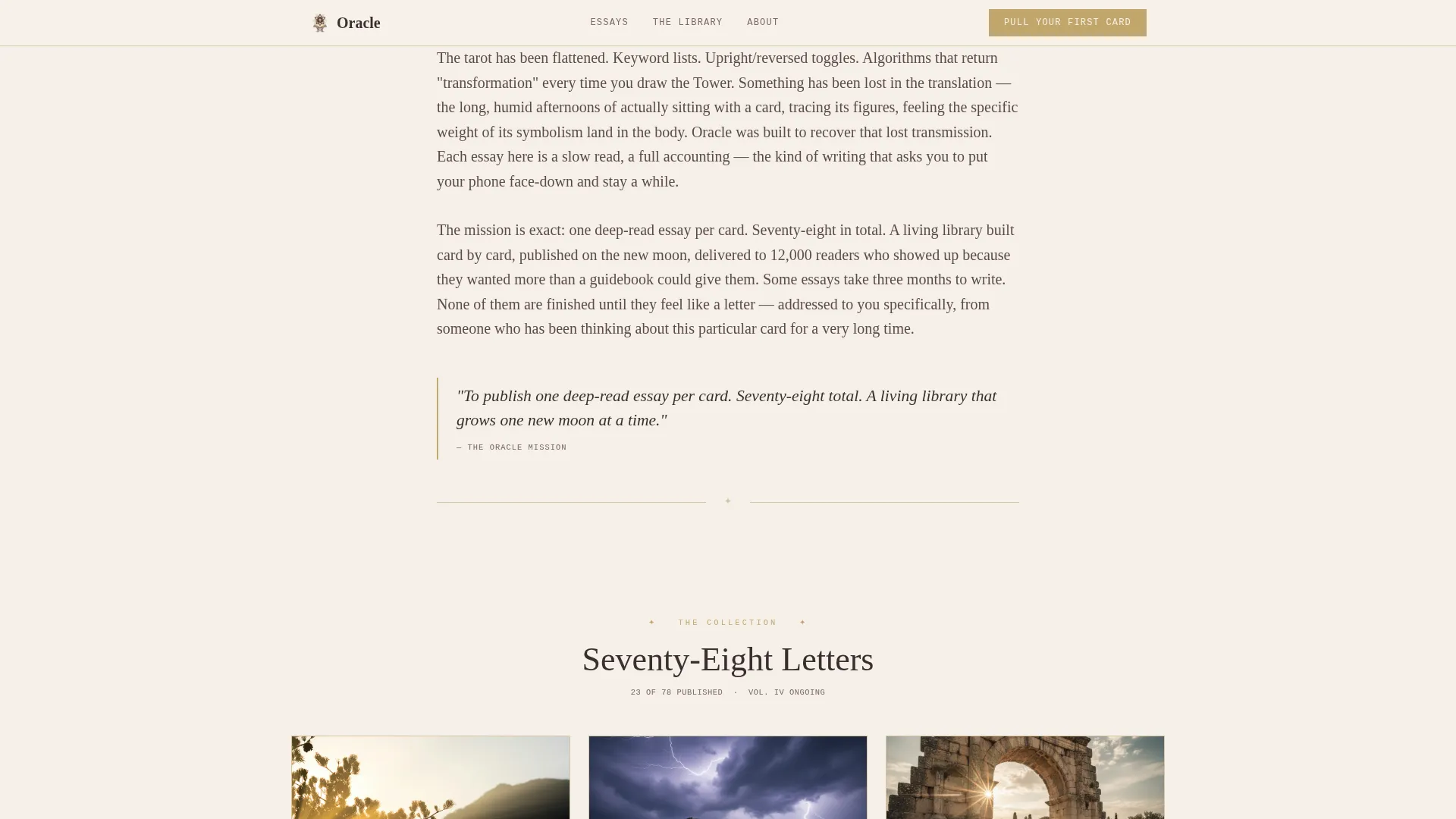
- A two-paragraph vision and mission manifesto followed by a variable-height masonry essay grid
- Two conversion paths: a "Pull Your First Card" modal and a mid-grid inline email banner citing 12,000 readers
Feature list
This template is built around five core structural capabilities, each grounded in the source brief.
Editorial Newspaper Masthead
The hero section is styled as a broadsheet publication header. "ORACLE" sits in an elegant editorial serif across the top, a hand-drawn Star card illustration in ink on cream sits centered beneath it, and a small-caps subhead reads like a journal title. A dateline formatted as a publication issue completes the composition. There is no animation, no movement, only quiet authority.
Vision and Mission Manifesto
Before the grid appears, visitors read a two-paragraph declaration on why divination deserves literary treatment. The mission statement then announces the 78-essay project: one deep-read essay per tarot card, building a living library. This sequencing earns the reader's trust before asking for anything.
Variable-Height Masonry Essay Grid
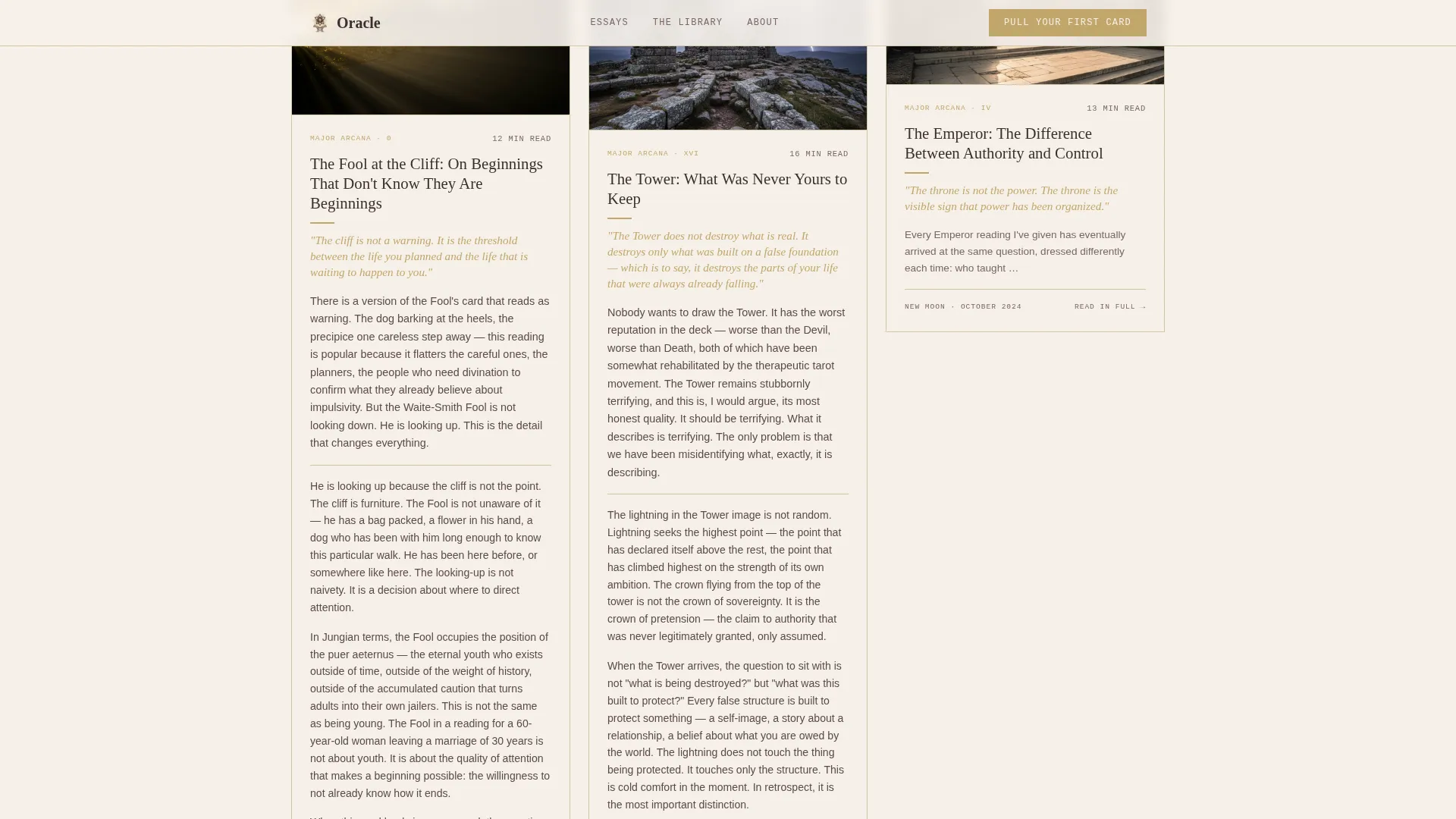
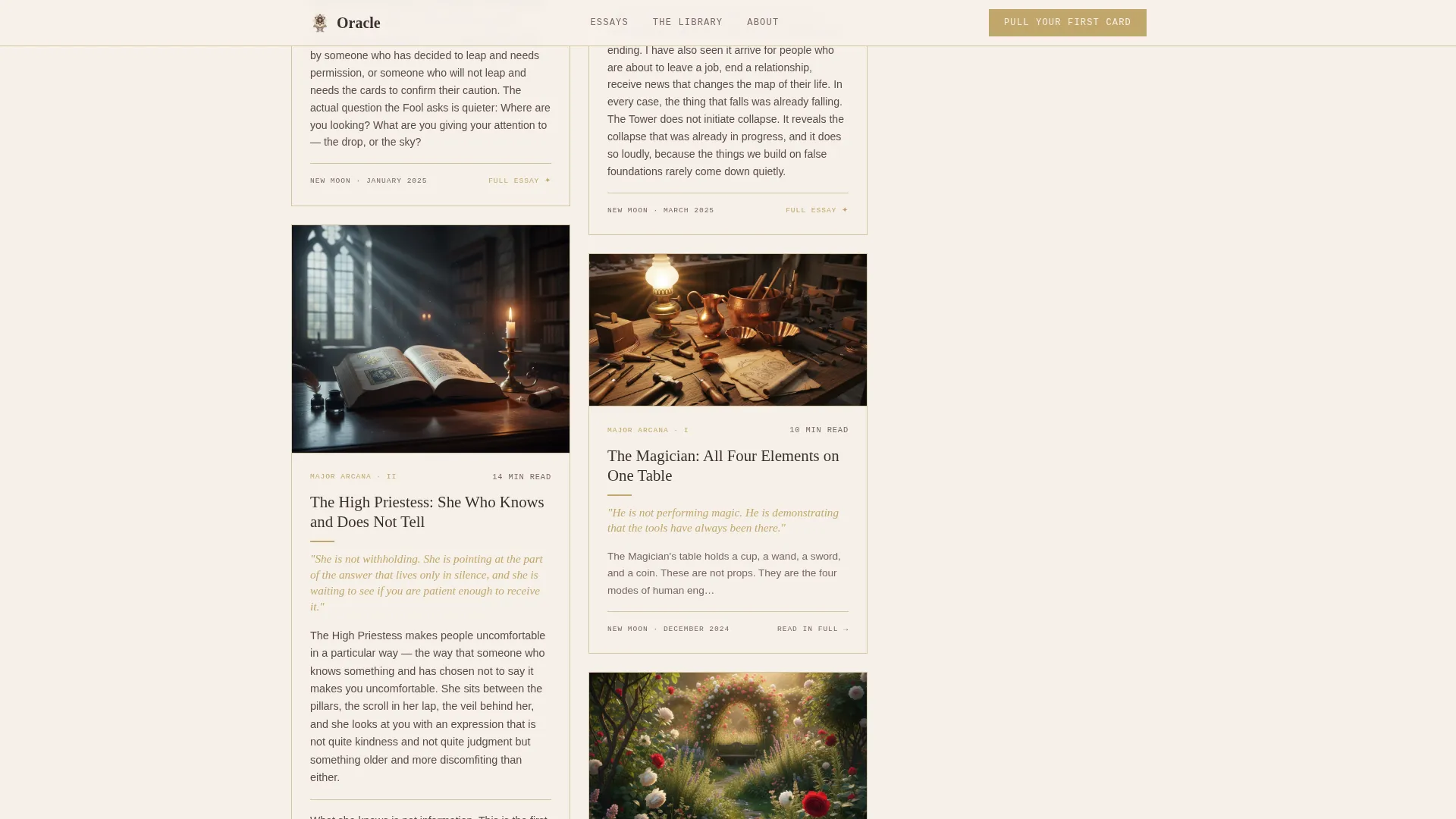
The masonry grid renders published essays as pinned manuscript tiles. Each tile carries hand-illustrated card art, a pull-quote highlighted in gold leaf, and a read-time estimate. Three full essays are readable on-page, proving voice and depth before any signup prompt appears. Tile heights vary naturally, giving the collection a handcrafted, growing-archive feel.
Dual Email Capture Paths
Two conversion points sit at different moments in the scroll. The primary call to action, "Pull Your First Card," triggers an email signup modal framed as a free personalized single-card reading. A secondary sticky banner at the grid's midpoint, "The 78 Letters," includes an inline email field and references the 12,000-reader community.
Scroll-Reveal Interaction
The template uses low-animation, scroll-triggered reveal behavior throughout. Content enters view as the reader scrolls, reinforcing the sense of discovery without distracting from the editorial atmosphere. The hero section is intentionally static, honoring the source brief's request for no hero animation.
Page sections overview
| Section | Purpose |
|---|---|
| Editorial Masthead Hero | Establishes publication identity and sets the authoritative, unhurried tone |
| Vision Manifesto Block | Delivers the two-paragraph declaration before the grid appears |
| Mission Statement | Announces the 78-essay living library project |
| Masonry Essay Grid | Displays the growing collection with card art, pull-quotes, and read times |
| Mid-Grid Email Banner | Captures subscribers inline with social proof at the grid's midpoint |
| Pull Your First Card | Triggers the primary email modal with a free reading framing |
| Single-Row Footer | Closes the page cleanly with minimal navigation |
Design & branding system
The visual system is drawn from a Renaissance atelier reference: dried pigment jars, linen-wrapped bundles, and gold-tooled leather spines catching afternoon light through a tall window. Every color choice is purposeful and restrained.
- Parchment cream (#F5F0E8) covers all backgrounds; deep umber (#3B2F2F) anchors body text; sandstone (#D4C5A9) separates content blocks like mortar between bricks
- Gold leaf (#C2A66B) appears only on links, card borders, pull-quotes, and hover states, reserved for the moments where the eye should land next
- Typography pairs Fraunces for serif display headings, DM Sans for clean body reading, and IBM Plex Mono for datelines and labels
Mobile & speed optimization
The template is designed desktop-first to honor the long-form atelier reading experience. It is also built to remain fully functional and readable on smaller screens.
- The masonry grid reflows responsively for mobile viewports without losing the variable-height manuscript feel
- Scroll-reveal interactions use minimal JavaScript, keeping page behavior lean and focused on content delivery
- Static content sections use server component architecture, reducing unnecessary client-side rendering
How this template helps you convert
Oracle earns the email signup before asking for it. The page is structured so that trust accumulates naturally through reading, not through urgency tactics.
- Three full readable essays prove voice and depth before any conversion prompt appears, so the signup feels like subscribing to a writer you already admire
- The "Pull Your First Card" modal reframes the opt-in as a gift, a free personalized card reading delivered to the inbox, lowering the friction of signing up
- The mid-grid "78 Letters" banner arrives after the reader has scrolled deep enough to trust the collection, adding social proof with a 12,000-reader reference at exactly the right moment
Other information about this template
Oracle fits naturally into a content publishing workflow for independent spiritual writers and editors who want a focused, long-form presence without the noise of a full multi-page site.
- The template is categorized under Blog and Editorial, Philosophy and Spirituality Blog, and Tarot and Divination Blog niches
- The Atelier Studio theme and Warm Stone color system give the template a distinctive visual identity suited to antiquarian, literary, and esoteric subject matter
- The footer follows a linear single-row pattern, keeping the close of the page minimal and consistent with the unhurried editorial tone
- The page is localized in English for a United States audience with no currency references
Theme
Atelier Studio
Creative direction
Vision & Mission
Color system
Warm Stone
Style
Masonry/Pinterest
Direction
Lead Generation
Page Sections
Editorial Newspaper Masthead
Vision and Mission Manifesto
Variable-height Masonry Grid
Dual Email Capture Paths
Scroll-reveal Interaction
Related questions
Can I use this template if I am just starting my tarot blog?
How does the 'Pull Your First Card' email modal work?
Does this landing page display well on mobile devices?
Can I edit the masthead, dateline, and manifesto text?
Is the masonry grid limited to a set number of essay tiles?