Legal & Policy Blog Blog & Content Website Template
Passage is a cinematic dark landing page template for an immigration law blog. It uses a 60/40 asymmetric editorial grid, oversized serif typography, and a chapter-driven scroll narrative to draw readers through immigration history into present-day legal analysis. The design converts readers into archive visitors and newsletter subscribers through two purposeful calls to action.
by Rocket studio
Quick summary
Passage is a single-page editorial template built for an immigration law journal. It tells a chronological story across three narrative chapters, moving from Ellis Island to today. The 60/40 asymmetric grid separates long-form prose from archival imagery and pull quotes. Every design decision serves one goal: earning reader trust before asking for a click.
Who this template is for
This template is written for editors, legal journalists, and independent publishers who want their content to feel like literature, not a law review. It suits creators who already have a strong editorial voice and want a visual home that matches it.
- Immigration law bloggers and legal journalists writing for affected communities
- DACA advocates, H-1B commentary writers, and asylum policy analysts
- Independent editors launching a long-form content publication or newsletter
What problem this template solves
Most legal blog templates feel clinical. They prioritize navigation menus and sidebar widgets over the actual writing. Readers who arrive searching for clarity about their visa case, their deportation hearing, or their pending green card encounter a page that feels indifferent to their situation.
- Standard blog layouts do not create emotional investment before asking for a sign-up
- Legal content sites rarely distinguish themselves visually from generic news templates
- Writers with strong voices have no ready-made editorial structure that reflects that weight
What you get with this template
You get a fully structured, single-page landing page that functions as both a brand statement and a content gateway. Each section is positioned to deepen reader trust before presenting a conversion prompt.
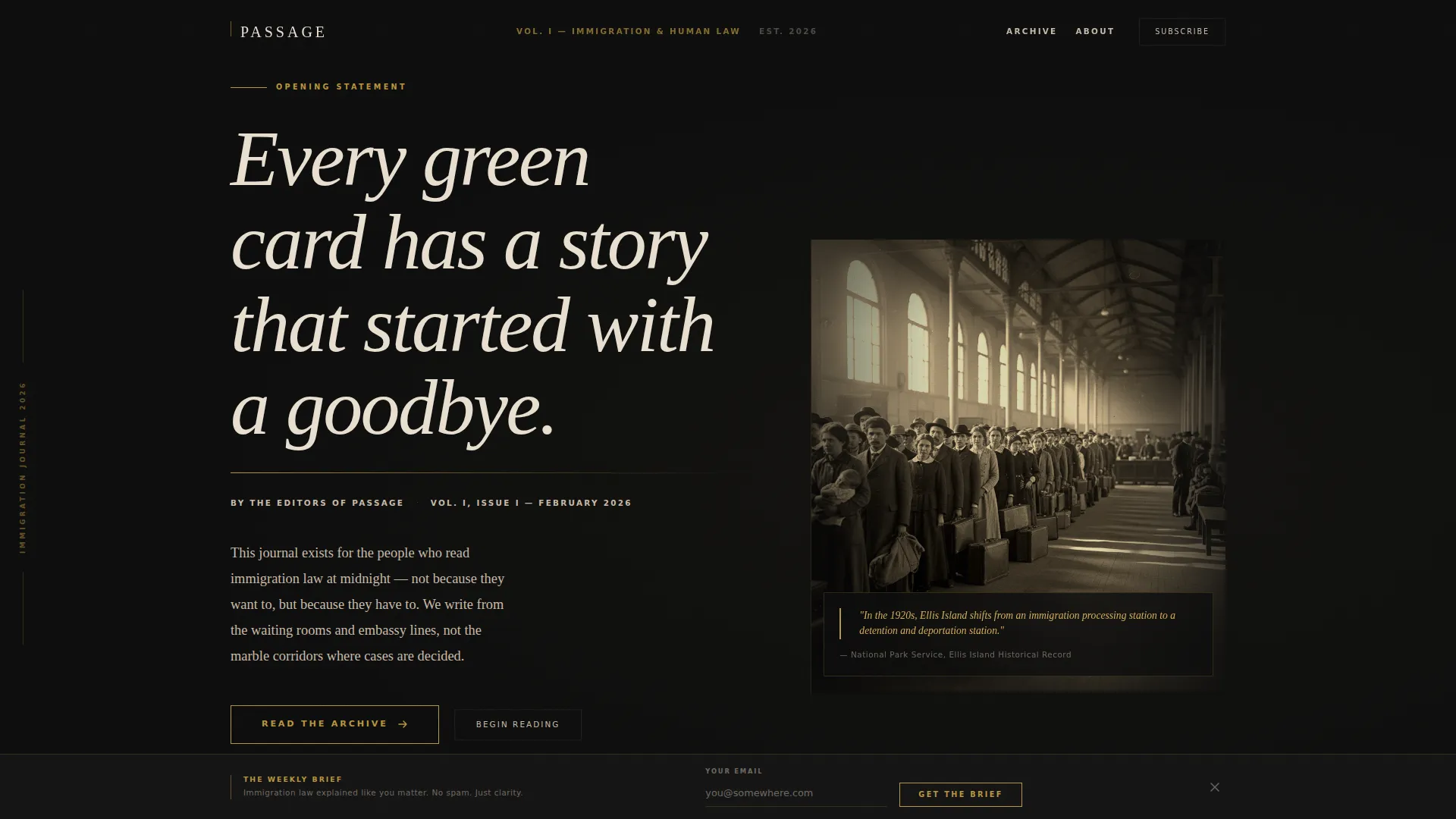
- A cinematic dark hero with an oversized manifesto headline in a 60/40 asymmetric split
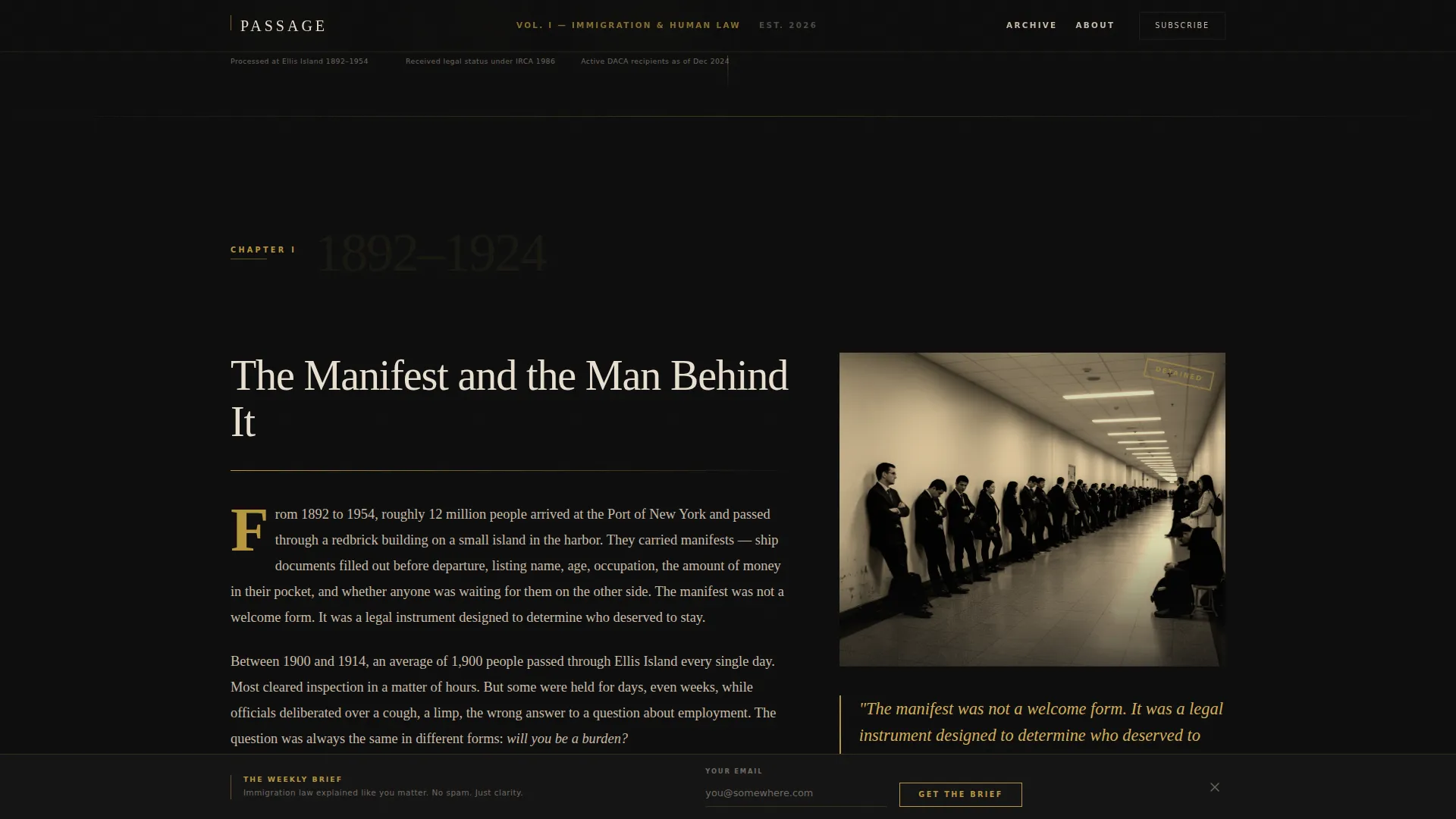
- Three narrative chapters, each pairing long-form prose with archival visuals and gold pull quotes
- A gold-leaf archive call-to-action button and a fixed bottom newsletter ribbon with a single email field
Feature list
A brief overview of the template's core built-in capabilities, each drawn directly from the design and interaction brief.
Asymmetric 60/40 Editorial Grid
The layout divides every section into a wide 60-column prose side and a narrower 40-column visual side. This deliberate imbalance mirrors a magazine spread and gives long-form writing the physical space it deserves.
Oversized Manifesto Hero
The hero section opens with a single typographic statement set in a large editorial serif against pure black. There is no hero image. The headline forces slow reading and establishes the journal's voice before anything else loads.
Three-Chapter Scroll Narrative
The page unfolds as three historical chapters: Ellis Island in the 1920s, the Immigration Reform and Control Act (IRCA) amnesty of 1986, and the Deferred Action for Childhood Arrivals (DACA) announcement of 2012. Each chapter escalates in personal stakes until the final section addresses the reader directly.
Scroll-Linked Parallax and Pull Quote Drift
GSAP ScrollTrigger powers staggered section reveals and a parallax layer between prose and imagery. Pull quotes in the 40-column drift upward on scroll, creating a sense of depth without distracting from the writing.
Gold-Leaf Archive Call to Action
After the third chapter, a gold-leaf styled button labeled "Read the Full Archive" appears at the point of highest earned trust. It is the primary conversion element and is intentionally withheld until the reader has moved through the narrative.
Fixed Newsletter Conversion Ribbon
A thin ribbon fixed to the bottom of the viewport offers a single email field and the "Get the Weekly Brief" prompt. It stays visible throughout the scroll without interrupting reading, targeting the reader who is already invested but not yet subscribed.
Page sections overview
| Section | Purpose |
|---|---|
| Cinematic Dark Hero | Opens with the oversized manifesto headline in a 60/40 asymmetric split against pure black |
| Chapter I: Ellis Island | Long-form 1920s immigration prose left, archival photograph right, scroll-linked parallax |
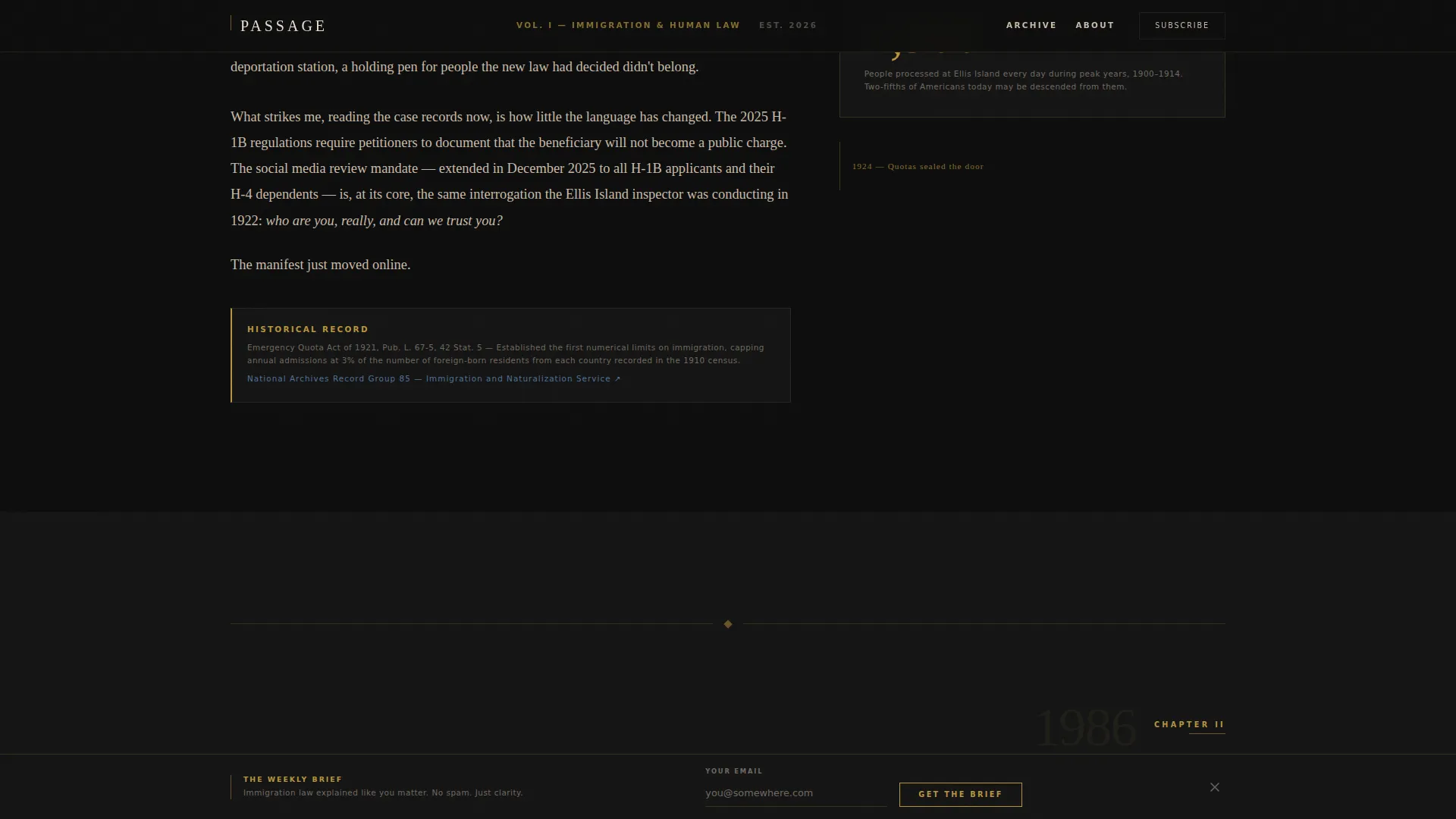
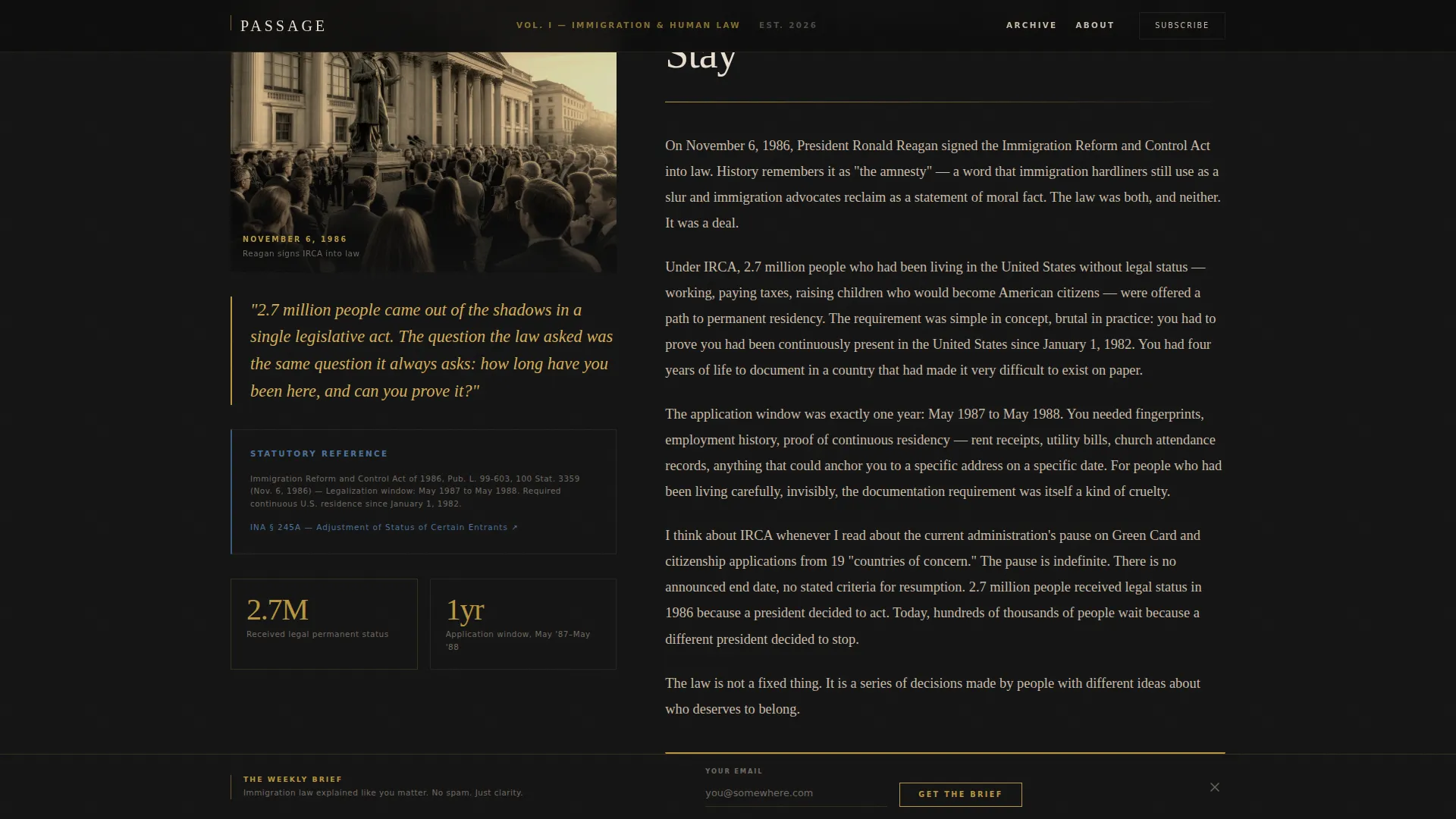
| Chapter II: IRCA 1986 | Reversed layout with gold pull quote and case citations anchoring the 40-column |
| Chapter III: DACA 2012 | First-person present-day voice, escalating personal stakes, addresses reader directly |
| Archive Call to Action | Gold-leaf button prompting readers to explore the full blog archive |
| Fixed Newsletter Ribbon | Bottom-anchored email field offering the weekly brief with minimal friction |
| Minimal Footer | Horizontal footer pattern keeping focus on content and exit paths clean |
Design & branding system
The visual identity is built around the aesthetic of a foreign correspondent's leather-bound notebook. Black dominates the canvas. Parchment carries body text in generous serif columns. Gold marks every moment of emphasis, and the visa-stamp blue appears only on interactive elements.
- Color palette: deep editorial black (#0D0D0D), archival parchment (#E8DFD0), muted gold leaf (#B8963E), visa-stamp blue (#3A5A7C)
- Typography: Fraunces for editorial serif headlines, DM Sans for body text and interface elements
- Visual tone: cloth-bound book aesthetic, yellowed pages under lamplight, ink-still-drying tactility
Mobile & speed optimization
The template is built desktop-first, designed for readers consuming long-form content at a desk or laptop. It adapts responsively to mobile viewports without breaking the editorial layout.
- Server Components handle static content sections to reduce unnecessary client-side load
- Images use lazy loading so heavy archival visuals do not block initial page rendering
- CSS smooth scroll is applied globally to keep chapter transitions fluid on all devices
How this template helps you convert
Passage earns trust through storytelling before it asks for anything. The conversion architecture is sequenced to match the reader's emotional journey through the content.
- The three-chapter narrative builds credibility and emotional investment before any call to action appears, so the "Read the Full Archive" button arrives at the moment of highest reader trust.
- The fixed newsletter ribbon stays present throughout the scroll without demanding attention, giving the reader a low-friction path to subscribe at any point in their reading session.
Other information about this template
This template sits at the intersection of editorial design and legal journalism, with specific intent for U.S. immigration policy content. The social proof woven into the chapter structure draws on verifiable historical numbers.
- The Ellis Island chapter references approximately 12 million arrivals processed through that entry point
- The IRCA 1986 chapter references roughly 2.7 million people who received amnesty under that legislation
- The DACA 2012 chapter references approximately 533,000 active recipients as context for present-day stakes
- The template's structure supports secondary audiences including immigration attorneys, policy researchers, and journalists who follow the beat
- The design system was intentionally built without competing visual noise, keeping the editorial voice of the author as the primary brand element
Theme
Editorial Magazine
Creative direction
Origin Story
Color system
Cinematic Dark
Style
Asymmetric Grid (60/40)
Direction
Click-Through
Page Sections
Asymmetric 60/40 Editorial Grid
Oversized Manifesto Hero
Three-chapter Scroll Narrative
GSAP Scroll-linked Parallax
Gold-leaf Archive Button
Fixed Newsletter Ribbon
Related questions
Who is this landing page template built for?
Does this template support newsletter sign-ups?
Can I use this template without technical animation experience?
How many sections does the page include?
Can the template be adapted for a different legal niche?