Last-Mile Delivery Landing Page Template
Route is a split-screen landing page template built for e-commerce parcel last-mile delivery services. It combines an Engineering Blueprint visual theme with a Charcoal and Amber color system to present hard delivery metrics, spec-sheet-style sections, and a focused lead generation form. The design targets operations-minded buyers who need proof of performance before they commit.
by Rocket studio
Quick summary
Route is a single-page landing page template designed for last-mile delivery services targeting mid-size e-commerce brands. Its Engineering Blueprint aesthetic, split-screen layout, and amber-on-charcoal data presentation make every metric feel earned. The primary conversion goal is a three-field "Get Your Delivery Audit" form, supported by a secondary gated PDF download path.
Who this template is for
This template is built for logistics and e-commerce operations professionals who need to demonstrate delivery performance through data. It speaks directly to buyers who evaluate vendors by numbers, not brand stories.
- Direct-to-consumer brand founders tracking failed-delivery rates and carrier reliability
- Fulfillment managers at regional warehouses managing multiple unreliable carriers
- Operations leads at subscription box companies where late deliveries drive customer churn
What problem this template solves
Mid-size e-commerce brands struggle to evaluate last-mile delivery vendors because most carrier pages bury performance data behind sales language. This template solves that credibility gap by leading with seven hard metrics before asking for any contact information.
- Generic carrier landing pages lack the specific proof points that operations leads need
- Visitors leave before converting when forms appear before trust is established
- Delivery failures, missed service level agreements, and chargebacks stay invisible until costs compound
What you get with this template
You get a fully structured, single-page lead generation template with a dark dispatch-room aesthetic and a clear conversion architecture. Every section is designed to move a skeptical operations buyer from awareness to audit request.
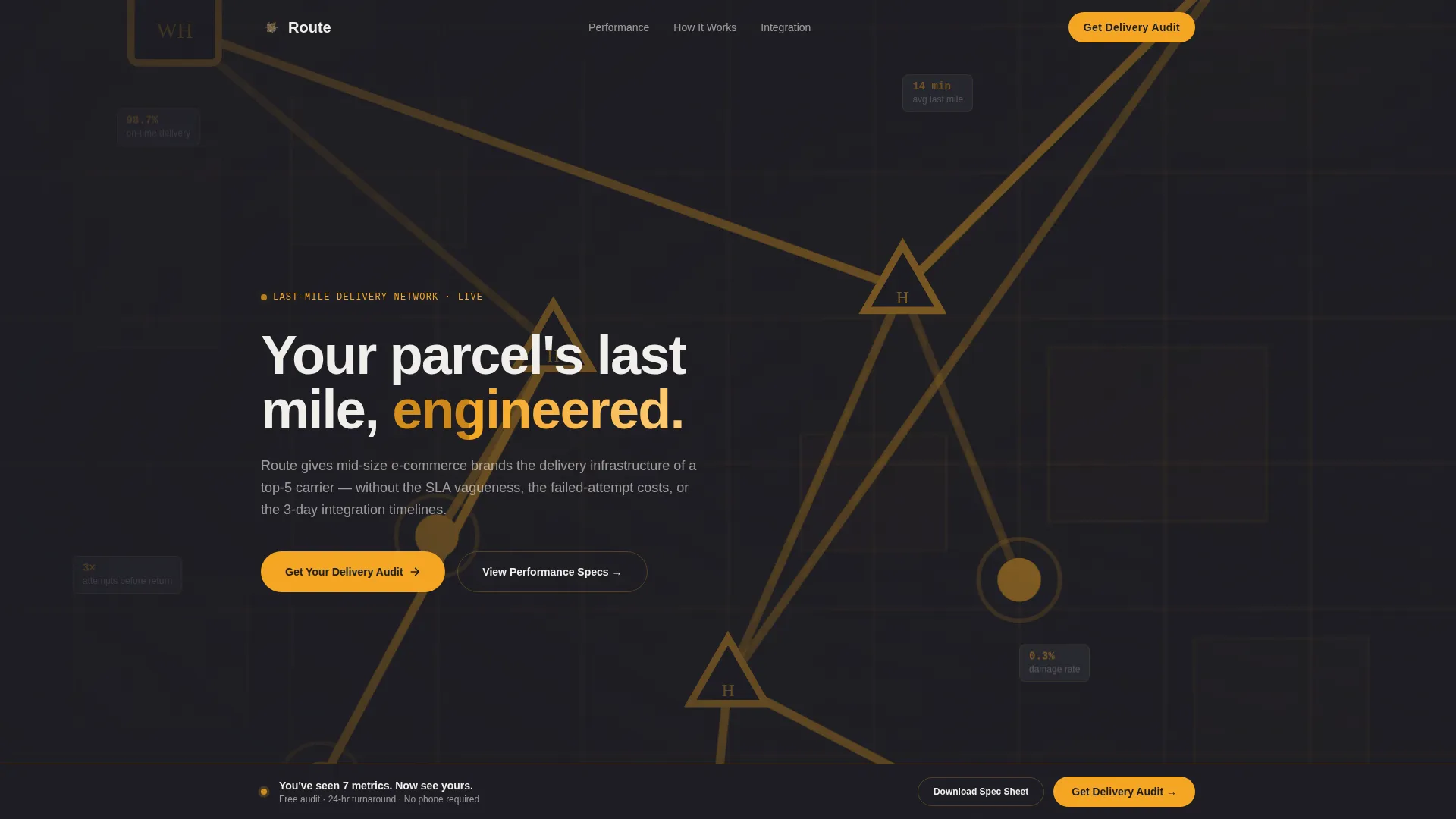
- A full-viewport hero section with a stylized blueprint city-grid map and floating amber performance stats
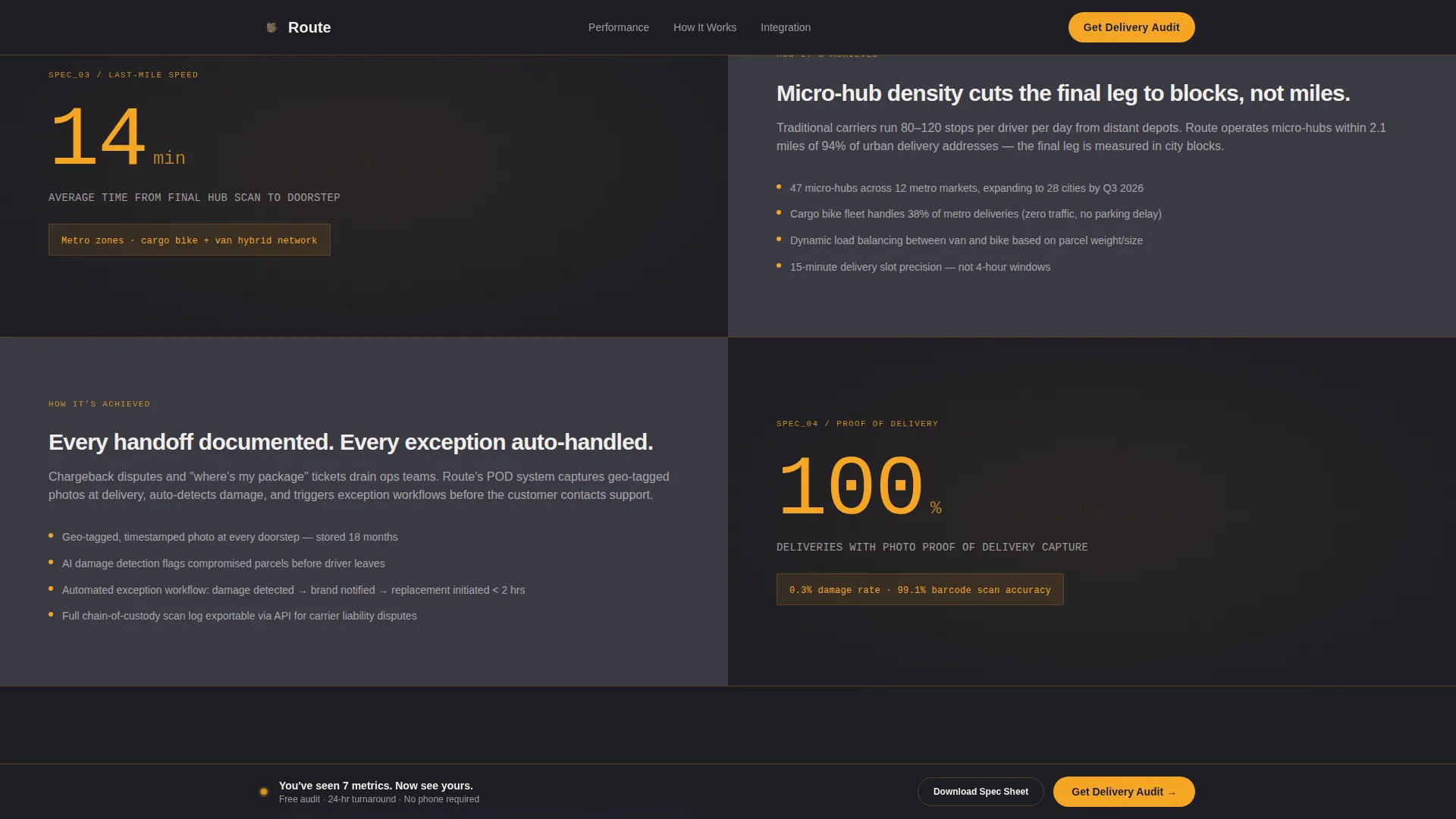
- Three split-screen spec sections pairing large amber metrics with technical explanations of how each number is achieved
- A three-field lead capture form and a secondary gated PDF download path for visitors not yet ready to talk
Feature list
This template includes six core features grounded directly in the design and structure brief.
Blueprint SVG Hero with Floating Stats
The header section renders a stylized city-grid map in blueprint line art on a deep charcoal background. Amber route lines connect warehouse nodes, sorting hubs, and doorstep delivery pins. Floating data callouts display specific performance figures beside each node, giving the map a live-ops dashboard feel from the first scroll position.
Split-Screen Spec Sheet Sections
Each spec section divides the viewport 50/50. The left panel renders a single performance metric large in amber with its unit and measurement context. The right panel delivers the technical explanation behind that number, covering topics such as route optimization, driver reallocation, and proof-of-delivery photo capture. Visitors scroll through specs the way an engineer reads a tolerance table.
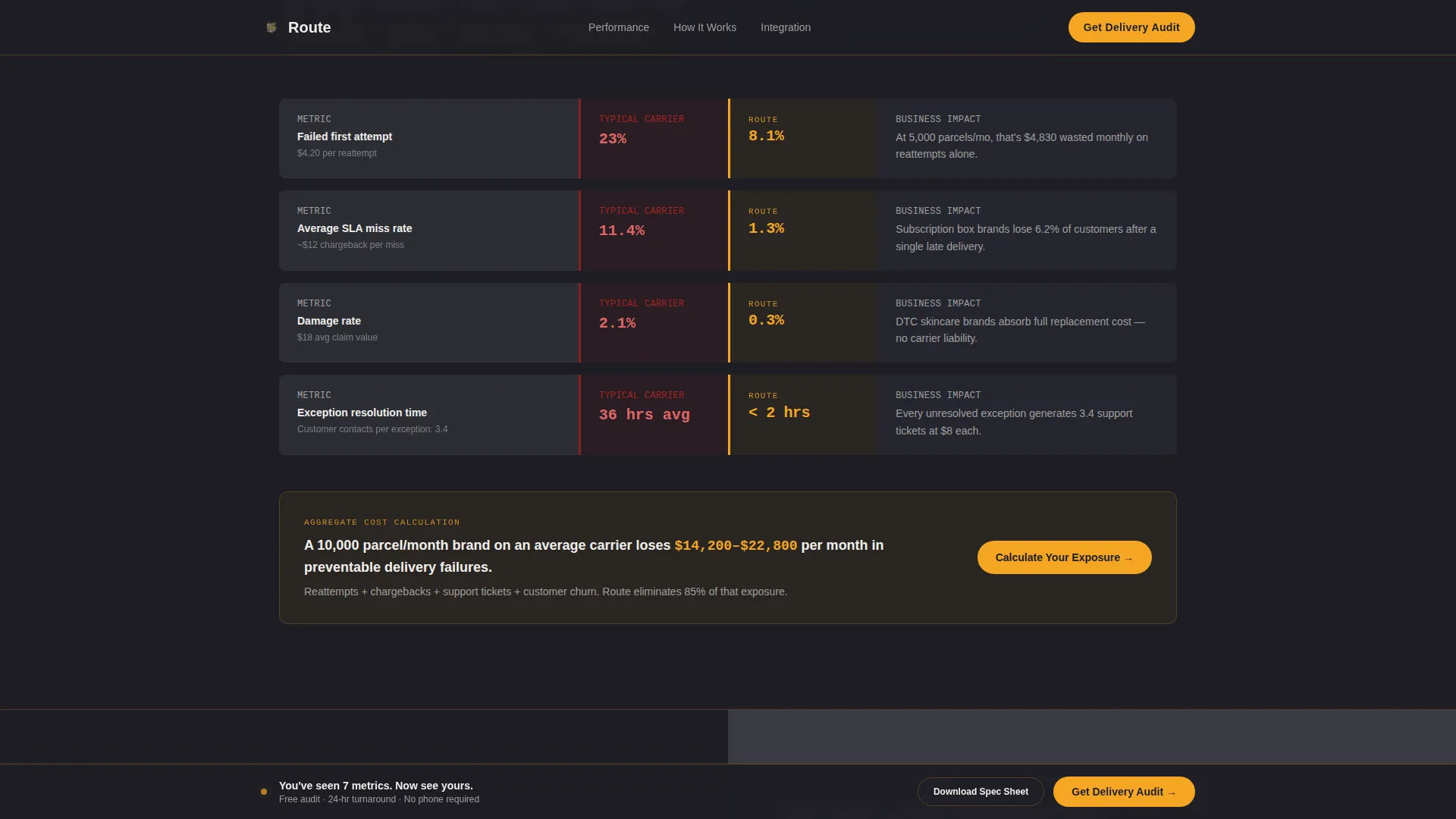
Escalating Stakes Failure Cost Section
A dedicated section shifts focus to what missed service level agreements actually cost: chargebacks, customer churn, and carrier comparison data. This section raises urgency for buyers still undecided after the spec sections, making the cost of inaction concrete rather than implied.
Three-Field Lead Generation Form
The primary conversion form collects only three fields in sequence: monthly parcel volume via dropdown, primary delivery region, and work email. No phone field is included, keeping friction low. Form validation is built in, and the form appears first at the base of the hero and again as a persistent bottom bar after the third spec section.
Gated PDF Secondary Conversion Path
A secondary call to action offers a downloadable spec sheet PDF for visitors not ready to request an audit. This path captures email and company name, giving the sales team a warm lead pool from visitors who engaged with the content but were not yet ready for a direct conversation.
Amber Pulse Animations and Scroll Reveals
The template uses SVG path drawing, amber pulse animations on route lines, and scroll-reveal stagger effects to make the page feel like a live dispatch system. Animations are handled by client-side components while static content uses server-side rendering for performance.
Page sections overview
| Section | Purpose |
|---|---|
| Hero Blueprint Map | Full-viewport city-grid infographic with amber route lines and floating performance stats |
| Spec Sheet One | On-time rate metric paired with route optimization methodology explanation |
| Spec Sheet Two | First-attempt success rate paired with driver reallocation methodology |
| Failure Cost Section | Stakes escalation showing missed SLA costs and competitor comparison |
| Integration Spec Form | API integration time spec plus the three-field "Get Your Delivery Audit" form |
| Footer Linear Row | Single-row footer with brand links and secondary nav |
Design & branding system
The visual identity follows an Engineering Blueprint theme built around a Charcoal and Amber color system. Every color choice has a functional role tied to the dispatch control room concept.
- Deep asphalt charcoal (#1E1E24) as the primary background, technical graphite (#3A3A44) for card surfaces, signal amber (#F5A623) on every data point and interactive element, and clean manifest white (#F0EFEB) for body text
- Typography pairs DM Sans for headings with JetBrains Mono for all metrics and data labels, reinforcing the engineering and precision feel
- Amber appears only where something is measured, moving, or actionable, never as decoration
Mobile & speed optimization
The template is designed desktop-first to serve operations leads working at their desks, but it is built responsively so the layout adapts cleanly to smaller screens. Performance decisions are baked into the component architecture.
- Server-side components handle all static content sections for faster initial load
- Client-side components are scoped only to animation-heavy elements such as SVG path drawing and amber pulse effects
- Scroll-reveal stagger and persistent call-to-action bar behavior are handled client-side without blocking static content rendering
How this template helps you convert
The conversion architecture is built around earning trust before asking for anything. By the time a visitor reaches the form, they have already seen seven hard metrics that outperform a typical incumbent carrier.
- The hero section leads with performance data rendered as a live map, establishing credibility in the first viewport before any pitch language appears.
- The spec sheet sections build a progressive case across three scroll positions, moving from what the system does to what happens when competitors fail, then directly into the integration form.
- The persistent bottom bar and the secondary PDF download path give buyers two ways to convert at different levels of readiness, capturing both high-intent and research-stage visitors.
Other information about this template
This template is built specifically for the e-commerce parcel last-mile delivery niche within the broader logistics and supply chain category. A few additional details are worth knowing before you build.
- The template targets USA-based operations, using USD and English-language defaults throughout
- The FAQ accordion component is included as an interactive element for handling common objections on the page
- The footer follows a linear single-row pattern, keeping the page exit clean and brand-consistent
- The page is structured for B2B logistics software-as-a-service use cases where the buyer cycle is research-heavy and conversion happens through demonstrated competence

Theme
Engineering Blueprint
Creative direction
Spec Sheet
Color system
Charcoal & Amber
Style
Split Screen (50/50)
Direction
Lead Generation
Page Sections
Blueprint SVG Hero Map
Split-screen Spec Sheet Layout
Failure Cost Stakes Section
Three-field Lead Capture Form
Gated PDF Secondary Path
Amber Pulse Animations
Related questions
Who is this landing page template designed for?
What conversion paths does this template include?
Can I customize the performance metrics and spec sheet content?
Does this template include animations?
What fields does the lead generation form collect?