Mobile & Network Operator Professional Website Template
Signal is a bold brutalist bento grid landing page built for 5G network providers. It leads with a raw stat at 120-pixel scale, then breaks capabilities into asymmetric metric tiles covering latency, throughput, device density, uptime, and more. A persistent amber call-to-action button and a secondary research link drive two distinct buyer paths toward conversion.
by Rocket studio
Quick summary
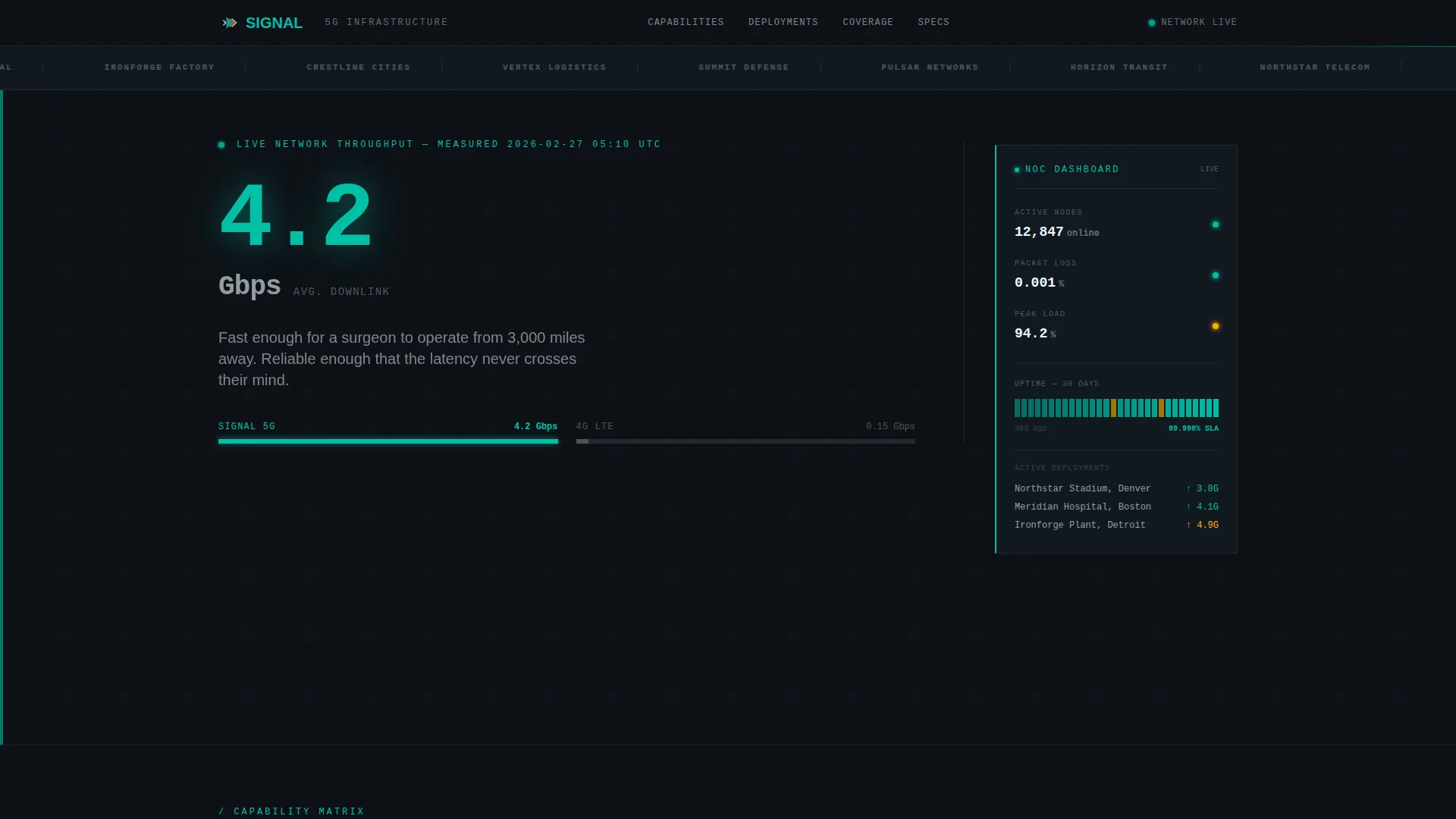
Signal is a single-page bento grid template designed for 5G network providers. It opens with a scrolling enterprise logo bar and one dominant stat in oversized monospace type. Below that, asymmetric capability tiles stack proof point by proof point. The layout funnels visitors from broad network credibility into specific deployment plan tiles, ending at a persistent conversion button.
Who this template is for
This template is built for organizations that sell or deploy serious network infrastructure. It speaks directly to technical buyers who need proof before they commit.
- Chief Technology Officers moving enterprise fleets to private 5G networks
- Municipal broadband officers working to close rural or urban coverage gaps
- IoT architects designing smart factory environments with high device density
What problem this template solves
Most network provider pages bury their best numbers inside dense body copy or behind a sales brochure download. Signal treats every metric as the headline. The layout removes decorative friction so the specification does the persuading.
- Visitors cannot instantly locate the performance proof they need to trust a provider
- Deployment plan differences get lost when every tier reads the same
- Research-mode buyers leave before reaching a call to action
What you get with this template
You get a single, fully structured landing page layout ready to represent a 5G network provider at enterprise scale. Every section has a clear job and a defined visual role.
- A scrolling enterprise logo bar rendered in flat white against deep network black
- An oversized 120-pixel monospace stat block that leads the page with a single downlink figure
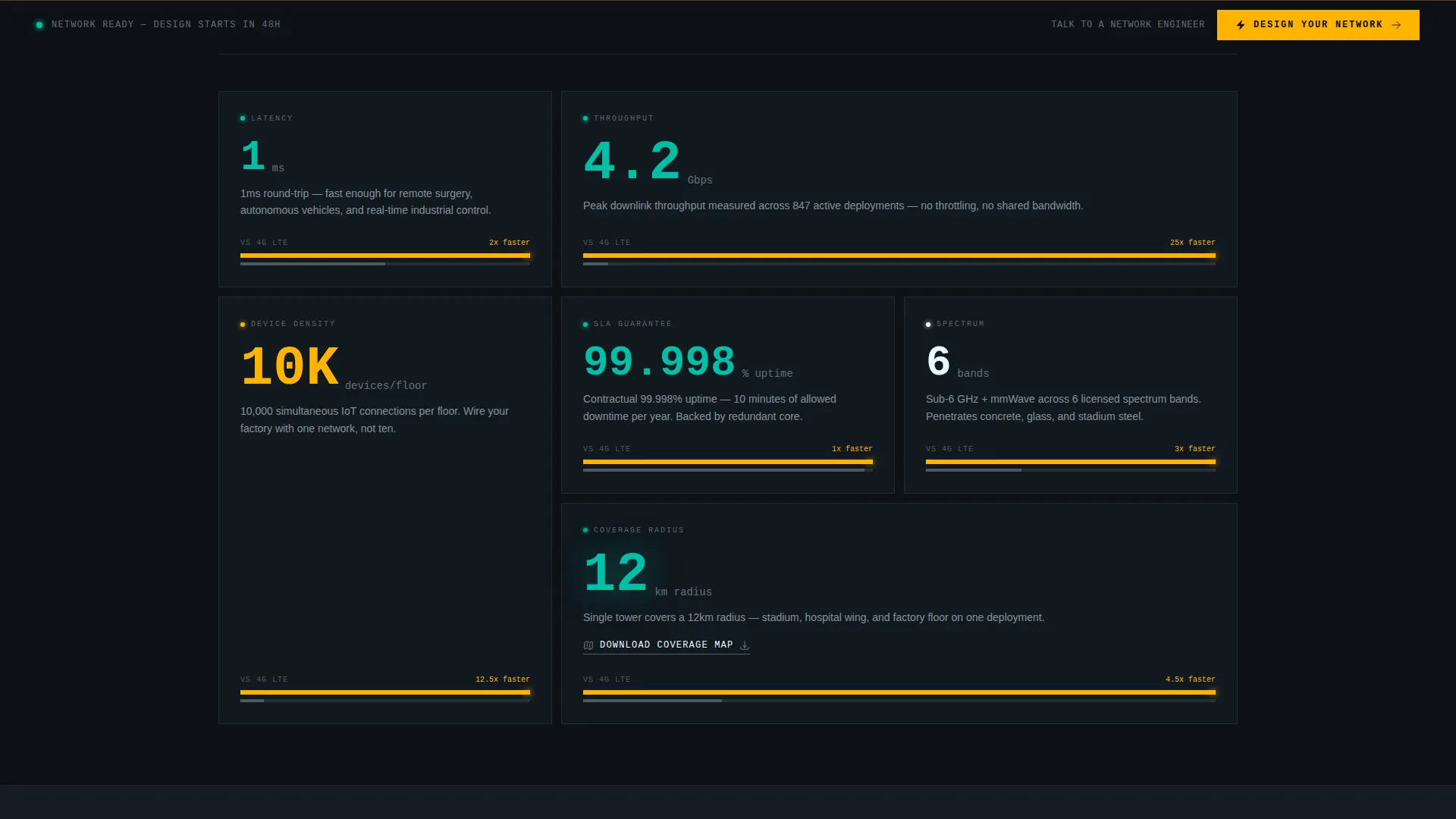
- Asymmetric bento grid tiles, each showing one capability metric with a plain-language translation and an amber progress bar comparing performance against 4G LTE
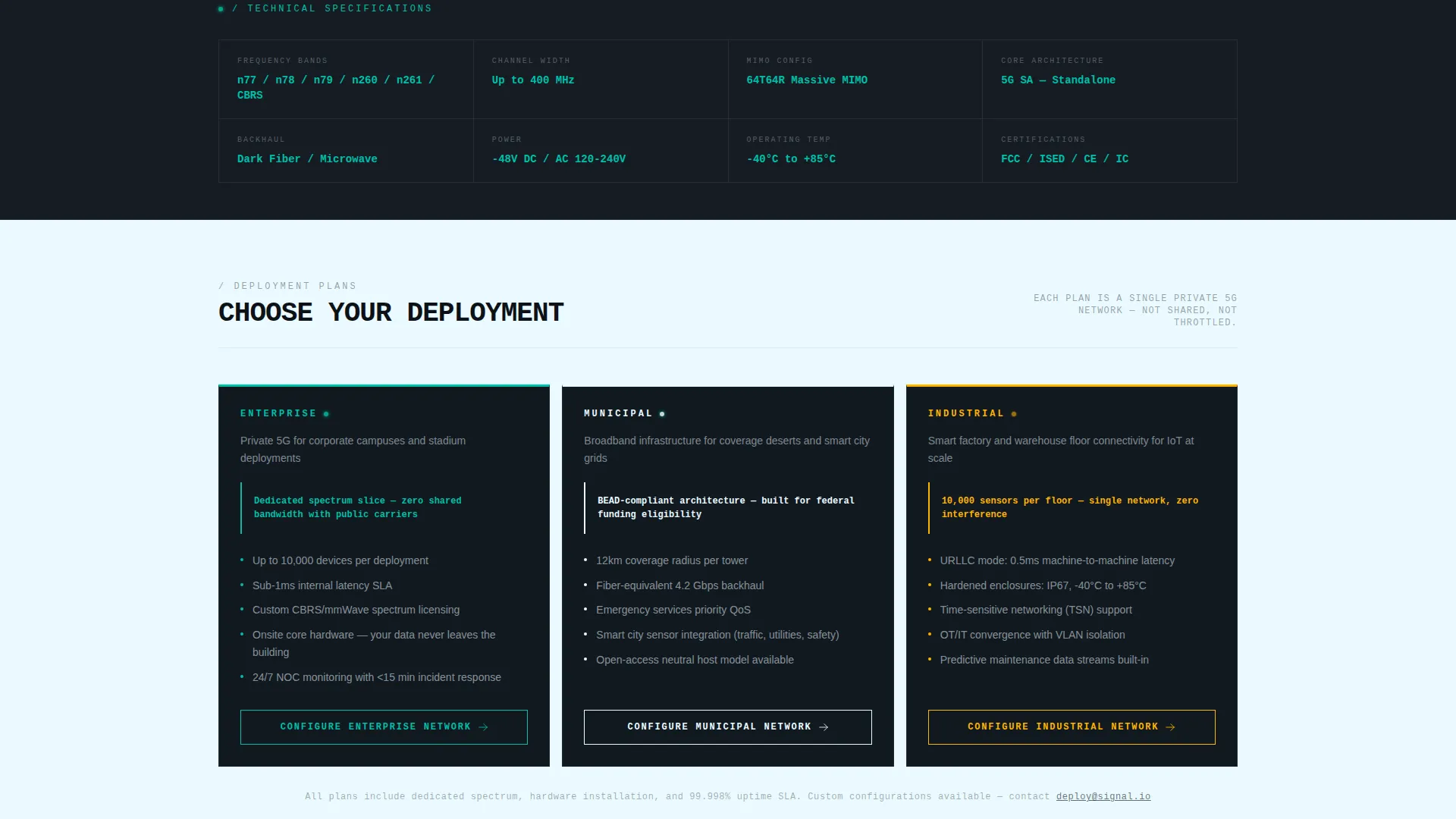
- Three deployment plan tiles covering enterprise, municipal, and industrial configurations
- A persistent amber call-to-action button anchored to the viewport bottom
- A secondary in-tile text link for visitors still in the research phase
Feature list
Signal delivers a focused set of designed capabilities that map directly to how technical buyers evaluate a network provider.
Scrolling Enterprise Logo Bar
A horizontal strip of client logos scrolls at a slow, mechanical pace across a deep network black background. Logos render in flat signal white. The motion feels deliberate, not decorative, reinforcing institutional credibility before a word is read.
120-Pixel Monospace Stat Block
A single performance figure, "4.2 Gbps average downlink," sits in 120-pixel monospace type directly beneath the logo bar. No surrounding copy competes with it. The number carries the argument on its own.
Asymmetric Capability Tile Grid
The bento grid breaks into tiles of varying widths and heights. Each tile holds one metric in oversized teal type, a one-line plain-language translation, and an amber progress bar benchmarked against 4G LTE. Covered capabilities include latency, throughput, device density, coverage radius, uptime service level agreement, and spectrum bands.
Staggered Scroll Animation
As the visitor scrolls, tiles animate into view like diagnostic readouts powering on one by one. The stagger creates a sense of a live system initializing, reinforcing the infrastructure tone without adding any decorative illustration.
Deployment Plan Tiles
Three distinct tiles near the bottom of the grid represent enterprise, municipal, and industrial plans. Each tile carries a single differentiating detail so buyers can self-identify their fit at a glance before clicking through.
Persistent Amber Call-to-Action Button
The primary "Design Your Network" button stays anchored to the bottom of the viewport throughout the entire scroll. It uses warning amber to stand apart from the teal and black palette, ensuring it is visible at every point in the buyer journey.
Page sections overview
| Section | Purpose |
|---|---|
| Logo Bar Strip | Establish enterprise credibility through client logos |
| Stat Hero Block | Lead with one dominant downlink performance figure |
| Capability Tile Grid | Present each network metric as a standalone proof tile |
| Coverage Radius Tile | Offer a secondary research link for map downloads |
| Deployment Plan Tiles | Differentiate enterprise, municipal, and industrial plans |
| Persistent call to action Button | Keep the primary conversion action visible at all times |
Design & branding system
The visual identity follows a Bold Brutalist theme built on the Teal Catalyst color system. Every decision prioritizes function and data legibility over decoration.
- Core palette: deep network black (#0D1117) for primary backgrounds, reactor teal (#00BFA6) for metric values and status indicators, signal white (#EAFAFF) for panel backgrounds and body type, and warning amber (#FFB300) reserved strictly for call-to-action elements and progress bar highlights
- Typography is oversized and left-aligned throughout, with monospace fonts applied wherever data or metrics appear, and no curved or script typefaces used anywhere in the layout
- Backgrounds alternate between #0D1117 slabs and #EAFAFFF panels, creating a rhythm that feels like a lit server rack viewed in a dark network operations center room
Mobile & speed optimization
The bento grid layout is structured to reflow clearly across viewport sizes. Asymmetric tiles that span multiple columns on desktop are designed to stack in a readable single-column order on smaller screens.
- Tile stagger animations are lightweight and tied to scroll position, keeping motion purposeful rather than resource-heavy
- The persistent viewport-anchored call-to-action button remains accessible on mobile without covering critical content
- Monospace stat typography scales down proportionally so the dominant figure remains impactful without overflowing narrow screens
How this template helps you convert
Signal is designed around a single conversion principle: remove every reason to leave before clicking. The layout stacks proof, then presents the action.
- The logo bar and 120-pixel stat block establish credibility in the first viewport, so buyers arrive at the tile grid already persuaded of the provider's scale
- Each capability tile adds one more confirmed proof point in sequence, building cumulative confidence tile by tile until the only remaining question is which deployment plan fits
- The persistent amber button stays in view throughout the entire scroll, while the secondary "Download Coverage Map" link inside the coverage tile captures research-mode visitors who are not yet ready to configure
Other information about this template
Signal fits naturally within a broader marketing stack for network infrastructure brands. A few additional details worth noting before you build.
- The template is category-matched to the Telecom and Connectivity space, specifically the Mobile and Network Operator subcategory, with a niche focus on 5G network providers
- The bento grid layout style allows individual tiles to be resized or reordered to prioritize the metrics most relevant to a specific deployment audience
- The amber progress bars inside capability tiles use a visual comparison against 4G Long-Term Evolution standards, giving technical buyers a familiar benchmark without requiring explanatory copy
- The secondary "Download Coverage Map" text link is positioned inside the coverage radius tile, so it intercepts research-phase visitors at the exact moment they are evaluating reach
- The template style, theme, and color system were selected through an intersection match with verified telecom and connectivity niche requirements, producing a Bento Grid layout with a Bold Brutalist theme and Teal Catalyst palette
Theme
Bold Brutalist
Creative direction
Feature Matrix
Color system
Teal Catalyst
Style
Bento Grid
Direction
Click-Through
Page Sections
Scrolling Enterprise Logo Bar
Pixel Monospace Stat Block
Asymmetric Capability Tile Grid
Staggered Scroll Tile Animation
Deployment Plan Tiles
Persistent Viewport-anchored Call to Action Button
Related questions
Who is the primary audience for this landing page template?
Can I update the metrics shown in the capability tiles?
What makes a bento grid layout effective for a network provider page?
Does the template handle two different visitor intents?
Is Bold Brutalist design appropriate for enterprise sales contexts?