Signal - Precision Pharmacovigilance Regulatory Submission Landing Page Template
Signal - Precision Pharmacovigilance Regulatory Submission Landing Page Template
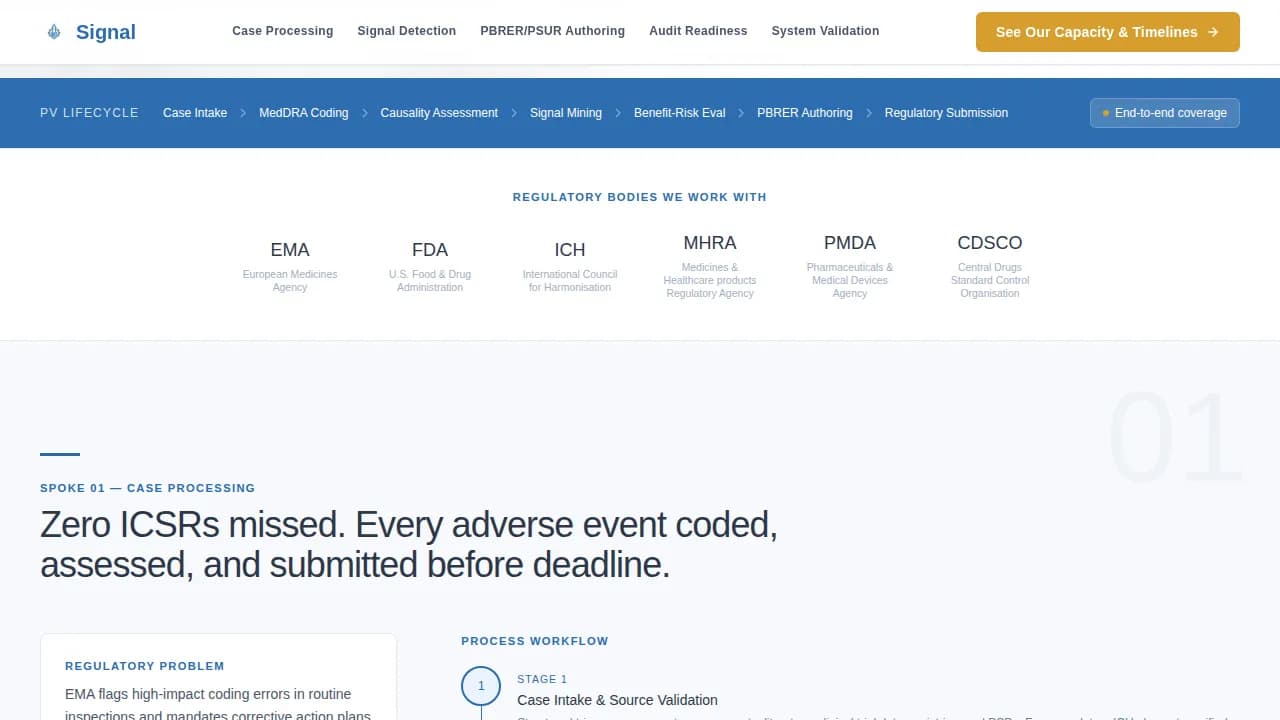
Signal is a hub-and-spoke landing page template built for pharmacovigilance service teams. It guides VP-level drug safety officers through five structured service spokes, Case Processing, Signal Detection, PBRER/PSUR Authoring, Audit Readiness, and System Validation, using a sequential, scroll-driven layout that mirrors the actual regulatory submission lifecycle from adverse event intake to final report delivery.
by Rocket studio
Loading preview…
Quick Summary
Signal is a precision-built landing page template for pharmacovigilance service providers. It presents five core service spokes through a sequential, anchor-nav scroll that mirrors the real workflow: from case intake and signal detection to periodic safety update report authoring and audit readiness. Every section is organized to build regulatory credibility and move qualified prospects toward a single, confident click.
Who This Template Is For
This template is designed for specialist pharmacovigilance teams that serve pharmaceutical companies and biotech firms on an outsourced basis. It speaks directly to the buyers who evaluate these teams: VP-level drug safety officers and regulatory affairs directors who need evidence of systematic capability before they commit.
Safety consultancies and contract research organizations handling post-market adverse events and regulatory submission cycles
Pharmacovigilance service providers who need to demonstrate structured methodology to risk-averse, deadline-driven stakeholders
PV teams positioning themselves as full-lifecycle partners, from individual case safety report processing through signal detection and periodic report authoring
What Problem This Template Solves
Most pharmacovigilance service pages read like capability lists. They do not show process. Buyers evaluating outsourcing partners need more than credentials, they need to see that every task in the regulatory lifecycle is systematized, traceable, and deadline-proof. This template solves that credibility gap.
Drug safety officers arrive under pressure: post-market report volumes are high, regulatory deadlines are fixed, and the risk of a missed submission is severe
Generic service pages fail to address specific concerns around coding accuracy, signal validation methodology, and evidence of compliance oversight
Without a clear structure, even qualified teams lose prospects who cannot quickly assess whether the organization can handle their volume and timelines
What You Get With This Template
The template delivers a fully structured, single-page hub-and-spoke layout with an anchor navigation system connecting five service spokes. Each spoke follows the same pattern: state the regulatory problem, present the methodology, and close with a call to action. The result is a page that reads like a validated standard operating procedure.
Theme
Corporate Precision
Creative direction
Step-by-Step Guide
Color system
Arctic White
Direction
Click-Through
Page Sections
Sequential Anchor Navigation System
Problem-then-methodology Spoke Structure
Compliance Metrics Display Blocks
Dual Call-to-action Architecture
Corporate Precision Visual System
Desktop-first Scroll Reveal Layout
Related questions
What is the rule of 3 in pharmacovigilance?
What are the regulatory requirements for pharmacovigilance?
How is signal detection carried out in pharmacovigilance?
What is RSI in pharmacovigilance?
Who should use this landing page template?
A cinematic split-header section with a headline, single-line descriptor, and visible anchor nav listing all five service spokes
Five sequentially ordered spoke sections covering Case Processing, Signal Detection, PBRER/PSUR Authoring, Audit Readiness, and System Validation
An amber call-to-action button at the header, repeated at the close of each spoke, and a persistent bottom bar on mobile for continuous conversion access
Feature List
This template is purpose-built around the pharmacovigilance regulatory submission lifecycle. Each feature reflects a deliberate design decision rooted in how VP-level safety officers evaluate service partners.
Sequential Anchor Navigation System
The page uses a hub-and-spoke anchor nav that lists all five service spokes in the header. As users scroll, the active spoke is highlighted. This gives buyers immediate context and lets them jump to the section most relevant to their current regulatory task, whether that is signal detection workflow or audit readiness evidence.
Problem-Then-Methodology Spoke Structure
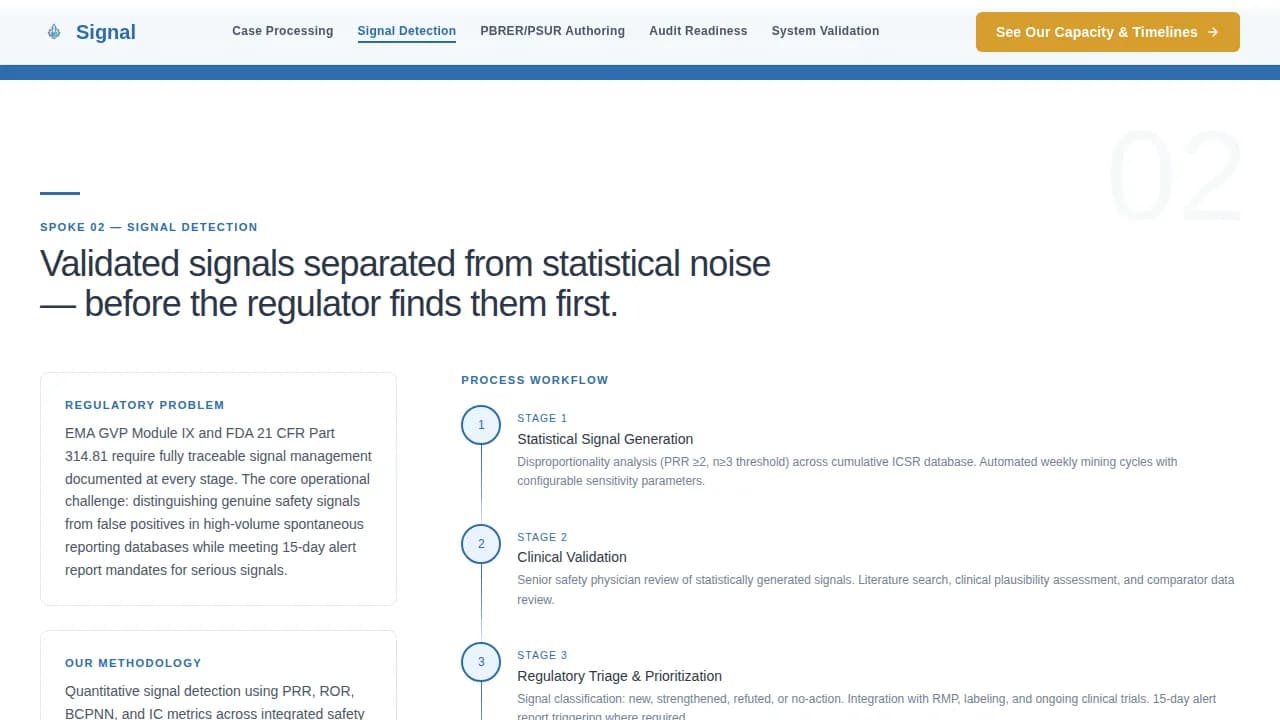
Each spoke section opens with the specific regulatory problem it solves, missed timelines, inconsistent MedDRA coding, under-detected safety signals, before presenting the structured approach that eliminates it. This pattern mirrors how drug safety officers assess risk: identify the failure mode first, then evaluate the solution. It keeps the assessment process on the page rather than in a follow-up call.
Compliance Metrics and Process Indicators
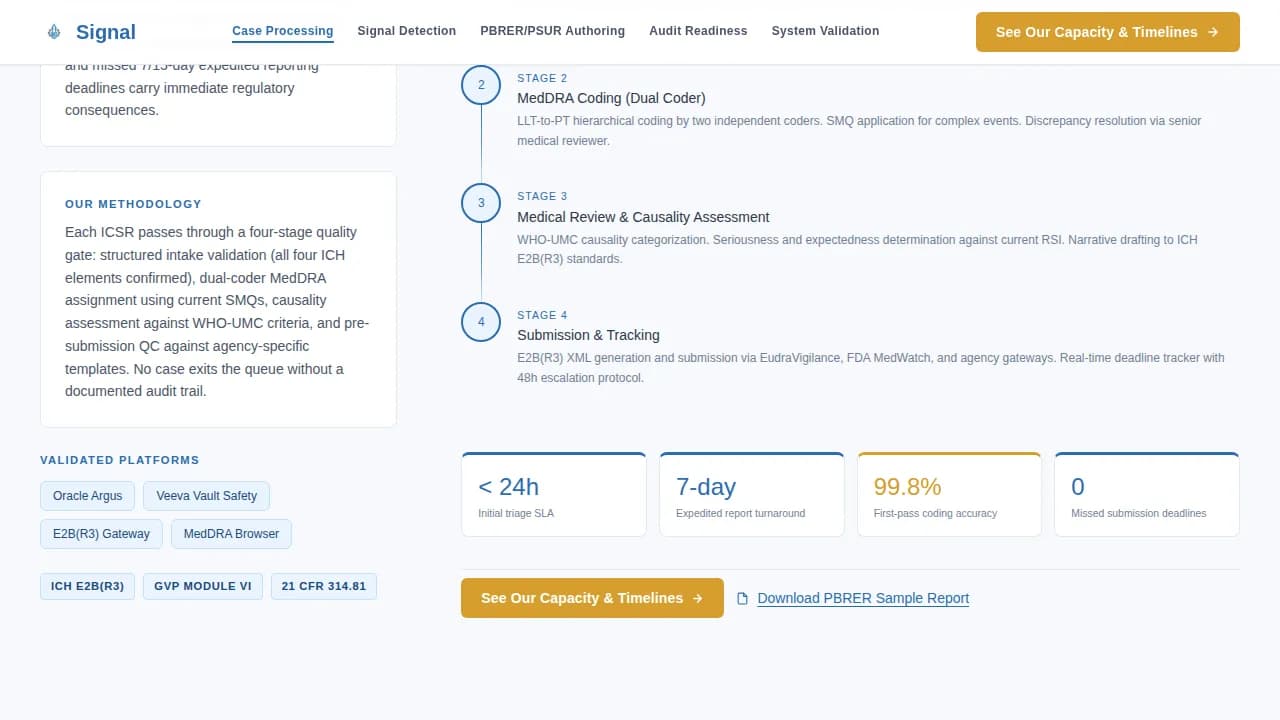
The template includes dedicated space within each spoke for compliance metrics, process diagrams, and precision indicators. For example, the PBRER/PSUR Authoring spoke can display timeline adherence data and ICH E2C(R2) alignment evidence. These data callouts are styled in alert amber so they draw the eye without cluttering the clinical layout.
Dual Call-to-Action Architecture
The primary call to action, styled in amber, appears at the header, at the close of every spoke section, and as a persistent mobile bar. A secondary text link for downloading a sample PBRER report captures high-intent prospects who want to evaluate deliverable quality before any conversation. Both actions route to the same capabilities page with pricing tiers, team credentials, and a scheduling calendar.
Corporate Precision Visual System
The Arctic White color system uses clinical white backgrounds, instrument-panel gray for body text, and sterile blue for headings and navigation anchors. Amber is reserved exclusively for calls to action and critical data callouts. This palette communicates the aesthetic of a validated electronic system, color is never decorative, always functional.
Desktop-First Layout with Scroll Reveal Behavior
The template is optimized for desktop workstation use, reflecting the reality that VP-level buyers review vendor pages on large screens during due diligence. Low-to-medium scroll reveal animations surface each spoke section progressively. Anchor smooth scroll and active-state nav tracking reinforce the sense of walking through a validated, step-by-step guide.
Page Sections Overview
Section
Purpose
Hero Header
Introduces the service and anchor nav
Case Processing
Covers ICSR intake and MedDRA coding
Signal Detection
Presents statistical methods and workflow
PBRER/PSUR Authoring
Shows timeline compliance and ICH process
Audit Readiness
Details QC checklists and deficiency prevention
System Validation
Demonstrates validated system credentials
Footer Bar
Provides linear single-row closing links
Design & Branding System
The visual identity follows a Corporate Precision theme that communicates the aesthetic of a validated electronic system. Every color choice is functional. The palette is designed to feel like the interface of a system where every pixel is audit-trailed and every action is documented.
Arctic White color system: clinical white (#F7F9FC) backgrounds, instrument-panel gray (#4A5568) for body text and dividers, sterile blue (#2B6CB0) for headings and navigation anchors, and alert amber (#D69E2E) reserved strictly for calls to action and critical data callouts
Typography uses Plus Jakarta Sans for headings and DM Sans for body copy, both clinical, precise typefaces that reinforce the validated-system aesthetic without sacrificing readability
Generous negative space dominates every section, keeping the layout uncluttered and allowing compliance metrics, process indicators, and trust signals to stand out clearly
Mobile & Speed Optimization
Although the template is desktop-first by design, reflecting VP-level buyers who review vendor pages on workstations, mobile experience is addressed with specific layout decisions that protect the conversion path on smaller screens.
A persistent bottom bar on mobile carries the primary amber call to action at all times, so the click is never more than a thumb away regardless of scroll position
Scroll reveal animations are kept at low-to-medium intensity, with minimal JavaScript used only for smooth anchor scroll and active nav state tracking
Server components handle all static content sections, keeping the interactive layer thin and the overall page responsive across device classes
How This Template Helps You Convert
This template is engineered for a single conversion goal: getting a qualified drug safety officer to click through to the capabilities page. There is no form on the page. The entire layout is built to generate enough regulatory credibility that the click feels like due diligence, not a gamble.
The anchor nav and spoke structure let buyers self-qualify by jumping to the service area most relevant to their current risk, signal detection, periodic report authoring, or audit preparation, and each spoke closes with a direct call to action before momentum fades
The dual call-to-action architecture addresses two buyer readiness levels: the primary amber button routes to a detailed capabilities page with team credentials and a scheduling calendar, while the secondary PBRER sample report download captures prospects who need to assess deliverable quality before speaking to anyone
Other Information About This Template
This template is suited to any organization that needs to present a full pharmacovigilance lifecycle to a sophisticated, deadline-driven audience. It is relevant not only for dedicated PV consultancies but also for contract research organizations and healthcare providers involved in post-marketing surveillance who rely on structured, audit-ready deliverables.
The signal precision pharmacovigilance regulatory submission landing page template is built around the principle that regulatory submissions are time-bound evidence packages. Every page section is organized to mirror the standard signal management lifecycle: Detection, Validation, Assessment. This mirrors GVP Module IX requirements for documenting signal management steps and aligns with ICH/regulatory formats that agency reviewers expect.
The template supports coverage of key submission components, including unique reference numbers such as the EPITT number used by the EMA, MedDRA-coded Safety Topic Identifiers, and Date of Detection and Validation fields, by providing structured content blocks where this information can be presented clearly and traceably.
AI-powered tools are increasingly used by modern pharmacovigilance systems to streamline safety data integration and automate signal detection tasks. This template is designed to accommodate that context: service providers using AI-driven tools can present their technology stack and speed advantages within the existing spoke structure without disrupting the validated-system aesthetic.
The template supports training content blocks within relevant spokes, allowing teams to communicate staff qualification and process training as part of their audit readiness evidence
Findings from disproportionality analysis and Bayesian data mining can be presented within the Signal Detection spoke using the built-in compliance metrics display blocks
The footer follows a linear single-row pattern, keeping the closing section clean and aligned with the clinical precision of the overall layout
An RMP update workflow and labeling review cadence can be referenced within the Audit Readiness spoke, supporting the full benefit-risk oversight narrative that regulatory agencies and internal stakeholders expect