ADHD Care Education Website Template
Calibrate is a zigzag landing page template built for ADHD patient education platforms. It translates the overwhelm of a new diagnosis into a calm, structured scroll experience. Credential badges, alternating step sections, medication comparison layouts, and a clear "Start Your Learning Plan" call to action give every visitor, adult, parent, or HR manager, an immediate sense of direction.
by Rocket studio
Quick Summary
Calibrate is a single-page, zigzag landing page template for ADHD education platforms. It pairs clinical authority with a warm, structured design so newly diagnosed adults, parents of children with ADHD, and HR professionals can move from confusion to action in one focused scroll. Every section earns the next click.
Who This Template Is For
This template is built for health and medical teams running an ADHD patient education platform. It fits anyone who needs to communicate complex ADHD information clearly and earn trust fast.
- Newly diagnosed adults seeking clarity after a psychiatrist appointment
- Parents of children or a teenager recently referred by a pediatrician
- HR managers researching workplace adjustments for a team member who just disclosed an ADHD diagnosis
What Problem This Template Solves
A diagnosis day is overwhelming. Most people leave a psychiatrist's office without a clear plan for what to do next. This template gives ADHD education platforms a structured, calm page that reduces cognitive load, avoids sensory overload, and moves visitors toward action without adding stress.
- No clear path forward after diagnosis, leaving adults and parents lost
- Difficulty communicating medication options, treatment plans, and strategies in plain language
- Low conversion rate on education pages that feel cluttered or intimidating
What You Get With This Template
You get a fully structured, mobile-first landing page with five numbered step sections, a credential badge header, and two conversion touchpoints. The layout is ready to tailor with your own content and branding.
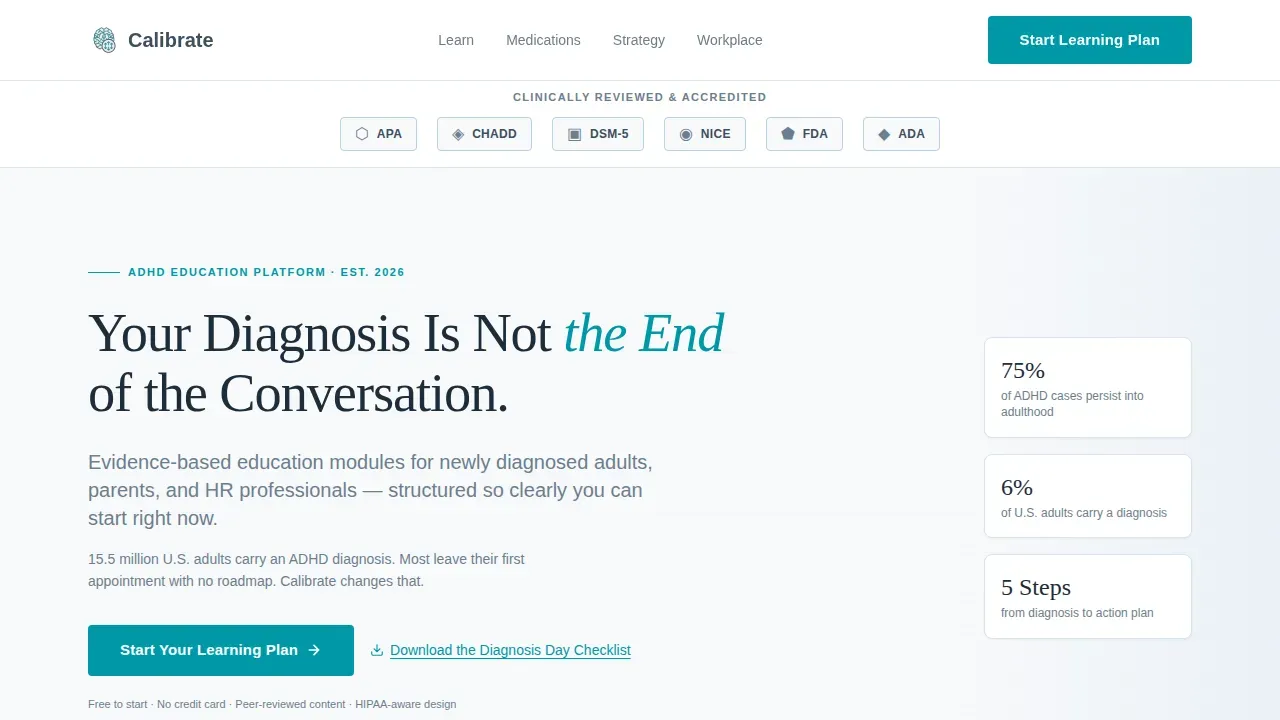
- A hero section with a credential badge band, headline, and primary call-to-action button
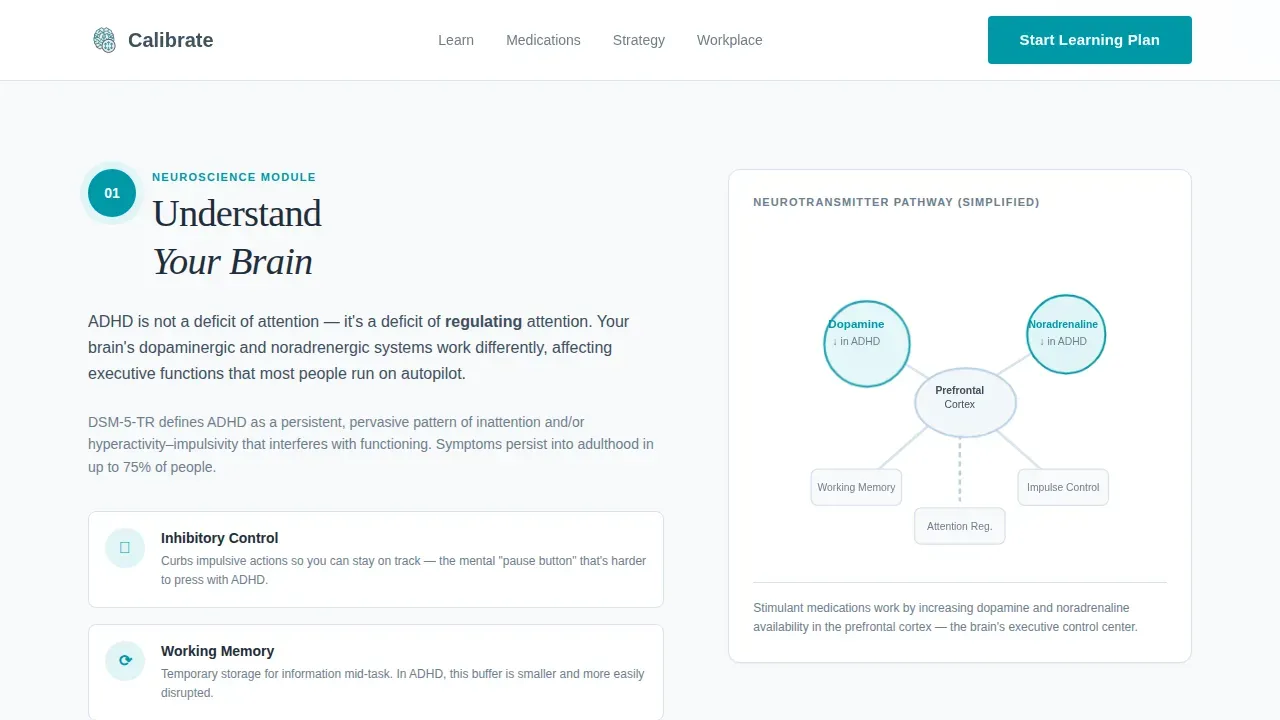
- Five alternating zigzag content sections covering brain education, medication options, coping strategies, digital tools, and workplace accommodations
- A linear single-row footer and a secondary "Download the Diagnosis Day Checklist" text link
Feature List
This template provides a set of purpose-built components. Each one is designed to reduce friction and build trust at every step of the scroll.
Credential Badge Header Band
The header opens with a horizontal row of clinical accreditation seals, peer-review icons, and medical advisory board credentials. Badges render in monochrome graphite with frost-blue borders. Each badge includes a micro-tooltip so visitors can review the credential detail on hover, providing immediate proof of authority before reading a single line of body text.
Zigzag Step Sections
Five numbered sections alternate left and right down the page. Step badges in signal teal anchor each column, creating a visible trail of progress. The sequence moves from passive learning to active planning, from understanding ADHD symptoms and neurotransmitter effects to building a personal strategy, so visitors feel progressively more capable with every scroll.
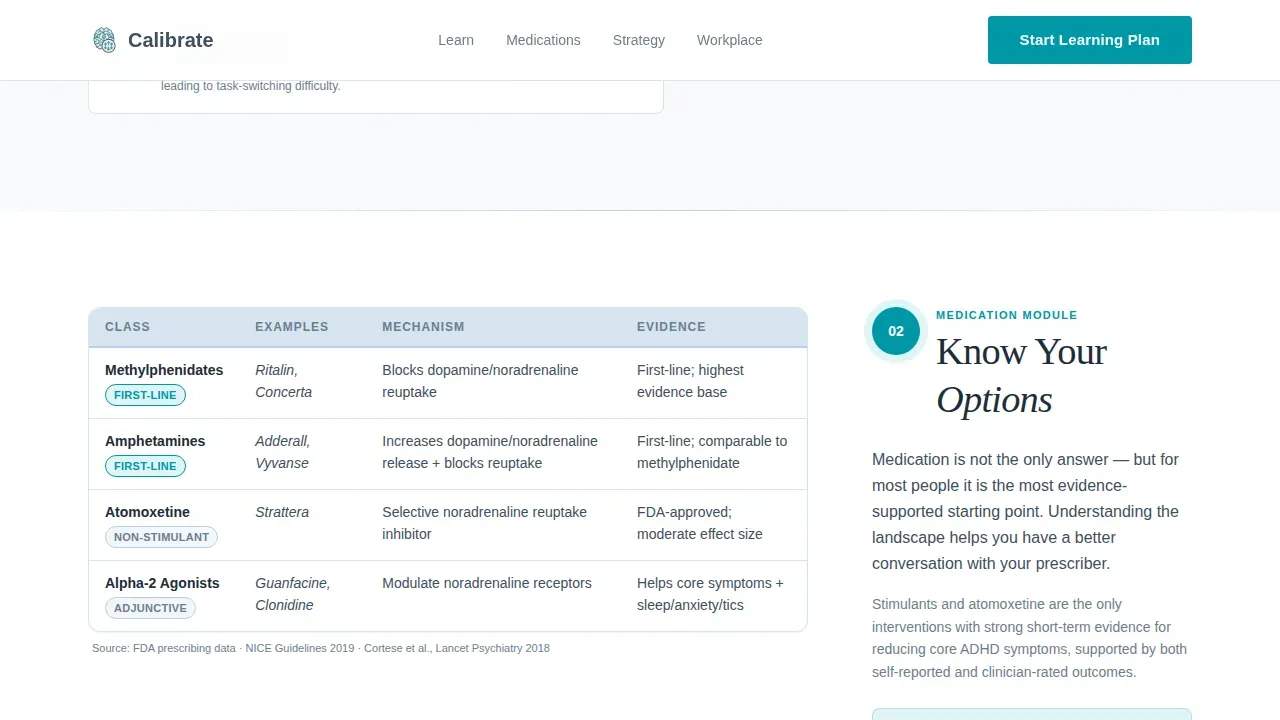
Medication Comparison Table
Step 2 includes a clean comparison table for medication classes. It helps visitors understand key differences in effects, frequency, and morning versus evening dosing without relying on clinical jargon. This layout supports informed conversations with a psychiatrist and encourages medication adherence by reducing confusion about options.
Combined Bento for Tools and Workplace Accommodations
Steps 4 and 5 share a combined bento layout covering digital tools and workplace accommodation templates. This section helps HR managers and adults understand reasonable adjustments, record relevant data, and identify what documentation they may need to provide to an employer.
Dual Call-to-Action Architecture
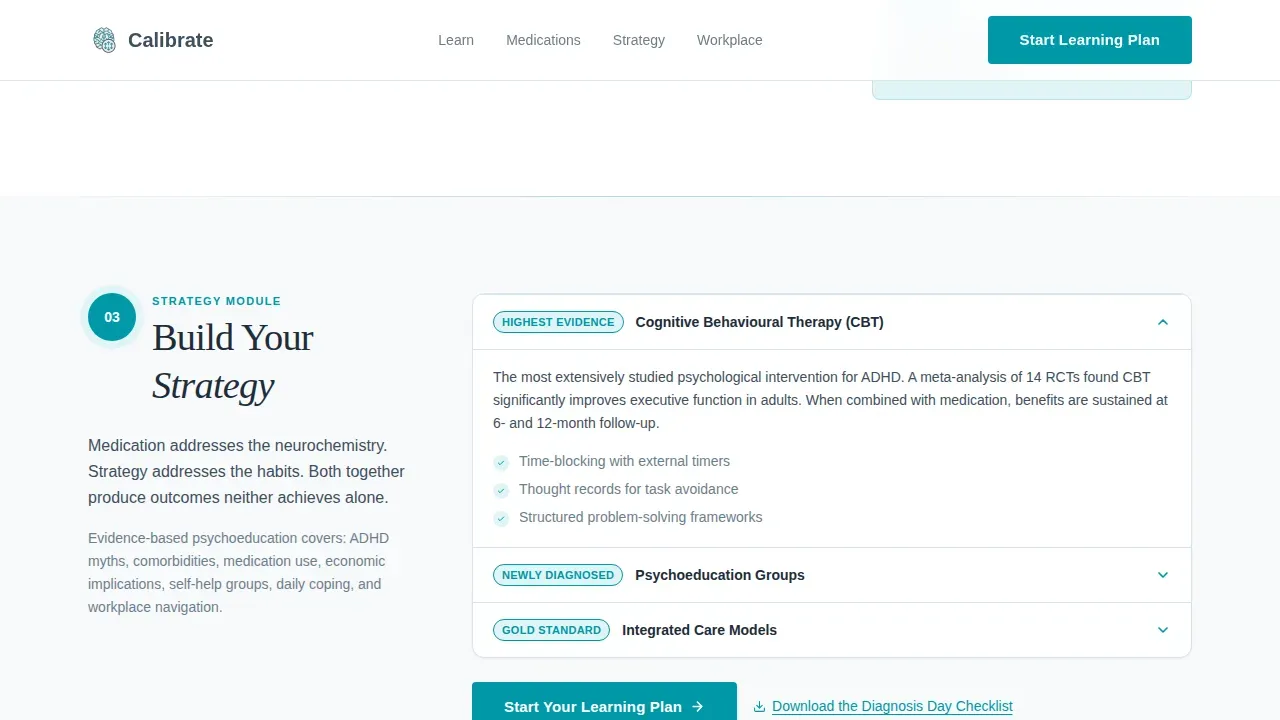
The primary call to action, "Start Your Learning Plan," appears beneath the badge header and repeats at the end of every third step. A secondary text link offers immediate value through a downloadable checklist. Both actions use precise, descriptive language to ensure visitors always know what happens next.
Scroll-Triggered Animation System
Section reveals are triggered on scroll. Badge entrance is staggered. Teal interactive elements use subtle hover states. The animation rate is kept at a medium level to avoid distraction, reflecting best practice for neurodiverse users who benefit from calm, predictable motion.
Page Sections Overview
| Section | Purpose |
|---|---|
| Hero Badge Band | Open with credentials and primary call to action |
| Step 1 Left | Explain brain and ADHD symptoms |
| Step 2 Right | Compare medication classes and effects |
| Step 3 Left | Introduce CBT and coping strategies |
| Step 4 Right | Present digital tools and progress tracking |
| Step 5 Left | Cover workplace accommodation templates |
| Footer Single Row | Close with navigation and secondary links |
Design & Branding System
The visual identity follows a Corporate Precision theme inspired by Scandinavian medical environments. The palette uses a muted Arctic White color system that reduces sensory overload and keeps attention on content. High contrast between text and background ensures readability at every scroll state.
- Clinical white (#F8F9FB) dominates all backgrounds; cool graphite (#3D4F5F) carries all body text at high contrast
- Pale frost blue (#D6E4F0) separates sections like faint ruled lines, while signal teal (#0097A7) appears only on interactive elements and progress indicators
- DM Sans is used for body and interface text; Fraunces display serif adds warmth to headlines without sacrificing legibility
Mobile & Speed Optimization
This template is built mobile-first because primary users are likely on their phones in a parking lot or waiting room. Layout, space, and tap targets are all optimized for small screens. Static content uses server components to minimize the JavaScript needed at load time.
- Zigzag sections reflow cleanly to a single-column layout on mobile, keeping the step-by-step order intact
- Scroll-triggered reveals and staggered badge animations are kept lightweight to maintain a smooth experience on mid-range devices
How This Template Helps You Convert
Structured patient education is essential for effective ADHD management, and this template earns each conversion by demonstrating expertise before asking for anything. By the time a visitor reaches the final call to action, clicking feels like turning to the next page they have already started reading.
- The credential badge band at the top establishes authority in the first second, so visitors in a high-stress situation trust the platform immediately.
- Each numbered step increases the visitor's sense of ability and agency, moving from understanding ADHD symptoms to building a personal plan, which makes the "Start Your Learning Plan" button feel like a natural next step rather than a commitment.
Other Information About This Template
This template is well-suited to platforms that also need clinical-facing components. Note that the Calibrate structured ADHD patient education landing page template is a front-end design resource, not a clinical software system. The built-in layouts can support documentation workflows, assessment record keeping, and symptom tracker frameworks when populated with your own content.
- The assessment and diagnosis section layouts reference the nature and structure of tools like an ADHD Diagnosis and Assessment template, which aids in documenting ADHD symptoms and adherence to clinical guidelines
- The symptom tracker section layout can support regular entries that help identify patterns, triggers, and trends in ADHD behavior over time, making it easier to collaborate with healthcare providers on treatment plans
- Allowing users to customize settings such as font size enhances accessibility; the template's settings are straightforward to adjust in code
- Downloading the secondary checklist PDF provides an immediate-value entry point with a low-commitment score for new visitors
- The template can support parents of children and a teenager navigating a new diagnosis, students managing academic tasks, and adults learning strategies for managing ADHD at work
- Plain language throughout avoids complex medical jargon, and the reassuring tone validates each visitor's experience from the first line of the page
Theme
Corporate Precision
Creative direction
Step-by-Step Guide
Color system
Arctic White
Direction
Click-Through
Page Sections
Credential Badge Header Band
Zigzag Numbered Step Sections
Medication Comparison Table
Dual Call-to-action Architecture
Combined Bento for Tools and Accommodations
Scroll-triggered Animation System
Related questions
Who is this landing page template designed for?
Does this template include a form or sign-up field?
Can I adapt the step sections for my own ADHD education content?
How does the template handle users who may be easily distracted?
Is this template suitable for mobile users?