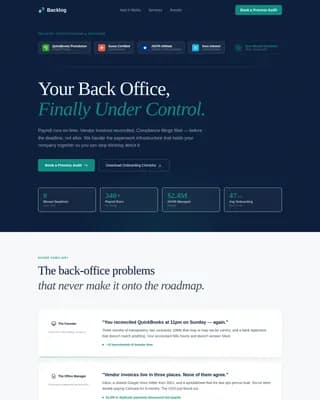
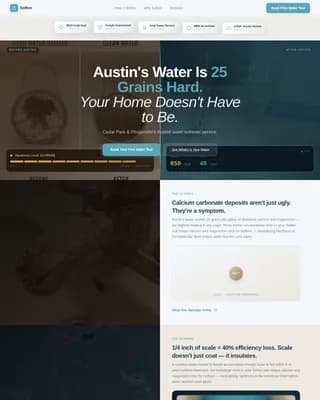
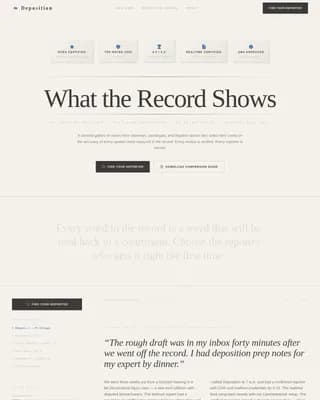
The Skim landing page template is built for plasterers and stucco contractors who need to earn trust fast. A fixed sidebar guides visitors through three escalating case studies, from a bedroom patch to a full exterior re-stucco to a historic plaster restoration. Stats, license badges, and client quotes do the convincing before the "Get Your Free Wall Assessment" button ever appears.
by Rocket studio
Loading preview…
Quick Summary
The Skim trusted plasterer stucco worker landing page template is a sidebar companion page designed for one-crew plastering and stucco operations. Three escalating case studies walk visitors from problem to process to result, building genuine trust before the call to action arrives. The Ink and Paper color system and Legal Shield visual theme make every element feel authoritative and document-precise.
Who This Template Is For
This template speaks directly to working plasterers and stucco contractors who rely on demonstrated results rather than flashy promises. It is purpose-built for operators who handle everything from a leaking ceiling patch to a whole house exterior re-stucco job. If your services span residential walls, commercial ceilings, or historic plaster restoration, this page positions you credibly for every scope.
Sole-operator plasterers and stucco contractors seeking more booked assessments
Property managers and general contractors who need a reliable sub on a tight timeline
Homeowners are often nervous about hiring contractors. They search online, land on a generic page, and leave before scrolling past the hero. The core problem is a trust gap: visitors cannot see your trowel work through a screen. This template closes that gap by walking prospects through real job documentation before asking them to book. Skim coating and plastering are inherently visual services, so the page leans on before-and-after evidence, client quotes, and visible license numbers to do the convincing.
No trust built before the call to action, so visitors bounce without booking
Competitors use generic pages with no case study evidence or plastering detail
This template delivers a fully structured, click-through landing page ready to connect to a booking calendar. There is no contact form on the page itself; the design pushes visitors toward a single, benefit-driven call to action after trust is already earned. Every section is crafted around the reality of a plastering and stucco job, from the damage photo to the smooth finish reveal.
Theme
Legal Shield
Creative direction
Case Study Narrative
Color system
Ink & Paper
Direction
Click-Through
Page Sections
Scrollable Sidebar with Active Section Tracking
Three Escalating Case Study Sections
Stats Metrics Hero Header
Per-section Benefit-driven Call to Action
Trust Badge Footer with License Documentation
Related questions
What trades and job scopes does this template cover?
How does the sidebar table of contents work?
How do I advertise my plastering business with this template?
What is the NOC code for stucco plasterer?
Can I customize the case study photos and client quotes?
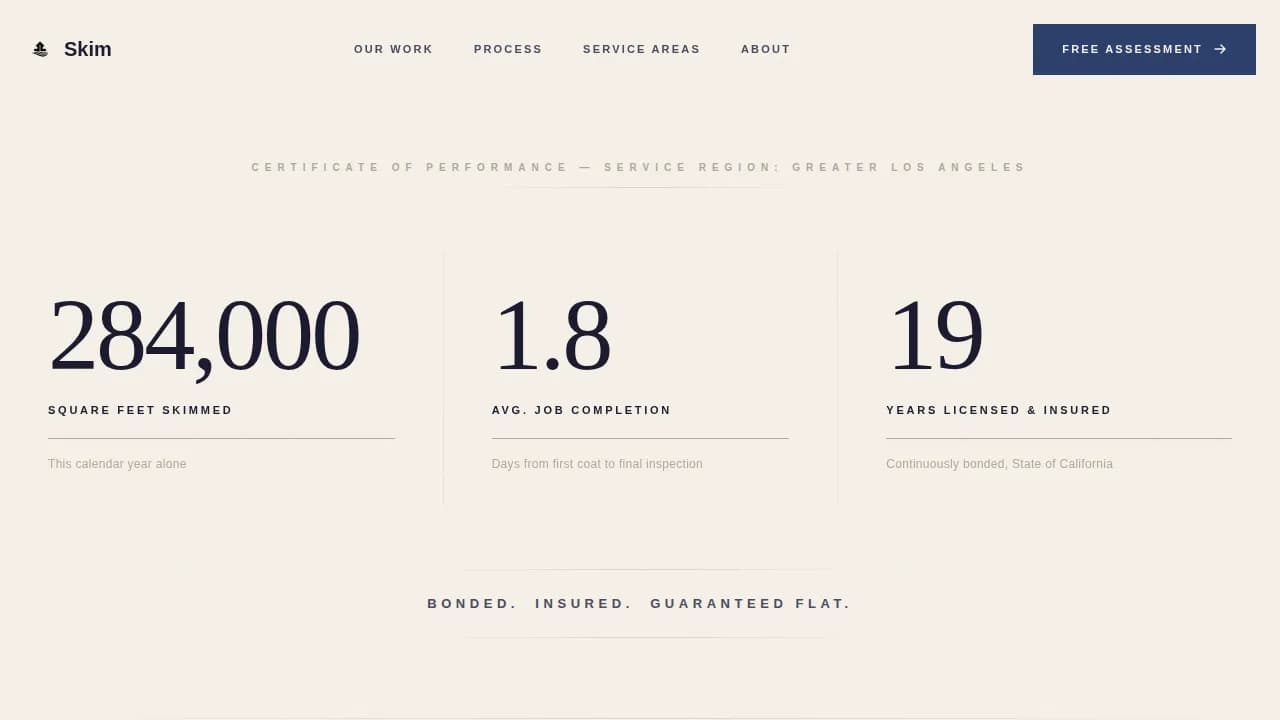
A Stats wall header with three oversized metrics: square feet skimmed, average job completion time, and years licensed and insured
Three sequential case study sections covering a bedroom patch, an exterior re-stucco, and a historic plaster restoration
A fixed sidebar table of contents that tracks scroll position and highlights the active case study section
Feature List
This template is built from prompt-defined sections and interaction patterns. Every feature below maps directly to the brief.
Scrollable Sidebar Table of Contents
The fixed sidebar holds a mini table of contents with three anchor links: The Problem, The Process, and The Result. As the visitor scrolls through each case study, the active section link highlights automatically. This keeps orientation clear across a long, evidence-heavy page and encourages visitors to read all three projects before clicking through.
Escalating Case Study Narrative
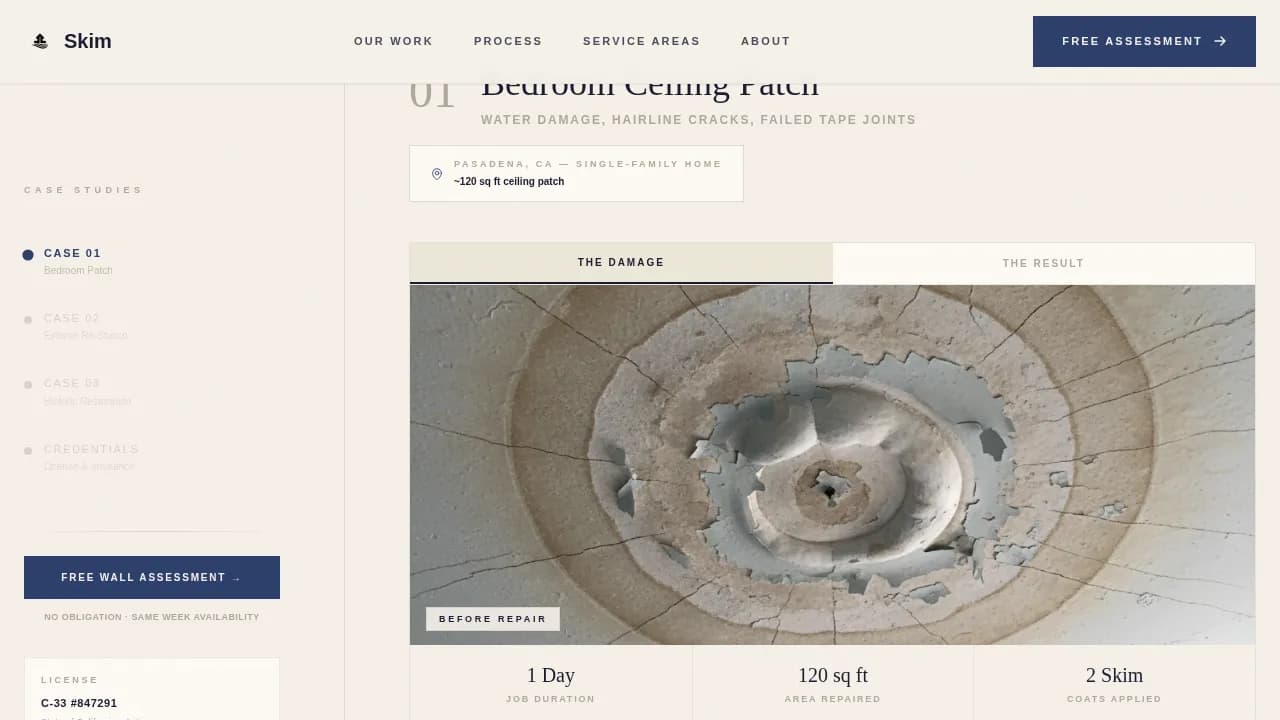
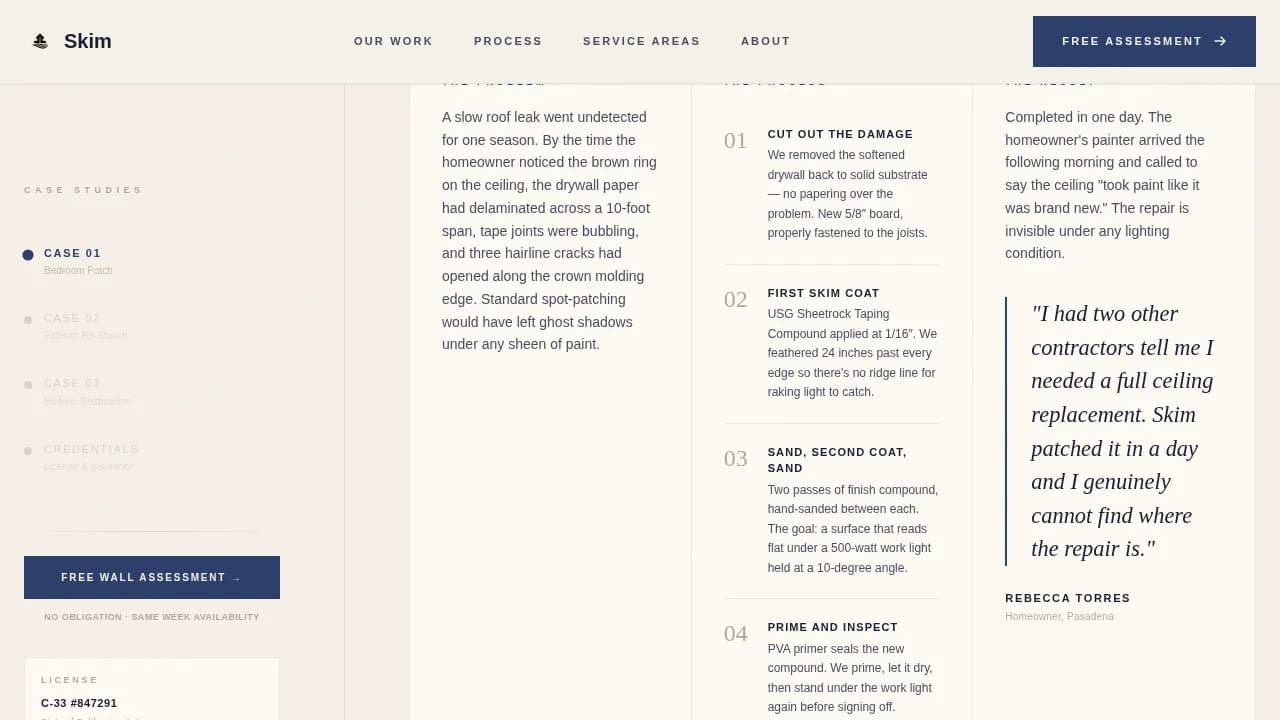
Three case studies are arranged in order of scope and stakes. Case Study One covers a small bedroom patch on drywall walls. Case Study Two walks through a full exterior stucco re-application, including lath inspection, surface preparation, mixing, and the final coat. Case Study Three handles a historic plaster restoration, where matching original texture and careful trowel technique make the big difference. Each case study opens with a damage photo, explains the repair process in plain language, and closes with the finished wall and a one-line client quote.
Stats Metrics Header
The hero section displays three oversized numbers set in contract black on parchment cream. Each figure reads like a stamped certificate: square feet of skim coating completed this year, average days to complete a job, and years the business has been licensed and insured. A single warranty-style tagline anchors the block below the numbers. This immediately signals credibility to homeowners and general contractors who need evidence before reading further.
Per-Case-Study Call to Action
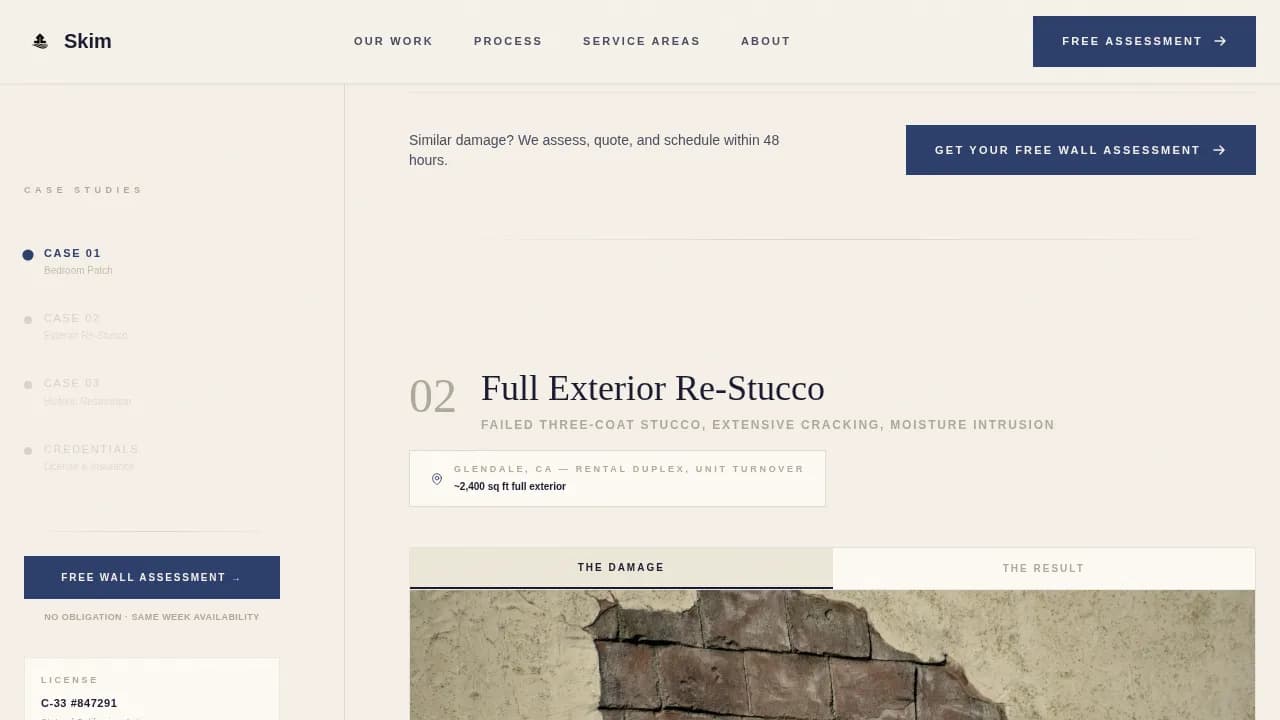
Each case study closes with a "Get Your Free Wall Assessment" button in notary-stamp navy. Repeating the call to action at the end of every project section means the visitor never has to scroll back to find it. By the third case study, the button feels like a natural next step rather than a sales push, because trust has already been built through visible documentation of real plastering work.
Trust Footer with License and Insurance Badges
The closing section of the page displays license numbers, insurance badges, and a final call to action. This trust footer verifies credentials in a format that mirrors professional documentation. Visitors who scroll all the way to the bottom are already engaged; the footer gives them the final confirmation they need to click through to the booking calendar.
Ink and Paper Legal Shield Design System
The visual identity uses a four-color palette applied with clear rules. Parchment dominates backgrounds. Contract black carries every headline. Ruled-line gray draws dividers between sections. Notary-stamp navy appears on every button and trust badge. The typography pairing of Fraunces for display text and DM Sans for body copy gives the page an authoritative but readable quality, like a signed work guarantee sitting on a clipboard.
Page Sections Overview
Section
Purpose
Stats Metrics Header
Display three oversized performance numbers and a warranty tagline
Case Study One
Bedroom drywall patch: problem, process, result, and call to action
Case Study Two
Full exterior stucco re-application with escalated scope and call to action
Case Study Three
Historic plaster restoration at peak trust level with call to action
Trust Badge Footer
License numbers, insurance badges, and final call to action
Developer Footer
Minimal pattern footer closing the page
Design & Branding System
The Ink and Paper color system gives this plastering landing page the feel of a legally binding document. Every color has a specific job, and no element breaks that assignment. The result is a page that reads as precise and controlled as the trowel work it represents.
Parchment cream (#F5F0E8) covers all backgrounds; contract black (#1A1A2E) carries headlines and body text; ruled-line gray (#B0A999) draws section dividers; notary-stamp navy (#2C3E6B) colors every button and badge
Fraunces serif handles all display headings for a document-weight authority; DM Sans handles all body copy for clear, comfortable reading
Scroll-linked animations include ruled-line draw effects on section entry and GSAP-powered reveals that match the careful, deliberate pace of professional plastering work
Mobile & Speed Optimization
The template is designed desktop-first to support the fixed sidebar layout. On smaller screens, the sidebar stacks above the case study content so mobile visitors still move through the same trust-building sequence. The page uses server components for all static content and client components only for scroll interactions, keeping the interactive load minimal.
Fixed sidebar collapses into a stacked table of contents on mobile, preserving navigation without blocking content
Hover states on case study cards and sticky call-to-action positioning remain functional across device sizes
Static content sections load as server components to keep the page responsive for homeowners searching on their phones
How This Template Helps You Convert
This landing page is engineered as a pure click-through. There is no form to fill out and no friction between reading and booking. The page earns the click through evidence, then delivers it at the right moment.
The Stats wall establishes instant authority: licensed years, square footage skimmed, and average job days give visitors concrete numbers before they read a single case study, which verifies your track record in the first scroll.
Each case study closes with a benefit-driven "Get Your Free Wall Assessment" button in notary-stamp navy, so customer satisfaction with the narrative naturally flows into action without requiring the visitor to hunt for next steps.
The trust footer places license documentation and insurance badges at the close of the page, ensuring handover readiness by giving hesitant visitors the final credential proof they need to commit to the booking calendar click.
Other Information About This Template
This section covers additional context, practical guidance, and supplemental detail about using this template effectively as a plastering and stucco contractor.
The skim trusted plasterer stucco worker landing page template is categorized under Professional Services and is tailored for the Plasterer and Stucco Worker Service Area Page niche. It pairs well with a short booking calendar page linked from each call to action button. Contractors can adapt the case study sections to their own renovation project portfolio, swapping in real photos of damage and completed walls for maximum visual impact.
Plastering invoices should be kept ready alongside the landing page. A plastering invoice should detail the scope of work, including specific tasks and materials used. Clear itemization helps with customer satisfaction after the job is done. Plastering invoice templates can be downloaded and edited in formats such as PDF, Word, and Excel, and they should include warranty terms and a job site address to avoid payment delays.
For contractors building their professional profile, a strong plasterer resume highlights hands-on skills and specific plastering techniques. Tailoring your resume for each position and quantifying your accomplishments with metrics both make a solid impression. Including specific projects you have worked on can give employers a clear picture of your capabilities.
This template supports the whole house plastering market as well as targeted small areas repairs, so the case study scope escalation is designed to match the range of jobs your business actually takes on
Skim coating is especially valuable after drywall repair or wallpaper removal, and the template's case study format naturally communicates that to homeowners who may not know what service they need
Lime plastering is more labor intensive than standard drywalling, and this template can support a section explaining that process: lime plaster is made from a mix of sand, lime, and water, it requires thin coats to cure properly, and it can be troweled to create various textures that drywall cannot replicate
The template is environmentally friendly in its design philosophy, using static server components to minimize unnecessary client-side processing
Using high-resolution hero shots of completed plastering projects as background images for each case study header attracts attention and provides the visual proof that stucco and plastering clients need before committing