Hobby & Passion Content Blog Website Template
Imprint is a cinematic dark landing page template built for rubber stamping blogs and craft communities. It pairs an asymmetric 60/40 grid with a scrapbook collage header, confessional origin-story scroll, and two clear calls to action. The result is a page that feels like a lived-in craft desk, earning every community click through storytelling rather than pressure.
by Rocket studio
Quick summary
Imprint is a single-page landing page template for handcrafted rubber stamping blogs. It uses an asymmetric 60/40 grid, a cinematic dark color system, and an origin-story scroll structure. Two calls to action guide visitors toward community membership or the blog archive. The design feels personal, textured, and emotionally specific.
Who this template is for
This template is built for creators who treat the rubber stamp as a serious expressive tool. It speaks directly to people who have ink on their fingers and a story to tell about how that happened.
- Journalers and card-makers who want a blog home that matches the intimacy of their craft
- Mixed-media artists ready to build a community around layered stamping technique
- Craft bloggers who want to earn a membership click through storytelling, not a discount popup
What problem this template solves
Most blog landing pages list features and hope for the best. A stamping blog carries something more personal: the smell of fresh ink, the satisfaction of a crisp impression on cream paper, and years of accumulated obsession. Generic layouts strip all of that away.
- Visitors land, feel nothing, and leave without clicking anything
- The blog's emotional depth gets buried under cluttered layouts with no clear visual hierarchy
- There is no path for the casual browser to stay engaged before committing to join
What you get with this template
You get a fully structured, emotionally sequenced landing page that scrolls the visitor backward through a founder's stamping journey. Every section pairs intimate craft photography with confessional narrative. The page earns its calls to action rather than demanding them.
- A collage-style hero header with rotated stamp fragments, washi tape layers, and a letterpress-style blog title
- An asymmetric 60/40 grid across origin, obsession, and community mosaic sections
- Two calls to action: a crimson text link woven into the story and a full-width button after the member card mosaic
Feature list
This section covers the core design and structural capabilities delivered by the template.
Collage Scrapbook Header
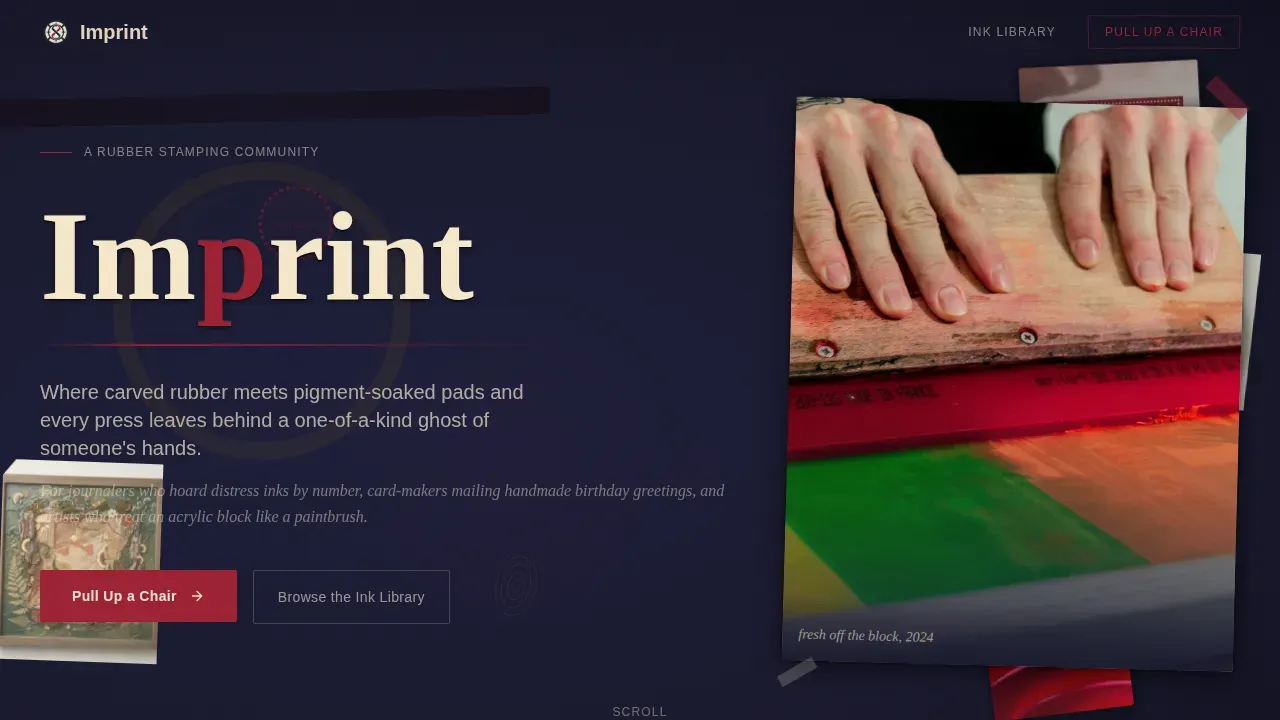
The hero fills the viewport with overlapping stamp impressions, torn paper textures, ink-stained detail, and handwritten script set at slight rotations. Nothing aligns on a grid. The blog title sits inside a heavy serif letterpress treatment against the deep lampblack background, so cream and crimson fragments glow like artifacts on a darkroom wall. The effect draws the eye the way a crowded craft desk does: with curiosity, not order.
Asymmetric 60/40 Origin Scroll
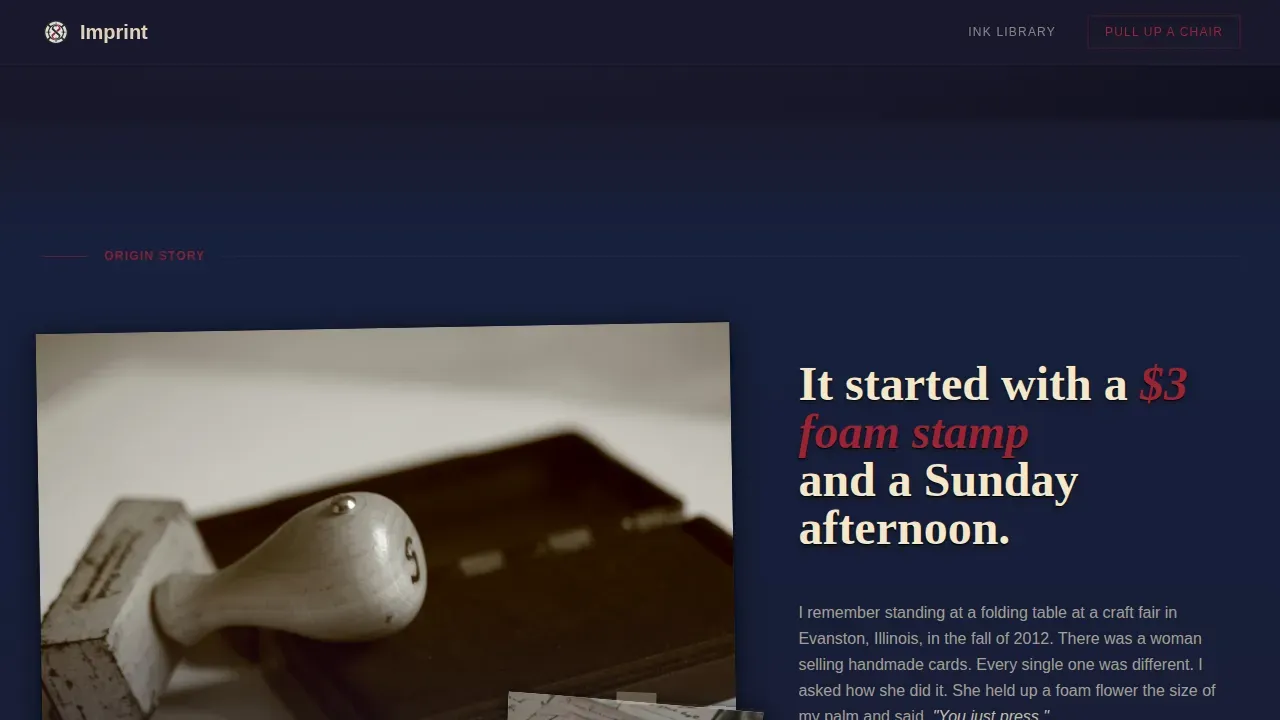
The main narrative sections use a 60-column image side paired with a 40-column text side. The wider column carries rich scans or photographs of actual stamped pieces. The narrower column carries short, confessional paragraphs. The layout reverses between sections so the scroll feels dynamic. This structure lets the story escalate emotionally, moving from technique to obsession to community belonging.
Dual Call-to-Action Architecture
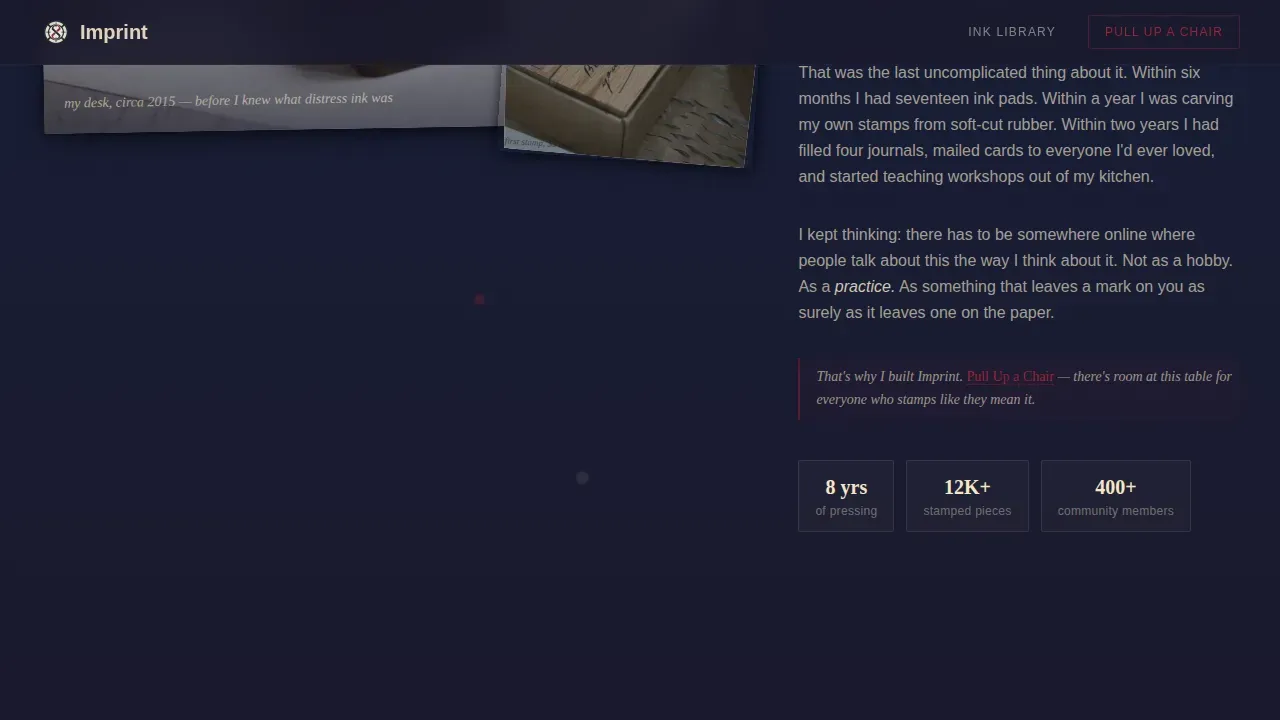
The primary call to action, "Pull Up a Chair," appears first as a subtle crimson text link at the story's emotional turning point. It reappears as a full-width button after the community mosaic section. A secondary path, "Browse the Ink Library," links to the blog archive for visitors who want to explore before committing. No form is required. The click is earned by belonging.
Community Member Card Mosaic
A grid of member-stamped cards provides social proof before the primary button appears. Seeing real work from real members makes the community feel lived-in and welcoming. This section builds trust the way a friend's craft desk does: through evidence of genuine, repeated creative practice.
High-Contrast Cinematic Dark Palette
The color system uses deep lampblack and smudged charcoal as backgrounds, with heavy cream cardstock tones for text and a single archival crimson reserved for links, buttons, and stamped motifs. The palette feels like a craft room lit by one pendant bulb at midnight: warm paper tones floating against velvety darkness.
CSS Animation and Scroll Interaction
The template includes CSS keyframe rotations, parallax layering, ink-smear hover effects, and staggered scroll reveals. Collage fragments react to cursor movement. Hover states produce stamp impression effects. All animations are GPU-accelerated so the visual richness does not fight the page's usability.
Page sections overview
| Section | Purpose |
|---|---|
| Hero Collage Header | Introduce the blog with a scrapbook-style stamp composition and the "Pull Up a Chair" crimson text link |
| Origin Story Section | Pair a large stamped-piece photograph with the founder's first stamp memory using the 60/40 grid |
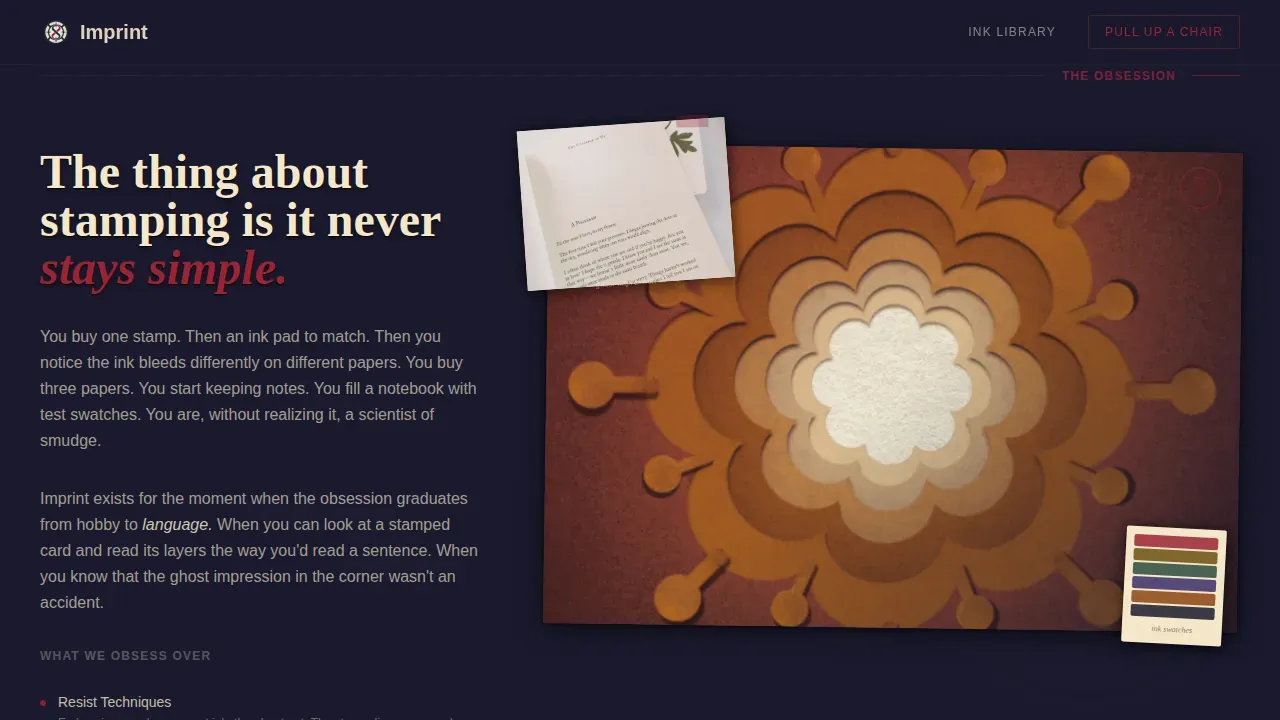
| Obsession Technique Section | Reverse the grid to showcase layered technique work alongside confessional narrative |
| Community Card Mosaic | Display member-stamped cards in a grid to build social proof before the primary button |
| Ink Library Path | Offer a secondary "Browse the Ink Library" call to action with a teaser of the blog archive |
| Footer Flow | Close with a horizontal footer pattern that keeps the page feeling cohesive |
Design & branding system
The visual identity follows an Ink and Paper theme expressed through a cinematic dark palette. Every color choice reinforces the craft-room atmosphere the blog's community already lives in.
- Lampblack (#1A1A2E) and smudged charcoal (#16213E) form the background layers; cream (#F5E6CA) carries body text and paper textures; archival crimson (#9B2335) marks every link, button, and stamped accent
- Typography uses Fraunces for all display headings to produce a letterpress-weight feel, and DM Sans for body paragraphs to keep narrative text clean and readable
- Shapes, rotations, and layered collage fragments replace traditional grid alignment, giving every surface the quality of a test-stamp sheet on torn cardstock
Mobile & speed optimization
The template is designed desktop-first, which suits the craft-desk aesthetic and the detail-heavy collage header. Mobile responsiveness is built in so the page remains usable on smaller screens without losing the atmospheric quality of the design.
- High-resolution stamping images are structured for optimization so the visual richness does not slow the page experience for visitors
- CSS animations are GPU-accelerated, keeping scroll reveals and hover interactions smooth across devices
- The asymmetric grid collapses gracefully on mobile so the 60/40 layout reads as stacked, readable sections rather than compressed columns
How this template helps you convert
The page is built around a Click-Through direction. Every structural choice moves the visitor toward one of two actions: joining the community or exploring the archive.
- The origin-story scroll builds emotional investment before any call to action appears, so the "Pull Up a Chair" link feels earned rather than interrupting
- The member card mosaic delivers social proof at the exact moment a visitor is deciding whether to click the full-width button, making the community feel real and worth joining
Other information about this template
This template sits at the intersection of expressive craft blogging and practical stamp-tool content. It is built to serve both creative and practical stamping audiences. The sections below cover additional context relevant to buyers who work with stamps across personal, creative, and business settings.
- The imprint handcrafted rubber stamping blog landing page template is designed for stamp enthusiasts at any level, from journaling hobbyists to serious mixed-media practitioners
- Custom rubber stamps and logo stamps are natural subjects for a blog built on this template; tutorial content covering custom logo stamps, custom stamp creation, and personalized stamps fits directly into the archive linked by the secondary call to action
- Self inking stamps are among the most practical tools in any stamper's kit; self inking designs use built in ink pads that eliminate the need for a separate ink source, and self inking stamps can produce thousands of crisp impressions before needing a refill, making them essential for both office paperwork and creative projects
- Pre inked stamps offer another popular stamp type; pre inked options deliver saturated, clean marks on documents, envelopes, invoices, and receipts without extra cost or mess, making pre inked stamps a reliable choice for consistent use across business correspondence
- Signature stamps and custom signature stamps save time by removing the need to hand-sign every document; signatures applied via a quality rubber stamp or self inking stamp stay consistent across paperwork, letters, and packaging
- Address stamps are a practical companion to the creative content this blog covers; address stamps let senders mark envelopes and packaging with a personal touch, and custom rubber stamps built for addressing can handle high-volume mailing without extra charge
- Logo stamps and custom logo stamps help businesses imprint their brand on invoices, receipts, packaging, and marketing materials; using logo stamps adds a personal touch to every piece of correspondence and reinforces brand identity through consistent use across all documents
- Notary stamps and notary seal tools serve legal documentation needs; notary stamps used for ensuring authenticity on official documents represent a professional stamp type with specific requirements around design and format; notary stamps are distinct from creative rubber stamp work but are a recognized part of the broader stamp category
- Company stamp tools, including self inking and pre inked options, help businesses streamline approval workflows; a well-designed company stamp can mark documents, sign off on receipts, date records, and add a lasting impression to outgoing letters without requiring a design team or extra charge
- The process of creating a custom stamp typically involves choosing your artwork or logo, selecting a size and stamp type, and uploading the file through an online platform; you can simply choose from available shapes and fonts, customize the layout to match your brand, and purchase without needing advanced design experience
- Self inking stamps and pre inked stamps are cleaner and more economical than traditional rubber stamps that require separate ink pads; for a fast-paced office environment, self inking is the practical default
- Custom rubber products including address stamps, signature stamps, and custom logo stamps can be used on paper products such as envelopes, invoices, receipts, and packaging to create lasting imprints; the difference between a hand-signed document and a stamp impression is speed, and the difference in quality is negligible when the stamp is made well
- Customizable templates for stamp layouts let users upload artwork and mark every document with crisp impressions that match their brand without needing a design team on call
- The engraving process used in some stamp types produces fine-detail marks suited to logo stamps with complex artwork; engraving is particularly relevant for notary seal designs and company stamp formats that require precision
Theme
Ink & Paper
Creative direction
Origin Story
Color system
Cinematic Dark
Style
Asymmetric Grid (60/40)
Direction
Click-Through
Page Sections
Collage Scrapbook Hero Header
Asymmetric 60/40 Origin Story Grid
Dual Call-to-action Architecture
Member Card Community Mosaic
CSS Animation and Scroll Interaction System
Cinematic Dark Color and Typography System
Related questions
Who is this template designed for?
Can I use this template to showcase both creative and practical stamp content?
Does this template include a sign-up form?
How does the dual call-to-action structure work?
Is this template suitable for a desktop-first audience?