Stoicism Stoic Philosophy Blog Landing Page Template
The Stoic Reserve Your Copy Stoicism Blog Landing Page Template is a single-page, hub-and-spoke landing page built for philosophy and self-mastery writers launching a coming-soon stoicism blog. It uses an aged Ink and Paper visual system, chapter-by-chapter scroll narrative, a two-field waitlist form, and a free downloadable chapter offer to turn curious visitors into committed readers before the blog even publishes.
by Rocket studio
Quick summary
This template gives stoicism and self-mastery writers a complete, content-led landing page that feels less like a website and more like the opening pages of a book the visitor cannot put down. Five structured chapter sections guide readers from an opening book-spread hero through a philosophical arc that ends at a waitlist form. The Ink and Paper design system, anchor navigation, and scroll-reveal pacing make every element feel earned.
Who this template is for
This template is built for writers, thinkers, and creators who want to build a reader community around stoic philosophy before their blog launches. It speaks the language of people who take ideas seriously and want a landing page that does the same.
- Writers building a stoicism or self-mastery blog and collecting early reader signups before their first post goes live.
- Coaches, independent authors, or creators who want a reader-supported publication model and need to validate interest before committing to a course of content.
- Creators influenced by modern stoicism who want a page that matches the depth and seriousness of the philosophy they are writing about.
What problem this template solves
Most coming-soon pages do not earn the signup. They ask for trust before they give anything in return. For a stoicism blog rooted in stoic ethics and serious philosophy, that approach fails twice: it misreads the audience and it wastes the strongest asset any writer has, which is the writing itself.
This template solves that problem by leading with content. Each section of the page delivers a real idea drawn from stoic thought before asking anything of the visitor. By the time the waitlist form appears, the reader has already been nodding along for five full scroll sections. The form does not feel like a gate. It feels like the next page.
- It replaces the empty placeholder aesthetic with a narrative arc that mirrors the blog's philosophical voice and stoic ideas.
- It gives the writer two conversion paths: a primary waitlist signup and a free downloadable first chapter, both capturing the same email address without friction.
- It frames the reader as a participant in a community of people doing difficult inner work, rather than a passive consumer browsing a product page.
What you get with this template
This template delivers a fully structured hub-and-spoke landing page that a writer can populate with their own words and launch without rebuilding any layout. Every element is designed around the specific demands of a philosophy-and-self-mastery audience: spare, deliberate, and deeply readable.
- Five chapter sections with distinct purposes, a persistent anchor navigation bar, and a footer following the minimal single-row pattern.
- An Ink and Paper color system built around aged parchment, iron gall ink, marginalia red, and faded graphite, with typography set in Fraunces for display, DM Sans for body, and IBM Plex Mono for chapter labels.
- A two-field waitlist form capturing email and an open-text response to the prompt "What are you enduring right now?", plus a secondary free chapter PDF call-to-action gated behind the same email capture.
Feature list
This template includes six purpose-built features drawn directly from the project brief. Each one serves the single objective of the page: to earn the waitlist signup through honest, high-quality writing.
Chapter-Based Anchor Navigation
The persistent anchor navigation sits at the top of the page and links directly to each of the five chapter sections below. A quill-icon button echoes the primary call-to-action throughout the scroll, so the visitor always has one deliberate next step visible without being pushed. The navigation keeps the reading experience cohesive and allows return visitors to jump to the section they left at.
Book-Spread Hero Section
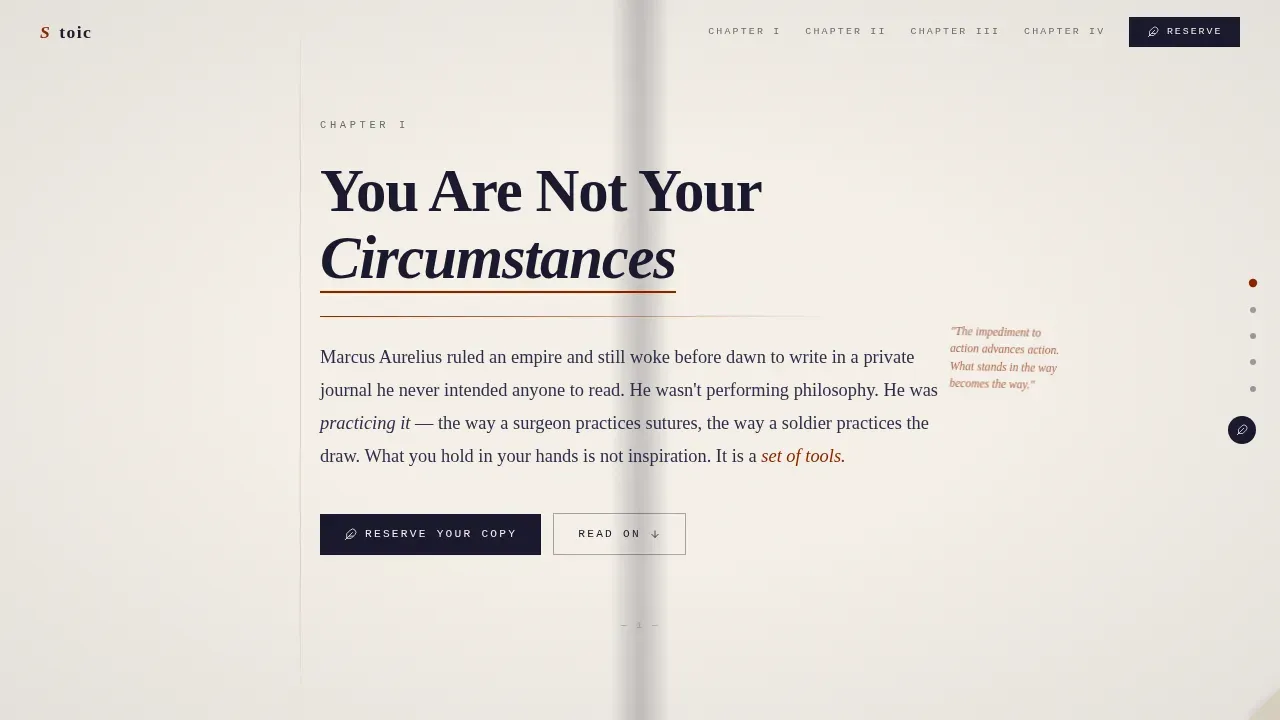
Chapter I opens as a full-viewport book spread. A visible gutter shadow runs down the center of the layout and a faint paper texture sits beneath the type, giving the impression of an open book rather than a web page. The chapter number appears in small caps above a pressed-type serif headline, and a single thin red rule separates the title from an opening paragraph written like the first lines of a prologue. No images and no illustrations appear here. The design trusts the words alone.
Confession-and-Reframe Chapter Structure
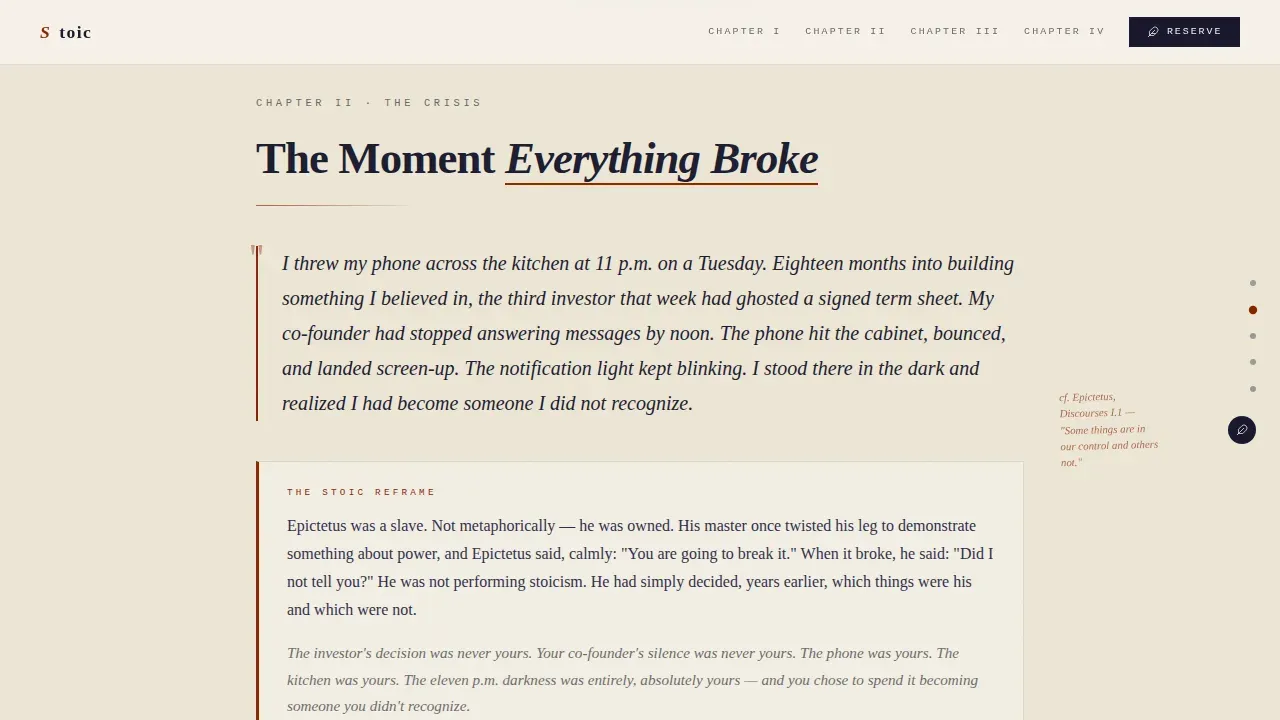
Chapters II through IV each open with a raw, specific human moment before presenting the stoic principle that reframes it. This structure mirrors the way stoic writings actually work: a concrete crisis, then a philosophical response drawn from stoic ethics. Each chapter uses marginalia-style annotations and pull quotes to break up the body text and hold attention across the full scroll.
Two-Path Email Capture Form
Chapter V holds the primary conversion element: a waitlist form with exactly two fields. The first field captures an email address. The second asks one open question: "What are you enduring right now?" The secondary path offers a free downloadable first chapter PDF, gated behind the same email capture. Both paths arrive at the same outcome without competing with each other.
Margin-Note Social Proof
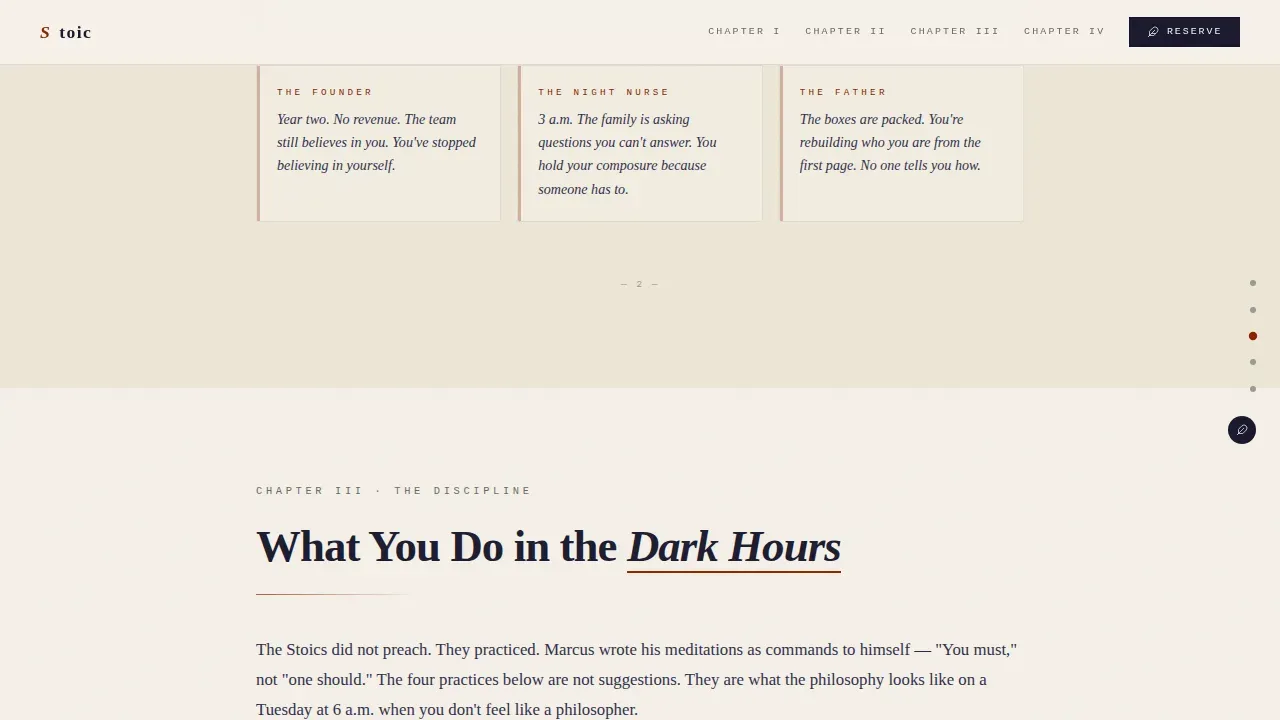
Chapter IV presents reader archetypes and testimonials styled as margin annotations, mimicking the handwritten notes a careful reader leaves in the margins of a book they are working through. This format fits the page's visual identity and delivers social proof in a way that feels authentic to the stoic journal aesthetic rather than grafted on from a generic template.
Scroll-Linked Chapter Reveal Animations
The template uses scroll-linked animations to reveal each chapter section as the visitor moves down the page. The effect suggests turning pages rather than scrolling a feed. Ink-draw underlines animate into view on key phrases, and the grain texture overlay reinforces the manuscript atmosphere throughout. All animations are set to medium intensity, keeping the page deliberate rather than distracting.
Page sections overview
| Section | Purpose |
|---|---|
| Chapter I Hero | Book-spread viewport with gutter shadow, grain texture, chapter number in small caps, serif headline, red rule, and opening prologue paragraph |
| Chapter II Crisis | Raw confession moment paired with a stoic reframe, supported by marginalia annotations |
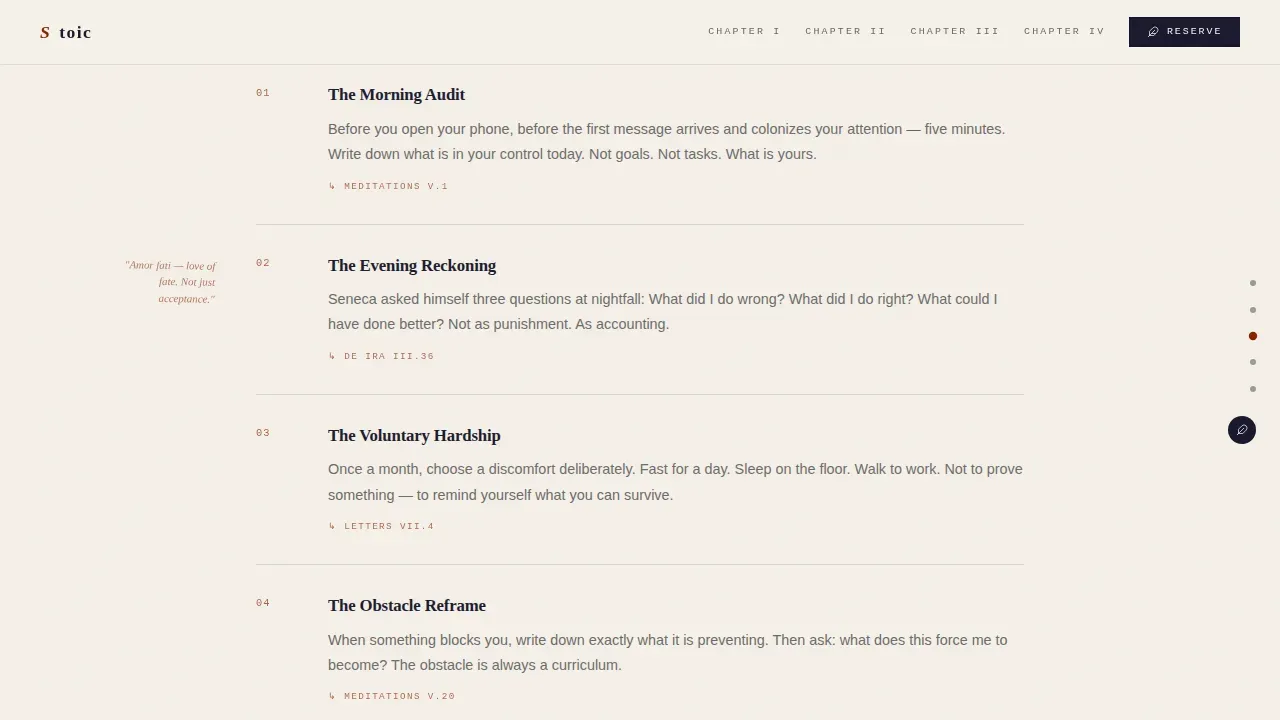
| Chapter III Discipline | Daily stoic practices presented with annotated text aesthetic and pull quotes |
| Chapter IV Fellowship | Reader archetype profiles and margin-note style testimonials |
| Chapter V Waitlist | Primary email capture form with open-text field, plus free chapter PDF secondary offer |
| Minimal Footer | Single-row footer following Pattern 8, minimal and typographic |
Design & branding system
The Ink and Paper color system anchors every visual decision on this template. Aged parchment (#F5F0E8) covers every background surface. Iron gall ink (#1A1A2E) commands every headline. Marginalia red (#8B2500) appears only where emphasis earns it, the same way a careful reader underlines a sentence that changes how they see the world. Faded graphite (#6B6B6B) handles secondary text without competing for attention.
- Typography: Fraunces serves as the display serif for titles and chapter headings, giving the pressed-into-the-page quality the brief demands. DM Sans handles body and interface text for legibility at reading length. IBM Plex Mono marks chapter numbers and labels, reinforcing the manuscript ledger aesthetic.
- Texture and atmosphere: a grain texture overlay sits across the full page. The book-spread gutter shadow in Chapter I anchors the open-book concept. Red appears only as a single thin rule and selective ink-draw underlines, never as a decorative device.
- Motion and pacing: scroll-linked chapter reveals and ink-draw underline animations run at medium intensity, creating rhythm without noise. The overall impression is a first-edition copy of the Meditations pulled from a monastery shelf, yellowed, deliberate, and complete.
Mobile & speed optimization
The template is designed desktop-first to honor the full book-spread concept, but it degrades gracefully to a single-column scrolling layout on smaller screens. The philosophical arc and chapter structure remain intact on mobile. The grain texture and gutter shadow simplify cleanly rather than disappearing entirely, preserving the atmosphere at every screen width.
- Desktop layout uses the two-page spread with centered gutter shadow. Mobile collapses to a single-column structure with full-width typography and retained parchment backgrounds.
- Static content is handled through server components, keeping JavaScript usage minimal and the page lightweight without sacrificing the scroll animation behavior.
- Image optimization is built into the template structure to support fast loading times, which matters for reducing bounce rates among readers who arrive from a direct link or a social share.
How this template helps you convert
The entire template is a conversion argument built from stoic ideas. It does not rely on urgency tactics, countdown timers, or inflated promises. Instead, it earns the signup by demonstrating, across five chapters of honest writing, that the blog is worth waiting for.
- The chapter narrative builds commitment gradually. Each section gives away real philosophical content, real confessions, and real ideas before asking for anything. By the time the reader reaches Chapter V, they have already spent meaningful time with the writing. Joining the waitlist is simply the natural next action, like turning a page.
- Two clear conversion paths reduce friction without splitting focus. The "Reserve Your Copy" primary call-to-action and the "Read Chapter One Free" secondary offer both lead to the same email capture. A visitor who wants the full blog joins the waitlist. A visitor who is still curious downloads the free chapter and joins at the same time. Neither path leaves empty-handed.
Other information about this template
This template is built specifically for creators working within the stoicism and self-mastery niche who want to launch with credibility and a reader base already in place. The following context helps round out the full picture of how this template fits into the broader ecosystem of stoic content online.
- Reading stoicism has grown steadily beyond academic circles. The vast majority of people begin with The Meditations of Marcus Aurelius, which is widely praised for its aphoristic style and accessibility. Alongside it, The Handbook of Epictetus, The Discourses of Epictetus, and Seneca's Letters to Lucilius are recommended texts that offer a basic understanding of stoic thought from three of the most important voices the stoic school ever produced.
- Marcus Aurelius, Seneca, and Epictetus are the three principal figures of stoicism. Most of what we know about stoic ethics and stoic ideas survives through their writings, since no complete texts by the Greek founders remain. Stoicism was founded around 300 B.C. by Zeno of Citium, who lectured from a painted porch, or stoa, in Athens. The major goal of stoicism is to achieve happiness through arete, a concept combining all the virtues: wisdom, justice, courage, and temperance.
- Modern stoicism has drawn heavily on ancient stoics across disciplines. Connections between stoic philosophy and modern cognitive therapy are well established. Cognitive behavioural therapy shares the stoic assumption that our thoughts, not external events, determine emotional experience. Cognitive distancing, a technique common in cognitive behavioural therapy, mirrors the ancient practice of separating oneself from anxious thoughts. Practicing misfortune and Premeditatio Malorum are stoic exercises that prepare the mind for setbacks, working in a similar way to exposure-based approaches in modern clinical practice.
- Stoic week is an annual event that introduces people to stoic practices through structured daily exercises. Writers and creators who build their blogs around stoic week cycles can use this template's chapter structure to align content with that calendar rhythm. A monday morning reflection post, for example, fits naturally into the Chapter III discipline framework this template provides.
- Ryan Holiday is a contemporary author whose works, including The Obstacle Is the Way, have introduced stoicism to a wide audience through narrative nonfiction. His presence on tim ferriss's blog and his podcast appearances helped bring stoic ideas into mainstream self help conversations. Writers building a stoic journal or stoicism blog often position their work in relation to these touchstones, and this template's tone of demanding mentorship resonates with that lineage.
- William Irvine's A Guide to the Good Life remains one of the most widely read modern introductions to stoic philosophy. It offers a practical guide to applying ancient wisdom in daily life without requiring prior study of ancient philosophy. A blog post on this template can reference it as entry-level reading for new subscribers who are just starting to explore reading stoicism.
- The stoics mentioned across popular culture, including Seneca, Marcus Aurelius, and Epictetus, are also cited in connections to the New Testament period. Ancient philosophers working in parallel traditions shared a concern with how a person ought to live, what counts as the good life, and how virtue relates to happiness. These intersections make stoic ethics a rich subject for detailed analysis in blog article form, especially when writers are addressing readers who come from religious or ethical backgrounds.
- This template supports a reader-supported publication model. Whether a subscriber joins as a free or paid subscriber, the waitlist form captures intent early. Writers can later convert free signups into paid subscribers as they build content. More money from a small, committed readership is a more sustainable path than chasing broad traffic, and this template's intimate, manuscript aesthetic self-selects for readers who take the work seriously.
- The template's form asks only for an email address and a single question. This keeps the barrier low while filtering for the kind of reader who is willing to reflect for a few minutes on what they are carrying. Worrying, understood as a failed attempt at problem-solving, is exactly the emotional state this template's writing addresses. Rational approaches to anxious thoughts, including cognitive distancing and the stoic practice of focusing on what one can control, are the key points the blog's content will return to week after week.
- Bad habits, negative emotions, and the sense that the world has narrowed around a single crisis are the daily life conditions this blog's ideal reader is navigating. The template's confession-and-reframe structure, which opens each chapter with a raw human moment before applying stoic ethics, speaks directly to that condition. It does not offer false hope. It offers the inner citadel: the idea, central to Marcus Aurelius and stoic philosophy alike, that the mind's capacity to respond with virtue is never taken away by external events.
- Writers curious about building a comparable presence in the self help space can use this template alongside any number of publishing or landing page platforms. The template itself is platform-agnostic in its design language, built to communicate the depth and seriousness of stoicism today in a way that generic self help books rarely achieve. The attitude this template conveys is not optimism but composure, not motivation but philosophy in daily practice, applied with the same care the ancient stoics brought to their own stoic writings.
Theme
Ink & Paper
Creative direction
Origin Story
Color system
Ink & Paper
Style
Hub & Spoke (Anchor Nav)
Direction
Waitlist/Coming Soon
Page Sections
Chapter-based Anchor Navigation
Book-spread Hero with Grain Texture
Confession-and-reframe Chapter Structure
Two-path Email Capture Form
Margin-note Social Proof Blocks
Scroll-linked Chapter Reveal Animations
Related questions
What kind of blog is this template designed for?
Do I need to write all five chapters before launching?
How does the free chapter PDF offer work within the template?
Can this template support a reader-supported publication model over time?
What makes this template different from a generic coming-soon page?