Templates
Aerospace & Defense
Space & Advanced Aerospace
Terraform - Industrial Mars Colonization Technology Landing Page Template
Terraform - Industrial Mars Colonization Technology Landing Page Template
The Terraform Industrial Mars Colonization Technology Landing Page Template is a single-column, deep-tech B2B layout built for companies manufacturing life-support and habitat systems for off-world human presence. It combines an Industrial Raw aesthetic with case study narrative scroll, mission-partner credibility signals, and a structured lead-generation form targeting aerospace prime contractors, sovereign space agencies, and venture consortiums evaluating Mars infrastructure.
by Rocket studio
Quick summary
This template gives Mars colonization technology companies a high-authority landing page that speaks directly to engineers and procurement leads. It opens with a mission-partner logo bar, moves through three engineering case studies, and closes with two conversion paths: a technical brief request form and a gated readiness assessment download. The design is industrial, dark, and deliberately credibility-first.
Who this template is for
This template is built for deep-tech hardware companies operating at the frontier of space infrastructure. It fits organizations whose buyers read specification sheets before they read marketing copy. The visitor arriving on this page is evaluating suppliers for programs where a single component failure is not recoverable.
- Program managers, chief engineers, and procurement leads at aerospace prime contractors sourcing subsystems for Moon-to-Mars architecture
- Sovereign space agencies and intergovernmental bodies building interplanetary roadmaps and long-duration habitat programs
- Deep-tech venture consortiums committing billions to off-world infrastructure before the first crew lands on Mars
What problem this template solves
Generic SaaS landing page templates fail aerospace buyers immediately. The moment a procurement lead sees a stock hero image and a bullet list of benefits, credibility evaporates. Aerospace and space technology companies need a layout that communicates engineering rigor visually, structurally, and tonally before a single word is read.
- There is no template format on the market that mirrors the mission-dossier reading pattern that defense and space procurement teams use to evaluate suppliers
- Most lead-generation layouts prioritize emotion over evidence, but buyers authorizing nine-figure spacecraft subsystem contracts need data, test cycles, and failure thresholds first
- Companies serious about terraforming Mars and off-world habitat systems cannot afford a landing page that looks like a consumer app
What you get with this template
You get a complete single-column landing page built around three engineering case studies that escalate in stakes: water, shelter, and air. Every section is structured to present a problem, a constraint, and a tested solution. The page earns its lead-generation form by delivering engineering evidence first.
- A Logo Bar header with mission-partner insignia placement, a stark typographic mission statement, and zero decorative imagery
- Three case study content blocks covering regolith-to-water extraction, inflatable habitat pressure testing, and closed-loop carbon dioxide to oxygen conversion
- A primary lead-generation form asking for organization name, role, technology area checkboxes, and a secure email field, plus a secondary gated PDF download path
Feature list
This section describes the core built-in capabilities of the template as delivered.
Mission-Partner Logo Bar Header
The header opens with a horizontal strip of partner insignia silhouettes sitting above a single line of white type. There is no hero image and no gradient. The restraint communicates that this company spends budget on engineering, not on marketing visuals. The logo bar functions as immediate social proof for an aerospace audience that recognizes institutional credibility on sight.
Case Study Narrative Scroll
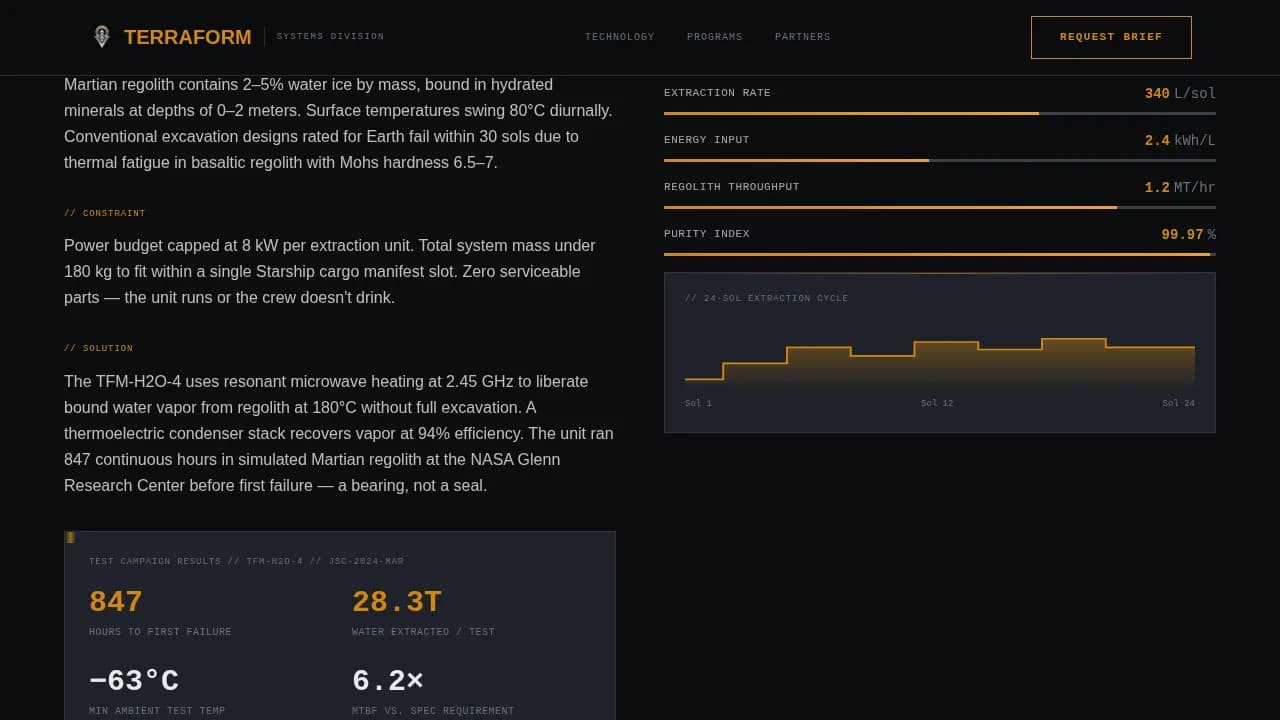
Each scroll section tells one technology program as a dossier entry: a problem statement, an engineering constraint, and a solution validated under load. Section one covers regolith-to-water extraction with tonnage yields and cycle durations. Section two presents inflatable habitat pressure testing with strain data overlaid on structural load photography. Section three delivers closed-loop carbon dioxide to oxygen conversion with a live-updating efficiency counter. The scroll escalates logically from liquid water production through shelter to breathable atmosphere, so the visitor understands the complete survival stack before reaching the form.
Dual Conversion Path Layout
The primary call to action, "Request Technical Brief," appears after the second case study once credibility is fully established. The form collects organization name, role selection from a dropdown of program manager, chief engineer, and procurement lead, technology area checkboxes, and a secure email field. A secondary path, "Download the Mars Readiness Assessment," offers a gated PDF for visitors who are earlier in their evaluation cycle. Both paths are positioned to capture different buyer stages in the same session.
Industrial Raw Dark Design System
The template uses a Carbon Fiber color system built around vacuum black backgrounds, machined titanium surface treatments, reactor warning amber accents, and pressurized-atmosphere white body text. Amber appears only on data callouts, interactive triggers, and call-to-action borders, functioning like caution markings on flight-critical hardware. Typography pairs DM Sans for interface and body copy, Fraunces for editorial headlines, and JetBrains Mono for data and metrics display.
High-Density Animation and Interactivity Layer
Scan-line overlays, scroll-triggered reveal sequences with stagger timing, counter animations on data metrics, and ambient flicker on amber elements are all built into the template. The live-updating carbon dioxide to oxygen efficiency counter runs as an interactive client component. Hover states activate on data callouts throughout the case study sections. The animation layer reinforces the pressurized-fabrication-bay atmosphere without sacrificing the page's utilitarian clarity.
Linear Single-Row Footer
The footer follows a compact linear single-row pattern. It provides the necessary institutional close without consuming visual weight that would compete with the conversion sections above it. The layout keeps the page focused on its two conversion goals through the final scroll position.
Page sections overview
| Section | Purpose |
|---|---|
| Logo Bar Header | Establish mission-partner credibility with partner insignia and typographic mission statement |
| Case Study One | Present regolith-to-water extraction with tonnage yields and cycle duration data |
| Case Study Two | Show inflatable habitat pressure testing with strain data and structural load overlays |
| Primary Lead Gen Form | Capture qualified leads via organization, role, tech area, and email fields |
| Case Study Three | Deliver closed-loop CO2-to-O2 conversion data with live efficiency counter |
| Secondary call to action Block | Offer gated Mars Readiness Assessment PDF for earlier-stage evaluators |
| Linear Single-Row Footer | Close with compact institutional information |
Design & branding system
The design system is built on an Industrial Raw theme that prioritizes material honesty over decoration. Every color, typographic choice, and animation behavior is grounded in the aesthetics of pressurized fabrication environments. The palette feels like the interior of a spacecraft station under harsh overhead light, not a consumer tech product.
- Vacuum black (#0B0D0F) dominates all backgrounds; machined titanium (#3A3F47) defines surface and panel treatments; reactor warning amber (#D4870E) marks every point where the eye must go; pressurized-atmosphere white (#E8EAED) carries all body text in high contrast
- DM Sans handles interface labels and body paragraphs; Fraunces sets the editorial authority of case study headlines; JetBrains Mono renders all numeric data, metrics, and technical specifications for a ground-truth engineering feel
- Carbon fiber texture, exposed fastener details, and anodized metal surface treatments run throughout the visual system, creating a consistent warm industrial atmosphere without decorative noise
Mobile & speed optimization
The template is desktop-first by design, which matches how aerospace procurement decisions actually happen. Engineers and program managers evaluating spacecraft subsystem suppliers work from workstations with large screens and the ability to read dense data tables and case study layouts at full fidelity. Mobile support is fully included.
- Server Components handle all static sections, including the logo bar, case study text blocks, and footer, keeping initial load fast without unnecessary client-side overhead
- Client Components are scoped only to the animated efficiency counter, the form with checkbox groups, and the scroll-triggered reveal sequences, limiting JavaScript execution to the interactive surface area
- The single-column flow translates cleanly to mobile viewports without layout reflow, maintaining the dossier reading pattern across all screen sizes
How this template helps you convert
The page is engineered to earn its lead-generation form rather than lead with it. Conversion happens because the visitor has consumed enough specific engineering evidence that they genuinely need the full data set the technical brief contains.
- The logo bar eliminates the credibility question in the first three seconds. Mission-partner insignia at the scale of NASA and sovereign agencies tells the procurement lead they are in the right place before they read a word of body copy.
- Three escalating case studies, water then shelter then air, present test data, failure thresholds, and performance ratios specific enough that an engineer recognizes real validation work. By the time the "Request Technical Brief" form appears, the visitor is asking for it rather than being asked.
- The secondary gated PDF path, "Download the Mars Readiness Assessment," captures earlier-stage visitors who are still determining their evaluation criteria, creating a second conversion funnel that runs in parallel without cannibalizing the primary form.
Other information about this template
This template sits at the intersection of hard science and visionary storytelling, which is exactly the challenge a landing page for Mars colonization technology must solve. The content structure is designed so that science-literate buyers get the engineering specificity they require while the narrative arc carries visitors who are still orienting to the scale of off-world infrastructure investment.
- The Martian atmosphere consists mostly of carbon dioxide gas but is far too thin and cold to support liquid water on the surface. Atmospheric pressure on Mars sits at roughly 0.6 percent of Earth's, making the martian surface essentially a vacuum without pressurized systems. The template's case study structure communicates why Terraform's hardware addresses each of these survival constraints in sequence.
- Mars average temperatures fall around negative 60 degrees Celsius and reach negative 144 degrees Celsius at extremes. Solar wind and radiation have stripped away Mars' ancient atmosphere over billions of years. The loss of a thicker atmosphere means liquid water cannot exist stably on the martian soil without engineered enclosures, which is the direct engineering problem the case studies address.
- Terraforming Mars as a civilizational goal remains beyond present-day technology. Current industrial methods for terraforming the entire planet span theoretical timescales of many thousands of years to centuries. The template is designed for the near-term hardware layer: the systems that keep astronauts alive at a forward station before any planetary-scale climate intervention becomes viable.
- The science fiction imagination of red planet colonization has shaped public interest in Mars for decades, but buyers on this page operate in the reality layer. Terraforming proposals include deploying orbiting mirrors, releasing greenhouse gases, and seeding martian soil with extremophile biology to begin atmosphere building. Raising Mars' temperature by at least 30 degrees Celsius would be the first step toward releasing frozen carbon dioxide from the polar ice caps and beginning to build a thicker atmosphere with higher atmospheric pressure.
- Achieving roughly 100 millibars of oxygen is the threshold for humans to survive on the martian surface without fully pressurized suits. Nuclear reactors represent one proposed energy source for industrial-scale operations at that level. The introduction of manufactured greenhouse gas aerosols is among the key technologies proposed alongside orbital mirror arrays to focus the sun's heat. The risk of a runaway greenhouse effect requires careful climate modeling before any large-scale intervention.
- Mars has nearly every element needed to produce food, fuel, plastics, and other materials on the planet itself. In-situ resource utilization, the practice of using local resources for survival and manufacturing, is the foundation of any viable Mars colonization strategy. Water will be essential for human consumption, agricultural systems, industrial activity, and the production of rocket propellant. The establishment of any habitat station should be located near identified water ice locations to minimize logistics overhead.
- Starship-class spacecraft and next-generation rocket systems are the launch vehicles most commonly referenced in current Mars mission planning. Satellites in Mars orbit support communications, navigation, and surface reconnaissance for landing site selection. Topographic data from those satellites helps in determining ideal locations based on elevation and proximity to water ice deposits. The cosmos of possible landing zones narrows significantly when filtered by access to water and radiation shelter from terrain features.
- The terraform industrial mars colonization technology landing page template uses Infrastructure-as-Code design logic: every section serves a defined function, every component has a spec, and the layout deploys reliably as a complete system. AI can assist teams in customizing and extending this template for specific mission profiles, enabling non-technical contributors to adapt content blocks without touching code. No-code tools make it possible for program communications teams to update case study metrics and form fields without engineering support.
- This template is categorized under Aerospace and Defense, subcategory Space and Advanced Aerospace, within the Mars Colonization Technology niche. It is built on a Single Column Flow structure with an Intersection Match Score of 13, indicating high alignment between the Industrial Raw theme, Carbon Fiber color system, Case Study Narrative creative direction, Logo Bar header concept, and Lead Generation landing-page direction.



Theme
Industrial Raw
Creative direction
Case Study Narrative
Color system
Carbon Fiber
Style
Single Column Flow
Direction
Lead Generation
Page Sections
Mission-partner Logo Bar Header
Case Study Narrative Scroll
Dual Conversion Path Layout
Industrial Raw Carbon Fiber Design System
High-density Animation and Interactivity
Performance-optimized Component Architecture
Related questions
Who is the primary audience for this template?
Can I customize the case study content and data metrics?
How does the dual conversion path work?
Is this template suitable for companies that are not yet at commercial scale?
What typography and color system does this template use?