Editorial Mental Health Blog Landing Page Template
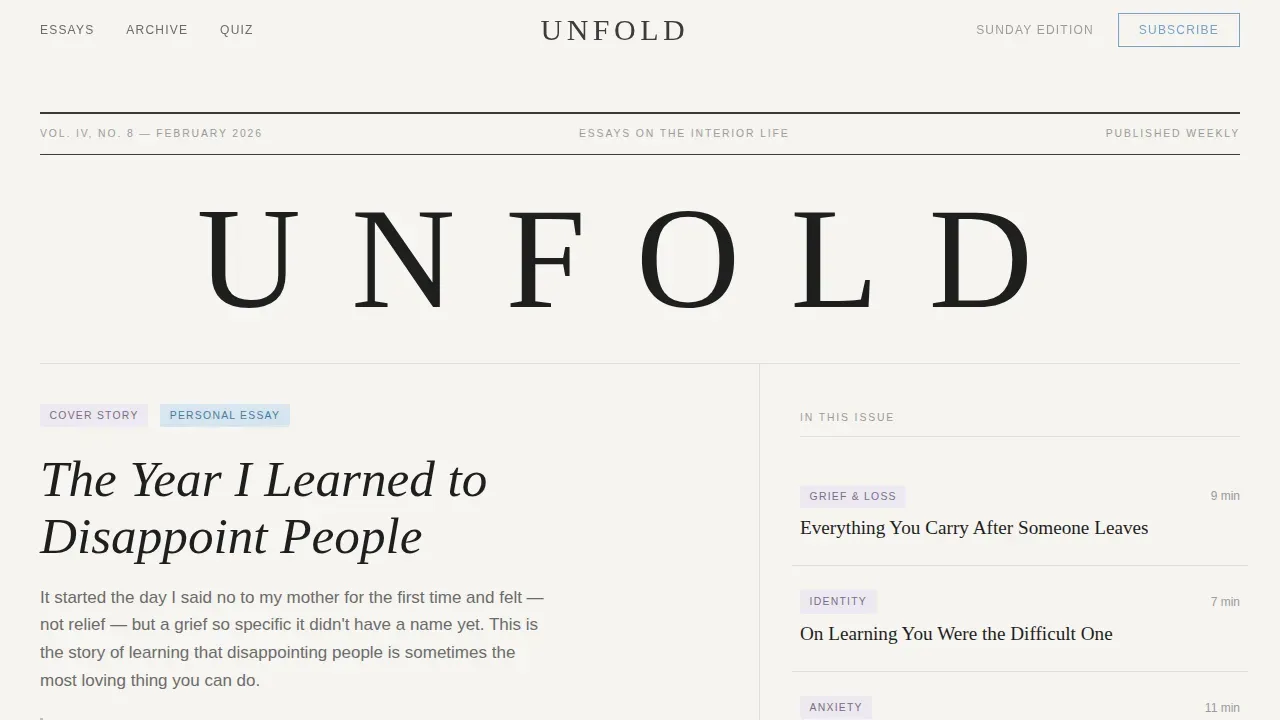
Unfold is an asymmetric 60/40 editorial landing page built for mental health literary journals. It pairs a newspaper-style masthead with a curated gallery walk layout, a five-step personalized quiz, and a Cloud Canvas color system. The design feels like a quiet bookstore read, not a clinical wellness site, making it ideal for writers, therapists, and mental health storytellers.
by Rocket studio
Quick summary
Unfold is a single-page mental health landing page template built around editorial design and emotional storytelling. It uses a 60/40 asymmetric grid, a gallery walk scroll structure, and a five-step quiz to connect readers with personalized content. The visual style is literary and unhurried, built for audiences who want to feel understood, not diagnosed.
Who this template is for
This landing page template is designed for creators and professionals who treat mental health writing as a craft, not a checkbox. It fits anyone building a publication where emotional honesty is the product.
- Mental health writers, essayists, and digital journal founders publishing weekly narrative content
- Therapists and counselors who want a stylish, shareable reading hub for clients
- Independent creators building a mental health blog landing page with a literary identity
What problem this template solves
Most mental health landing pages default to clinical imagery, sterile layouts, and generic wellness brand design. They fail the reader who arrives at 2 a.m. searching for emotional language, not a brochure. This template solves that mismatch directly.
- The gallery walk design removes urgency and builds trust through generous whitespace and curated reading rooms
- The quiz interstitial captures email addresses only after delivering real value, reducing friction and increasing genuine opt-ins
- The asymmetric grid separates featured editorial content from a table-of-contents stack, giving visitors an immediate sense of editorial depth
What you get with this template
This template delivers a fully structured mental health landing page with every major section pre-built and editable. You get a complete design system ready to receive your writing, graphics, and brand choices.
- A newspaper-style masthead with a 60/40 hero split, featured essay headline, and small-caps table-of-contents column
- Three themed gallery rooms covering Anxiety and Overwhelm, Grief and Loss, and Identity and Growth, each with asymmetric article card layouts
- A five-question quiz interstitial with illustrated options, on-screen results, and an optional email field that appears only after results are delivered
Feature list
This landing page template is built around editorial design decisions that serve both the reader experience and your mental health content strategy.
Asymmetric Editorial Hero Grid
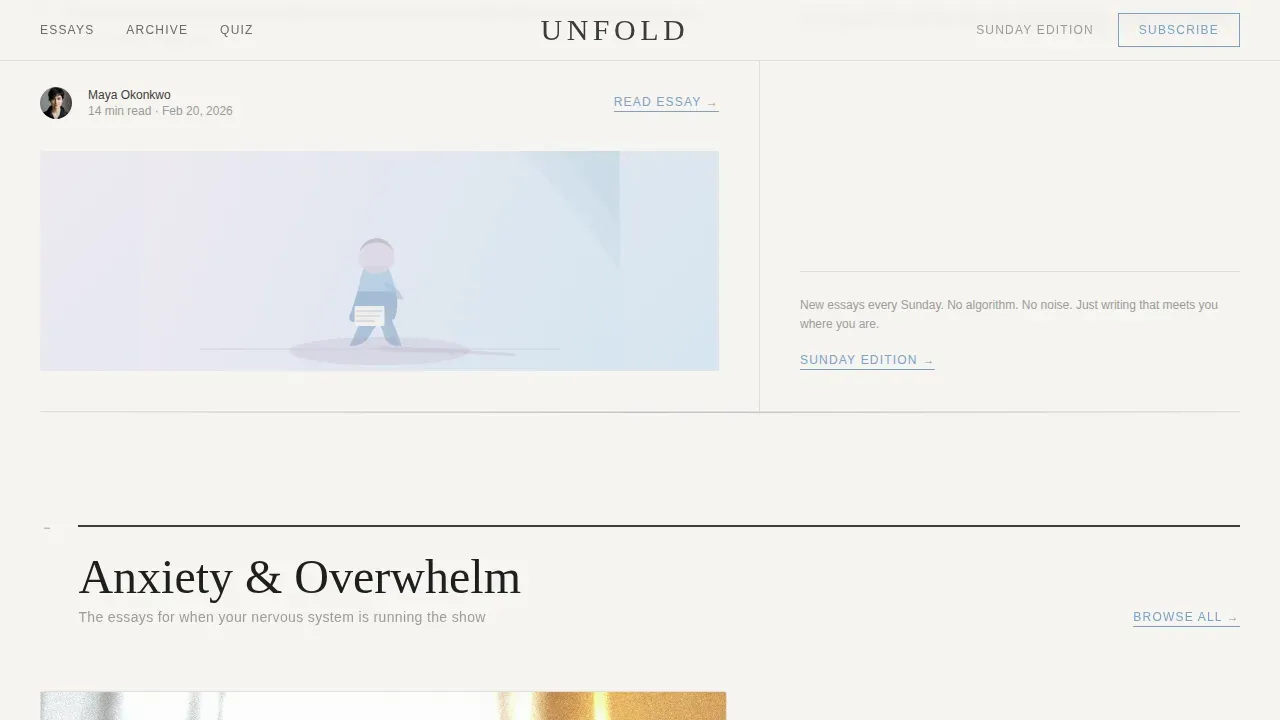
The hero section uses a 60/40 split. The wider column holds the featured essay headline and a soft editorial illustration. The narrower column carries a table-of-contents stack of three recent article titles in small caps. The layout signals literary journal, not wellness brand, from the first scroll.
Gallery Walk Scroll Structure
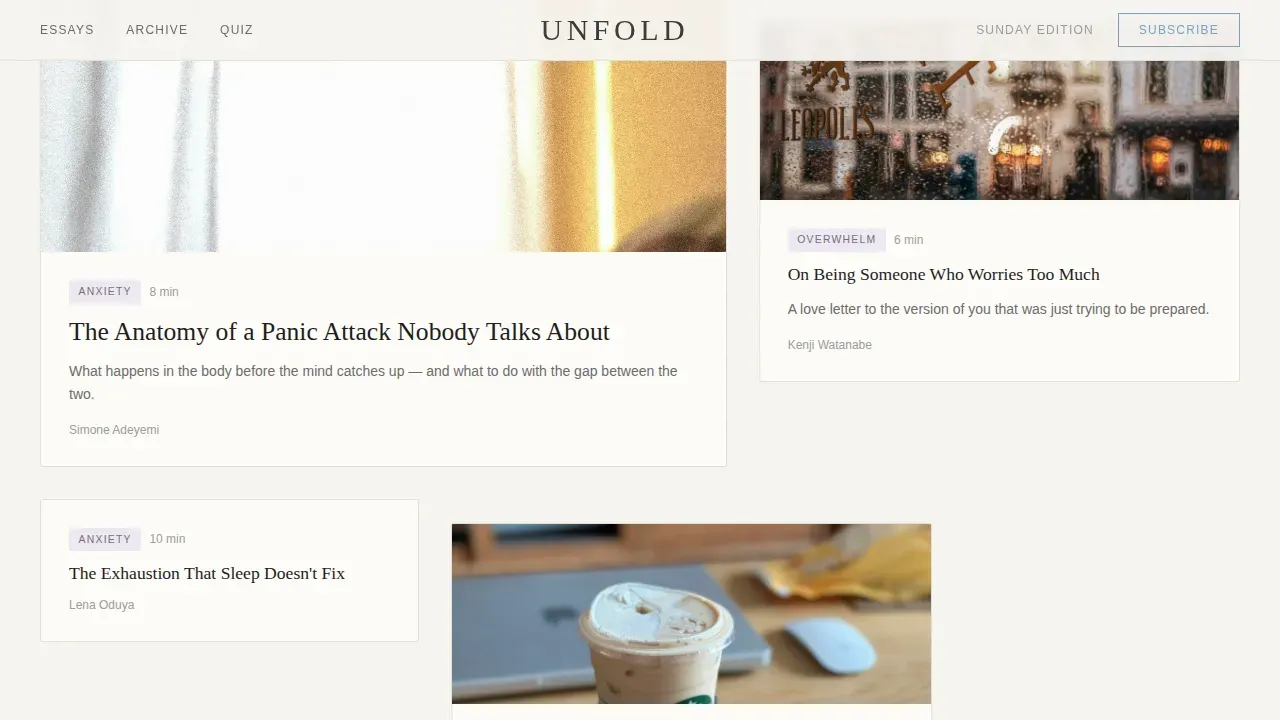
The page organizes content into three distinct gallery rooms. Each room shifts the lavender-to-blue ratio slightly, like lighting changing between museum halls. Article cards sit at intentional asymmetric offsets, some large with an image, some small with a title and a single sentence. Whitespace acts as silence between pages of writing, giving visitors permission to pause.
Five-Step Personalized Quiz
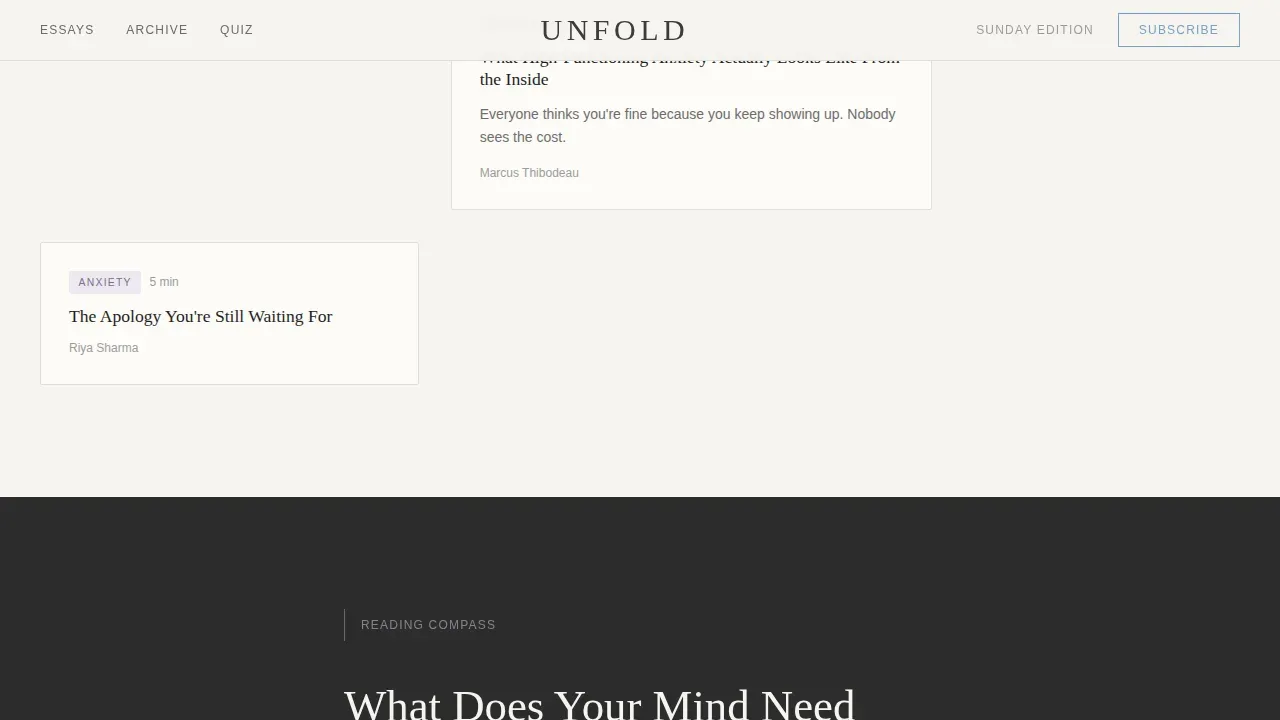
The quiz interstitial is placed after the second gallery room and anchored again in the footer. It asks five soft either-or questions with illustrated options, avoiding clinical scales entirely. Results map to a personalized reading list from the archive, displayed on-screen. The email field appears only after the reader has already received their results.
Cloud Canvas Design System
Every design choice in this template serves emotional safety. The background is soft cumulus white, body text is muted graphite set in Fraunces serif and DM Sans, and interactive elements use a deliberate rain-sky blue accent. Section dividers and pull-quote borders use hush lavender, creating a palette that feels like watercolor on cotton paper.
Social Proof Sections
The template includes space for a reader count, a therapist testimonial pull-quote, and article share numbers. These elements appear within the gallery rooms and reinforce trust without disrupting the editorial flow. Each proof element is designed to feel like a recommendation from a colleague, not a marketing statistic.
Sunday Edition Footer Subscribe
The footer holds a quiet secondary call to action: "Subscribe to the Sunday Edition." A matching link lives in the masthead for readers who already know they want to stay. The footer also includes minimal navigation links to keep the page clean and purposeful.
Page sections overview
| Section | Purpose |
|---|---|
| Masthead hero | Features the publication title, editorial headline, and 60/40 grid with table-of-contents column |
| Anxiety gallery room | Displays asymmetric article cards for the Anxiety and Overwhelm content theme |
| Quiz interstitial | Delivers the five-step personalized mental health reading assessment |
| Grief and Identity rooms | Presents the Grief and Loss and Identity and Growth gallery rooms with a lighting shift |
| Footer subscribe | Anchors the Sunday Edition signup and minimal site links |
Design & branding system
The design language of this landing page is built around one idea: emotional safety through visual restraint. Every design element earns its place.
- Typography uses Fraunces for serif display headlines and DM Sans for body text, giving pages a typeset rather than typed feel
- The Cloud Canvas color palette uses four deliberate colors: soft cumulus white (#F6F4F0), muted graphite (#3B3B3B), hush lavender (#C5B9CD), and rain-sky blue (#7BA0C4)
- All graphics and image placements follow an editorial illustration style with no stock photography or clinical imagery
Mobile & speed optimization
This template is built mobile-first, reflecting the reality that most mental health landing page visitors arrive on a phone at late hours. The design adapts gracefully from a rich desktop editorial layout to a clean, readable single-column experience on smaller screens.
- Scroll-linked gallery transitions and quiz step animations are set at a medium level, keeping the experience fluid without creating performance strain
- The static hero and client-side quiz structure keep initial load time low and the interactive quiz component fast
- The five-step quiz is easy to complete on a smartphone, with large illustrated options replacing small text inputs
How this template helps you convert
The conversion strategy in this landing page template is built around trust before capture. Every design and structural decision removes friction and builds emotional credibility first.
- The quiz interstitial delivers a personalized reading list before asking for any email, so visitors receive value first and opt in by choice
- The gallery walk structure gives readers a reason to scroll through multiple pages of content, naturally increasing time on site and building familiarity with the publication
- The "Subscribe to the Sunday Edition" path in the masthead and footer gives returning visitors a simple, low-pressure way to commit without completing the quiz
Other information about this template
This template is part of a broader category of mental health landing page resources designed for editorial creators. A few additional facts help clarify how it fits into your workflow and tool set.
- Mental health blog templates like this one can be customized to fit your branding and content needs, including fonts, colors, and image placements
- Templates for mental health blogs can be shared as public or private links and embedded into other websites or blogs for cross-platform reach
- Visually appealing mental health blog templates help attract and engage readers effectively, and this template is built with that principle at its core
- This mental health landing page template can be downloaded or exported in standard formats to fit various publishing and distribution needs
- The Unfold editorial mental health blog landing page template draws inspiration from the broader Unfold ecosystem, a link-in-bio and storytelling tool developed by Squarespace, aimed at creators, freelancers, and small brands who want a visually polished hub to share on social media platforms
- Unfold as a platform allows users to embed content such as video, audio, or other media into their bio site, and this template mirrors that philosophy by making room for rich, embeddable media within the editorial layout
- Effective mental health website design prioritizes user experience, and this template reflects that with user-friendly navigation and calm visual elements that support engagement
- AI tools can help streamline content creation for mental health blogs, and this template is structured to make it easy to add and update content without rebuilding the page each time
- The template supports strategies for growing a mental health audience across social media and via email, with both a quiz capture path and a newsletter subscribe path built in
Theme
Editorial Magazine
Creative direction
Gallery Walk
Color system
Cloud Canvas
Style
Asymmetric Grid (60/40)
Direction
Quiz/Assessment
Page Sections
Asymmetric 60/40 Editorial Hero
Three-room Gallery Walk Layout
Five-step Personalized Quiz
Cloud Canvas Color and Type System
Social Proof Integration
Dual Subscribe Paths
Related questions
Can I customize the colors and fonts in this template?
Do I need coding skills to set up this landing page?
How does the quiz work for readers?
Can I embed media like video or audio into this template?
Is this template suitable for therapists as well as writers?