
Rocket.new Solve delivers complete, investor-ready market entry reports in under 90 minutes. It combines market research, competitive intelligence, and revenue modeling into one workflow. Teams move from idea to data-backed strategy without weeks of fragmented analysis.
What does it take to walk into an investor meeting with a market entry analysis that holds up under questioning?
Rocket.new's Solve product handles the entire process, from market research to competitive intelligence to revenue modeling, using over 150 data sources and delivering a structured report in roughly 60 to 90 minutes.
According to a 2025 ProductBoard survey, 68% of product teams collect competitor review data, but only 19% have a repeatable process for acting on it. That gap is where founders lose weeks, and where Rocket picks it up.
What Market Entry Analysis Covers
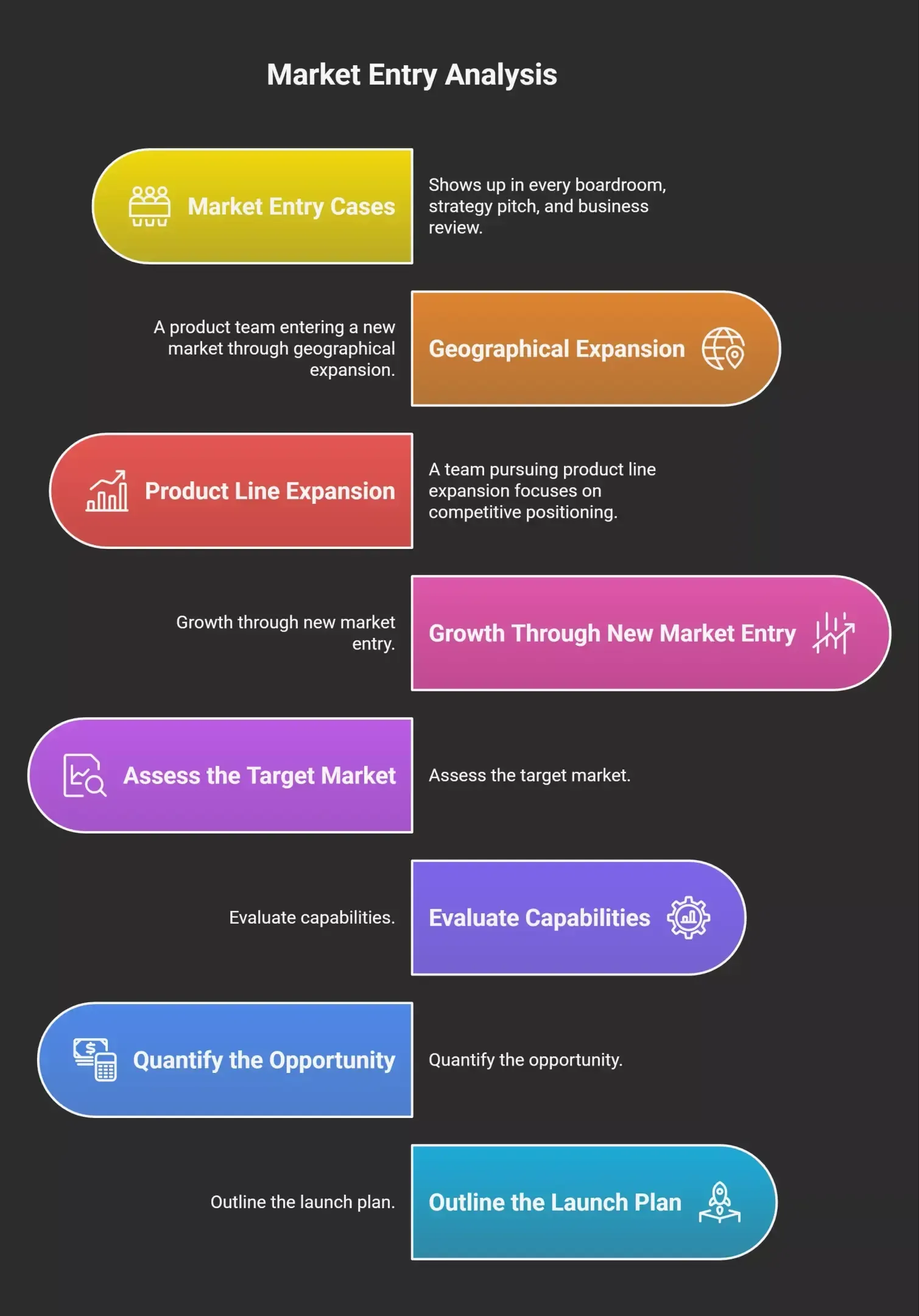
Market entry cases show up in every boardroom, every strategy pitch, and every business review. The core question: should this company pursue a specific growth opportunity, and can it win against competitors already serving those customers?
-
A market entry analysis evaluates whether a company can profitably enter a new market and what it would cost. A SaaS company exploring APAC needs data on local competitors, customers, and growth potential before committing resources.
-
The analysis tests structured problem-solving. Investors want to see this process, not just the answer.
-
Skipping this step means the product team, sales team, and development team all build from assumptions. Customers notice when a product launches without data behind it. Users leave when the value does not match what competitors already offer.
Three Types of Market Entry Cases
There are three main types of market entry cases:
-
Geographical expansion: taking an existing product into a new market where competitors, customers, and compliance requirements differ. A fintech company entering Southeast Asia faces different competitors and regulatory factors than in the US.
-
Product line expansion: launching a new feature within a market the company already serves, capturing market share from competitors. A project management tool adding video conferencing to compete with Microsoft Teams gives customers a reason to stay instead of switching to competitors.
-
Growth through new market entry: the company evaluates whether to build, buy, or partner its way into a new market segment. An enterprise software business might acquire a smaller competitor, a strategy decision that depends on cost, scale, and the competitive landscape.
Each type carries different cost profiles and timelines. A product team entering a new market through geographical expansion has to account for local competitors, different customer expectations, and white space in the competitive landscape. A team pursuing product line expansion focuses on competitive positioning against existing competitors and whether the new feature creates real product differentiation.
The Four-Step Market Entry Process
-
Assess the target market: evaluate market size, growth rate, competitive landscape, and geopolitical factors. A company targeting Latin America needs to account for regional trade agreements and local competitors.
-
Evaluate capabilities: does the team have the development capacity, the sales team reach, and the business system to support a launch? Can the technical teams handle localization?
-
Quantify the opportunity: determine the potential market share the company could capture and compare it against the cost of entry. A $4B TAM with a realistic 2% capture means $80M in addressable revenue.
-
Outline the launch plan: map the pricing strategy, the pricing model, the target market segments, and the resource allocation needed. Should the company offer a free tier to attract early adopters, or go straight to paid customers? The answer depends on what competitors charge and how much value the product delivers on day one. The right tools make this analysis faster.
Skipping step two is the most common mistake. A company might find a gap in the competitive landscape, build a project around it, then realize the development team cannot ship in time. Competitors fill the gap.
Why Market Entry Projects Stall
The problem is not that teams lack tools. Insights sit in too many places, and nobody connects them into a strategy. A product manager pulls market trends from one system, competitor pricing from another, and customer feedback from a third. The sales team has call notes, background for the call, and deal insights that never reach the product team. Competitive intelligence lives in browser tabs, not in a strategy-ready format that makes sense for investors.
The Competitive Intelligence Gap
68% of product teams collect G2 review data from competitors, but only 19% turn those insights into business decisions. That gap shows up in every market entry project that stalls.
-
Competitive intelligence tools are shifting from quarterly market research to continuous data loops. Teams that track competitors weekly catch things that quarterly reviewers miss. For example, a competitor drops pricing, and a team running weekly competitive intelligence catches it within 48 hours. Customers who would have churned stay because the sales team adjusted the pitch.
-
Review count and ratings on software review sites directly affect how customers perceive competitors. For example, when users read 200 negative reviews about a competitor's onboarding, they look for alternatives. That is a competitive advantage the product team can build on.
-
If 40% of a competitor's reviews mention slow support, the sales team can use that data on every call. For example, sharing specific comparison points from review data helps customers trust the evidence over the competitor's marketing.
What Product Teams Miss About Competitors
Technical teams focus on what they can build. Product teams focus on what customers ask for. Neither group tracks what competitors are doing in real time.
-
A competitor launches a new feature that shifts market positioning. If the product team does not catch it for six weeks, the company loses the window. Customers who were considering switching have already signed with the competitor. The response comes too late.
-
Enterprise software buyers evaluate competitors side by side. If the company does not know where it sits, the sales team cannot answer comparison questions. For example, a customer asks, "how do you compare on cost?" and the rep has no answer. That customer signed with a competitor because nobody had a competitive intelligence system in place.
-
Market trends shift faster than annual planning cycles. For example, a competitor moves to usage-based pricing and captures customers who find flat-rate plans too expensive. Users leave for competitors that match how they actually use the tools.
How Rocket.new Runs the Market Entry Process
So, how does Solve on Rocket.new run a market entry analysis that is ready to present to investors the same day?
Rocket uses an AI-powered workflow called vibe solutioning to automate data gathering, synthesis, and presentation generation. The platform takes a single prompt (a market problem, decision, or opportunity) and returns a structured report backed by data.
-
A founder types "evaluate the market for compliance tools for mid-market healthcare companies" and Rocket returns a full report covering market potential, competitors, projections, and a 90-day execution plan.
-
The market analysis includes quantified market size: TAM, SAM, and SOM. A report might show a $12B TAM but a $340M SOM based on realistic market share data.
-
Findings are scored by confidence levels. A market share estimate backed by three independent data sources scores higher than one from a single blog post.
From Prompt to Investor-Ready Output
Rocket generates a structured output from a single prompt:
-
Parallel AI agents gather real-time data from competitor websites, public reviews, and industry reports. One agent pulls competitor pricing data while another pulls hiring signals to reveal where competitors are investing.
-
Those agents pull from over 150 sources, cross-referencing competitor activity, growth signals, and user behavior among customers.
-
Rocket synthesizes the raw data into a structured report covering competitive positioning, market entry cost, and launch planning.
-
The output includes a resource allocation plan that maps to the project scope. The report might recommend focusing on mid-market customers because competitors have left a gap in that segment.
The entire process takes 60 to 90 minutes. For scale, a traditional market research project covering the same scope costs $15,000 to $50,000 and takes two to four weeks.
What the Report Looks Like
The output matches the questions investors ask:
| Report Section | Investor Question | Example Insight |
|---|---|---|
| Market Sizing (TAM/SAM/SOM) | How big is the opportunity? | "$4.2B TAM, 12% annual growth" |
| Competitive Landscape | Who are the competitors? | "Seven direct competitors, two with declining users" |
| Competitive Intelligence | What are competitors doing? | "Top competitor hired 14 enterprise reps in Q1" |
| Revenue Model | What is revenue potential? | "SOM of $38M at 2% market share in year one" |
| Pricing Approach | How should we price? | "Competitors average $49/user/month" |
| 90-Day Plan | Can this team execute? | "Beta launch in week 6, 200 early adopter target" |
| Risk Assessment | What could go wrong? | "EU compliance requirements add 4 weeks" |
Competitive Intelligence That Keeps Running
Most market analysis is a snapshot. Rocket handles this differently. The competitive Intelligence product monitors competitors continuously after the initial report.
-
Daily intelligence digests alert users to competitor activities: hiring changes, new feature launches, and shifts in market positioning. For example, a competitor posting 12 engineering jobs in one week signals a build push the team should anticipate.
-
Every signal from competitors connects back to the original market entry project. The team knows whether the strategy still makes sense as competitors move.
-
The product team, sales team, and technical teams all access the same insights. For example, when a competitor shifts toward enterprise focus, every team sees it, not just the product manager.
Turning Competitor Insights into Sales Ammunition
When the sales team walks into a call, they need to know what competitors said last week, not last quarter.
-
For example, a competitor drops a pricing tier. The sales team sees this in the daily digest and adjusts the pitch before the next customer call. The team keeps customers who would have switched.
-
For example, a competitor publishes a case study showing gains for their customers. The product team identifies the gap in their own value proposition and builds a response. Users get a better product because competitive intelligence is fed directly into the roadmap.
-
For example, a competitor changes homepage messaging to target a different customer segment. This reveals a market positioning shift that the business can counter with its own launch plan.
Feasibility: The Question Before Market Entry
Before any market entry project moves forward, someone needs to ask: Is this idea viable? A feasibility study determines whether a business initiative is practical, profitable, and achievable before the company commits resources. It makes sense to run this analysis before a single dollar goes to development. A solid strategy depends on feasibility, not just market size.
Five Feasibility Factors
-
Technical feasibility: can the development team build it? For example, does the company have the tools, talent, and system architecture to ship?
-
Economic feasibility: does the growth potential justify the cost? For example, if the market entry cost is $500K and projected first-year value is $2M, the business case holds.
-
Scheduling feasibility: can the team ship before competitors fill the gap?
-
Operational feasibility: does the company have the sales team, customer support, and capacity to scale? For example, launching in Europe requires support users can reach in local time zones.
-
Legal feasibility: are there regulatory barriers that affect cost or timeline? For example, entering healthcare adds HIPAA costs that change the project budget.
Running a feasibility study early helps the business avoid wasting resources on unviable ideas. For example, a startup discovers that a regulatory requirement adds $200K to the project cost. Better to know that before the pitch.
Market Validation Before Development
Market validation sits between market research and market entry. It tests whether real customers will pay.
-
Run a beta launch with early adopters. Track user behavior and revenue, not just sign-ups. For example, 200 users signed up, but only 12 paid, tells a different story than 80 conversions.
-
Test pricing against competitors. If the company's price sits above the market average but the product differentiation is unclear, customers choose cheaper competitors. For example, users compare tools based on cost first.
-
Validate with real customer conversations. Customers describe real problems in a 15-minute call. They will not describe them in a Google Docs form.
The Rocket platform supports market validation by including customer segment data and willingness-to-pay modeling. Moving forward with development after this step means the company has evidence, not just conviction.
What People Are Saying
"Most founders I talk to have no shortage of ideas. What they lack is a process for validating whether a market is worth entering before they commit resources. The companies that win are the ones that define the market around the job customers are trying to get done, not around a product category." - Tony Ulwick, Founder and CEO of Strategyn, on LinkedIn
Ulwick has spent 30 years helping companies define markets through customer needs. His point maps to the market entry problem: founders build before they understand what customers need. A market analysis that starts with customer jobs produces a plan investors trust.
How Rocket.new Powers Every Market Entry Project
Rocket.new is a vibe-solutioning platform that integrates market research, competitive intelligence, and market validation into one strategy workflow. The AI-powered platform connects three products (Build, Intelligence, and a market strategy engine) with shared context. Insights from the market entry project carry directly into the build phase and into ongoing competitor monitoring.
Here is what Rocket brings:
-
Vibe solutioning platform: type a problem, get a strategy recommendation backed by insights from 150+ sources
-
25,000+ templates, free to use: start from a template and Rocket adapts it to your market, your customers, and your competitors
-
Saves up to 80% tokens: efficient with AI resources, meaning lower cost per project
-
Supports Flutter (mobile) and Next.js (web): the development team goes from insights to code without switching tools
-
Collaboration built in: product team, sales team, technical teams, and users all work from the same project
-
3 Products, One platform: Solve, Build, and Intelligence: market research, product launch, and competitor tracking in one place
Market Entry Use Cases
-
A product manager at a SaaS company uses the platform to evaluate APAC expansion. The report covers market size, local competitors, customer expectations, and revenue projections. The team presents key findings the same day. For example, the report identifies a gap where no competitor offers localized onboarding, a competitive advantage to build around.
-
A startup founder generating a market entry analysis for investors gets TAM, competitive landscape, and launch timing in under two hours. For example, the report flags two competitors that recently raised Series B, showing investors see potential in the category.
-
A sales team uses Intelligence to track competitors daily. For example, when a competitor shifts toward an enterprise focus, the sales team targets the customers that the competitor is leaving behind.
-
A development team runs a feasibility study. For example, building in Flutter reduces cost by 40% compared to native, changing the resource allocation plan. The call to action section of the report recommends a phased launch: beta with 100 users in month one, scale to 1,000 by month three.
Getting to Investor Day Without Losing a Month
How does Solve on Rocket.new run a market entry analysis that is ready to present to investors the same day? By connecting the entire process, gathering data, running competitive intelligence, modeling revenue, and building the presentation, into one continuous workflow.
Rocket gives founders and product teams a platform that produces data-driven decisions from day one. The company enters every investor conversation with a strategy backed by evidence, scale projections, and a clear answer to every question about competitors, customers, and cost.
Turn your next market entry idea into an investor-ready strategy in under 90 minutes with Rocket.new Solve.
Table of contents
- -What Market Entry Analysis Covers
- -Three Types of Market Entry Cases
- -The Four-Step Market Entry Process
- -Why Market Entry Projects Stall
- -The Competitive Intelligence Gap
- -What Product Teams Miss About Competitors
- -How Rocket.new Runs the Market Entry Process
- -From Prompt to Investor-Ready Output
- -What the Report Looks Like
- -Competitive Intelligence That Keeps Running
- -Turning Competitor Insights into Sales Ammunition
- -Feasibility: The Question Before Market Entry
- -Five Feasibility Factors
- -Market Validation Before Development
- -What People Are Saying
- -How Rocket.new Powers Every Market Entry Project
- -Market Entry Use Cases
- -Getting to Investor Day Without Losing a Month