
Want to turn an idea into a working app fast? Learn how AI app builders help startups create prototypes quickly, reduce costs, and validate concepts early without relying on large development teams.
Need to launch an app quickly without hiring a large development team?
Modern AI app-building platforms let startups describe an idea in simple terms and turn it into a working product in hours rather than months.
Startup speed matters. A report from CB Insights shows that 38% of startups fail because they run out of cash, often after long development cycles. Faster app development can help teams validate ideas before incurring high costs.
This blog explains how these platforms work, what features matter, and how startups can build a real app without deep coding knowledge.
What is an AI App Builder?
An AI app builder is a platform that helps people create and launch software using natural language instead of manually writing code.
In a traditional setup, a development team spends weeks planning architecture, building the backend, setting up databases, and connecting APIs. With a modern app builder, much of that work is automated.
You simply describe your idea using text prompts. The system then generates the UI, the backend logic, and even the database structure.
This type of AI-powered system is popular with non-technical founders who have strong app ideas but limited coding experience.
Many builders can even generate IOS and Android apps using the same backend.
Why Startups Prefer AI App Builders?
Startups usually move fast. They want to test ideas quickly and reach users before competitors. Traditional app development can slow this process because teams must design architecture, build the backend, configure authentication systems, and connect api keys before launching anything.
A modern AI app builder simplifies this path. Instead of spending weeks writing code, founders can focus on turning an idea into a working app and testing it with real users.
Here are some of the main reasons startups prefer these platforms:
- Faster Prototypes: A founder can describe the product idea using simple prompts, and the ai builds a prototype. In many cases, this results in a working app within hours.
- Lower Costs: Startups without strong coding knowledge can avoid hiring a full development team in the early stages. This reduces development expenses while the idea is still being tested.
- Quick Testing: Teams can test features with real users and gather feedback before investing months into development.
- No Code Environment: A no-code interface allows founders to modify features, update screens, and adjust backend logic without touching code.
So instead of spending weeks writing code and setting up infrastructure, startups can focus on improving the idea, learning from users, and building the app step by step.
Key Features to Look for in an AI App Builder
Not all AI-powered platforms offer the same capabilities. Startups should focus on features that help them build and launch an app quickly while keeping the process simple.
A good AI app builder should reduce the need for heavy coding and automate most of the technical setup. Here are some features that make a big difference when choosing the right platform.
Natural Language Development
Many modern platforms rely on natural language prompts. Founders can describe features in plain language, and the system automatically generates the UI and backend logic.
This approach helps people with limited coding knowledge turn an idea into a functional product without spending weeks writing code.
Backend and Database Generation
A strong AI app builder should automatically generate the core technical structure of an app.
This usually includes:
- Database structure
- Backend endpoints
- Authentication systems
These elements normally require significant code work. Automation saves many hours during development.
Web and Mobile Support
Good platforms support both web apps and native mobile experiences.
Some systems rely on Google's Flutter framework to create cross-platform builds. This allows startups to launch Android apps and other mobile versions without maintaining separate codebases.
Built-in Hosting
Many modern platforms include built-in hosting. This means startups can launch their web product without setting up servers or infrastructure.
It simplifies deployment and lets teams focus on testing the app with real users.
Data Management
An app often needs a structured way to store and organize information. Modern app builder tools help teams manage data and sync data with services such as Google Sheets.
This helps founders track users, orders, or activity without building a complex database from scratch.
API Connections
Most builders also allow developers to connect external services using api keys.
This allows the app to pull data from third-party platforms such as payment systems, analytics tools, or email services.
When these features work together, startups can move from an idea to a working product much faster while keeping the development process simple and manageable.
AI App Builder vs Traditional Development
Let’s look at how a modern AI app builder compares with traditional development.
| Feature | AI App Builder Platform | Traditional Development |
|---|---|---|
| Setup Time | Hours | Weeks or months |
| Coding Required | Minimal code | Heavy writing code |
| Team Size | Solo founder or small team | Full development team |
| Cost | Low early stage | High salaries |
| Testing | Rapid test cycles | Slow deployment |
This shift is why no-code platforms are becoming common in startup circles.
Types of Apps Startups Can Build
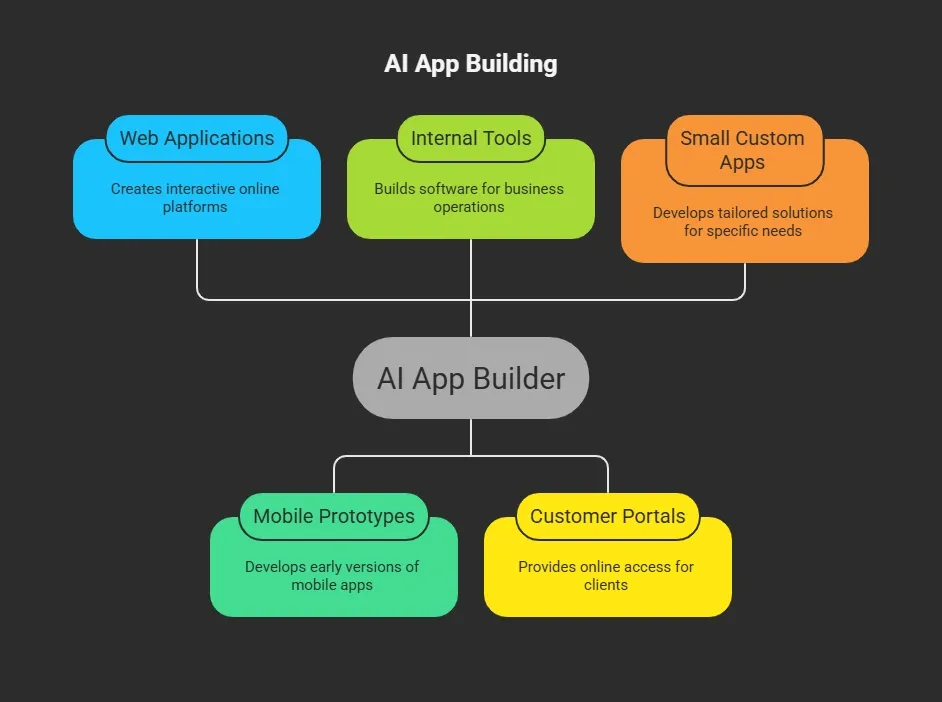
Using an AI app builder, founders can quickly create different types of software products. Instead of spending months on traditional app development, startups can launch smaller solutions first and expand them as the idea grows.
Many founders start with a simple idea, build a basic app, and then improve it based on user feedback.
Use Cases
- Internal Tools: Startups often begin by building internal tools to manage operations. These may include sales dashboards, workflow trackers, and workflow automation systems that help teams organize tasks and monitor performance.
- Customer Portals: Companies can create customer portals where users log in, view data, track activity, and manage their accounts. These apps rely on authentication systems and backend logic to keep user information organized.
- Web Applications: Many founders launch web applications for booking, scheduling, analytics, or marketplace platforms where multiple users interact with the app.
- Mobile Apps: Some platforms also support native mobile development. This allows startups to release Android apps and other mobile versions, so users can access them easily on their phones.
These use cases help founders quickly test their ideas and launch a working product with minimal development time. As the number of users grows, the app can be expanded with additional features and integrations.
The Role of AI Agents in App Creation
Modern AI-powered platforms include AI agents that assist with development.
These agents help with tasks such as:
- Generating backend endpoints
- Building UI layouts
- Setting up the database structure
- Connecting APIs with api keys
The AI agents also help test the app by checking logic errors in the code. So instead of manually writing code, founders guide the system using natural language.
Community Insight
One LinkedIn post described the experience of testing an AI builder with a simple prompt.
“I gave an AI builder just one sentence and it built a complete working app. No setup. No coding. It just worked.”
In that post, the creator explained how the tool generated a full app with user profiles, filters, chat features, and a mobile ready interface from a single idea.
Rapid App Development with Rocket.new
Rocket.new is a vibe solutioning platform designed to help startups quickly turn an idea into a working app. The platform focuses on rapid app generation using natural language prompts, making development accessible even to founders with limited coding knowledge.
A founder simply describes the product idea in plain language, and the system generates the interface, the backend, and the database structure. This approach allows startups to move from concept to prototype much faster than traditional app development.
Top Features
- Prompt to App Creation: Builds apps directly from single prompts
- Figma Import: Converts design files into live, editable layouts
- AI-Powered Backend: Automatically handles logic, data, and workflows
- Custom Domain Support: Publishes projects with a branded domain
- Code Export: Allows developers to extend or customize later
- Live Preview: Shows instant updates while editing
The platform also supports web apps, internal dashboards, and startup prototypes, allowing founders to test ideas quickly with real users.
Rocket.new the Fastest AI App Builder
The goal of this guide is to help startups find tools to launch products quickly. Rocket.new meets this goal by reducing the manual work required during app development.
Instead of spending weeks writing code, founders can describe their idea and let AI generate the interface, backend logic, and data structure. The platform also includes built-in hosting, authentication setup, and easy custom domain configuration.
This combination allows startups to move from idea to working app faster. Teams can build prototypes, test features with early users, and adjust the product without managing complex infrastructure.
For startups that want to experiment quickly and validate app ideas, a platform like Rocket.new significantly speeds up the app-building workflow.
The Rise of No-Code App Development
The popularity of no-code platforms is growing quickly in the startup world. Many founders want to launch an app without spending months learning programming or managing complex development workflows.
This shift is happening because modern AI-powered tools simplify the process of turning an idea into real software.
Why No Code is Growing
- Generative AI Tools: The rise of generative AI has made it easier for platforms to automatically generate interfaces, backend systems, and database structures.
- More Non-Technical Founders: Many non-technical founders are launching startups. They often have strong app ideas but limited coding experience, so no-code tools make development possible.
- Plain Language Development: A modern app builder allows founders to create features using plain-language instructions rather than manual coding.
- Vibe Coding Workflows: Some platforms support vibe coding, in which the founder interacts with AI in a conversational way to refine the app.
For example, a founder might say:
“Create a booking app with login and payment tracking.”
The system then generates the code, sets up the backend, and automatically connects to the database structure.
This level of automation changes how startups approach app development. Instead of spending weeks building infrastructure, founders can focus on improving the idea, testing the app with users, and expanding features as the product grows.
The Fastest AI App Builder for Startups
Startups often face slow app development cycles. Founders usually need developers to write code, configure infrastructure, and set up the backend before testing their app ideas. This delays feedback from real users and increases early costs. Modern ai powered platforms simplify this process. Founders can describe an idea in natural language, and the system automatically generates the UI, backend logic, and data structure.
Platforms like Rocket.new show how this approach works in practice. The fastest AI app builder for startups allows founders to launch a web app, test features quickly, and refine the product based on user feedback. Instead of spending months writing code, teams can create and improve products faster while still supporting full stack applications.
Table of contents
- -What is an AI App Builder?
- -Why Startups Prefer AI App Builders?
- -Key Features to Look for in an AI App Builder
- -Natural Language Development
- -Backend and Database Generation
- -Web and Mobile Support
- -Built-in Hosting
- -Data Management
- -API Connections
- -AI App Builder vs Traditional Development
- -Types of Apps Startups Can Build
- -Use Cases
- -The Role of AI Agents in App Creation
- -Community Insight
- -Rapid App Development with Rocket.new
- -Top Features
- -Rocket.new the Fastest AI App Builder
- -The Rise of No-Code App Development
- -Why No Code is Growing
- -The Fastest AI App Builder for Startups