
Solve on Rocket.new treats conflicting evidence as a valuable insight, not a problem to hide. It surfaces multiple signals with confidence ratings and visualizes trade-offs clearly. This enables teams to make informed decisions instead of relying on oversimplified answers.
What do you do when you ask a business question and the research comes back pulling you in two completely different directions?
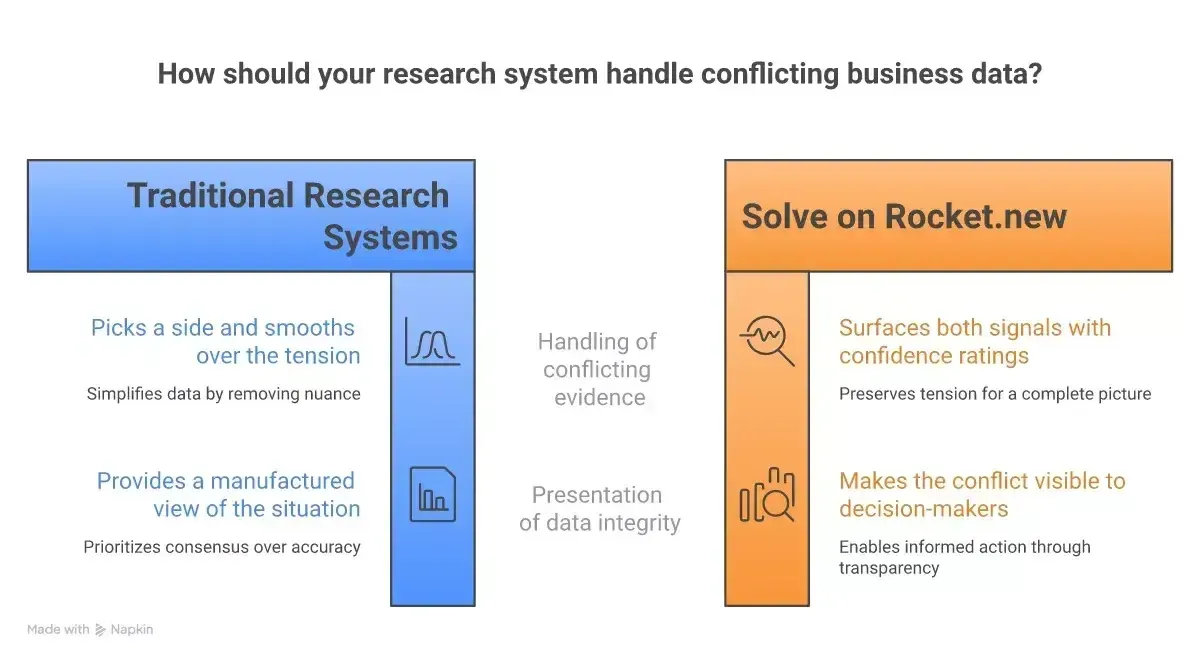
That is not a rare situation - it is how most serious decisions actually work. Solve on Rocket.new was built for exactly this. When evidence conflicts, Solve does not pick a side and bury the tension.
It surfaces both signals, tags each with a confidence rating, and takes into account all relevant factors, visualizing tradeoffs to support better decision-making and giving you the context to make a real call, rather than a false sense of certainty.
According to a 2025 SoftServe survey of 750 business leaders, 58% say their companies regularly make key decisions based on inaccurate or inconsistent data. The problem is not always the data - it is that most research systems were never built to handle conflict in the data.
Why Conflicting Evidence is Such a Costly Business Problem
The Reality of Noisy, Contradictory Markets
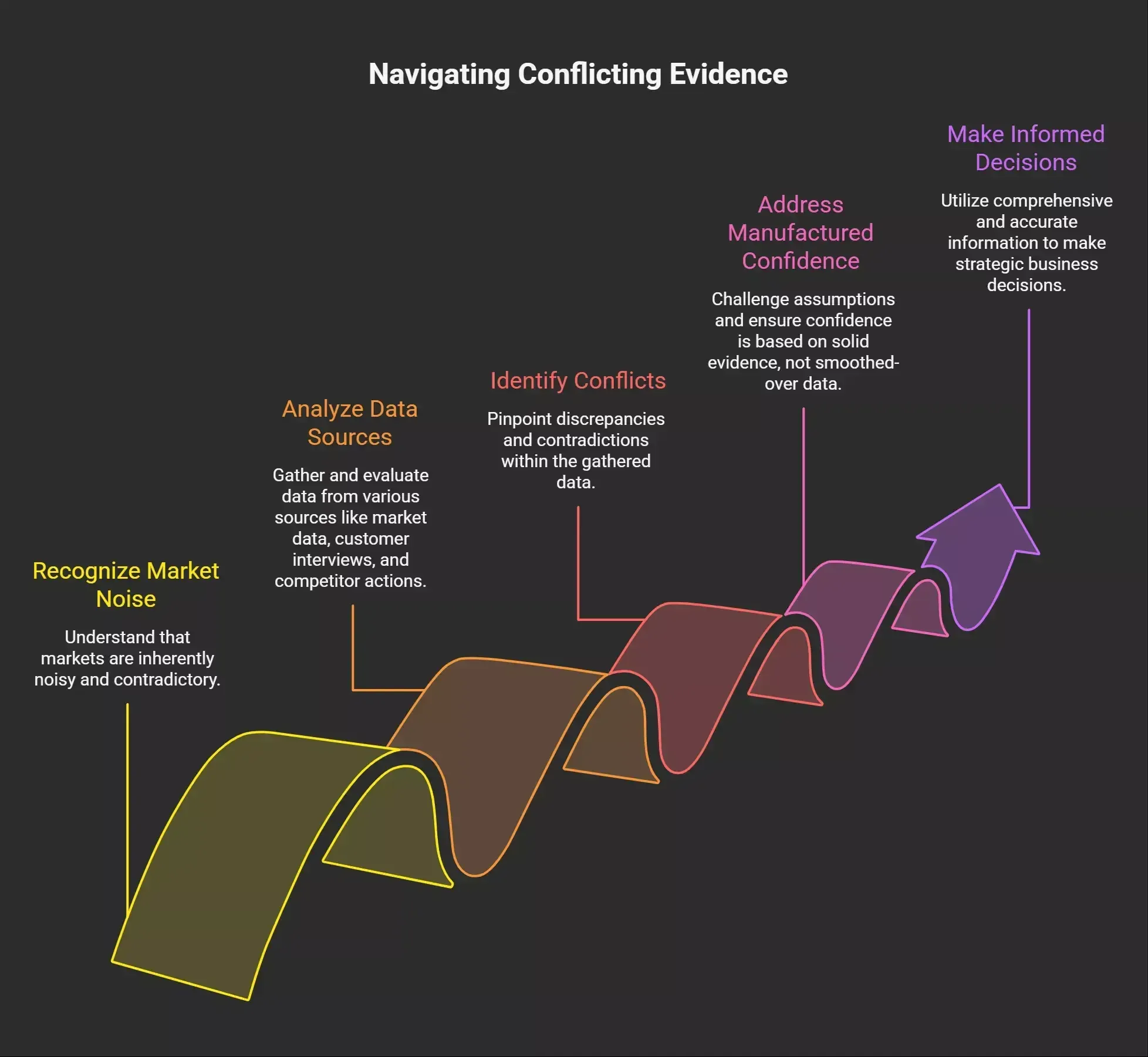
Most business questions do not come with a clean, obvious answer. Market data says one thing. Customer interviews say another. A competitor’s recent move suggests a third direction entirely. This is not a data quality problem. It is a structural reality. Real markets are noisy, shifting things, and any question worth asking will produce signals that do not all point the same way.
What the Numbers Say About Bad Decision-Making
The cost of handling this badly is steep. McKinsey and the Institute of Directors found that poor decision-making costs a typical Fortune 500 company $250 million per year in wasted management time - before you factor in the opportunity cost of building the wrong thing or entering the wrong market.
Prices play a crucial role here, as they directly influence resource allocation and optimal design objectives in both business and economic contexts, shaping how teams prioritize projects and make trade-offs. Harvard Business School analyzed more than 30,000 product launches and found that 80% fail, mostly due to poor strategic decisions built on incomplete or misread information.
The Hidden Danger of Manufactured Confidence
The underlying problem is simple: most teams get research that gives them a confident-sounding answer. But the confidence was manufactured. The conflict was smoothed over before they ever saw it. And the team moved forward on a foundation that was not as solid as it looked.
This is the most expensive kind of mistake. Not a bad execution of a good idea - a good execution of the wrong thing.
The Reality of Noisy, Contradictory Markets
Most business questions do not come with a clean, obvious answer. Market data says one thing. Customer interviews say another. A competitor’s recent move suggests a third direction entirely. This is not a data quality problem. It is a structural reality. Real markets are noisy, shifting things, and any question worth asking will produce signals that do not all point the same way.
What the Numbers Say About Bad Decision-Making
The cost of handling this badly is steep. McKinsey and the Institute of Directors found that poor decision-making costs a typical Fortune 500 company $250 million per year in wasted management time - before you factor in the opportunity cost of building the wrong thing or entering the wrong market.
Prices play a crucial role here, as they directly influence resource allocation and optimal design objectives in both business and economic contexts, shaping how teams prioritize projects and make trade-offs. Harvard Business School analyzed more than 30,000 product launches and found that 80% fail, mostly due to poor strategic decisions built on incomplete or misread information.
The Hidden Danger of Manufactured Confidence
The underlying problem is simple: most teams get research that gives them a confident-sounding answer. But the confidence was manufactured. The conflict was smoothed over before they ever saw it. And the team moved forward on a foundation that was not as solid as it looked.
This is the most expensive kind of mistake. Not a bad execution of a good idea - a good execution of the wrong thing.
The Reality of Noisy, Contradictory Markets
Most business questions do not come with a clean, obvious answer. Market data says one thing. Customer interviews say another. A competitor’s recent move suggests a third direction entirely. This is not a data quality problem. It is a structural reality. Real markets are noisy, shifting things, and any question worth asking will produce signals that do not all point the same way.
What the Numbers Say About Bad Decision-Making
The cost of handling this badly is steep. McKinsey and the Institute of Directors found that poor decision-making costs a typical Fortune 500 company $250 million per year in wasted management time - before you factor in the opportunity cost of building the wrong thing or entering the wrong market.
Prices play a crucial role here, as they directly influence resource allocation and optimal design objectives in both business and economic contexts, shaping how teams prioritize projects and make trade-offs. Harvard Business School analyzed more than 30,000 product launches and found that 80% fail, mostly due to poor strategic decisions built on incomplete or misread information.
The Hidden Danger of Manufactured Confidence
The underlying problem is simple: most teams get research that gives them a confident-sounding answer. But the confidence was manufactured. The conflict was smoothed over before they ever saw it. And the team moved forward on a foundation that was not as solid as it looked.
This is the most expensive kind of mistake. Not a bad execution of a good idea - a good execution of the wrong thing.
The Reality of Noisy, Contradictory Markets
Most business questions do not come with a clean, obvious answer. Market data says one thing. Customer interviews say another. A competitor’s recent move suggests a third direction entirely. This is not a data quality problem. It is a structural reality. Real markets are noisy, shifting things, and any question worth asking will produce signals that do not all point the same way.
What the Numbers Say About Bad Decision-Making
The cost of handling this badly is steep. McKinsey and the Institute of Directors found that poor decision-making costs a typical Fortune 500 company $250 million per year in wasted management time - before you factor in the opportunity cost of building the wrong thing or entering the wrong market.
Prices play a crucial role here, as they directly influence resource allocation and optimal design objectives in both business and economic contexts, shaping how teams prioritize projects and make trade-offs. Harvard Business School analyzed more than 30,000 product launches and found that 80% fail, mostly due to poor strategic decisions built on incomplete or misread information.
The Hidden Danger of Manufactured Confidence
The underlying problem is simple: most teams get research that gives them a confident-sounding answer. But the confidence was manufactured. The conflict was smoothed over before they ever saw it. And the team moved forward on a foundation that was not as solid as it looked.
This is the most expensive kind of mistake. Not a bad execution of a good idea - a good execution of the wrong thing.
What Most AI Tools Do When Evidence Conflicts
The Default Response: Averaging it Out
Most AI tools - chatbots, research assistants, general search - handle conflicting evidence the same way: they average it out.
When two signals pull in opposite directions, the system finds a middle ground. It produces an answer that does not fully reflect either signal. The output sounds complete and authoritative, often padded with decorative background noise that distracts from actionable insights. The user walks away feeling informed. But the actual tension in the data - the thing that should have shaped the decision - was never surfaced.
Why General-Purpose AI Falls Short for Business Decisions
This is one of the core limitations of general-purpose AI tools for business decisions. They are built to generate a fluent, confident response. Conflict does not fit that pattern well. So it gets resolved before you ever see it.
The Blind Spot in Vibe Coding
Vibe coding platforms have a similar blind spot. Tools like Lovable, Bolt, and v0 are excellent at building what you tell them to build. But they do not analyze whether the direction is right. They do not surface signals that cut against your assumptions. They build. The thinking - and the risk of building the wrong thing - stays entirely with you.
The real difference between building and thinking: There is nothing wrong with those tools doing what they are built to do. The problem is using them as a substitute for the thinking that should come before the build.
How Solve on Rocket.new Handles a Question Where the Evidence Points in Two Different Directions
The Core Principle: Conflict is the Finding
So, how does Solve on Rocket.new handle a question where the evidence points in two different directions?
Solve was designed with a different principle: when the evidence conflicts, the conflict is the finding.
A Structured Pipeline, Not a Single Search
Mapping questions into structured dimensions before data collection can significantly improve decision-making outcomes in business contexts, as it ensures that teams address the right problems rather than making assumptions.
When you send Solve a business question, it does not run a single search and synthesize the results into one polished answer. It runs a structured six-step pipeline that breaks your question into component dimensions, mapping complex decision criteria into structured research streams, and then brings those streams together for synthesis.
How the Process Works Step by Step
The process works like this:
-
You ask a question in plain language.
-
Solve clarifies if needed, sets the research objective, where each research stream is designed to approach a specific target or desired outcome.
-
Solve then breaks the question into component dimensions through query decomposition.
Parallel Agent Streams and Signal Tagging
Using parallel AI agents to research each dimension of a question can provide comprehensive insights that are interconnected, enhancing the quality of decisions made by teams.
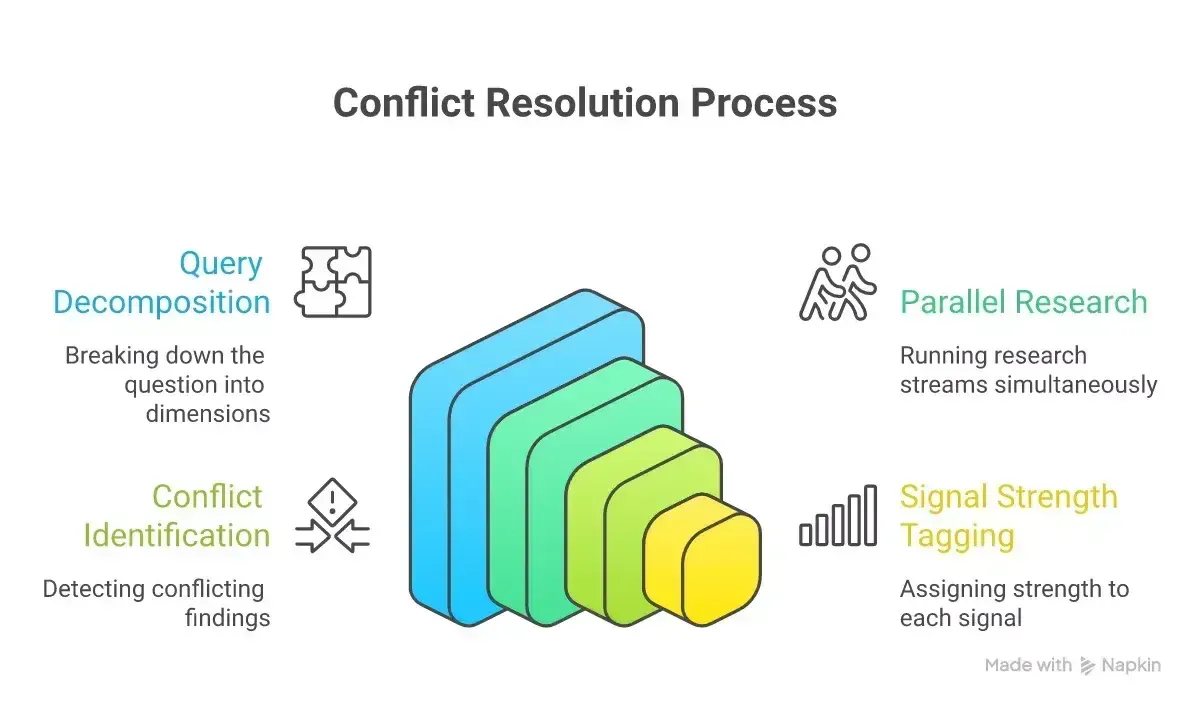
Each dimension runs as a parallel agent research stream. When findings conflict, both signals appear in the output tagged HIGH, MEDIUM, or LOW. All streams then merge into a structured report covering the verdict, analysis, evidence, risks, and execution path. After that, you can follow up to drill down, challenge, or pivot.
How Synthesis Works When Findings Conflict
The key moment is synthesis. When findings from different research streams come back in conflict, Solve does not average them. Instead, the synthesis step has a clear form: it tags each finding with a signal strength, HIGH, MEDIUM, or LOW, based on source quality, recency, and corroboration. Both signals appear in the output with their respective confidence ratings, and the conflict is explicitly called out in the analysis rather than resolved into false clarity.
This is a deliberate product decision. Rocket.new founding belief is that the work is only as good as the thinking before it. Manufactured certainty is not thinking - it is noise dressed up as clarity.
Signal Strength Tagging: What HIGH, MEDIUM, and LOW Actually Mean
Every finding in a Solve report carries a signal tag. This is not decorative. It tells you how much weight to put on each piece of evidence - and where the gaps are.
| Signal Strength | What It Means | What to Do With It |
|---|---|---|
| HIGH | Well-corroborated, multiple sources, recent, consistent | Treat as a solid foundation for the decision |
| MEDIUM | Supported but not fully corroborated - some inconsistency across sources | Factor in, but verify the key claims before committing |
| LOW | Single source, older data, or directly contradicted by other findings; represents the worst-supported evidence among the findings, similar to the minimax principle in multi-objective optimization | Do not ignore - could be an early signal worth investigating |
When evidence conflicts, you will typically see two findings with different signal strengths. One might be tagged HIGH - solid, well-sourced, recent. The other tagged MEDIUM or LOW - present in the data but not as strongly supported. That contrast tells you something important.
It also tells you what to investigate next. A LOW signal that contradicts a HIGH signal is not automatically noise to discard. It might point to a market shift, a niche segment behaving differently, or a data gap worth closing before you commit resources to a direction.
Why Query Decomposition Matters for Complex Business Questions
One reason most research tools miss conflicting signals is structural: they treat your question as a single query. One search. One synthesis. One answer.
The process of query decomposition allows teams to break down complex business questions into manageable parts, which can lead to more accurate and actionable insights.
Solve breaks your question into independent components, treating each as a separate research stream simultaneously. A question about whether to enter a new market might decompose into components such as:
-
Market size and growth trajectory
-
Competitive density and current positioning
-
Customer job-to-be-done analysis
-
Regulatory and compliance environment
-
Analogous market precedents from other geographies
-
Cost of entry vs. projected return on capital
Each of those components might produce data that points in a different direction. The market might be large, but the competitive density is high. The customer need might be strong, but the regulatory picture is complex. The analogous market precedent might suggest a longer-than-expected sales cycle. None of that conflict would surface if you ran it as a single question and got a single answer.
Decomposition into components is what makes conflict visible. And visible conflict is what actually helps you make a better decision - because you are working with an accurate picture of what you know and what you do not.
The Challenge Follow-Up: Pressure-Testing the Weaker Case
After the initial Solve report, you can run follow-ups that actively push against the output. The platform is built for conversational iteration - each question builds on the full context of everything that came before it, allowing you to review the evolving analysis to summarize findings and approaches.
Three follow-up patterns are built into how Solve works:
-
Drill-down - go deeper into one specific section of the analysis
-
Challenge - stress-test the primary recommendation
-
Pivot - redirect the analysis if an unexpected finding changes the frame entirely
The Challenge pattern is specifically designed for situations where the evidence splits. If Solve surfaces two conflicting signals and leans toward one as the primary recommendation, you can ask it to build the strongest possible case for the other side. Each follow-up creates a new version of the analysis, so you can track how the picture shifts as you pressure-test it.
This matters because conflicting evidence is not always a reason to pause. Sometimes the stronger signal is clearly stronger - and the Challenge confirms that. Sometimes the weaker signal points to something real that deserves more weight than the initial analysis gave it. The follow-up process helps you figure out which situation you are actually in.
A Practical Example of Conflicting Evidence in Action
The Scenario: Expanding Into a New Vertical
Say you are considering expanding your SaaS product into a new vertical. You ask Solve to analyze the opportunity.
How Solve Decomposes the Question
Solve decomposes the question. The market sizing research comes back HIGH - the vertical is large and growing at a pace that looks attractive. The competitive analysis comes back MEDIUM - there are two established players, but both have documented customer complaints about specific capability gaps. The customer research comes back with a LOW signal, suggesting this vertical's buyers, users in this context, use a significantly different procurement process than your current users, one that could slow your sales cycle substantially.
Navigating Trade-Offs in Multi-Signal Decisions
In practice, solving such multi-objective problems involves approaches that support decision-makers in real-world applications, helping to address the complexities and trade-offs encountered.
What Happens Without a System Like Solve
Without a system like Solve, you might have run a quick search, found the market size data, felt confident, and started building. The procurement complexity signal, the one that could determine whether your current go-to-market motion works at all, would have been missed entirely.
What the Output Actually Gives You
With Solve, all three signals appear in the report with their respective confidence ratings. The output does not tell you to proceed or not. It tells you what is known, what is uncertain, and what the key questions are. You can then ask Solve to go deeper on the procurement signal, run a drill-down on that LOW finding, and understand whether it represents a dealbreaker or a solvable problem before you commit.
That is a meaningfully different starting point for a decision.
What Others in the Field are Saying
Strategy advisor Ruth Napier captured the honest reality of complex business decisions in a widely shared LinkedIn post:
“These are rarely decisions with perfect data. Often the information is incomplete, contradictory, or equally balanced. Experience, judgement… and sometimes the data simply does not help.”
The answer is not to wait for perfect data - that moment rarely arrives. The answer is to build a research system that makes the quality and conflict of data visible, so you can act with real context instead of manufactured confidence. The purpose is to inform decision-makers with relevant insights and clarity about complex problems, equipping them to make better strategic choices. That is what Solve was built to do.
Solve vs. Other AI Tools on Conflicting Evidence
| Capability | Chatbots (ChatGPT, Claude) | Search Tools (Perplexity) | Vibe Coding Tools (Lovable, Bolt, v0) | Solve on Rocket.new |
|---|---|---|---|---|
| Surfaces conflicting signals | No - averages out | Partial - multiple links, no synthesis | Not applicable | Yes - both signals with tags |
| Signal strength tagging | No | No | No | Yes - HIGH / MEDIUM / LOW |
| Query decomposition into dimensions | No | No | No | Yes - parallel research streams |
| Challenge follow-up patterns | Limited | No | No | Yes - drill-down, challenge, pivot |
| Output carries forward into build | No | No | Partially (direct build only) | Yes - full context passed to Build |
| Collaboration features built in | No | No | No | Yes - shared workspaces, audit logs, integrated solve, build, and intelligence |
The structural difference goes beyond feature comparison. A chatbot gives you a fluent answer. Solve gives you a structured, analytical deliverable, with findings, evidence, confidence levels, risks, a call to action section to guide users toward next steps, and a clear execution path.
This approach is designed to maximize overall value by balancing multiple objectives and supporting better decision-making through integrated collaboration features. That is a different kind of output designed for a different kind of decision.
How Context Compounds Over Time in Rocket.new
Rocket.new's problem-solving approach, termed 'vibe solutioning', emphasizes understanding every dimension of a business question before any data is pulled, which contrasts with traditional methods that often jump straight to data collection.
Introducing the Vibe Solutioning Category
Rocket.new created the category of Vibe Solutioning, the first named category in AI that covers the complete arc from strategic intelligence to execution to ongoing business operation in one platform with shared compound context. Solve is the intelligence layer of that system, and teams begin with a setup process to configure the platform for their specific needs and methodologies.
Why Solve is Different From Standalone Research Tools
What makes Solve different from standalone research tools is not just how it handles a single question.
By maintaining shared project memory, Rocket.new allows teams to reference all accumulated knowledge across tasks, reducing context loss and ensuring that the development process is informed by previous insights.
The output does not disappear after you read it. The Solve analysis - including the flagged conflicts, the signal tags, and the follow-up refinements- becomes part of the project shared context in Rocket.new. Context compounds over time across every step the team takes inside the project.
From Intelligence to Execution: How Build Uses Solve's Output
When you move to Build on Rocket.new production-grade builder for web apps and mobile apps, that analysis is already present. Planning plays a key role here, as teams organize and prepare for complex tasks using the insights from Solve. The risk you identified during research is visible when the developer opens the build task.
The competitive intelligence established in the Solve output informs the landing page. The procurement complexity flagged during the market analysis shapes how the product is scoped. Integrated code generation in Build enables faster and more coherent development, ensuring that the resulting apps are aligned with the strategic insights from Solve.
Eliminating context loss at the source: This is context loss eliminated at the source. Not a handoff from research to build - an architecture where thinking flows directly into execution.
Rocket.new Launches with Solve, Build, and Intelligence Working Together in One Platform
Rocket 1.0 ships with three capabilities that work together around complex decisions.
Solve: Structured Analysis With Conflicting Signals Surfaced
Solve takes any business question - market entry, competitive intelligence, product direction, M&A assessment, regulatory research, pricing strategy - and delivers a structured analytical output within 60 to 90 minutes, with conflicting signals surfaced and tagged explicitly. The platform enables optimized and efficient solutions by balancing multiple objectives, while also ensuring that human judgment and involvement remain central to the decision-making process.
Build: Production-Grade Output Rooted in Research Context
Build generates production-grade web apps, mobile apps, landing pages, and internal tools from the direction established in Solve. The build starts with the full context of the research already embedded - so the first generation reflects genuine product thinking, not a blank-slate prompt. Teams can decide how to spend resources most effectively to achieve desired outcomes, guided by the insights from Solve.
Intelligence: Continuous Market Monitoring That Compounds Over Time
Intelligence continuously monitors competitor signals across every public platform they operate on - product updates, job postings, pricing changes, and content strategy shifts. When something changes in the market that conflicts with a prior Solve conclusion, a new Solve question can be triggered with fresh context. The research compounds over time.
How the Three Work Together on Ambiguous Decisions
For a team working through a genuinely ambiguous decision - one where the evidence points in two different directions - this combination changes how the work gets done. Solve maps the conflict. Build lets you act on the best available direction. Intelligence watches for the signals that might resolve the conflict as more information becomes available.
What the Vibe Solutioning Category is Actually Built Around
This is what the vibe solutioning platform category is built around: not just faster answers, but better decisions - because the thinking, the building, and the monitoring all happen in one system with shared context that compounds over time.
Making Decisions When the Evidence Splits
The most expensive business mistakes rarely come from bad execution. They come from executing well on a wrong assumption, a confident bet on the wrong thing that the full picture of the data would have questioned, especially when the value of different options and their proximity to your desired outcomes is not fully considered.
Most research systems were not built to show you that full picture. They were built to give you an answer. And an answer that smooths over conflict is not actually more useful; it is less useful, because it hides the thing you needed to know, including the value trade-offs between conflicting objectives.
Handling the Evidence Points in Two Different Directions with Solve
It does what every good analyst does: it shows you both sides, tells you how strong each signal is, gives you the tools to pressure-test the weaker case, and connects that thinking directly to what you build next.
Solve also provides the necessary background for the call, equipping decision-makers with relevant, customized information to inform their strategy. When the data is messy, and for most decisions worth making, it is, that is the kind of system that leads to better outcomes.
Start using Solve on Rocket.new to turn conflicting data into a confident, decision-ready strategy.
Table of contents
- -Why Conflicting Evidence is Such a Costly Business Problem
- -The Reality of Noisy, Contradictory Markets
- -What the Numbers Say About Bad Decision-Making
- -The Hidden Danger of Manufactured Confidence
- -The Reality of Noisy, Contradictory Markets
- -What the Numbers Say About Bad Decision-Making
- -The Hidden Danger of Manufactured Confidence
- -The Reality of Noisy, Contradictory Markets
- -What the Numbers Say About Bad Decision-Making
- -The Hidden Danger of Manufactured Confidence
- -The Reality of Noisy, Contradictory Markets
- -What the Numbers Say About Bad Decision-Making
- -The Hidden Danger of Manufactured Confidence
- -What Most AI Tools Do When Evidence Conflicts
- -The Default Response: Averaging it Out
- -Why General-Purpose AI Falls Short for Business Decisions
- -The Blind Spot in Vibe Coding
- -How Solve on Rocket.new Handles a Question Where the Evidence Points in Two Different Directions
- -The Core Principle: Conflict is the Finding
- -A Structured Pipeline, Not a Single Search
- -How the Process Works Step by Step
- -Parallel Agent Streams and Signal Tagging
- -How Synthesis Works When Findings Conflict
- -Signal Strength Tagging: What HIGH, MEDIUM, and LOW Actually Mean
- -Why Query Decomposition Matters for Complex Business Questions
- -The Challenge Follow-Up: Pressure-Testing the Weaker Case
- -A Practical Example of Conflicting Evidence in Action
- -The Scenario: Expanding Into a New Vertical
- -How Solve Decomposes the Question
- -Navigating Trade-Offs in Multi-Signal Decisions
- -What Happens Without a System Like Solve
- -What the Output Actually Gives You
- -What Others in the Field are Saying
- -Solve vs. Other AI Tools on Conflicting Evidence
- -How Context Compounds Over Time in Rocket.new
- -Introducing the Vibe Solutioning Category
- -Why Solve is Different From Standalone Research Tools
- -From Intelligence to Execution: How Build Uses Solve's Output
- -Rocket.new Launches with Solve, Build, and Intelligence Working Together in One Platform
- -Solve: Structured Analysis With Conflicting Signals Surfaced
- -Build: Production-Grade Output Rooted in Research Context
- -Intelligence: Continuous Market Monitoring That Compounds Over Time
- -How the Three Work Together on Ambiguous Decisions
- -What the Vibe Solutioning Category is Actually Built Around
- -Making Decisions When the Evidence Splits
- -Handling the Evidence Points in Two Different Directions with Solve