
Most AI projects fail because teams skip research and build without a clear direction. Rocket.new combines Solve, Build, and Intelligence into one vibe solutioning platform that keeps research, development, and competitor tracking connected. Teams of any size can generate research-grade insights, build production-ready apps, and monitor competitors without needing a dedicated research department.
What Goes Wrong When People Skip Research
What happens when a group starts building an AI app without answering the right questions first?
Honestly, most of the time, the project dies. Over 80% of AI projects fail, and the root cause is almost never the technology. It is the thinking, or the lack of it, that kills the idea before it ships.
- Most teams do not have a dedicated research function. They rely on scattered Google searches, gut instinct, and a few files someone pulled together the night before a meeting.
- The information they work with is outdated by the time it reaches a decision-maker. Links go stale, files get lost, and nobody can point to a single source of truth.
- People walk into calls without shared context, and the conversation loops instead of moving forward.
So why do some people still ship with confidence while others get stuck? The answer lives in their process, and where they do their thinking before they begin building.
Why 8 Out of 10 AI Initiatives Stall
Various sources and polls indicate that 8 out of 10 IT projects and implementations fail, which is likely similar for AI projects due to human factors and lack of preparedness.
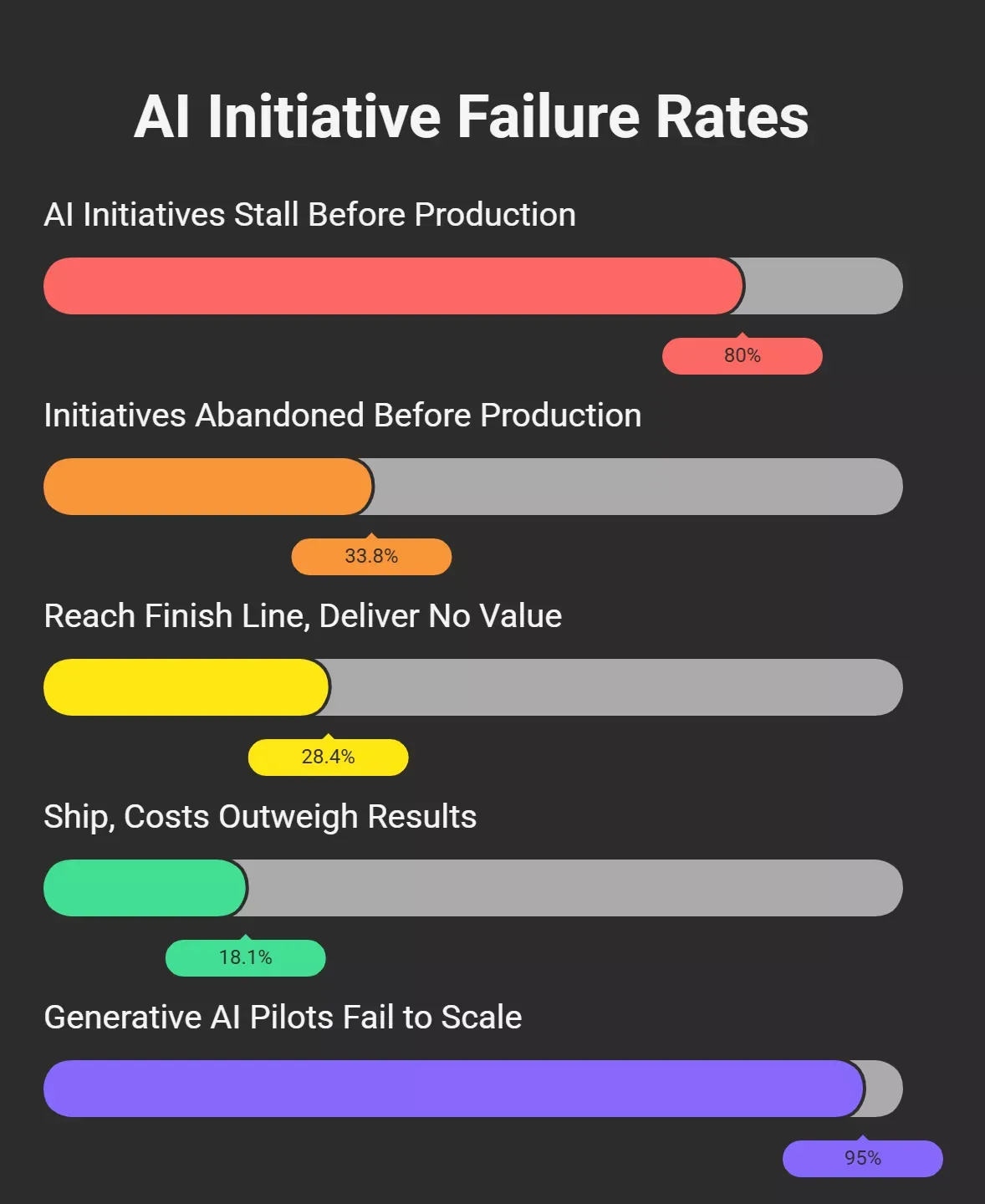
The numbers are interesting, and honestly a bit alarming. RAND Corporation found that more than 80% of initiatives involving AI stall before reaching production. That is twice the rate of non-AI IT projects.
- 33.8% of these initiatives get abandoned before production.
- 28.4% reach the finish line but deliver no measurable value.
- 18.1% ship, but the costs outweigh the results.
MIT's research adds another layer. 95% of generative AI pilots fail to scale, not because the models are broken, but because companies built generic wrappers that did not integrate into workflows or learn over time.
- Many companies rush to adopt AI tools without a clear understanding of their operational needs, and the projects collapse under misaligned expectations.
- Leadership often mistakes a prototype for a finished product. A polished demo is not a shipped product. In reality, that prototype is just the beginning of a much longer process.
- Projects built on AI fail when the questions being answered are wrong. If you begin building from a weak or vague idea, every layer you add makes the problem worse.
So the point is not that AI is bad. It is that most people skip the preparation that makes their AI tools and projects work. The work is only as good as the thinking before it.
The Real Cost of Using Separate Tools
AI tools allow small teams to automate repetitive research tasks, enabling scalability of insights without increasing headcount. But what happens when a group tries to run research, building, and competitive analysis across separate tools?
- A product lead uses one AI tool for market research, another to write the PRD, a third for building the prototype, and a fourth for tracking competitors.
- Every switch loses context. The market insights that shaped the original idea do not flow into the coding workspace. The competitive signals never reach the builder.
- Files live in different folders, links get buried in Slack threads, and by the time the group regroups, half the decisions have already been answered by someone who did not have the full picture.
This fragmentation is the default for most people running projects. And it is worse than just inconvenient. It leads to real failures.
| Problem | What Happens With Separate Tools | What Happens With One Platform |
|---|---|---|
| Market research | Manual, scattered across tabs | Automated, structured output |
| Decision to stakeholders | Slide decks built from scratch | Ready-to-present briefs |
| Building the product | Re-explain the context to a new tool | Context carries forward |
| Competitor tracking | Quarterly manual checks | Continuous daily monitoring |
| Alignment across people | Meetings to re-sync lost links | Everyone works from one workspace |
| Context loss | High, gets worse over time | None, the platform remembers |
The worse the fragmentation gets, the more time people spend re-explaining instead of building. Projects stall. Progress stalls. And the whole organization slows down.
What Vibe Solutioning Actually Means
Vibe coding changed how people think about building software. Andrej Karpathy coined the term in early 2025, and within months, Collins Dictionary named it Word of the Year. The core idea: describe what you want in natural language, and let AI write code for you. You skip the manual coding entirely. You focus on intent, not syntax.
Vibe solutioning takes that same philosophy and pushes it further upstream.
- Vibe coding starts at the build. Vibe solutioning starts at the problem.
- Most AI tools fail to deliver effective intelligence because they often address the wrong problem due to unclear goals or weak questions.
- Before anyone writes a single line of code, you need to understand the market, figure out what to build, and get aligned with your collaborators. Vibe solutioning is that entire pre-build process, handled by AI.
- You describe a problem, a market opportunity, or a decision you need to make. The vibe solutioning platform returns structured research, evidence, and a recommendation you can act on.
Rocket.new is the world's first vibe solutioning platform. It covers the full arc: from the first question to a live product to continuous competitive monitoring.
On one platform, solve, build, and track what your competition does next. Solve, Build, and Intelligence work together so your decisions carry forward instead of starting fresh every time you open a different app.
Vibe solutioning is not vibe coding with extra steps. It is the thinking layer that makes vibe coding actually work for real projects.
How Solve on Rocket.new Replaces a Research Hire
Now find out why do teams without a dedicated research function get the same intelligence as teams that have one on Rocket.new?
Many companies that want deep research either hire an analyst or pay for expensive consulting engagements. Smaller organizations cannot afford that. They figure it out on their own, which means slower decisions, weaker insights, and more guesswork. The default is to wing it.
Solve on Rocket.new changes this.
- Type any market problem, opportunity, or decision. Add a doc, a deck, or provide links for context if you have them.
- Rocket's AI runs the deep research: market analysis, competitor landscape, regulatory concepts, growth strategies, and product direction.
- The output is a structured brief with evidence, real data and figures, and a clear recommendation. Ready to present to a room, hand to a developer, or push straight into building.
Here is what that looks like in practice:
- A founder with a mobile apps idea types a one-paragraph description of the problem.
- Solve on Rocket.new pulls market data, identifies competitors, and recommends a feature set.
- The founder reviews the brief, adjusts it, and pushes it directly into Build, where Rocket already has the full context.
- No re-explaining. No starting from scratch. No lost files.
This is how groups without a dedicated research function get the same quality of answered output as companies that have a full research department. The system handles the research. The people focus on decisions.
You can use Solve for anything: a new product direction, a GTM strategy, a regulatory question, or background for the call with a potential investor. Provide links to any relevant resources, and the answered brief comes back sharper. Every question answered, every number sourced.
Building With Full Context Instead of Guesswork
Once the research is done, most people hit a wall. They take their findings, open a completely different tool, and begin building from zero. The insights they gathered do not transfer. The decisions they made live in a Google Doc somewhere. The context evaporates.
Rocket.new does not work that way.
- When you move from Solve into Build on Rocket, the entire context of your research carries forward. Every decision, every data point, every recommendation. No data left behind.
- You do not need to re-explain your idea to a code generator. Rocket already knows what you are building and why.
- Building happens through plain-English prompts or from the full context of your decisions. Web apps, mobile apps, landing pages, SaaS products, dashboards, internal tools.
Projects built with context ship faster and fail less often. The research feeds directly into what gets built, and that connection is the difference between a product that matches the market and one that misses completely.
- This also means your user needs, your competitors, and your market position stay visible throughout the entire workflow. No more syncing meetings where half the time goes to getting everyone caught up.
- Every file, every decision, every brief lives in the same place. Links to previous answers stay accessible. That is how you keep projects from getting stuck.
AI allows people to work faster. Studies show 16% faster idea generation for individuals and 13% faster for groups when AI handles repetitive research tasks. But speed without direction makes things worse. Context gives that direction.
Where Does Vibe Coding Fit In?
Vibe coding has earned its place. Y Combinator reported that 25% of its Winter 2025 batch had codebases that were 95% AI-generated. Google's Sundar Pichai said over 30% of new code at Google comes from AI. Code generation at this scale is real, and the results speak for themselves.
But vibe coding alone does not solve the research problem.
- Vibe coding answers "how do I build this?" It does not answer "what should I build?" or "will anyone actually use it?"
- Code generation without prior research leads to products that work technically but miss the market entirely. The user experience might be polished, but the concept behind it was never validated.
- People who vibe code without vibe solutioning end up building things nobody asked for, and then they are worse off than when they started.
Rocket.new connects both. You begin with vibe solutioning to figure out the right thing to build. Then you push into vibe coding where Rocket generates deployment-ready output in Flutter for mobile apps or Next.js for web apps. Rocket already understands the requirements because the research answered those questions first.
- You do not need to write code to get a live deployment. Rocket handles staging, production, and one-click deploy.
- The code is downloadable. You own the IP. You can integrate it with your existing tools and workflows.
- This is how AI app development goes from "months of planning" to "one conversation."
Vibe coding is the engine. Vibe solutioning is the capability that tells the engine where to go.
What People Are Saying
The shift toward AI-powered research for smaller organizations is not just theory. People building real companies post about it constantly.
"AI creates 'superagency,' the ability for individuals to punch far above their weight."- Reid Hoffman, LinkedIn Co-Founder, from Superagency (2025)
Hoffman's point matches what happens on Rocket.new every day. People in groups of two or three use the research layer to do market analysis that used to require a full-time dedicated analyst. They push that research into Build and ship polished web apps and mobile apps in days. Then they watch what competitors do next through the Intelligence tab, so they stay prepared without manual monitoring.
The gap between large and small organizations is closing. And the companies that close it fastest are the ones using a vibe solutioning platform where research, building, and tracking live together.
How Rocket.new Gives Every Team a Research Function
This is the core question answered. Because Rocket replaces the research function with a system that does the same work, faster, and keeps the results connected to everything that comes after.
Here is what Rocket brings to every user:
- Vibe solutioning platform: Describe any problem. Get structured research, market analysis, and a clear recommendation, no analyst required.
- **25,000+ templates library, free to use**: Pick a starting point close to your idea. Rocket adapts it to your context, your brand, and your goals.
- Supports Flutter (mobile) and Next.js (web): Build for any platform from the same starting point. Mobile apps and web apps from one workflow.
- Collaboration features built in: People work together inside the same workspace. No fragmented setup for different roles.
- 3 Pillars, Solve, Build, and Intelligence: The first vibe solutioning platform that covers thinking, building, and tracking in one place. Solve Build and Intelligence, unified.
So here are use cases that connect research to building directly:
- Pre-launch market validation: Before building a new product, run the research layer to understand the competitive landscape, find gaps, and validate the idea with real market data. Push the validated concept into Build without losing context. Post your launch faster than competitors who are still trying to figure out what to build.
- Ongoing competitive monitoring: Continuous intelligence monitoring provides teams with an early warning system for competitor repositioning, saving up to 80% of the time usually spent on manual research. The Intelligence tab watches competitor websites, social media, pricing changes, hiring signals, and product launches continuously. You get daily briefs instead of relying on quarterly manual checks. Every signal is answered and logged in the same workspace.
- Investor-ready preparation: Need background for the call with a VC? Rocket generates a market brief with current data, competitive positioning, and growth projections. Walk into the meeting prepared with real data, real numbers, and working links to your sources.
- Post-launch iteration: After deployment, the Intelligence tab keeps tracking what competitors do. When a competitor shifts messaging or launches a new feature, Rocket spots it and helps you understand what it means for your product. You can post updates and push new features in response, all from the same workspace.
Put Rocket to work for your next project. You do not need a research hire to get research-grade insight.
The Work That Compounds Over Time
One thing that makes Rocket different from using separate tools: the work accumulates and gets sharper over time.
- Every research brief you run adds to the context of your organization and its projects.
- Every competitor signal the Intelligence tab captures gets connected to your existing projects.
- Every Build iteration benefits from the decisions you already made.
This is how continuous monitoring works in practice. Instead of running a quarterly competitive review (which is already outdated by the time you present it), the platform provides daily strategic briefs. Competitor repositioned? Changed pricing? Shipped a new feature? You know about it the same day. The questions your stakeholders raise get answered before the next meeting.
- Smaller groups can react faster than larger companies because they have less bureaucracy. Pair that speed with continuous AI monitoring, and you have a capability that most large organizations still do not have.
- By fine-tuning workflows on proprietary files and internal documents, smaller groups match or beat the output of larger companies running dedicated research departments.
- The insights do not just sit in a file somewhere. They feed back into the research and building layers, so the next decision you make is informed by everything that came before. Every answered question, every insight, every competitive signal stays linked to your projects.
High collective performance depends more on group dynamics and equal participation than on individual talent. Rocket's shared context makes sure every user and every collaborator has access to the same information, regardless of role. That changes how people inside the system make decisions together and helps everyone understand the full picture.
Closing the Gap Between Thinking and Shipping
Why do teams without a dedicated research function get the same intelligence as teams that have one on Rocket.new?
Because the gap was never about headcount. It was about having a platform that connects research to building to tracking in one workflow.
Rocket.new closes that gap for any group, at any size, from the first idea to post-launch monitoring. The people who figure this out early will ship faster, build products that match their market, and stay ahead of competitors who are still juggling separate tools and losing context with every handoff.
Start your next AI project with Rocket.new and turn research, building, and competitive intelligence into one continuous workflow.
Table of contents
- -What Goes Wrong When People Skip Research
- -Why 8 Out of 10 AI Initiatives Stall
- -The Real Cost of Using Separate Tools
- -What Vibe Solutioning Actually Means
- -How Solve on Rocket.new Replaces a Research Hire
- -Building With Full Context Instead of Guesswork
- -Where Does Vibe Coding Fit In?
- -What People Are Saying
- -How Rocket.new Gives Every Team a Research Function
- -The Work That Compounds Over Time
- -Closing the Gap Between Thinking and Shipping