
The limitations of Base44 compared to Rocket.new come down to scope, speed, and scalability. Base44 works well for simple internal tools built on guided workflows, but it falls short when you need rapid app generation, full-stack web and mobile output, built-in market research, or predictable credit costs.
The limitations of base44 compared to Rocket.new are real, and they matter once your project moves beyond a simple prototype. Base44 is a guided AI app builder focused on structured, modular app creation. It works well for lightweight apps and internal tools.
Rocket.new, on the other hand, is a vibe solutioning platform that combines strategic research, full-stack generation, and competitive intelligence in one place.
So if you are picking between the two, here is what you actually need to know.
What is Rocket.new and What Makes It Different?
Rocket.new is not just another entry in the growing list of ai app builders. It is a complete platform built around three pillars:
-
Solve: validates ideas, runs market research, creates PRDs, and produces structured reports you can export as PDF, HTML, or PowerPoint
-
Build: generates production-ready Next.js web apps and Flutter mobile apps from natural language prompts, with GitHub sync, custom domains, staging and production environments, and version control
-
Intelligence: monitors competitors continuously with daily briefs, pricing change alerts, and trend signals delivered to a live dashboard
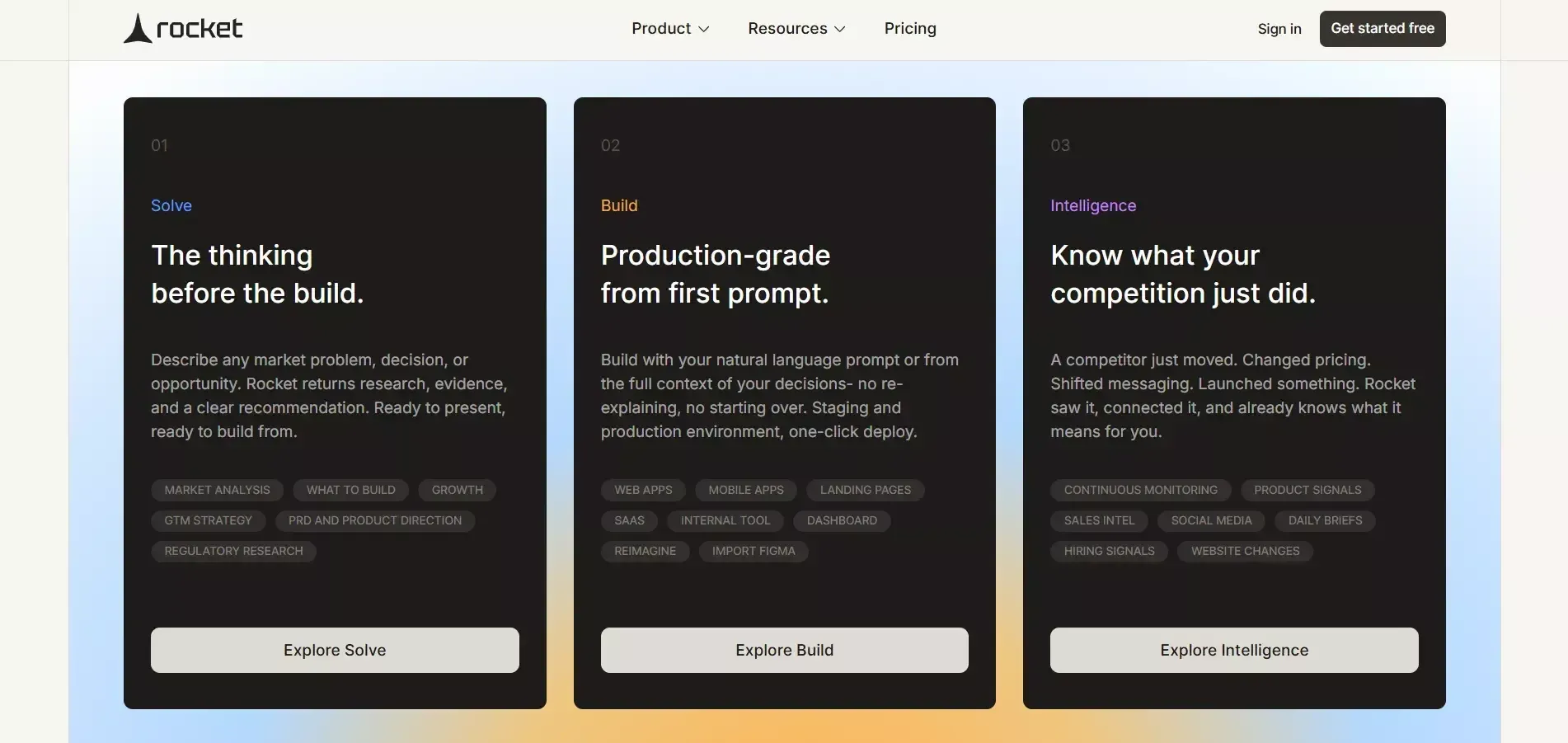 These three pillars share context. Research from Solve feeds directly into a Build task. A competitor signal from Intelligence can trigger a new Solve analysis. No tool switching. No lost context.
That is a fundamentally different product from Base44, which focuses only on the app-building layer.
How Do Rocket.new and Base44 Approach App Generation?
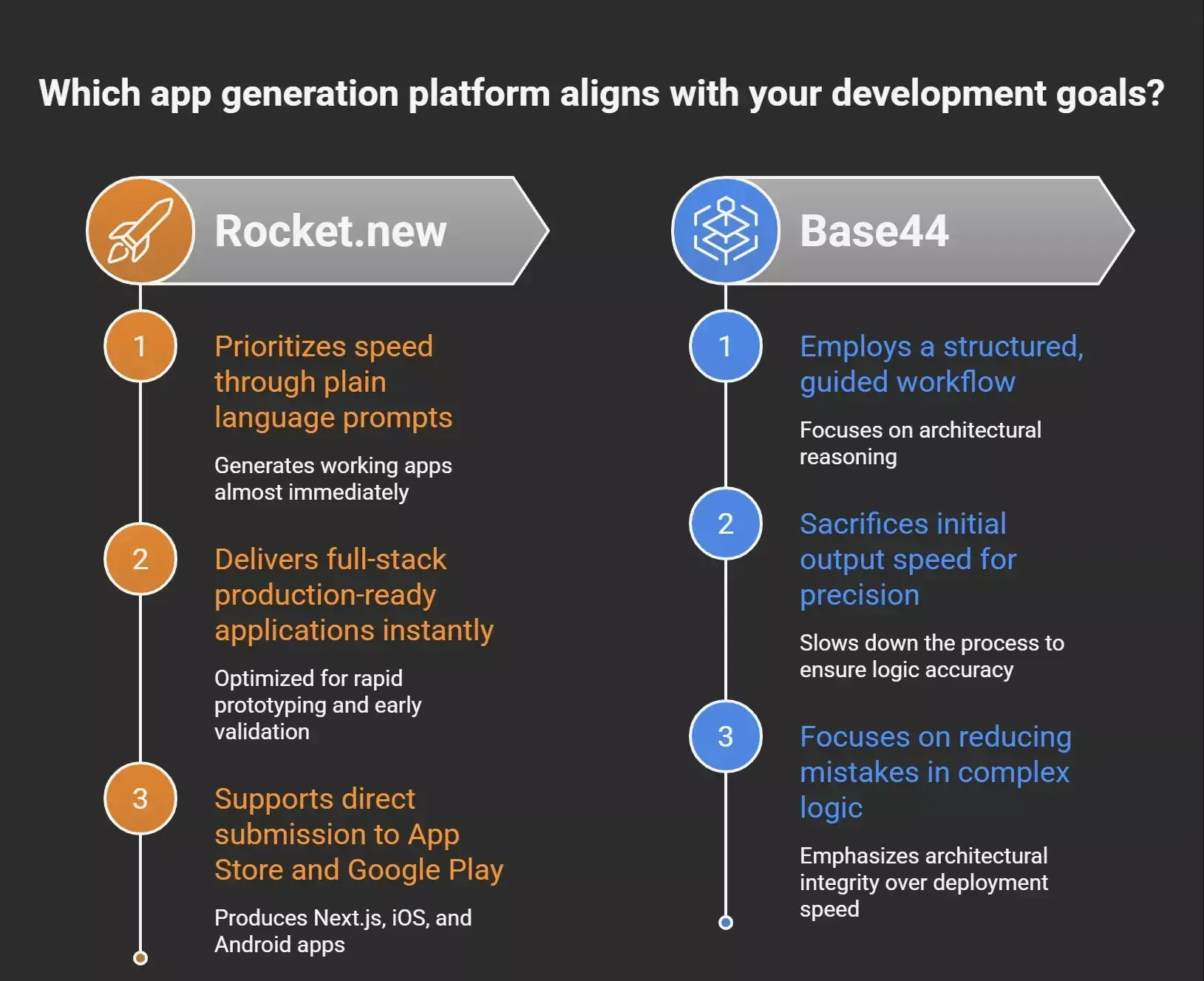
Rocket.new is built for speed. You describe what you want in plain language, and it generates a working app almost immediately. The platform produces production-ready Next.js apps for the web and Flutter apps for iOS and Android. You can submit directly to the App Store and Google Play. That is full-stack generation in a way Base44 simply does not match.
Base44 takes a more structured approach. It walks you through guided workflows and architectural reasoning. That can help reduce mistakes in complex logic, but it slows down initial output compared to Rocket.new.
For rapid prototyping, early stage validation, and getting a working app in front of users fast, Rocket.new is the stronger choice.
What are the Key Limitations of Base44 vs Rocket.new?
Here is a breakdown of where Base44 falls short when you put the two platforms side by side.
1. No Mobile App Generation
Base44 builds web apps only. Rocket.new builds both web and mobile apps natively using Flutter, with direct submission to the App Store and Google Play. If your product needs to live on a phone, Base44 is not the right tool.
2. No Strategic Research Layer
Base44 has no equivalent to Rocket.new's Solve feature. You describe a business problem to Rocket, and it researches it, maps the market, identifies gaps, and gives you a recommendation before you write a single line of code. Base44 skips all of that and goes straight to building, which means you are making product decisions without data.
3. No Competitive Intelligence
Rocket.new's Intelligence feature monitors competitors 24/7. It tracks website changes, pricing shifts, messaging updates, job postings, and more. Base44 offers nothing like this. Once your app is live on Base44, you are on your own when it comes to knowing what your competition is doing.
4. Backend Lock-In
Base44's backend logic and database are typically locked to its platform. If you want to migrate, you are likely looking at a significant rebuild. Rocket.new generates real, exportable code. You can connect to GitHub, download your project, and take it anywhere. That means full code ownership, not vendor lock.
5. The Dual Credit System Creates Cost Unpredictability
Base44 uses two separate credit pools: message credits for building your app, and integration credits consumed every time a user of your app triggers an action like an LLM call, file upload, or database query. That second pool is unpredictable because it scales with your user activity, not just your own building sessions.
Rocket.new uses a single credit system. Credits never expire at the end of the billing cycle. You can purchase more as needed. There are no hidden costs tied to what your end users do inside the app.
6. Bug Fixes Cost Extra Credits
Community feedback around Base44 consistently surfaces a pattern called credit burn. The AI introduces a bug, and fixing it requires additional message credits. For complex logic, you may need to repeat prompts multiple times before the fix applies consistently across the entire app. That adds unpredictable cost and slows down iteration.
7. Database Performance Bottlenecks
Base44's built in database can experience performance bottlenecks under high load. There are no options for manual optimization, like database indexing. As your app scales, this becomes a real constraint. It is fine for lightweight apps and early-stage validation, but it is not designed for production traffic at scale.
Rocket.new vs Base44: A Direct Comparison
| Feature | Rocket.new | Base44 |
|---|---|---|
| Web apps | Yes, production-ready Next.js | Yes |
| Mobile apps | Yes, Flutter (iOS + Android) | No |
| Market research layer | Yes (Solve) | No |
| Competitive intelligence | Yes (Intelligence, 24/7) | No |
| Natural language prompts | Yes | Yes |
| Code export and ownership | Yes, full code access | Limited, platform lock-in |
| GitHub sync | Yes | Yes (paid plans) |
| Version control | Yes, staging + production | Limited |
| Custom domains | Yes | Yes (paid plans) |
| User authentication | Yes | Yes |
| Free plan | Yes, 20 credits | Yes, 25 message credits/month |
| Entry paid plan | $25/month | $16/month |
| Credits expire | No | Yes, resets each billing cycle |
| Credit system | Single pool, never expires | Dual pool (message + integration) |
| Backend lock-in | No | Yes |
How Do Pricing Models Compare Between Rocket.new and Base44?
Both platforms offer a free plan with a limited AI generation tokens, so you can try before you commit.
-
Free: 20 one-time credits, full Build access, public tasks
-
Build plan: $25/month, 100 credits/month, unlimited team members, GitHub sync, custom domains, 25+ integrations, staging and production environments, version control, SEO/WCAG/GDPR compliant builds
-
Solve + Build: $250/month, 1,000 credits/month
-
Solve + Build + Intelligence: $350/month, 1,500 credits/month
-
Credits never expire and can be topped up anytime
Base44 pricing:
-
Free: 25 message credits/month, 100 integration credits/month
-
Starter: $16/month, 100 message credits, 2,000 integration credits
-
Builder: $40/month, 250 message credits, 10,000 integration credits
-
Pro: $80/month, 500 message credits, 20,000 integration credits
-
Elite: $160/month, 1,200 message credits, 50,000 integration credits
-
Credits reset each billing cycle
The entry point for Base44 is lower at $16/month. But the dual credit structure means your actual monthly cost depends heavily on how many users interact with your app and how often those interactions trigger integrations. For production apps with active users, costs can climb fast and unpredictably.
Rocket.new's single non-expiring credit system gives you more control over spending across your billing cycle.
Who Uses Which Platform? Real Use Cases by Type
| User Type | What They Want to Build | Which Platform Fits Better |
|---|---|---|
| Non-technical founder | Full product from idea to launch | Rocket.new (research + build + track) |
| Internal tools builder | Simple admin dashboard or CRM | Base44 (structured guided workflows) |
| Startup team | Web and mobile apps with fast iteration | Rocket.new (full-stack generation) |
| Solo developer | Quick prototype for early stage validation | Either, depending on complexity |
| Product team | Apps plus competitive monitoring | Rocket.new (Intelligence included) |
Base44 suits teams that need a structured AI-guided workflow for building modular internal tools. Rocket.new suits builders who need speed, scope, and a platform that goes beyond code generation into strategy and market awareness.
What Real Users Say About Rocket.new vs Base44
On Trustpilot, Rocket.new holds a 3.3/5 score compared to Base44's 2.3/5 from 373+ reviews, a meaningful gap worth noting.
One verified Rocket.new user, Andrew T. Reilley III, put it plainly:
"Rocket.new materially compressed weeks of work into hours and cut our development budget by 80%" (Trustpilot, January 2026).
A user who tested both platforms side by side added: "Rocket is better at building UI; from your initial prompt it will build great UI and general functionality."
On the Base44 side, the most repeated complaints in community feedback point to credit burn and unpredictable costs. Many reviewers report that the AI requires repeated corrections that consume credits without resolving the underlying problem, and that integration credits run out unexpectedly, locking users out of their app's core functions mid-build (Trustpilot, base44.com).
Base44 does have fans among early-stage builders, with Product Hunt rating it 4.9/5 for rapid prototyping of simple tools, but for anyone building beyond a lightweight app, the reviews consistently point toward Rocket.new as the stronger, more predictable platform.
How Does Rocket.new Handle the Full App Development Arc?
Most no code tools and AI app builder-focused platforms start when you have already decided what to build. Rocket.new starts before that decision.
Here is how the three pillars connect in a real workflow:
-
You have a product idea. You run a Solve task. Rocket researches the market, maps competitors, identifies demand signals, and gives you a structured recommendation.
-
You use those insights to scope your Build task. The context from Solve is already in the project, so Rocket builds with full knowledge of your goals.
-
Once live, Intelligence monitors your competitors continuously. Pricing changes, feature launches, messaging shifts, all of it surfaces in your dashboard automatically.
That end-to-end loop is what makes Rocket.new vs base44 a comparison of two different categories of tools. Base44 is a capable app builder for structured workflows. Rocket.new is a scalable AI system for teams that want to research, build, and grow from one platform.
Which Platform is Better for Your App Development Goals?
The limitations of base44 compared to Rocket.new are most visible when your project grows beyond simple internal tools. If you need web and mobile apps, built-in market research, competitive intelligence, non-expiring credits, full code ownership, and a platform that thinks before it builds, Rocket.new is the stronger fit. Start free at Rocket.new and run your first Solve or Build task today.
Rocket.new covers the full arc from idea validation to production-ready apps. Head to Rocket.new to start building for free.
Table of contents
- -What is Rocket.new and What Makes It Different?
- -How Do Rocket.new and Base44 Approach App Generation?
- -What are the Key Limitations of Base44 vs Rocket.new?
- -1\. No Mobile App Generation
- -2\. No Strategic Research Layer
- -3\. No Competitive Intelligence
- -4\. Backend Lock-In
- -5\. The Dual Credit System Creates Cost Unpredictability
- -6\. Bug Fixes Cost Extra Credits
- -7\. Database Performance Bottlenecks
- -Rocket.new vs Base44: A Direct Comparison
- -How Do Pricing Models Compare Between Rocket.new and Base44?
- -Who Uses Which Platform? Real Use Cases by Type
- -What Real Users Say About Rocket.new vs Base44
- -How Does Rocket.new Handle the Full App Development Arc?
- -Which Platform is Better for Your App Development Goals?