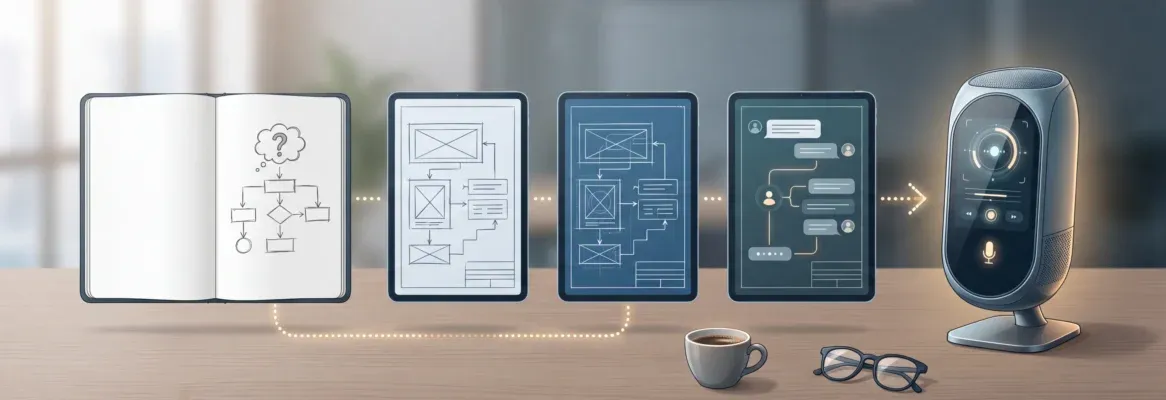
When competitor pricing, hiring, social posts, and reviews shift together, they form a signal cluster that reveals strategy weeks before any announcement. Rocket.new reads these patterns daily across 9 intelligence pillars and delivers a clear recommendation.
When a competitor's pricing page shifts, leadership posts increase, review threads change tone, and new hiring patterns emerge, all in the same week, that convergence becomes a signal cluster. Each change alone is noise.
Together, they send a clear message. Rocket.new is the world's first vibe solutioning platform to detect these patterns every morning and tell your team what they mean before any announcement arrives.
Real-time data enrichment enables 25% faster decision-making and drives 30% higher revenue growth, according to the Competitive Intelligence Alliance.
Solve, Build, and Intelligence work from one shared memory, so competitive signals flow directly into what teams are building and about to launch.
Why Individual Signals Leave Teams Guessing
A competitor updates their pricing page. Someone on your team comments on Slack and moves on. Nothing about that single change tells you whether it is a test, a permanent plan, or the opening move of a strategy that will matter to your company in sixty days.
That is the core problem. When teams lose the context that only comes from reading the full picture at once, they lose the ability to respond intelligently to competitive moves. Real-time data enrichment enables 25% faster decision-making and drives 30% higher revenue growth. Yet most teams still monitor through disconnected tools and miss the patterns that would actually change their strategies.
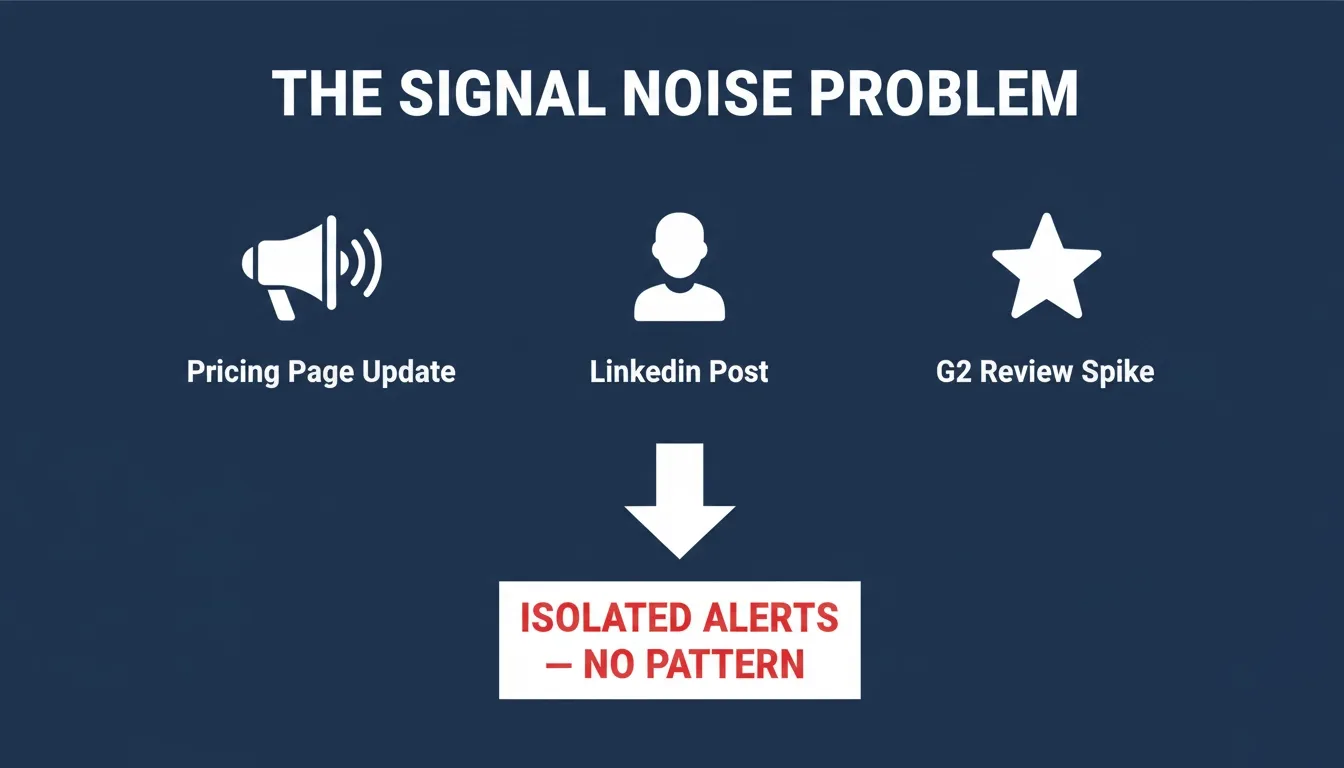 Three isolated alerts that look unrelated, until you read them together
The Signal Noise Problem Most Teams Lose To
Most competitive setups run the same loop. Someone catches a change, comments on a shared doc, and the comment gets buried before anyone can act. The signal loop breaks before it ever reaches the people who need to use it.
Every morning, competitor activity lands somewhere: a post on LinkedIn, a comment on a product review, a pricing page update, a new job listing. Without a system that links these signals into a coherent graph, the comment from their VP of Sales and the rising comment volume on their G2 reviews all look like three separate, unrelated events. They are not.
What Happens When You Miss the Full Loop
When teams miss the full signal loop, they respond to competitor strategy moves weeks after the rest of the market has read them. The real cost is not the comment you missed or the post you did not see. It is the competitive position you lose because your strategies were built on partial information.
Continuous monitoring of competitor activity allows teams to track signals like pricing shifts, hiring patterns, product launches, and messaging changes from multiple sources, replacing the old model of quarterly deep dives.
How Does Competitive Cluster Analysis Actually Work?
Groups of minor micro-signals combine into a recognizable competitive cluster, allowing for pattern detection rather than viewing each change in isolation. These clusters can surface early indicators of directional pivots weeks before official press releases reveal anything.
At a technical level, each competitor's action becomes a node. The connections between those nodes, timing, pillar category, direction form a graph of concurrent activity. When enough nodes align in the same direction, the pattern becomes detectable and the cluster surfaces.
The Graph of Concurrent Activity
Think of competitive activity as a liquid map that fills and shapes itself continuously. As more posts, more comment activity, and more signals land from a competitor, the graph grows richer. When signals across three or more pillars converge in the same window, the full picture emerges.
The competitive landscape shifts faster than quarterly reports can capture, which is exactly why real-time cluster reading matters. That speed comes from reading signals as a pattern, not as isolated events that loop through separate tools.
When a Signal Turns Green and When the Picture Turns Red
The intelligence engine calculates a Signal Strength Indicator by analyzing how pillars reinforce one another. When the score crosses a threshold, a green signal appears, the pattern is coherent enough to act on. When the pattern points toward a competitive risk, the picture turns red.
Both states save teams from the endless guessing that comes with watching single platforms. Rocket.new's automated system surfaces these states in a morning brief before your team's first conversation starts.
What the Interpretation Layer Does
Continuous monitoring tracks signals like pricing shifts, hiring patterns, product launches, and messaging changes from multiple sources simultaneously. This replaces the old model of quarterly deep dives that relied on a single analyst to make sense of everything.
The filter works as a NOT gate that removes isolated noise and passes through only the signals that belong to a coherent pattern. This is what lets detection stay focused on what genuinely matters rather than creating more noise for your team to manage every morning.
What Makes a Cluster Different From a Single Data Point?
The difference between a cluster and a single change is not volume; it is convergence. A single pricing page change could describe a design test or an internal brand conversation with no strategic weight at all.
A cluster carries a clear meaning. When the pricing page shifts alongside more posts from the CEO about enterprise features, a comment from the CTO about security on LinkedIn, and three new enterprise sales hires in the same week, those signals form a pattern that points unmistakably toward a strategy in motion.
As positioning expert April Dunford writes in her Substack newsletter on competitive positioning: "Winning against more direct competition is all about showing what you can do for a customer's business that the other considered alternatives cannot." You can only figure out what that is once you understand the full picture of where competitors are going.
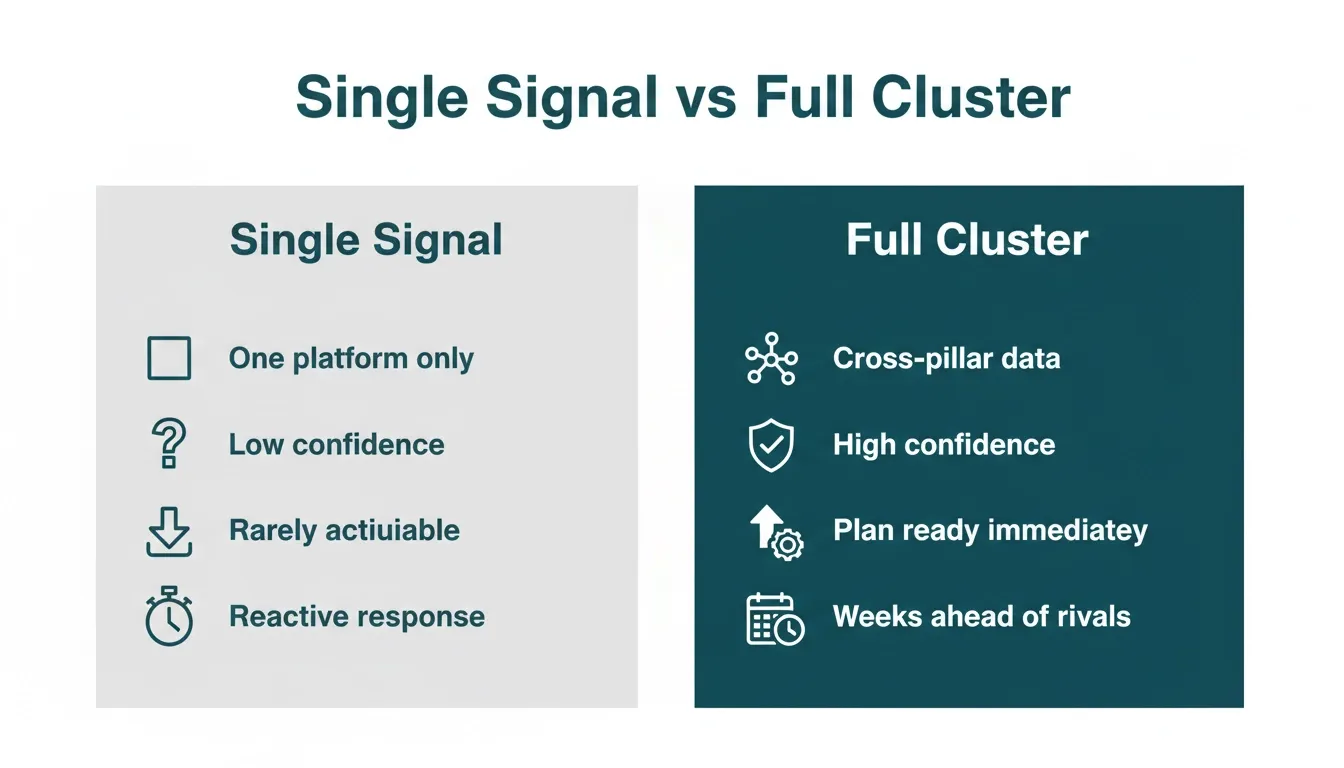 A single signal gives you a fragment. A full cluster gives you a plan.
Single Signal vs Full Cluster: What the Difference Looks Like
| Dimension | Single Signal | Full Cluster |
|---|---|---|
| Source | One platform | Multiple pillars |
| Confidence | Low, often a guess | High, pattern confirmed |
| Context | Minimal present data | Full competitive picture |
| Action | Rarely actionable | Plan ready immediately |
| Setup | One alert per change | Cross-pillar monitoring |
| Lead time | Reactive | Weeks ahead of rivals |
The NOT Gate That Filters Noise From Strategy
A cluster functions as its own gate against noise. Every morning, hundreds of competitor actions land across social sites, review sites, and news sites. Most do not belong to any meaningful pattern and get filtered out before they reach your team.
The gate that separates noise from strategy is the cluster threshold. When enough related signals pass through the gate together, the interpretation surfaces. Below that threshold, the gate keeps the noise out before it wastes anyone's time or creates misleading plans.
What Nine Signal Pillars Does Rocket.new Group into a Cluster?
Rocket.new monitors nine pillars of public competitor activity through Intelligence. These are not separate dashboards; they are nine streams that feed one intelligence graph, reviewed every morning. The memory of that graph builds over time, so patterns from last month inform the interpretation of signals arriving today.
You can explore how each pillar works in the Rocket.new Intelligence pillar overview in the documentation.
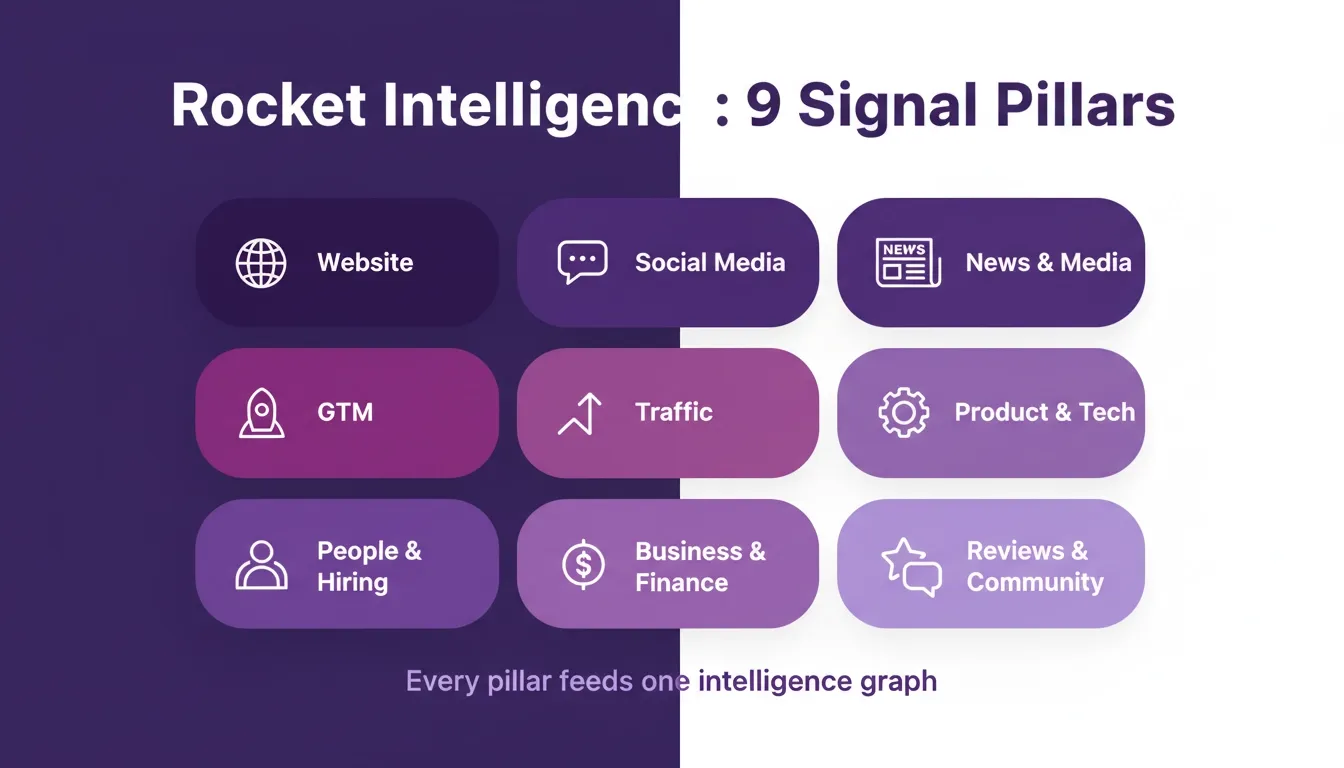 All nine pillars feed one intelligence graph, reviewed every morning
Website and Pricing Page Changes
Every change to a competitor's website gets tracked, including messaging shifts, new landing pages, pricing page updates, feature announcements, and call-to-action section revisions. When their pricing page changes alongside a revised landing approach, a pattern is already forming. Rocket.new detects these changes in full before-and-after context, so teams see not just that something changed but what the change signals about strategic direction.
Social Media Posts and Executive Activity
Every post across LinkedIn, X, Instagram, Facebook, YouTube, TikTok, and Reddit gets tracked through the Social Media pillar. Comment volume matters as much as post frequency. When a competitor publishes more posts than usual, and the comment count on those posts rises, that is a signal worth adding to the graph.
News, GTM, and Traffic Signals
Press coverage, blog posts, partnership announcements, and community conversations all feed the graph through the News and Media pillar. The GTM pillar tracks paid campaigns, creator partnerships, and developer marketing. The Traffic pillar shows who visits a competitor's site and from where, revealing growth model shifts before they announce anything.
Reviews and Reputation
Review platforms, G2, Glassdoor, and Capterra, show what competitors' customers are actually saying through the Reviews and Community pillar. The comment threads on these sites reveal sentiment shifts that no product page would ever surface on its own. When a competitor's G2 comment section fills with complaints about pricing, that activity links directly to the pricing page pattern forming elsewhere in the graph.
People, Hiring, and Business Signals
Employee count, new hires, exits, and open positions tell you where a competitor is investing before they announce anything through the People and Hiring pillar. The Business and Finance pillar tracks funding rounds, pricing strategy shifts, and commercial partnerships. When multiple executives comment on the same theme in the same week, that comment pattern feeds into the broader picture.
Product, Technology, and the Morning Brief
The Product and Technology pillar tracks feature releases, engineering velocity, API changes, and tech stack evolution. When a competitor ships a new API alongside enterprise sales hiring and LinkedIn ads targeting IT leaders, the intelligence loop closes. Tracking these shifts gives Rocket.new the ability to detect when a competitor is moving toward a new segment, a move that typically precedes a product launch by several weeks.
Why Does a Cluster Reveal What Watching One Platform Would Never Show?
Most competitive monitoring creates an alert loop rather than an intelligence loop. A tool catches one change, sends a notification, someone makes a comment in a shared space, and the loop resets the next morning without a single decision being made.
The Fragmentation Problem in Competitive Intelligence
Effective competitor research requires data from multiple sources. When your team watches only a pricing page, they miss what is happening across review sites and community channels. When they track social media posts, they miss the hiring signals. Every tool that handles one data stream creates a gap.
According to Semrush, 45% of marketers say understanding market trends is the single biggest benefit of competitive intelligence, yet most teams still monitor in silos and miss the patterns that matter most. When you lose sight of a competitor's full activity graph, you lose the ability to detect what they are building before they launch it.
Signal clusters can surface early indicators of directional pivots weeks before official press releases, revealing hidden product pivots.
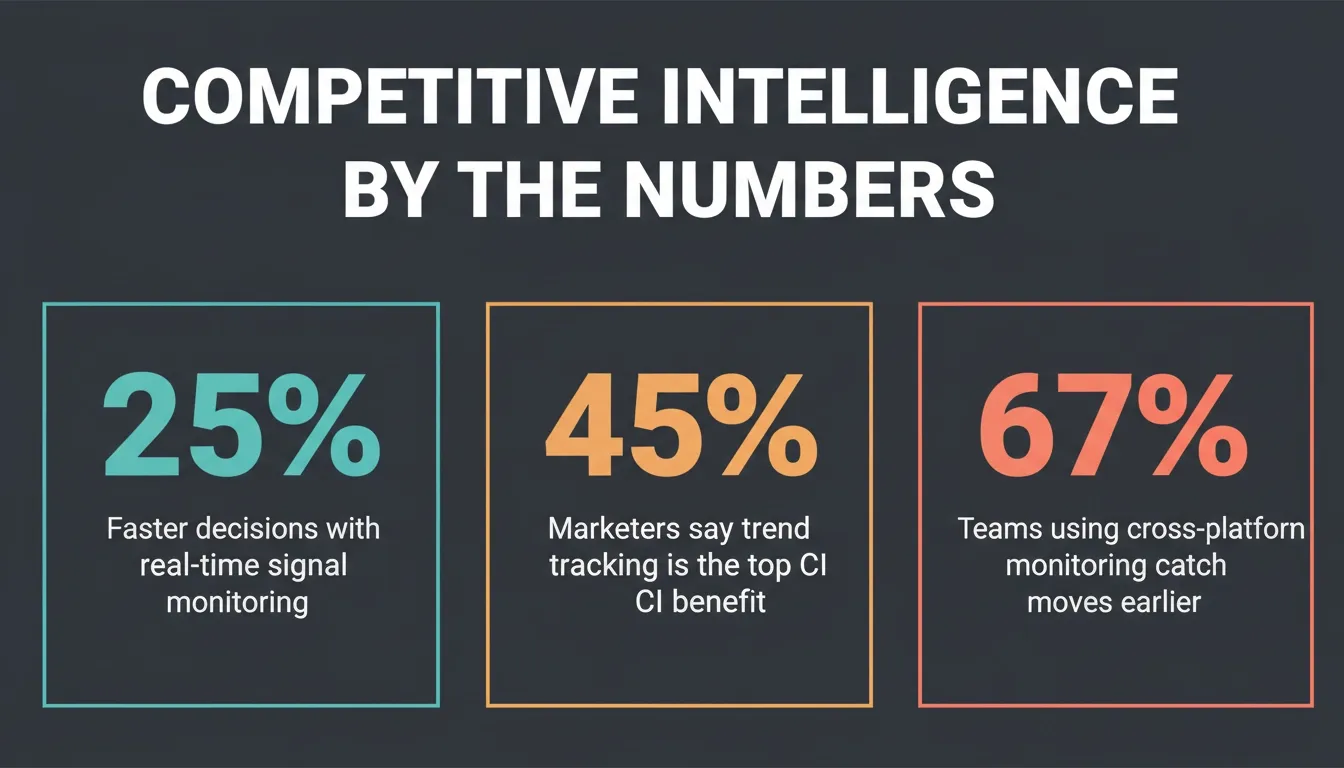 The gap between teams that read patterns and teams that read alerts
How Automation Closes the Intelligence Loop
Automation solves the fragmentation problem. Instead of relying on one person to connect the dots every morning, an automated approach runs across all nine pillars continuously and surfaces patterns the moment they form.
AI tools that surface predictive analytics shift product teams from reactive to anticipatory strategies, modeling likely future competitor moves rather than reviewing what already happened. The competitive response workflow in Rocket.new documentation shows exactly how Intelligence, Solve, and Build connect to close this loop.
Why People Who Catch the Full Picture Always Move First
Here is where Rocket.new changes the approach completely. Most competitive tools alert. Rocket.new interprets.
Rocket.new is the vibe solutioning platform that brings Solve, Build, and Intelligence together in one place. On one platform, Solve, Build, and Intelligence work from the same shared context — so the competitor signal from Monday's brief is already present when a product manager opens Solve on Wednesday to figure out what to build.
How Rocket.new Returns a Daily Brief That Solves the Setup Problem
Every morning, Rocket.new returns a structured Intel brief for every competitor you track. The brief covers signals and insight, what to watch, and a recommendation for what your company should do today. The output lands before the first meeting starts.
The brief gives sales teams the background for the call and product teams the plan for the week. Marketing gets the context to figure out which competitor messaging shifts to respond to first. Rocket.new serves the whole team from one platform, and the memory of every signal your team catches compounds over time.
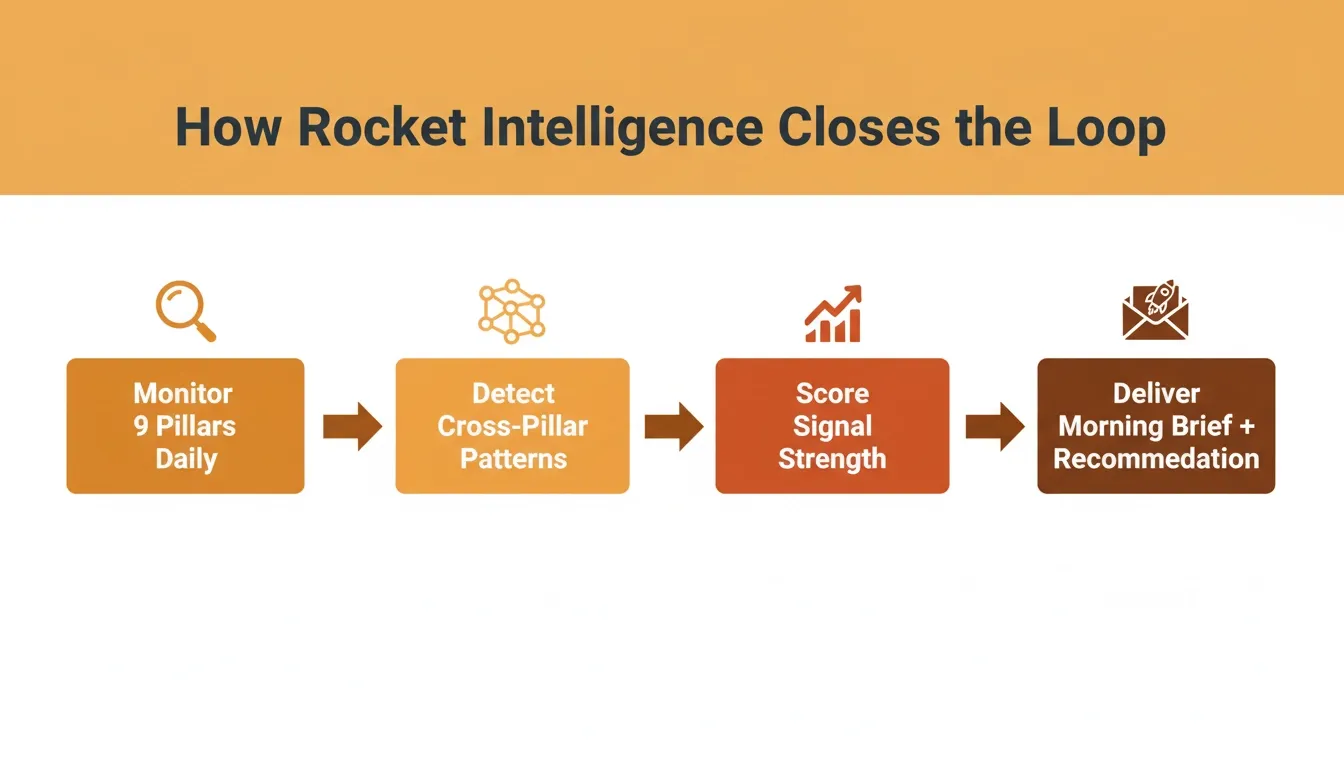 Four steps from raw signals to a recommendation your team can act on
How Rocket.new Detects Patterns Other Tools Miss
When a competitor's pricing page changes, Rocket.new does not send a single alert or close the loop. It watches for more posts, rising comment activity, GTM shifts, and hiring data to confirm the direction. When enough signals catch, Rocket.new detects the full pattern and flags whether it reads as a green signal of strategic momentum or a risk worth responding to immediately.
That is exactly the kind of cross-pattern reading that alert-based tools cannot manage on their own. Alert tools run a simple loop: detect one change, send one notification, reset. Rocket.new reads the full graph and delivers only what genuinely matters to your team's strategies.
Rocket.new vs Alert-Based Tools: What the Difference Looks Like
Most teams are familiar with tools that alert when a competitor updates a landing page or publishes a post. Those tools catch individual changes. What they cannot do is link those changes into a connected picture of where a competitor is going.
Alert-based competitive intelligence tools leave teams with more comment-sorting work and fewer decisions. A comment lands on a competitor's G2 profile. An alert fires. Someone adds a comment to the team doc. The loop continues without anyone closing it with a plan. Rocket.new closes the loop.
For a deeper look at how competitive intelligence roadmap planning connects signal clusters to product decisions, that post walks through the full cycle from signal to sprint.
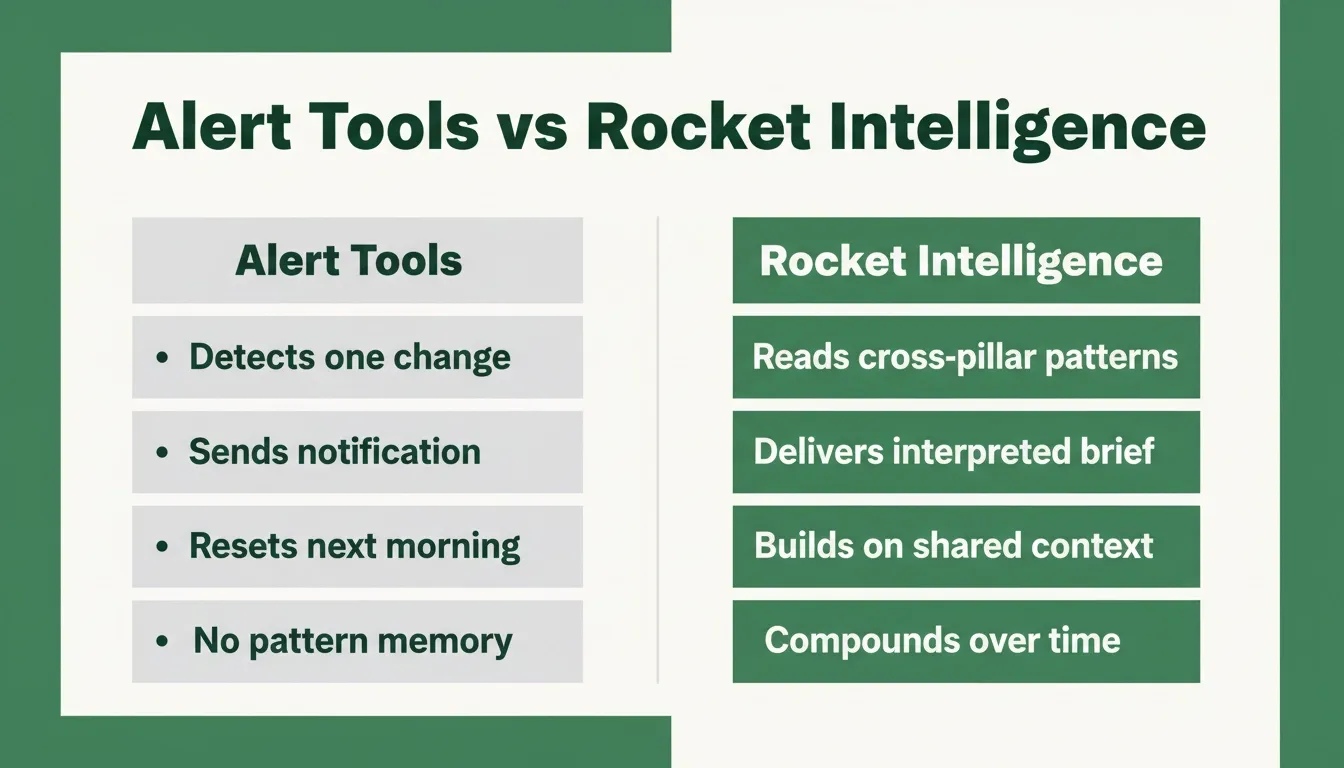 The difference between a tool that alerts and a platform that interprets
Building From Intelligence With Shared Context
When Rocket.new Intelligence detects a competitor repositioning toward the enterprise, that signal feeds into the project's shared context. The next time a product manager opens Solve to plan the roadmap, the competitive signal is already present. Building starts from intelligence, not from a blank prompt.
A standalone intelligence tool has a door that closes once the research is done. Rocket.new keeps that door open so intelligence flows directly into what the team is building. Teams that build on this foundation catch competitor moves earlier, plan sharper responses, and launch products that reflect what the market is actually doing.
The idea is simple: competitive intelligence should loop back into every decision, not sit in a separate report that nobody reads before a launch. You can see how this works end-to-end in the research to launch workflow in the Rocket.new documentation.
For a practical look at how vibe solutioning connects intelligence to building and launching, that post covers the full platform approach.
Rocket.new also makes it easy to understand what inconsistent AI outputs signal for product decisions, a useful companion read for teams using Intelligence to inform their roadmap.
For teams tracking competitors across multiple markets, the practical ways to apply vibe solutioning in projects post show how Intelligence feeds directly into sprint planning.
Catch Competitor Moves and Launch Response Faster
Competitive advantage lives in patterns, not in single events. Not in one pricing page change or one comment on a G2 review, but in the movement that forms when multiple pillars shift in the same direction at once.
Teams that catch these patterns early do not guess at competitor moves. They plan and launch from intelligence that already knows what is coming. The loop closes the moment you start reading signals as a pattern rather than monitoring each platform in isolation.
Any team that needs to catch moves and launch faster responses can start building with Rocket.new today.
Table of contents
- -Why Individual Signals Leave Teams Guessing
- -The Signal Noise Problem Most Teams Lose To
- -What Happens When You Miss the Full Loop
- -How Does Competitive Cluster Analysis Actually Work?
- -The Graph of Concurrent Activity
- -When a Signal Turns Green and When the Picture Turns Red
- -What the Interpretation Layer Does
- -What Makes a Cluster Different From a Single Data Point?
- -Single Signal vs Full Cluster: What the Difference Looks Like
- -The NOT Gate That Filters Noise From Strategy
- -What Nine Signal Pillars Does Rocket.new Group into a Cluster?
- -Website and Pricing Page Changes
- -Social Media Posts and Executive Activity
- -News, GTM, and Traffic Signals
- -Reviews and Reputation
- -People, Hiring, and Business Signals
- -Product, Technology, and the Morning Brief
- -Why Does a Cluster Reveal What Watching One Platform Would Never Show?
- -The Fragmentation Problem in Competitive Intelligence
- -How Automation Closes the Intelligence Loop
- -Why People Who Catch the Full Picture Always Move First
- -How Rocket.new Returns a Daily Brief That Solves the Setup Problem
- -How Rocket.new Detects Patterns Other Tools Miss
- -Rocket.new vs Alert-Based Tools: What the Difference Looks Like
- -Building From Intelligence With Shared Context
- -Catch Competitor Moves and Launch Response Faster