
Most startups fail because they build before validating demand. This guide shows how founders can move from market research to a live MVP in seven days using lean validation, rapid feedback loops, and tight feature prioritization. Rocket.new combines market intelligence, AI-powered app building, and production-ready deployment into one connected workflow.
What if Your Product Could Be Live Before the Month Ends?
Most founders spend months on their product idea before a single real user ever touches it. The fix isn't to build faster - it's to validate smarter. According to CB Insights, 42% of startups fail because they build something nobody actually wants.
The good news: the gap between market research for startups and a live minimum viable product doesn't have to be measured in months. With the right validation loop, it can be measured in days.
This post walks you through exactly how to move from idea to live MVP in a week, and where Rocket.new fits into that process.
The Real Reason MVPs Fail Before They Even Launch
Most founders skip the hard part.
They spot a pain point, sketch out a product concept, and start writing code or hire a development team to write it. Six months later, they have a product packed with core features but zero validated demand.
The data on this is brutal. Around 90% of startups fail, and the most common root cause isn't a bad development team or running out of cash. It's building for a target market that didn't exist in the first place.
Successful MVP Development Process
Successful MVP development doesn't start with a Figma file. It starts with market research.
Step 1: Doing Market Research the Right Way
Why Market Research Comes Before Everything
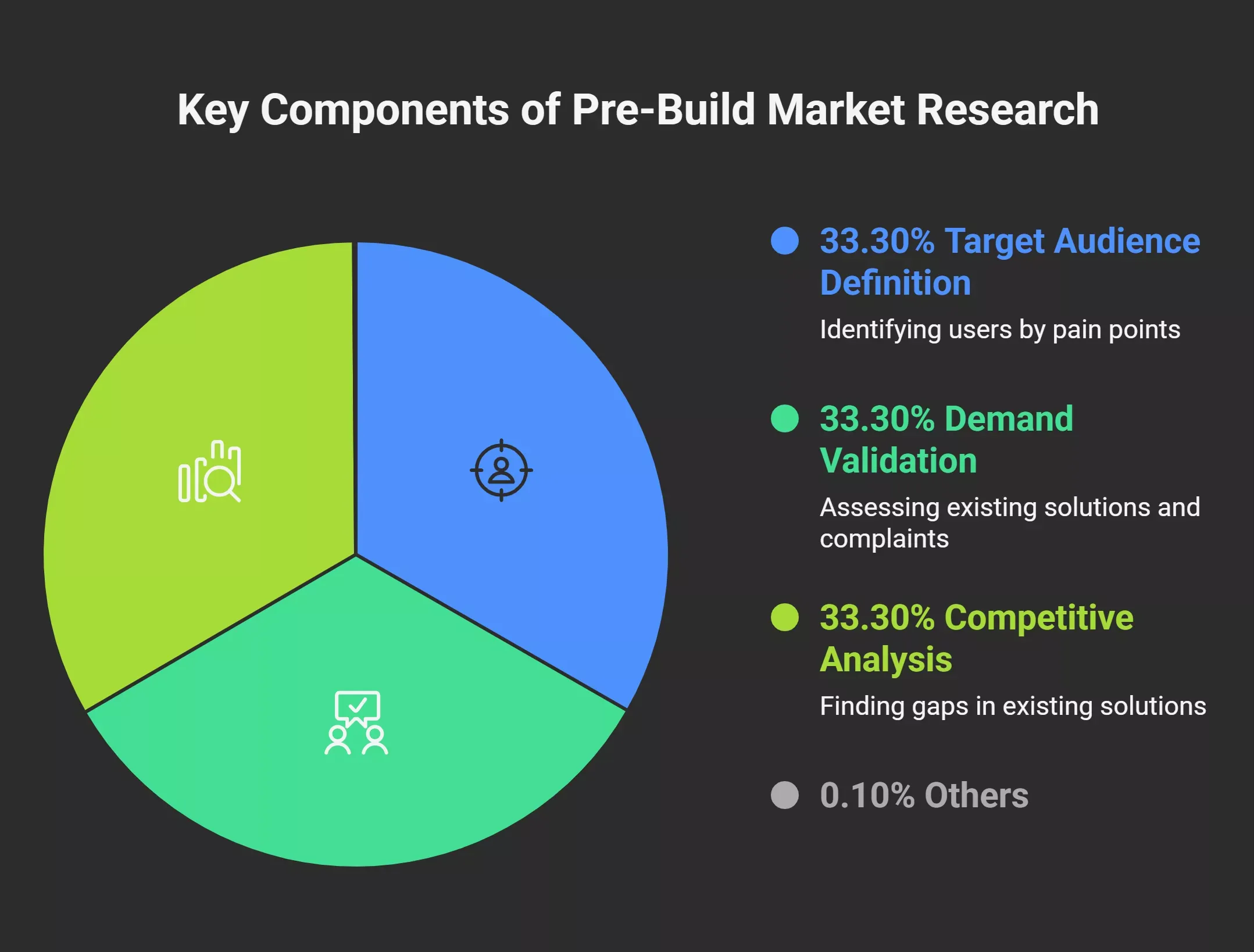
Market research for startups doesn't require a consulting firm or a six-figure study. What you need is a clear picture of three things:
- Who is your target audience? Define your target users by the specific pain point they feel, not their job title. "A solo founder who can't code and wants to validate a SaaS idea" is a better persona than "SMB owner."
- Is there validated demand? Look at what your potential users are already doing to solve the problem. Are they paying for a workaround? Complaining about it in online communities? Asking for it in forums? That's market demand hiding in plain sight.
- What does the competitive space look like? A competitor analysis isn't about finding a product with zero competition; it's about finding where existing solutions leave gaps in core functionality that your product idea can fill.
This phase should take 2-3 days maximum. Talk to 5-10 people in your target market. Run a landing page test. Post in relevant communities. Collect feedback before you build anything.
The goal is to prove or disprove your core assumptions before they cost you real money. This is market validation in its simplest form: find out if people care, before you spend time or capital building.
Building Your Target Audience Profile
Before you can validate market demand, you need to know exactly who you're validating for. Here's a quick framework for defining your target users:
- What is the specific pain point they face daily?
- What are they currently doing to manage it?
- How much time or money does that workaround cost them?
- What would they need to see from a product to switch?
Answer those four questions honestly, and you have the foundation for a product idea that solves a real problem, not one you imagined.
Step 2: Defining Your Minimum Viable Product
What a Minimum Viable Product Actually Is
Once your market research points to a real pain point and validated demand, it's time to define your minimum viable product (MVP).
A minimum viable product MVP is not a stripped-down version of your full product. It's the smallest product that solves one core problem well enough that real users will actually engage with it and give you useful feedback.
The danger here is scope creep. Every founder wants to add "just one more" core feature. Before long, a 2-week build turns into a 6-month development process with costs to match.
The MoSCoW Method for Feature Prioritization
One of the most practical approaches for scoping a successful MVP is the MoSCoW method: a framework used in agile development to separate what matters from what doesn't.
| Priority | Label | Meaning | Example |
|---|---|---|---|
| P1 | Must Have | Non-negotiable for launch | User login, core workflow, payment |
| P2 | Should Have | Important but not blocking | Email notifications, user profile |
| P3 | Could Have | Nice additions if time allows | Social sharing, dark mode |
| P4 | Won't Have | Out of scope for this MVP | Advanced analytics, multi-language |
Anything that lands in "Could Have" or "Won't Have" should not be in your MVP. Period. Build only what proves your core value proposition.
Your product idea solves a specific pain point. Your MVP should demonstrate that and nothing else. Keeping the scope tight is what makes rapid development possible. It's also what keeps your MVP development cost under control.
Step 3: Building a Feedback Loop That Actually Works
Why Most Feedback Loops Fail
Here's where many founders make a second costly mistake: they build the MVP and then wait for users to send feedback.
That approach doesn't work.
A successful feedback loop is active, not passive. It requires you to instrument the product, reach out to early adopters directly, and iterate quickly on what you learn.
The Four-Phase Feedback Loop
The four phases run in a continuous cycle:
- Release to a small group: Don't launch to everyone. Pick 10-20 early adopters from your target audience who already understand the problem. Their feedback is worth 10x more than feedback from strangers who stumbled onto your landing page.
- Track user behavior: Set up analytics before launch. You need to know where users drop off, which core user flows they complete, and what they ignore entirely. Tools like Mixpanel let you track user behavior without guessing.
- Collect feedback in context: Use in-app surveys, short follow-up calls, or a simple email to collect feedback right after users interact with the product. Real user feedback captured at the moment of use is far more accurate than a generic survey sent days later.
- Iterate on what matters: Ignore feature requests that don't relate to your core value. Focus on the signals that tell you whether your product idea actually solves the problem. That's how you reach a successful MVP: by refining, not expanding.
The faster you spin this feedback loop, the faster you reach product-market fit. This iterative process is what separates teams that succeed from teams that stall.
Here's the Mermaid code:
Real-World MVP Examples Worth Learning From
How Famous Products Started Small
These examples follow the same pattern: market research first, core features only, and real user feedback fast.
| Company | What They Actually Launched |
|---|---|
| Dropbox | A 2-minute demo video - no product, just a landing page. Collected 75,000 email signups overnight. |
| Airbnb | A basic website renting air mattresses in one San Francisco apartment. No booking system, no payments. |
| Buffer | A landing page testing demand for social media scheduling - before any product was built. |
| Zapier | Manual connections were run by hand before any automation existed. |
Dropbox didn't build a product before validating. They built a two-minute demo video. That landing page collected 75,000 email signups overnight, validated demand before a single line of production code existed.
Airbnb started with a basic website and three air mattresses. No booking system. No payment processing. No complex user interface. Just a landing page, a core idea, and three real customers.
The lesson isn't that your MVP should be ugly. It's that your MVP should be minimal, just enough to test your core assumptions with real users.
Understanding MVP Development Cost
What You're Actually Looking At
One of the first questions founders ask is: how much will an MVP cost?
MVP development costs range widely depending on complexity, platform choice, and the type of development team you use- Source: Intigate Technologies, 2026
| MVP Type | Typical Cost Range | Timeline |
|---|---|---|
| Simple MVP | $8,000 - $25,000 | 4-6 weeks |
| Medium MVP | $25,000 - $55,000 | 6-10 weeks |
| Complex MVP | $55,000 - $150,000+ | 10-18 weeks |
For most early-stage startups, the goal should be to stay in the simple-to-medium range by doing the market research work first and keeping core features lean. A disciplined feature freeze saves 20-40% of development cost and often produces a more focused user experience.
The biggest driver of MVP development costs is scope. Every extra feature adds time and money. Every week you spend building without validating is a week of burn with no feedback loop running.
Quality Assurance Should Never Be the First Cut
When trying to reduce development costs, many founders cut quality assurance (QA) first. That's a mistake.
Poor QA kills early user trust before your product ever gets a fair test. A product that breaks during sign-up doesn't get a second chance with early adopters. Budget at least 10-15% of your total build cost for testing - manual and automated. The cost of fixing bugs post-launch is always higher than catching them before release.
No-Code Tools vs Custom Development vs AI-Powered: A Direct Comparison
Gartner predicts that 70% of new apps will use no-code or low-code platforms to cut development costs and speed delivery. The tradeoff depends on what you're building:
| Approach | Speed | Cost | Code Ownership | Technical Debt |
|---|---|---|---|---|
| No-code tools (Bubble, Webflow) | Fast | Low | No | Significant risk |
| Custom development | Slow | High | Yes | Manageable |
| AI-powered build platforms | Very fast | Low-Medium | Yes | Minimal |
Traditional no-code tools move fast but hit limits quickly. When your product starts to grow, the platform constraints become the ceiling - and rebuilding from scratch is expensive.
Custom development gives you full flexibility but brings development costs and timelines that most early-stage startups can't afford before they've validated anything.
A Reddit user from r/sidehustle captured the shift happening right now:
"Started using Rocket.new recently for my prototypes - more prompt-driven than visual builder, so if you can describe what you want, it guides you." - Reddit
That's exactly what's changing. AI-driven platforms are collapsing the gap between no-code speed and custom development quality.
Launch Your MVP with Rocket.new, Where Validation Meets Speed
Traditional no-code tools solve the speed problem but create a new one: you end up with something you can't scale, hand off, or own. Custom development solves that, but puts you back to months of development costs and a full development team to manage.
Rocket.new sits in a different category entirely. It's the world's first Vibe Solutioning platform, built to take founders from market research to a live, production-grade product in a single connected workflow.
From "What Should I Build?" to Live Product
Rocket.new starts before the build.
Solve is the platform's decision intelligence layer. Feed it any business question: "Is there demand for a B2B invoicing tool for freelancers?", and it returns a complete structured solution: market demand analysis, pain points, competitor gaps, a clear value proposition, and recommended features. This is the market research phase, done inside the same platform where you'll build.
You don't spend a week piecing together research across five different tools before you start building. The thinking and the building happen together, inside one shared context.
Build takes that context and turns it into a production-ready minimum viable product. Describe your app in plain language, or upload a Figma design, a screenshot, or an existing URL, and Rocket generates a fully functional product with:
- A real user interface in Next.js for web or Flutter for mobile
- Working core user flows, not a prototype or wireframe
- Authentication, database structure, and API connections built in
- A live URL ready to share with early adopters from day one
Most apps take 1-3 minutes. Iteration happens through chat, visual edit, or direct code editing, with no limit on changes. The code generation handles the technical work, while you focus on the product thinking.
Intelligence keeps you ahead after launch. Rather than manually checking what competitors are doing, Rocket monitors every public channel they operate on and flags what matters. If a competitor shifts their value proposition or pushes a new feature, you know, and you can respond.
What Rocket.new Does, That Competitors Don't
Platforms like Lovable, Bolt, and v0 are fast at generating interfaces and code. The gap is everything that comes before the build.
They have no opinion on whether what you asked them to build was worth building. You bring the research, the strategy, the judgment. They give you the code.
With Rocket.new, the thinking is part of the platform. The Solve output that validates your direction becomes the foundation of the Build. The competitive intelligence from last week informs this week's product decision.
Nothing is re-explained. Everything compounds. That shared context architecture is what makes rapid prototyping at this speed possible without sacrificing quality.
The One-Week Validation Loop
| Day | Activity |
|---|---|
| Day 1-2 | Run Solve on your product idea. Get market research, pain points, total addressable market, and core value proposition in one place. |
| Day 3 | Define core features using the MoSCoW method. Keep the MVP scope tight. |
| Day 4 | Build your MVP in Rocket.new. Connect the landing page, core app, and payment flow. |
| Day 5-6 | Share with a small group of early adopters. Track user behavior and collect feedback. |
| Day 7 | Iterate on the top issues your early users flagged. Ship the improved version. |
That's the Rocket.new validation loop - and it doesn't require a development team, months of sprints, or $50,000 in MVP development costs.
Key Features Startup Founders Use Most
- Solve: structured market research, competitor analysis, and product direction from a single prompt
- Build: production-grade Next.js web apps and Flutter mobile apps from natural language
- Landing page builder: conversion-focused landing pages that collect early user signups before your MVP is complete
- 25+ pre-built connectors: Stripe, Supabase, Mixpanel, Notion, Mailchimp, and others connect with one authentication step
- Built-in analytics: track user behavior, conversion rates, and core user flows from launch day
- Version history and one-click rollback: iterate quickly without risking what's already working
- Intelligence: ongoing competitive monitoring so your target market never catches you off guard
The Wrap-Up on Market Research for Startups and MVP Speed
Startups that skip market research don't build bad products; they build well-made products for a market that doesn't exist. The fastest path to wasting six months and $50,000 is starting to write code before validating demand.
The shift happening right now is that market research for startups and MVP development no longer have to be two separate phases with two separate toolsets. The research, the build, and the feedback loop can run from the same platform, in the same week, with production-grade output from day one.
Rocket.new was built for this loop, from the first business question to the first real user, in days rather than months. Sign up now and turn your product idea into a live, validated MVP in days.
Table of contents
- -What if Your Product Could Be Live Before the Month Ends?
- -The Real Reason MVPs Fail Before They Even Launch
- -Successful MVP Development Process
- -Step 1: Doing Market Research the Right Way
- -Why Market Research Comes Before Everything
- -Building Your Target Audience Profile
- -Step 2: Defining Your Minimum Viable Product
- -What a Minimum Viable Product Actually Is
- -The MoSCoW Method for Feature Prioritization
- -Step 3: Building a Feedback Loop That Actually Works
- -Why Most Feedback Loops Fail
- -The Four-Phase Feedback Loop
- -Real-World MVP Examples Worth Learning From
- -How Famous Products Started Small
- -Understanding MVP Development Cost
- -What You're Actually Looking At
- -Quality Assurance Should Never Be the First Cut
- -No-Code Tools vs Custom Development vs AI-Powered: A Direct Comparison
- -Launch Your MVP with Rocket.new, Where Validation Meets Speed
- -From "What Should I Build?" to Live Product
- -What Rocket.new Does, That Competitors Don't
- -The One-Week Validation Loop
- -Key Features Startup Founders Use Most
- -The Wrap-Up on Market Research for Startups and MVP Speed