
This blog explores why traditional market research tools fall short for product builders and how shipping a Rocket.new MVP gives founders real consumer insights faster. It covers key tools, a step-by-step pre-launch research approach, and how Rocket.new compares to traditional development timelines.
What if the best market research tool you'll use is the product you ship today?
Most founders spend weeks picking the right surveys, setting up focus groups, and running competitor research before writing a single line of code. Meanwhile, the market keeps moving.
The global market research industry is projected to reach $150 billion by 2025 - and yet, 42% of startups still fail because they built something nobody wanted. (ESOMAR via Research Network, Modall)
Access to market research tools is not the problem. Knowing when and how to use them is.
Ship an MVP first. Then let your real users do the market research for you.
Why Traditional Market Research Falls Short for Product Builders
Traditional market research methods - surveys, focus groups, competitor analysis - are genuinely useful. But they share a common flaw: they ask people what they think they want, not what they'll actually use or pay for.
People are notoriously unreliable at predicting their own behavior.
In focus groups, participants tell you what sounds good in the room. In market research surveys, people answer with what they think the researcher wants to hear. The result is a gap between survey responses and real-world consumer behavior that can quietly sink a product before it ever ships.
That doesn't mean you skip research entirely. It means you pair research tools with real user validation - and you do it faster than most teams think is possible.
The Market Research Tools Worth Knowing
Before you build anything, a handful of market research tools help you spot demand signals, understand your target audience, and size the competitive analysis problem. Here's a clear breakdown:
| Tool | Best For | What Makes It Stand Out |
|---|---|---|
| Google Trends | Spotting market trends and keyword patterns | Free, real-time data |
| Google Keyword Planner | Keyword research and demand sizing | Search volume by region |
| SurveyMonkey | Online surveys and survey responses | Pre-built survey templates |
| Typeform | Collecting qualitative data with open-ended questions | Conversational form experience |
| Pew Research Center | Demographic data and public opinion polling | Free, research-grade content |
| SEMrush | Competitor research and SEO analysis | Deep backlink and traffic data |
| BuzzSumo | Social media monitoring and content research | Top content by keyword |
| Google Data Studio | Data visualization and reporting dashboards | Free, connects to Google Analytics |
These tools give you market research data, consumer insights, and a window into your competitive landscape before you build. They help you scope the problem, define your target market, and catch obvious gaps in your assumptions.
But they only go so far.
What No Market Research Survey Can Actually Tell You
Here's the hard truth: market research software cannot show you whether your specific execution will resonate with your specific users.
You can analyze all the market trends you want. You can run a dozen online surveys and collect thousands of survey responses. None of that tells you if the experience of using your actual product - the onboarding, the key feature, the point where users either get it or leave - actually works.
That gap is where startups get into trouble. And it's why the most experienced builders approach market research differently.
"Validate. I wasted at least 5 years building stuff nobody needed... I run DMs with 10-20 users every day, where I chat about all my ideas and features I wanna add. I clearly see what resonates with me most and only go build those."- John Rush, Serial Founder - LinkedIn
John's approach makes one thing clear: traditional market research is a proxy. The moment you put a working product in front of real users, the quality of your data improves by an order of magnitude. Real consumer behavior is deeper than any survey result.
This is why the smartest product teams treat the MVP itself as a market research tool.
Shipping an MVP Is a Market Research Method
An MVP - Minimum Viable Product - is not a rough draft to be embarrassed about. It's a deliberately minimal version of your product designed to answer one question: do real people actually want this, and will they use it?
When you ship an MVP, you convert passive assumptions into live data.
You see:
-
Which core features users actually engage with
-
Where they drop off in the flow
-
What they ask for next without being prompted
-
What confuses them that you never predicted
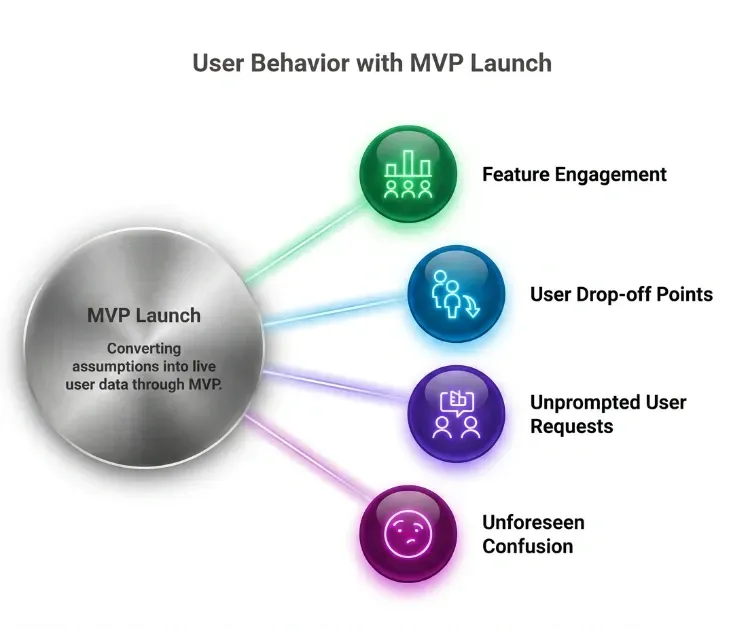 That's qualitative research and quantitative analysis happening at the same time, with your real target audience, in real conditions. No survey design required.
And the market is shifting in exactly this direction. According to Attest's 2026 research on market research trends, 89% of market researchers already use AI tools regularly or in experimental phases - and 83% plan to increase that investment in the year ahead. (Attest)
The MVP-first approach is simply the product team's version of the same shift.
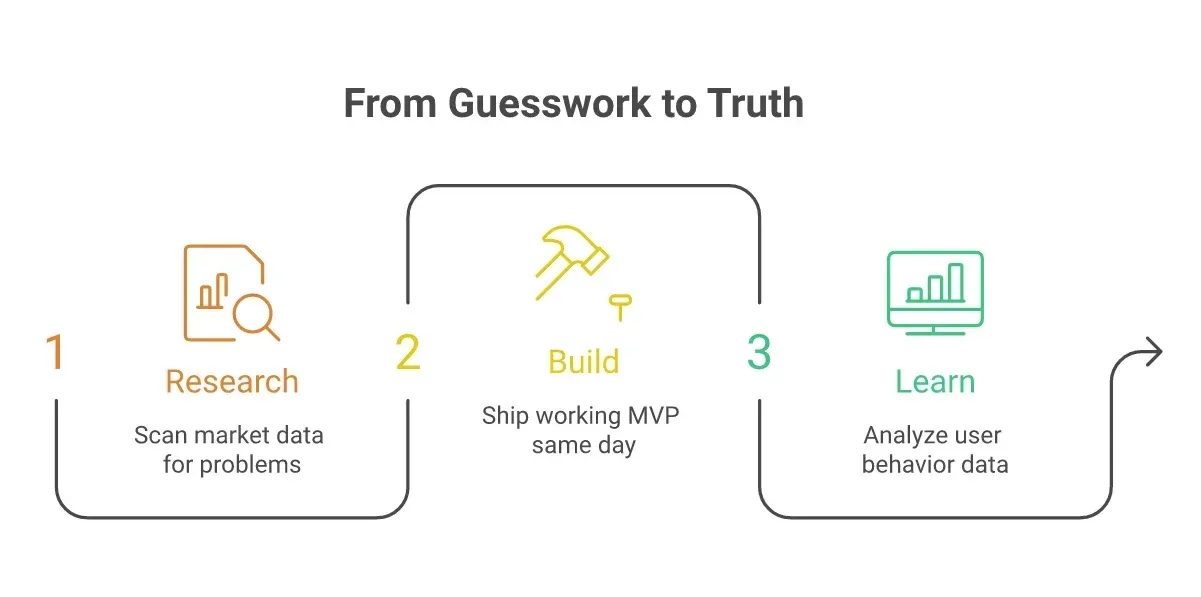 MVP Feedback Loop: Research → Ship → Learn
How to Conduct Market Research Before You Build - Without Slowing Down
Shipping an MVP first does not mean shipping blind. Some upfront research protects you from obvious mistakes and sharpens your target market focus. Here's a focused approach that takes days, not months.
Start With Google Trends and Keyword Research
Before anything else, use Google Trends to check whether your core problem is something people actively search for. Pair that with Google Keyword Planner for search volume estimates and keyword suggestions by region.
If there is no search signal around your problem, you may be solving something people do not know they have - which means your marketing plan carries a heavier burden from the start.
Run 5-10 Short User Interviews Instead of Full Surveys
Skip the lengthy market research survey for now. Instead, have short 15-20 minute conversations with 5-10 people who match your target audience profile. Ask open-ended questions about how they currently handle the problem. Do not mention your product. Just listen.
This kind of qualitative research surfaces insights that a structured survey would never capture. Consumer behavior patterns, emotional friction points, and the exact language people use to describe the problem - all of that comes out in conversation.
Do a Fast Competitor Research Pass
A quick competitor research pass across Reddit, Product Hunt, and App Store reviews tells you what users of similar products love and complain about. That is actionable consumer sentiment data in under an hour no expensive market research platform required.
Pay attention to the one-star reviews. That is where real user frustration lives, and that is often exactly where your product opportunity sits.
Set One Core Metric Before You Ship
Before your MVP goes live, decide on a single success metric. Day-7 retention, activation rate, or whether users come back a second time without being prompted. That one number keeps your data analysis clean and your next iteration focused.
Rocket.new: The Fastest Path From Research to Reality
Most product teams hit a wall right here. The research is done. The direction is clear. But building the MVP takes months - and by the time it ships, market trends have shifted, competitor research is stale, and the opportunity has narrowed.
That is the exact problem Rocket.new solves.
What Is Rocket.new?
Rocket.new is an AI-powered platform that lets founders, product teams, and non-technical builders ship fully functional MVPs in hours rather than weeks. You describe your product in plain language, and Rocket.new generates a working application ready to put in front of real users.
It closes the gap between market research and market validation. The moment you have an idea worth testing, Rocket.new turns it into something real.
Key Features for MVP-Based Market Research
Natural language to working app
You do not need a technical background. Describe what you want to build, and Rocket.new handles the interface, logic, and data flow. No coding, no waiting on a development team.
Production-ready output, not a prototype
Rocket.new generates full-stack code that actually runs not a mockup or wireframe. This means you can collect real data, run user flows, and track consumer behavior from day one.
Ship in hours, not months
Where a traditional development team might take four to eight weeks to build a working MVP, Rocket.new compresses that to a single session. That's weeks of runway preserved and weeks of real user feedback you would otherwise miss.
Built for fast iteration
Once users start responding, Rocket.new makes it straightforward to update and redeploy quickly. The build-feedback loop gets tighter with every cycle, which is exactly what market research methods are designed to create.
How Teams Use Rocket.new for Real Market Research
-
Validate demand fast: Ship a core feature and see if users actually engage with it, before investing in a full build.
-
Test positioning angles: Build two different versions and let real consumer behavior tell you which one connects.
-
Run live user research: Different onboarding flows, different value propositions, different target audience messaging all tested with real people instead of focus groups.
-
Make marketing strategies sharper: When you know what users do, not just what they say, your marketing plan becomes data-driven from the start.
Rocket.new vs. Traditional Development Approaches
| Rocket.new | Traditional Dev Team | |
|---|---|---|
| Time to first MVP | Hours | 4-8 weeks |
| Technical skills required | None | Developers needed |
| Cost for first version | Low | High |
| Real user data available | Day one | Weeks or months later |
| Iteration speed | Days | Weeks |
| Feedback loop cadence | Tight | Slow |
| Risk of building wrong thing | Low | High |
Traditional development pushes market validation far into the future. Rocket.new puts it at the start of the process, where it belongs.
Turning User Feedback Into a Market Research Flywheel
Once your MVP is live, the work shifts from building to listening. Real market research happens in this phase and it compounds over time.
Watch behavior, not just what users say. Set up basic analytics from day one. Where do users click? Where do they stop? Where do they come back? Behavioral data analysis tells a more honest story than survey responses.
Talk to users who churned. The people who left are just as valuable as the ones who stayed. A simple question "What made you stop using it?" is one of the most reliable market research methods available. Their answer often points directly to your next product decision.
Track customer sentiment over time. As you ship updates, watch whether sentiment improves or worsens. Simple net promoter score polls or open-ended feedback forms work well at this stage. This is low-cost consumer research that runs continuously.
Build a living knowledge base of user insights. Document what you learn after every sprint. This becomes your market research data grounded in real consumer behavior, updated regularly, and far more accurate than any upfront survey results.
Let Your Users Tell You: The Best Market Research is a Live Product
Most founders treat market research tools as something you use before you build. The best product teams treat them as something that never stops.
The tools in this article from Google Trends and keyword research to social media monitoring and data visualization all have a place in a good product process. But none of them replace the signal you get from real users interacting with a real product.
Market research tools give you a starting point. A working MVP gives you the truth.
That is the case for shipping first and learning fast. And Rocket.new is how you get there before anyone else in your market does. Build your idea today, put it in front of users tomorrow, and let their actual behavior shape everything that follows.
Table of contents
- -Why Traditional Market Research Falls Short for Product Builders
- -The Market Research Tools Worth Knowing
- -What No Market Research Survey Can Actually Tell You
- -Shipping an MVP Is a Market Research Method
- -How to Conduct Market Research Before You Build - Without Slowing Down
- -Start With Google Trends and Keyword Research
- -Run 5-10 Short User Interviews Instead of Full Surveys
- -Do a Fast Competitor Research Pass
- -Set One Core Metric Before You Ship
- -Rocket.new: The Fastest Path From Research to Reality
- -What Is Rocket.new?
- -Key Features for MVP-Based Market Research
- -How Teams Use Rocket.new for Real Market Research
- -Rocket.new vs. Traditional Development Approaches
- -Turning User Feedback Into a Market Research Flywheel
- -Let Your Users Tell You: The Best Market Research is a Live Product